




 Scan QR Code
Send My Request
Fluoroplastic Injection Molding: Overcoming PTFE/PFA Processing Challenges to Forge the “Industrial Backbone” for High Temperature and Corrosion Resis
2026-03-25
Discover how Bost, a leading PTFE sheets supplier for industrial applications, overcomes fluoroplastic injection molding challenges. Our expertise in processing PTFE/PFA ensures high temperature and corrosion-resistant solutions that strengthen the industrial backbone. Reliable, innovative, and durable.
In the fields of chemical engineering, semiconductors, aerospace, and high-end medical devices, there is a material known as the “King of Plastics”—Fluoroplastic. With its exceptional resistance to extreme temperatures, near-perfect chemical inertness, and extremely low coefficient of friction, it plays an indispensable role in harsh environments where even metals fail.
However, precisely because of this “perfection,” the injection molding of fluoroplastics becomes extremely challenging. Whether it’s the sintering process for PTFE (Polytetrafluoroethylene) or the melt injection for PFA/FEP, stringent demands are placed on mold design, temperature control systems, and operational expertise. Today, from the perspective of precision injection molding, we will delve into how to tame this “rebellious” high-performance material.
H2: The “Temperament” of Fluoroplastics: Why Are They Both Attractive and Difficult?
Before discussing how to process them, we must understand the core characteristics of fluoroplastics. Their ability to remain stable in extreme temperatures ranging from -200°C to 260°C is due to the exceptionally strong carbon-fluorine bonds in their molecular structure. This robustness gives them properties like non-stick, self-lubrication, and corrosion resistance, but it also directly leads to their processing difficulties:
High Melt Viscosity: Take PTFE, for example. It has virtually no true “melt” state. Even when heated above its melting point, its fluidity remains poor, making conventional injection molding impossible. It typically requires a “sintering” process similar to powder metallurgy.
High Coefficient of Thermal Expansion: While PFA and FEP are injection moldable, their shrinkage rate during cooling is significantly higher than that of common engineering plastics. If the mold design doesn’t provide adequate compensation, products are prone to sink marks, warpage, or dimensional non-conformance.
High-Temperature Corrosivity: The injection temperature for fluoroplastics is typically between 350°C and 400°C. At such high temperatures, standard mold steel can corrode. Additionally, the gases produced by material decomposition are corrosive, placing high demands on the material of both the mold and the screw.
H2: How Does Precision Injection Molding “Tame” Fluoroplastics?
Given the challenges outlined above, a mature and systematic precision injection molding solution is key to success. Through years of process accumulation, we have identified three core control points.
H3: 1. Mold Design: From “Tolerance” to “Precision”
For fluoroplastic injection, mold design is the first checkpoint and the most error-prone stage.
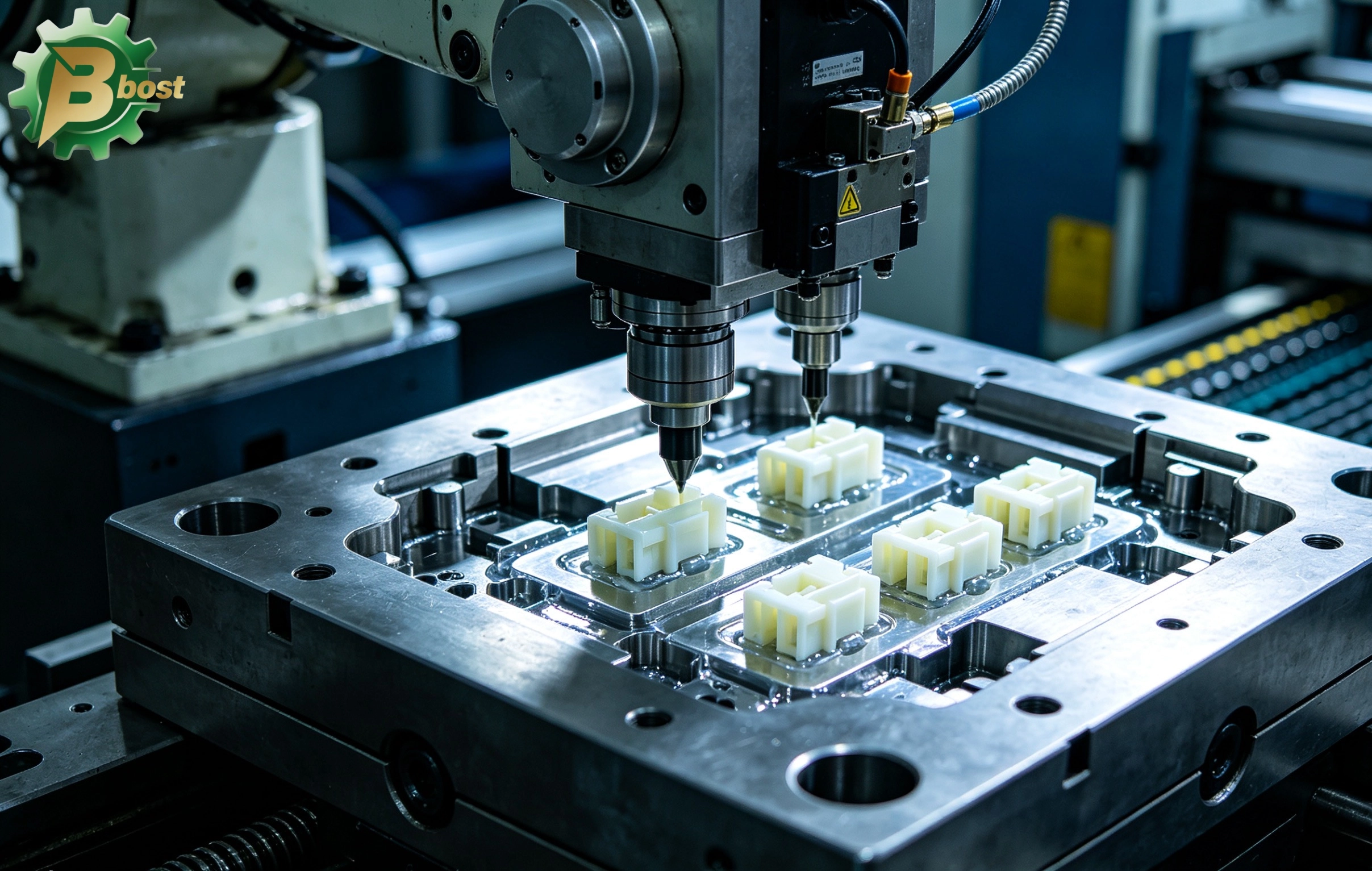
Runner System: Due to the poor fluidity of fluoroplastics, the runner must be as short and wide as possible to minimize pressure loss. We often use hot runner systems to ensure the melt maintains a uniform temperature before entering the cavity. However, for grades prone to degradation, the temperature control of the hot runner must be accurate to within ±1°C to prevent material carbonization at “dead points” within the runner.
Venting Design: This is paramount. Fluoroplastics are prone to generating gases during injection. If venting is inadequate, it can lead to “burn marks” (black spots) on the part and create a high-pressure “air lock” at the end of the cavity, causing short shots. In our mold designs, we typically employ multi-stage venting grooves and even design vacuum venting systems on the parting line to ensure rapid gas evacuation.
H3: 2. Injection Process: The “Art” of Parameter Tuning
Equipment is the foundation, but the process is the soul. When working with fluoroplastics, parameter adjustments often cannot follow the same logic as for standard plastics.
Temperature Control: This is where the experience of the technical team is most tested. Barrel temperatures must increase in a stepped profile, ensuring the material is fully melted during plasticization without degrading due to excessive residence time. Moreover, mold temperature control is even more critical than for standard injection molding. For PFA materials, the mold temperature typically needs to be maintained between 150°C and 200°C. A mold temperature that is too low can lead to flow marks on the surface and insufficient crystallinity, compromising corrosion resistance.
Injection Speed and Pressure: We favor a multi-stage injection strategy: “slow-fast-hold.” The initial slow speed prevents the melt from impacting the cavity and causing jetting. The subsequent high speed utilizes shear heat to enhance fluidity, ensuring filling of thin-walled sections. Finally, the holding pressure must be precisely calculated to counteract the dimensional fluctuations caused by the material’s high shrinkage rate.
H3: 3. Post-Processing and Quality Control: The Critical “Last Mile”
Fluoroplastic parts are often not “finished” upon ejection. Residual internal stresses can lead to cracking later in service if not addressed.
Annealing: For melt-processable fluoroplastics like PFA and FEP, we perform an “annealing” process after ejection. The parts are placed in a constant-temperature oven, slowly heated to just below their heat deflection temperature, held for several hours, and then slowly cooled. This process effectively eliminates internal stresses, ensuring dimensional stability for long-term use in high-temperature or highly corrosive environments.
Rigorous Testing Regime: For fluoroplastic parts, standard caliper measurements are insufficient. We utilize 3D scanning and optical measuring machines to inspect critical dimensions. For PFA fittings used in the semiconductor industry, we also conduct stringent air tightness tests and particle extraction tests to ensure they meet the highest standards for ultra-clean environments.
H2: Application Scenarios: When Fluoroplastic Becomes the Only Choice
It is precisely because we have overcome these processing hurdles that fluoroplastics can be widely used in “mission-critical” applications where no other material suffices.
Semiconductor Manufacturing: Wafer cleaning and etching processes require transporting ultra-pure strong acids and bases. PFA tubing and fittings, with their extremely low metal ion extraction and exceptional chemical resistance, serve as the “blood vessels” of semiconductor equipment.
Chemical Industry: Reactor linings, corrosion-resistant valves, and seals made from PTFE can ensure equipment operates stably in media like high-temperature sulfuric acid and hydrofluoric acid for over a decade, significantly reducing maintenance costs.
Automotive & New Energy: In high-voltage connectors and sensor housings for new energy vehicles, fluoroplastics are gradually replacing traditional engineering plastics due to their excellent flame retardancy and aging resistance, becoming a critical barrier for high-voltage safety.
H2: Conclusion
Processing fluoroplastics has never been an easy task. It requires not just an injection molding machine, but a comprehensive technical system integrating material science, mold design, precision control, and quality inspection. We understand that behind every fluoroplastic component lies the customer’s expectation for reliability in extreme operating conditions.
If you are seeking a partner capable of stably and efficiently producing high-quality fluoroplastic parts, please visit our website at https://www.gz-bost.com. Our technical team is ready to engage in in-depth discussions about your application needs, providing you with a full-process precision injection molding solution from material selection to mass production delivery.
Recommended for you
The Peak Art of Custom Manufacturing According to Drawings: Comprehensive Guide to Precision Solutions for Custom Parts According to Drawing
Ending Mechanical Wear and Resonance: The Comprehensive Guide to Precision Customization and Mass Production of a Custom Rubber Pad
The Ultimate Armor for Smart Hardware: Advanced Customization and Precision Injection Molding Guide for a Custom Plastic Box
The Ultimate Weapon to Tame Vibration and Noise: Deep Dive into the Custom Process and Mass Production Logic of a Custom Rubber Bushing
Product Categories
FAQ
FAQs
How do I select the appropriate engineering plastic grade for my product?
Selection should be based on parameters such as load conditions (e.g., pressure/friction), temperature range, medium contact (e.g., oil/acid), and regulatory requirements (e.g., FDA/RoHS). Our engineers can provide free material selection consulting and sample testing.
Can Bost customize modified plastics with special properties?
Yes! We offer modification services such as reinforcement, flame retardancy, conductivity, wear resistance, and UV resistance, for example:
• Adding carbon fiber to enhance stiffness
• Reducing the coefficient of friction through PTFE modification
• Customizing food-grade or medical-grade certified materials
What are the core advantages of Bost engineering plastics compared to ordinary plastics?
Bost engineering plastics feature ultra-high mechanical strength, high-temperature resistance (-50°C to 300°C), chemical corrosion resistance, and wear resistance. Compared to ordinary plastics, their service life is extended by 3 to 8 times, making them suitable for replacing metals in harsh environments.
What is the delivery lead time? Do you offer global logistics?
Standard products: 5–15 working days; custom modifications: 2–4 weeks. We support global air/sea freight and provide export customs clearance documents (including REACH/UL certifications).
What is the minimum order quantity (MOQ)? Do you support small-batch trial production?
The MOQ for standard products is ≥100kg. We support small-batch trial production (as low as 20kg) and provide mold testing reports and performance data feedback.
You may also like
Custom Plastic Knobs Precision Injection Molded
More Details →
Custom Plastic Knobs Precision Injection Molded
Custom Injection Molded Parts from Drawings
More Details →
Custom Injection Molded Parts from Drawings
Underwater Camera Shell Custom Plastic Molding
More Details →
Underwater Camera Shell Custom Plastic Molding
Leave a Message
Have any questions or concerns about our products? Please leave us a message here, and our team will get back to you promptly.

24 hours quotes delivered
Submit CAD files, get quote in 24 hours

No MOQ required
From prototyping to high-volume

±0.02 mm Precision
Advanced CNC with full inspections

1,000+ tons in stock
26 materials ready to ship
© 2026 BOST. All Rights Reserved.