




 Scan QR Code
Send My Request
From Design to Delivery: A Complete Guide to High-Performance Precision Injection Molding
2026-03-30
Discover Bost’s expert guide on high performance plastic injection molding, covering every step from design to delivery. Learn how our high-temp plastic injection molding solutions ensure precision, durability, and efficiency for your projects. Trust Bost for quality and innovation.
Anyone who’s worked in product development knows that injection molding seems simple on the surface but is full of hidden challenges. From a design drawing to mass production, how many steps are involved? And what risks are lurking at each stage?
We’ve been in this industry for over two decades, serving more than 1,500 clients. We’ve encountered challenges, solved them, and helped countless clients avoid costly mistakes. Today, we want to compile these years of experience into a comprehensive guide. Whether you’re an engineer, a procurement professional, or a product manager, we hope this guide to injection molding helps you navigate the process more smoothly.
H2: Chapter 1: Design Phase—Why DFM Analysis Can Save You 30% on Costs
Many clients come to us with drawings already finalized, molds already ordered, and sometimes even trial runs already started. By that point, optimization opportunities are often lost. Our first piece of advice: bring your injection molding partner in during the design phase.
H3: DFM Isn’t About Finding Faults—It’s About Saving Money
DFM (Design for Manufacturability) analysis means having injection molding engineers review your design before tooling starts. They look at wall thickness uniformity, sharp corners, draft angles, rib placement—all the details that affect moldability.
These aren’t trivial details. Non-uniform wall thickness can cause sink marks and warpage. Insufficient draft angles can lead to part damage during ejection. If these are caught before tooling, only the drawing changes. If caught after tooling, the mold has to be modified—time and money lost.
Our data shows that DFM analysis typically helps clients reduce part costs by 15–30%. Sometimes it’s as simple as adjusting a fillet radius or optimizing gate location—small changes that lead to longer mold life, shorter cycle times, and higher yields.
H3: Material Selection Should Happe Early
In any injection molding project, material selection should go hand in hand with design. Different materials have different shrinkage rates, flow characteristics, and tool steel requirements. If the design is finalized before the material is chosen, you may find that certain design features don’t work well with the material you eventually select.
For example, high-performance materials like PEEK have poor flowability—thin walls may not fill completely. Glass-filled materials exhibit anisotropic shrinkage and require compensation in the design. These considerations need to be addressed early.
H2: Chapter 2: Mold Phase—Precision Is Designed, Not Reworked
The mold is the “mother tool” in injection molding. If the mold lacks precision, even the best injection molding machine won’t save you. And 80% of mold precision is determined in the design phase; the remaining 20% comes from machining and assembly.
H3: Mold Flow Analysis Is Not Optional
We’ve emphasized mold flow analysis in previous articles, but it bears repeating: for precision injection molding, mold flow analysis is a standard requirement, not a value-add.
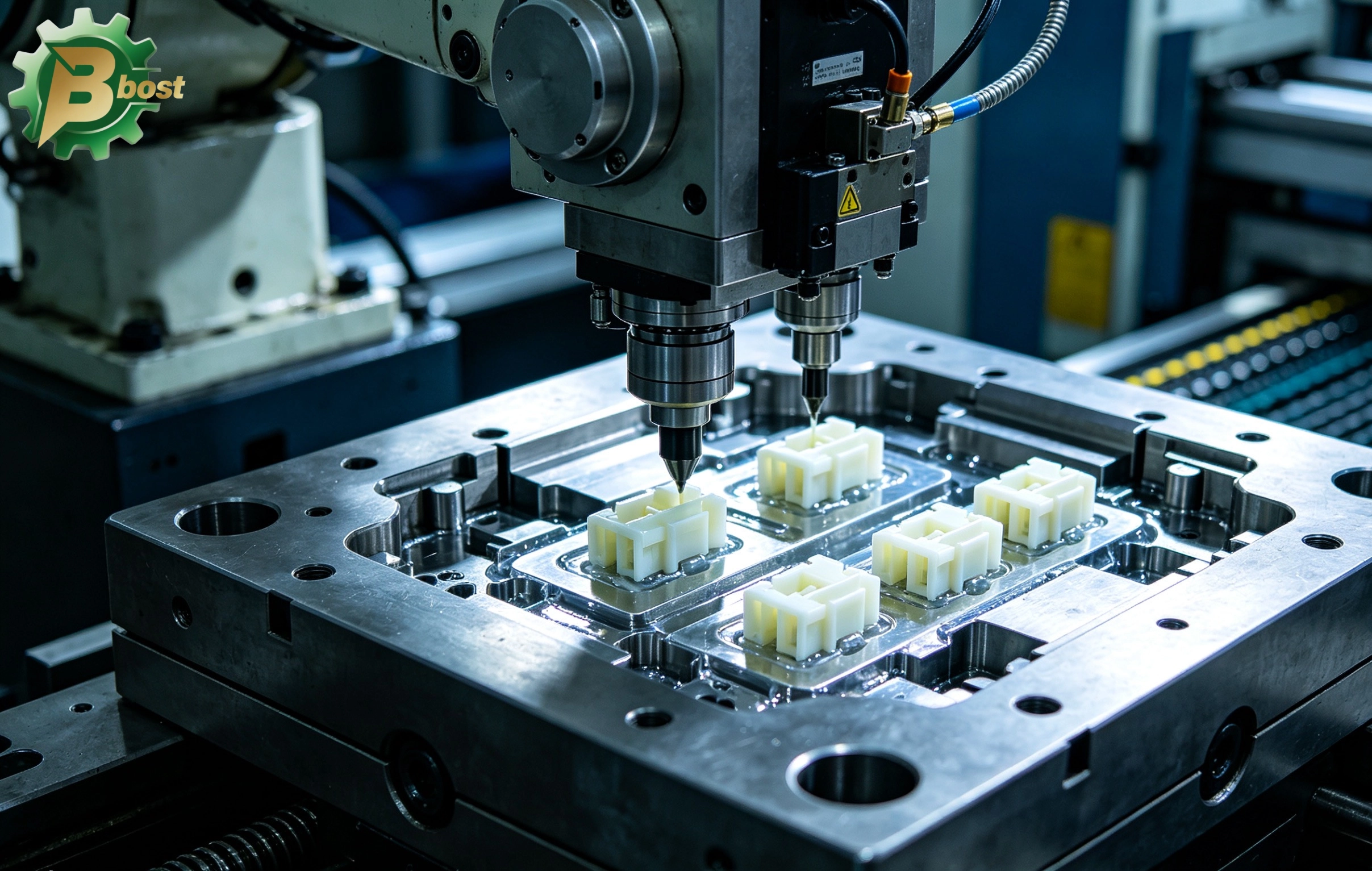
It shows you how the melt flows inside the cavity, where air gets trapped, whether cooling is uniform, and whether warpage is likely. A mold that has been analyzed will require significantly fewer trial runs and will deliver better yield rates in mass production.
H3: Tool Steel Selection Affects Lifespan and Cost
Many people choose tool steel based solely on price, overlooking two key factors: how many parts you need to make, and what material you’re using.
If you only need a few thousand parts, standard tool steel is fine. But if you need hundreds of thousands or millions of parts—or if you’re using glass-filled materials—you need high-quality steel with good wear and corrosion resistance. Otherwise, the mold will wear over time, part dimensions will drift, and yield will drop.
H3: Mold Machining Precision Determines Part Precision
A tolerance of ±0.02mm is now standard in precision injection molding. Achieving this requires high-precision machining equipment and experienced mold makers. This is why we maintain our own mold shop—keeping mold manufacturing in-house is the only way to ensure precision.
H2: Chapter 3: Trial Runs and Mass Production—From “Capable” to “Consistently Capable”
A good mold is only half the battle. The goal of trial runs is to find a stable process window that allows the mold to produce consistent quality parts at scale.
H3: Trial Runs Aren’t About “Making a Few Good Parts”
Many shops treat trial runs as simply producing a few acceptable samples before moving to production. But a proper trial run should identify the process window—the range of parameters within which the mold produces good parts.
An experienced process engineer will deliberately push parameters to both ends to see how wide the window is. If the window is narrow and parts go out of spec with small fluctuations, the project is likely to face problems during mass production.
H3: Process Control Matters More Than Sample Quality
Once mass production begins, what separates a great injection molding partner from an average one isn’t the first shot—it’s the 10,001st.
Is equipment properly maintained? Are process parameters monitored in real time? Are operators following standard procedures? These are all part of process control. Our approach: every machine is connected to a network, and parameters are monitored in real time. Alerts trigger automatically if values drift outside set ranges.
H3: Full Traceability Is the Final Line of Defense
If something goes wrong, can you quickly trace it back to the specific batch, machine, and shift? In industries like automotive, medical, and electronics, customers will ask.
We maintain a complete production record for every part: raw material lot numbers, drying logs, mold IDs, process parameters, inspection reports—all traceable. This isn’t just for audits; it’s so we can identify and resolve issues quickly when they arise.
H2: Chapter 4: Delivery and Service—The Difference Between a Supplier and a Partner
Delivery is the final step, but it’s not the end. A true injection molding partner continues to provide support after parts ship.
H3: On-Time Delivery Is the Baseline
A 98% on-time delivery rate isn’t “excellent” in our book—it’s the minimum. Because we know our clients’ production lines can’t wait. Any delay can ripple down to their customers.
H3: Responsiveness Reflects Commitment
Problems happen in production. What matters is how the supplier responds. Do they make excuses, or do they immediately analyze the root cause and propose solutions? Do they leave you to figure it out, or do they proactively help?
Many clients come to us because their previous suppliers “passed the buck” when issues arose. Responsiveness may sound abstract, but anyone who’s been in a tough project knows it matters more than price.
H3: One-Stop Service Simplifies Procurement
When one supplier handles mold making, injection molding, and secondary operations (like printing and assembly), you have a single point of contact and receive finished parts. Fewer suppliers means less coordination and fewer potential breakdowns.
That’s exactly what we offer. From DFM analysis to mold design, from injection molding to post-processing—all in-house. You don’t have to coordinate across multiple vendors. We handle it all.
H2: Final Thoughts
This guide distills over two decades of experience. From design to delivery, every step has its nuances. We hope it helps you better understand the injection molding landscape and equips you to know what to look for in a partner.
If you’re looking for a partner that truly understands injection molding, we’d welcome the chance to talk. We can help with DFM analysis, mold optimization, and fine-tuning your process.
Visit our website at https://www.gz-bost.com to submit your project requirements or connect directly with our technical team. We’d be happy to discuss your next project.
Recommended for you
The Peak Art of Custom Manufacturing According to Drawings: Comprehensive Guide to Precision Solutions for Custom Parts According to Drawing
Ending Mechanical Wear and Resonance: The Comprehensive Guide to Precision Customization and Mass Production of a Custom Rubber Pad
The Ultimate Armor for Smart Hardware: Advanced Customization and Precision Injection Molding Guide for a Custom Plastic Box
The Ultimate Weapon to Tame Vibration and Noise: Deep Dive into the Custom Process and Mass Production Logic of a Custom Rubber Bushing
Product Categories
FAQ
FAQs
What is the minimum order quantity (MOQ)? Do you support small-batch trial production?
The MOQ for standard products is ≥100kg. We support small-batch trial production (as low as 20kg) and provide mold testing reports and performance data feedback.
Can Bost customize modified plastics with special properties?
Yes! We offer modification services such as reinforcement, flame retardancy, conductivity, wear resistance, and UV resistance, for example:
• Adding carbon fiber to enhance stiffness
• Reducing the coefficient of friction through PTFE modification
• Customizing food-grade or medical-grade certified materials
What are the core advantages of Bost engineering plastics compared to ordinary plastics?
Bost engineering plastics feature ultra-high mechanical strength, high-temperature resistance (-50°C to 300°C), chemical corrosion resistance, and wear resistance. Compared to ordinary plastics, their service life is extended by 3 to 8 times, making them suitable for replacing metals in harsh environments.
How do I select the appropriate engineering plastic grade for my product?
Selection should be based on parameters such as load conditions (e.g., pressure/friction), temperature range, medium contact (e.g., oil/acid), and regulatory requirements (e.g., FDA/RoHS). Our engineers can provide free material selection consulting and sample testing.
What is the delivery lead time? Do you offer global logistics?
Standard products: 5–15 working days; custom modifications: 2–4 weeks. We support global air/sea freight and provide export customs clearance documents (including REACH/UL certifications).
You may also like
Custom Plastic Knobs Precision Injection Molded
More Details →
Custom Plastic Knobs Precision Injection Molded
Custom Injection Molded Parts from Drawings
More Details →
Custom Injection Molded Parts from Drawings
Underwater Camera Shell Custom Plastic Molding
More Details →
Underwater Camera Shell Custom Plastic Molding
Leave a Message
Have any questions or concerns about our products? Please leave us a message here, and our team will get back to you promptly.

24 hours quotes delivered
Submit CAD files, get quote in 24 hours

No MOQ required
From prototyping to high-volume

±0.02 mm Precision
Advanced CNC with full inspections

1,000+ tons in stock
26 materials ready to ship
© 2026 BOST. All Rights Reserved.