




 Scan QR Code
Send My Request
Bridging the Gap from Blueprint to Mass Production: How to Avoid Trial-and-Error Costs with Top-Tier plastic injection molding Solutions?
2026-04-06
Bost offers expert plastic injection molding and custom plastic injection molding services to streamline your production. Our top-tier solutions help bridge the gap from blueprint to mass production, minimizing trial-and-error costs and ensuring efficient, high-quality manufacturing. Trust Bost for precision and reliability.
- Why Do Your Parts Frequently Fail During the plastic injection molding Stage?
- The Three Core Pillars Determining the Success or Failure of High-Quality plastic injection molding
- 1. Upfront DFM Analysis and Ultimate "Mold Design"
- 2. Scientific "Injection Molding Process" Parameter Tuning
- 3. "Precision Injection Molding" Control Breaking Tolerance Limits
- The Trap of Hidden Costs: The Truth Behind Low-Priced plastic injection molding Quotes
- Conclusion: Spare Your Next Hardware Project from the "Pain of Trial and Error"
n the circles of overseas B2B procurement and hardware R&D, a frustrating scenario often plays out: R&D teams spend months and invest heavily in polishing perfect 3D blueprints and 3D printed prototypes, only to encounter unprecedented disasters when entering the mass production stage. Product dimensions are frequently out of tolerance, ugly weld lines appear on the surface, or parts even suffer brittle fracture during assembly.
Frankly speaking, many project managers underestimate the complexity of the manufacturing process. They often assume that as long as the drawing is fine, finding a contract manufacturer to melt plastic and inject it into a mold will naturally yield the finished product. However, reality is incredibly cruel. Modern plastic injection molding is by no means a simple physical replication; it is a "black box" where fluid dynamics, polymer materials science, and extreme thermodynamics intersect. If you do not deeply understand the underlying logic of this process at the beginning of the project, the trial-and-error costs you pay later will be exponential.
From the perspective of a senior manufacturing expert, this article will deeply analyze the engineering logic behind high-quality plastic injection molding. Whether you are a sourcing director looking for suppliers or an R&D engineer optimizing product structures, these insights from the frontline of production will help you accurately avoid pitfalls in your next project.
Why Do Your Parts Frequently Fail During the plastic injection molding Stage?
When faced with mass production failures, the first reaction of many companies is often to blame the material for being poor or the machines for lacking precision. But in the numerous "firefighting" projects we have handled, over 80% of the defects were already destined before the mold was even cut.
Traditional empiricism often ignores the dynamic performance of polymer materials under high temperature and high pressure. When the plastic melt is injected into the mold cavity at extremely high speeds, it faces complex shear heat, rapid cooling, and the ensuing volumetric shrinkage. Without scientific calculation and simulation, it is extremely easy to produce short shots, obvious sink marks, or warpage during the plastic injection molding stage.
Even more fatal is the problem of internal stress. For some industrial components with stringent load-bearing or impact-resistance requirements, if the packing and cooling stages in the injection molding process are out of control, the polymer molecular chains will be forcibly frozen in an unnatural state. Products like this may appear qualified on the outside, but in actual customer use, a slight external impact will shatter them like glass. This is exactly why we need an extremely rigorous engineering system to master the complex process of plastic injection molding.
The Three Core Pillars Determining the Success or Failure of High-Quality plastic injection molding
To smoothly transition a challenging component into commercial mass production, excellent suppliers will never use the clumsy method of "blind trial and error." What truly separates the best from the rest is the extreme control over the following three core pillars.
1. Upfront DFM Analysis and Ultimate "Mold Design"
There is an old saying in the industry: "70% mold, 30% injection." In top-tier plastic injection molding services, mold design is absolutely not just simply converting CAD drawings into machining programs, but a profound reconstruction of the product's manufacturability.
Before formally cutting expensive mold steel, a professional engineering team must conduct a detailed Design for Manufacturability (DFM) review and Moldflow analysis. For example, engineers will astutely pinpoint uneven wall thicknesses that cause heat accumulation and suggest coring solutions to the client; or accurately calculate draft angles to prevent the product from being scratched during ejection. For parts with extremely complex shapes, we will adopt cutting-edge conformal cooling layouts, allowing the coolant to fit the product contours like capillaries. This not only drastically shortens the plastic injection molding cycle time but also kills the risk of warpage at its root.
2. Scientific "Injection Molding Process" Parameter Tuning
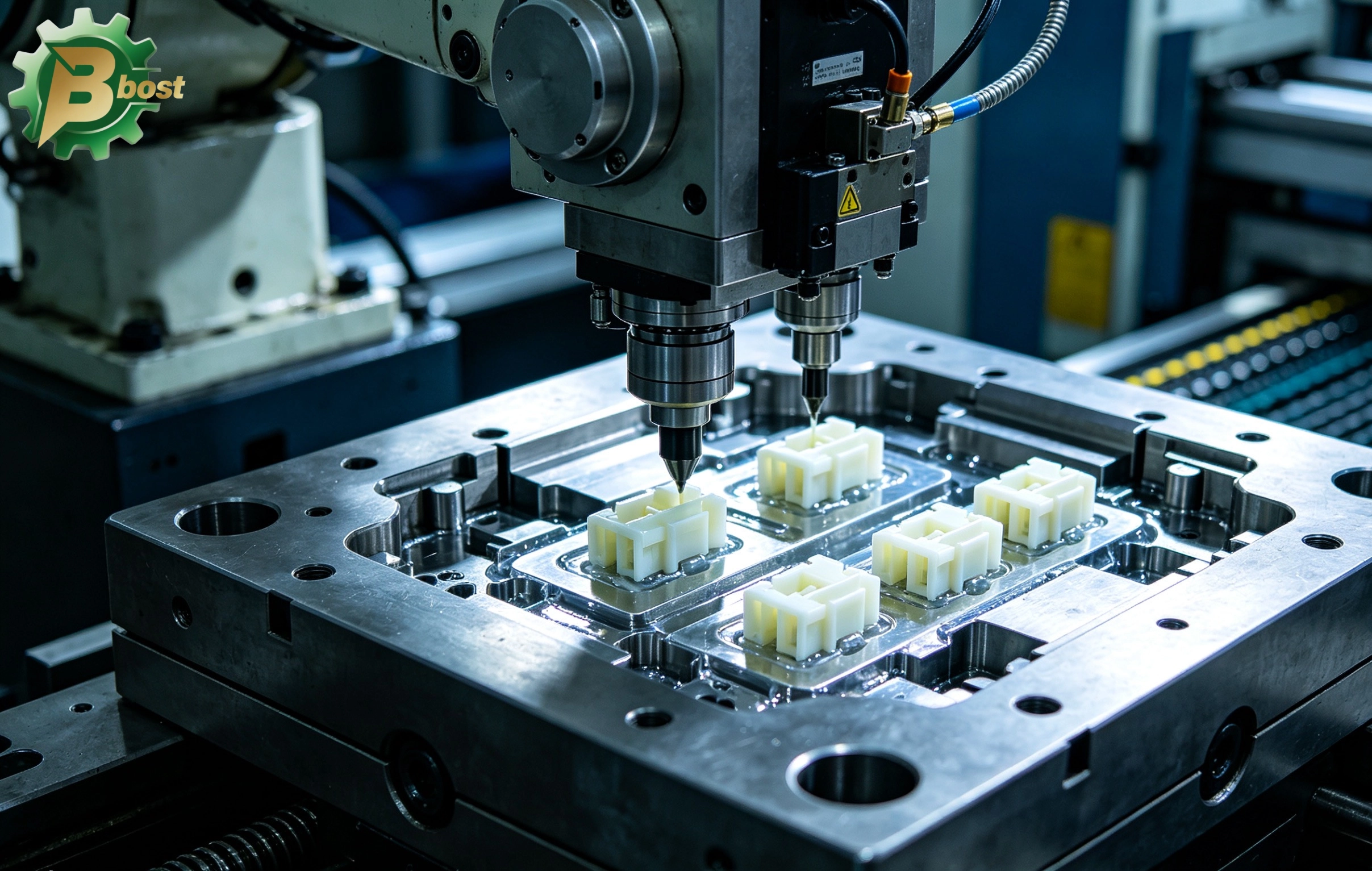
Even with an expensive high-end mold, it is a waste of resources if the setup technician only turns knobs based on feeling. High-end plastic injection molding requires translating empiricism into data-driven "scientific molding."
Every injection is a race against time, temperature, and pressure. Professional setup engineers need to accurately set multi-stage injection speeds: slowing down when the melt flows through the gate to avoid material degradation caused by high shear force, speeding up when filling the main cavity to prevent premature cooling of the melt front, and finally pausing precisely at the V/P (Velocity to Pressure) switchover point. This extreme micro-carving of the process window is the only rule to guarantee batch stability.
3. "Precision Injection Molding" Control Breaking Tolerance Limits
Ordinary injection factories focus on "whether a product can be molded," while precision injection factories focus on "whether the dimensional fluctuation of the product remains within 0.02mm after one million cycles."
For clients in fields such as medical devices and automotive electronics, CPK (Process Capability Index) is the lifeline for evaluating plastic injection molding quality. This requires the factory not only to be equipped with fully closed-loop servo injection machines in terms of hardware but also to achieve strict temperature and humidity control in the workshop environment. In addition, the pre-drying treatment of materials brooks no carelessness—even a 0.2% deviation in moisture content can leave fatal silver streaks on transparent PC parts.
The Trap of Hidden Costs: The Truth Behind Low-Priced plastic injection molding Quotes
In B2B procurement, when facing quotes provided by different suppliers, you may find huge price discrepancies. To control budgets, many buyers tend to choose the factory with the lowest tooling fees and unit prices. But this decision often hides a massive trap of hidden costs.
Ultra-low plastic injection molding quotes often mean that the supplier is cutting corners where you can't see. They might use cheap domestic pre-hardened steel instead of imported S136 vacuum-quenched steel, causing the mold to wear and deform after tens of thousands of shots, leaving product edges covered in flash. They might not be equipped with automated robotic arms and conveyor belts, relying entirely on manual labor to pick products out of the mold cavity, which is not only inefficient but also causes surface scratches. When you are forced to halt your production line due to quality issues, or have to spend money to remake the mold, you will find that the little money you saved initially is not even enough to pay for one emergency air freight shipment.
When looking for a long-term manufacturing partner, you should value the Total Cost of Ownership (TCO), rather than a flimsy quotation sheet.
Conclusion: Spare Your Next Hardware Project from the "Pain of Trial and Error"
In today's highly competitive manufacturing industry, plastic injection molding has long been a hardcore battle integrating cutting-edge materials science and precision machining. A reliable injection partner is not just a contract manufacturer, but an extension of your R&D team, providing you with profound engineering wisdom and strong risk-resistance capabilities.
If you are currently struggling with hard-to-overcome structural defects, or if your new project urgently needs a mass production solution that balances cost reduction and high quality, Guangzhou Bost (https://www.gz-bost.com) will be your most solid technical backbone. We have over ten years of deep experience serving global overseas clients, are proficient in processing various complex special engineering plastics, and provide a one-stop closed-loop service from upfront free DFM analysis and precision mold manufacturing to ultimate large-scale mass production.
Do not let minor tolerance deviations become the final straw that drags down your entire product line. Visit our official website immediately at https://www.gz-bost.com and submit your 3D models or project requirements. Our team of senior engineers will provide you with a dedicated plastic injection molding solution and a highly competitive quotation within 24 hours. Let us work together to turn the "black box" of injection molding into the most stable and transparent link in your supply chain!
Recommended for you
The Peak Art of Custom Manufacturing According to Drawings: Comprehensive Guide to Precision Solutions for Custom Parts According to Drawing
Ending Mechanical Wear and Resonance: The Comprehensive Guide to Precision Customization and Mass Production of a Custom Rubber Pad
The Ultimate Armor for Smart Hardware: Advanced Customization and Precision Injection Molding Guide for a Custom Plastic Box
The Ultimate Weapon to Tame Vibration and Noise: Deep Dive into the Custom Process and Mass Production Logic of a Custom Rubber Bushing
Product Categories
FAQ
FAQs
What are the core advantages of Bost engineering plastics compared to ordinary plastics?
Bost engineering plastics feature ultra-high mechanical strength, high-temperature resistance (-50°C to 300°C), chemical corrosion resistance, and wear resistance. Compared to ordinary plastics, their service life is extended by 3 to 8 times, making them suitable for replacing metals in harsh environments.
How do I select the appropriate engineering plastic grade for my product?
Selection should be based on parameters such as load conditions (e.g., pressure/friction), temperature range, medium contact (e.g., oil/acid), and regulatory requirements (e.g., FDA/RoHS). Our engineers can provide free material selection consulting and sample testing.
What is the minimum order quantity (MOQ)? Do you support small-batch trial production?
The MOQ for standard products is ≥100kg. We support small-batch trial production (as low as 20kg) and provide mold testing reports and performance data feedback.
Can Bost customize modified plastics with special properties?
Yes! We offer modification services such as reinforcement, flame retardancy, conductivity, wear resistance, and UV resistance, for example:
• Adding carbon fiber to enhance stiffness
• Reducing the coefficient of friction through PTFE modification
• Customizing food-grade or medical-grade certified materials
What is the delivery lead time? Do you offer global logistics?
Standard products: 5–15 working days; custom modifications: 2–4 weeks. We support global air/sea freight and provide export customs clearance documents (including REACH/UL certifications).
You may also like
Custom Plastic Knobs Precision Injection Molded
More Details →
Custom Plastic Knobs Precision Injection Molded
Custom Injection Molded Parts from Drawings
More Details →
Custom Injection Molded Parts from Drawings
Underwater Camera Shell Custom Plastic Molding
More Details →
Underwater Camera Shell Custom Plastic Molding
Leave a Message
Have any questions or concerns about our products? Please leave us a message here, and our team will get back to you promptly.

24 hours quotes delivered
Submit CAD files, get quote in 24 hours

No MOQ required
From prototyping to high-volume

±0.02 mm Precision
Advanced CNC with full inspections

1,000+ tons in stock
26 materials ready to ship
© 2026 BOST. All Rights Reserved.