




 Scan QR Code
Send My Request
Breaking the "Black Box" of Industrial Manufacturing: How High-End Injection Molding Empowers Mass Production of Complex Parts
2026-04-06
Discover how Bost, a leading plastic injection molding supplier, breaks the black box of industrial manufacturing. Our high-end injection molding technology empowers mass production of complex parts with precision and efficiency, driving innovation and quality in every project.
- Why Traditional Injection Molding Processes Cannot Meet Today's Stringent Industrial Demands?
- Three Core Dimensions Determining the Success or Failure of an Injection Molding Project
- 1. Upfront DFM Analysis and Ultimate Mold Design
- 2. Dynamic Temperature Control and Scientific Injection Molding Parameters
- 3. Breaking Through the Technical Blind Spots of Venting and Runner Balancing
- A Global Supply Chain Perspective: How to Identify a Truly Professional Injection Molding Partner?
- Conclusion: Making Your Next Manufacturing Project Foolproof
In the current B2B overseas procurement and global supply chain system, many sourcing managers and R&D engineers often fall into a fatal misconception: evaluating a professional injection molding supplier using the generic standards meant for ordinary hardware or assembly plants. The result is often a disastrous failure during the mass production stage, frequently encountering dimensional shrinkage, warpage, or even functional failure.
In fact, modern injection molding is no longer the simple physical action of "melting plastic and letting it cool" as traditionally perceived. It is a veritable "black box" process, a complex engineering ecosystem interwoven with fluid dynamics, polymer materials science, and extreme thermodynamics. When we shift our focus from ordinary PP and ABS to special engineering plastics at the top of the polymer pyramid (such as PEEK, PPS, and PEI), high-end injection molding technology becomes the only bridge across this technological divide. This article will deeply analyze the core barriers of high-authority injection molding projects from the underlying engineering logic, helping you avoid pitfalls in your next supply chain selection.
Why Traditional Injection Molding Processes Cannot Meet Today's Stringent Industrial Demands?
With the rapid development of industries such as aerospace, high-end medical devices, and new energy vehicles, the operating environments for components are becoming increasingly extreme. They often need to maintain dimensional stability under high temperatures exceeding 200°C or resist chemical corrosion in highly acidic or alkaline environments. Against this backdrop, traditional injection molding processes and standard general-purpose plastics have hit their physical performance ceilings.
When enterprises attempt to produce these high-performance components through injection molding, disaster inevitably follows if the supplier still relies on outdated empiricism for blind mold trials. For instance, when processing special plastics containing high percentages of glass fiber (GF) or carbon fiber (CF), their extremely poor melt flow rate (MFR) easily leads to short shots, obvious weld lines, or floating fibers inside the injection molding cavity. More seriously, during the instantaneous high-temperature and high-pressure injection process, the polymer molecular chains are forcibly stretched. If the cooling and packing stages cannot effectively release this internal stress, the product will suffer from brittle fracture during subsequent assembly or actual use.
This is exactly why we repeatedly emphasize: precision injection molding is absolutely not a low-end manufacturing process that relies solely on machine operation. It is a core competitiveness capable of transforming expensive polymer resins into high-precision physical entities without any degradation.
Three Core Dimensions Determining the Success or Failure of an Injection Molding Project
Over the past decade, we have taken over countless "failed" projects botched by traditional contract manufacturers. Tracing back to the root cause, most failed injection molding cases stem from a loss of control over the following three dimensions.
1. Upfront DFM Analysis and Ultimate Mold Design
There is an unbreakable ironclad rule in the industry: "70% mold, 30% injection." In top-tier injection molding services, mold design is never about blindly cutting steel once a drawing is received; it is a profound reshaping of the product's DNA.
Highly difficult specialty materials usually come with extremely high shrinkage rates and viscosities. Before formally cutting the mold, a professional injection molding engineering team must conduct a comprehensive Design for Manufacturability (DFM) review and Moldflow analysis to simulate the entire process of resin filling, packing, and cooling within the mold cavity. For example, to address heat accumulation caused by uneven wall thickness, we need to accurately pinpoint the areas and propose reasonable coring and draft angle solutions; for precision and complex geometric parts, we introduce cutting-edge conformal cooling layouts. This allows the coolant to perfectly fit the product contours, thereby drastically shortening the injection molding cycle time and completely eliminating the risk of warpage. Excellent mold design can save weeks or even months of back-and-forth mold modification time for subsequent mass production.
2. Dynamic Temperature Control and Scientific Injection Molding Parameters
Owning an expensive mold does not guarantee the production of qualified parts. One of the core barriers of high-end injection molding lies in the extreme control over the processing window. This requires not only the hardware support of fully servo-driven injection molding machines but also the "micro-carving" of the four major variables—temperature, pressure, speed, and time—by experienced process engineers.
Taking the injection molding of PEEK material as an example, this semi-crystalline polymer is highly sensitive to temperature. If the mold temperature is below 160°C, the molecular chains on the product surface will present an amorphous state due to rapid cooling, resulting in a dark color and severely substandard hardness. A professional injection molding process must be equipped with high-power mold temperature controllers or oil heaters, and even introduce dynamic temperature compensation systems, to ensure that the thermodynamic environment inside the cavity is always in the optimal crystallization state.
3. Breaking Through the Technical Blind Spots of Venting and Runner Balancing
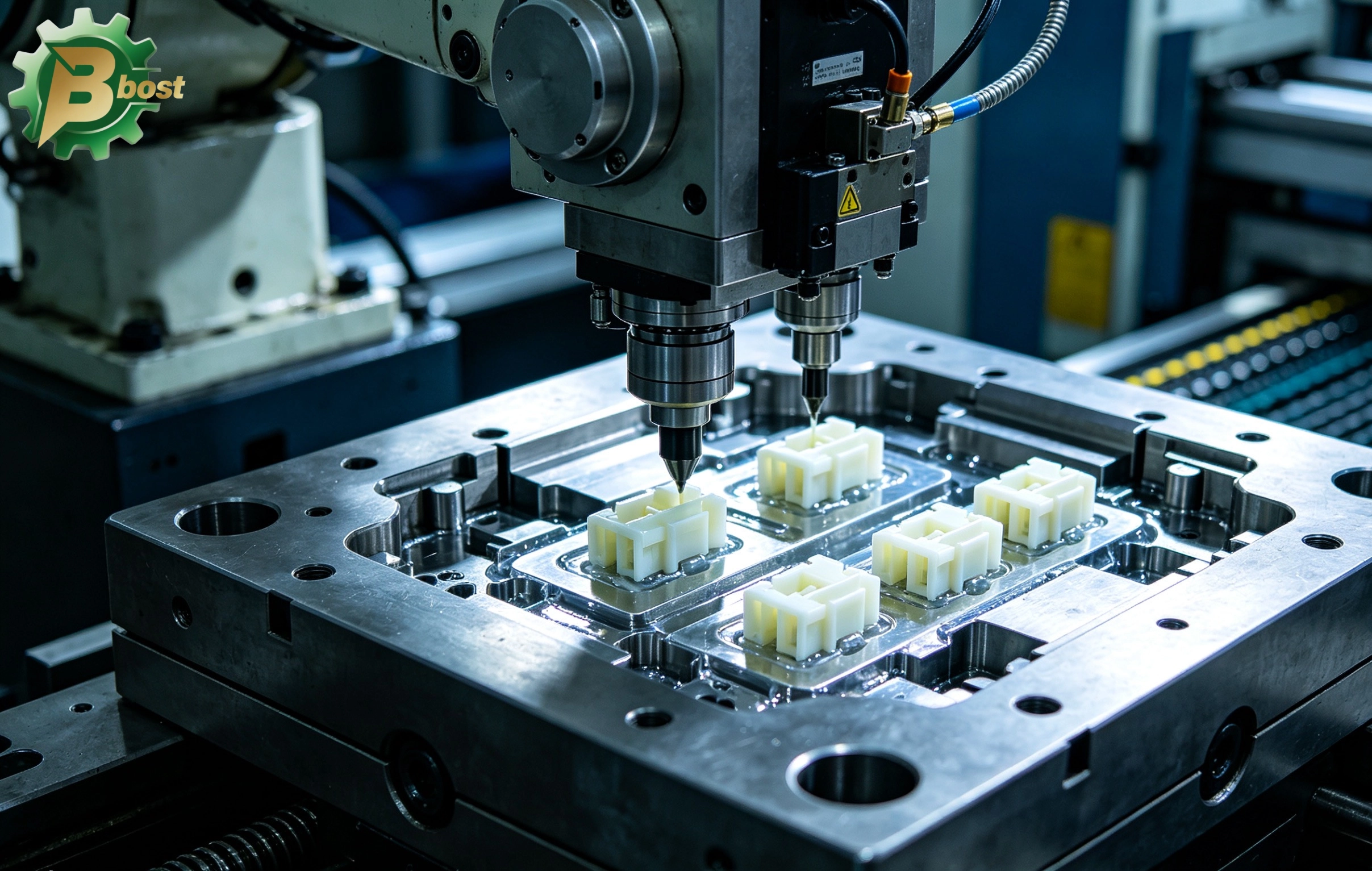
Many buyers easily overlook a detail during factory audits: the design of the venting grooves. During the high-speed injection molding process, the advancing melt front will sharply compress the air inside the mold cavity. If venting is poor, it is extremely easy to cause trapped air, burn marks, or even fatal tiny bubbles at the end of the product. For precision injection molding, the depth of the venting grooves often needs to be strictly controlled between 0.02mm and 0.05mm—a fraction deeper causes flash, while a fraction shallower results in poor exhaust. Furthermore, runner balancing in multi-cavity molds is a true test of skill. Only by ensuring that the melt reaches every cavity simultaneously within the injection molding cycle can you avoid the awkward situation where some products are over-packed while others are short-shot.
A Global Supply Chain Perspective: How to Identify a Truly Professional Injection Molding Partner?
Faced with a mixed bag of suppliers and extravagant quotations on the market, how should overseas buyers clear the fog and find a truly capable injection molding partner?
First, be wary of excessively low mold quotes. If a factory's injection molding tooling fee is far below the industry average, they are likely cutting corners on steel selection (such as replacing high-hardness H13 or S136 vacuum-quenched steel with cheap, easily worn steel) or machining precision. A mere 0.05mm machining error is enough to cause your product to frequently jam on a fully automated assembly line.
Second, investigate whether they have an integrated in-house capability for both tooling and molding. Many factories claiming to provide one-stop injection molding services actually do not have their own core mold processing centers; instead, they outsource the molds to small surrounding workshops. Once dimensional deviations occur during the mass production stage, the costs of mold modification and communication will rise exponentially. A true expert not only has an internal Tooling Room but can also achieve a closed-loop data system from mold trials to mass production.
Finally, pay attention to workshop 5S and the degree of automation. High-end precision injection molding absolutely does not rely on manual labor to extract products. Observe whether their injection molding machines are equipped with fully servo-driven robotic arms as standard, and whether the raw material drying system is comprehensive (insufficiently dried materials will leave fatal silver streaks on the product surface). These details directly reflect the quality DNA of the factory.
Conclusion: Making Your Next Manufacturing Project Foolproof
In today's pursuit of extreme performance and lightweighting, injection molding is a hardcore battle that integrates materials science and precision machinery. A reliable injection molding partner provides not just the production capacity of machines, but the profound engineering wisdom, risk-avoidance experience, and strong risk-resistance capabilities behind them.
If you are currently struggling with difficult-to-handle special engineering plastics, or if your parts originally produced via CNC machining urgently need to achieve cost reduction and efficiency enhancement through high-end injection molding solutions, Guangzhou Bost (GZ-BOST) will be your most solid technical backbone. We have over 10 years of complex injection molding experience, providing you with true worry-free delivery from proof of concept and free in-depth DFM analysis to ultimate global mass production.
Do not let minor tolerance deviations ruin your entire product line. Visit our official website immediately at https://www.gz-bost.com and submit your 3D models or project requirements. Our team of senior engineers will provide you with a dedicated injection molding process evaluation and a highly competitive quotation within 24 hours. Let us work together to turn the "black box" of injection molding into the most transparent and stable link in your supply chain!
Recommended for you
The Peak Art of Custom Manufacturing According to Drawings: Comprehensive Guide to Precision Solutions for Custom Parts According to Drawing
Ending Mechanical Wear and Resonance: The Comprehensive Guide to Precision Customization and Mass Production of a Custom Rubber Pad
The Ultimate Armor for Smart Hardware: Advanced Customization and Precision Injection Molding Guide for a Custom Plastic Box
The Ultimate Weapon to Tame Vibration and Noise: Deep Dive into the Custom Process and Mass Production Logic of a Custom Rubber Bushing
Product Categories
FAQ
FAQs
What is the minimum order quantity (MOQ)? Do you support small-batch trial production?
The MOQ for standard products is ≥100kg. We support small-batch trial production (as low as 20kg) and provide mold testing reports and performance data feedback.
What are the core advantages of Bost engineering plastics compared to ordinary plastics?
Bost engineering plastics feature ultra-high mechanical strength, high-temperature resistance (-50°C to 300°C), chemical corrosion resistance, and wear resistance. Compared to ordinary plastics, their service life is extended by 3 to 8 times, making them suitable for replacing metals in harsh environments.
Can Bost customize modified plastics with special properties?
Yes! We offer modification services such as reinforcement, flame retardancy, conductivity, wear resistance, and UV resistance, for example:
• Adding carbon fiber to enhance stiffness
• Reducing the coefficient of friction through PTFE modification
• Customizing food-grade or medical-grade certified materials
What is the delivery lead time? Do you offer global logistics?
Standard products: 5–15 working days; custom modifications: 2–4 weeks. We support global air/sea freight and provide export customs clearance documents (including REACH/UL certifications).
How do I select the appropriate engineering plastic grade for my product?
Selection should be based on parameters such as load conditions (e.g., pressure/friction), temperature range, medium contact (e.g., oil/acid), and regulatory requirements (e.g., FDA/RoHS). Our engineers can provide free material selection consulting and sample testing.
You may also like
Custom Plastic Knobs Precision Injection Molded
More Details →
Custom Plastic Knobs Precision Injection Molded
Custom Injection Molded Parts from Drawings
More Details →
Custom Injection Molded Parts from Drawings
Underwater Camera Shell Custom Plastic Molding
More Details →
Underwater Camera Shell Custom Plastic Molding
Leave a Message
Have any questions or concerns about our products? Please leave us a message here, and our team will get back to you promptly.

24 hours quotes delivered
Submit CAD files, get quote in 24 hours

No MOQ required
From prototyping to high-volume

±0.02 mm Precision
Advanced CNC with full inspections

1,000+ tons in stock
26 materials ready to ship
© 2026 BOST. All Rights Reserved.