




 Scan QR Code
Send My Request
2026 Ultimate Guide: How to Select and Partner with a Top Injection Molding Manufacturer?
2026-03-21
Discover the 2026 Guide by Bost to select and partner with a top injection molding manufacturer. Learn expert tips for choosing the best custom injection molding manufacturer to ensure quality, efficiency, and innovation for your manufacturing needs.
- Chapter 1: Defining Excellence – Standards of a Top Injection Molding Manufacturer
- 1.1 Robust DFM (Design for Manufacturing) Capabilities
- 1.2 In-house Mold Design & Fabrication Strength
- 1.3 Scientific Molding and Process Consistency
- Chapter 2: From Blueprint to Part – The Injection Molding Process Explained
- 2.1 Moldflow Analysis
- 2.2 The Trial Process (T1 to Top Production)
- 2.3 Secondary Processing Support
- Chapter 3: Material Science – Choosing the Right Engineering Plastic
- 3.1 Common Resins and Applications
- 3.2 Environmental Trends: Recycled and Bio-based Materials
- Chapter 4: Cost Control and Pricing Transparency
- 4.1 Tooling Cost vs. Unit Price
- 4.2 Hidden Factors Influencing Quotes
- Chapter 5: Quality Management Systems (QA & QC)
- Chapter 6: Supply Chain Communication – Secrets to Working with Overseas Manufacturers
- Conclusion: Bringing Your Ideas to Life with GZ-Bost
In the intricate landscape of global B2B sourcing, selecting an injection molding manufacturer is not just about finding a factory; it is about choosing a strategic partner that dictates the lifecycle of your product. Whether it’s high-precision medical devices, complex automotive components, or consumer electronics, the success of injection molding is directly linked to brand reputation and market access.
This guide provides a comprehensive roadmap, from technical evaluation and mold design to cost control, deeply analyzing every core aspect of collaborating with an injection molding manufacturer to help you make the smartest decisions in the volatile market of 2026.
Chapter 1: Defining Excellence – Standards of a Top Injection Molding Manufacturer
When searching for an injection molding manufacturer, you may be overwhelmed by thousands of results. However, an "expert-level" manufacturer must possess three core technical dimensions:
1.1 Robust DFM (Design for Manufacturing) Capabilities
An exceptional injection molding manufacturer should not just passively accept drawings. They should intervene early in the project, providing DFM analysis to identify potential risks like sink marks, warpage, or air traps. This proactive engineering intervention can save weeks of trial-and-error time.
1.2 In-house Mold Design & Fabrication Strength
"The mold is the mother of injection molding." An injection molding manufacturer that relies on outsourced mold shops often struggles to control precision and lead times. Top-tier suppliers usually have their own CNC machining centers, EDM (Electrical Discharge Machining) equipment, and senior mold designers who can recommend the most suitable steel (such as S136, H13, or NAK80) based on product life requirements.
1.3 Scientific Molding and Process Consistency
In 2026, relying purely on a technician's "intuition" is obsolete. Professional injection molding manufacturers employ Scientific Molding techniques, monitoring production in real-time through cavity pressure and temperature sensors. This data-driven approach ensures that the 10,000th part is identical to the first, with tolerances controlled as tight as ±0.01mm.
Chapter 2: From Blueprint to Part – The Injection Molding Process Explained
Understanding the internal workflow of an injection molding manufacturer helps you manage project expectations more effectively.
2.1 Moldflow Analysis
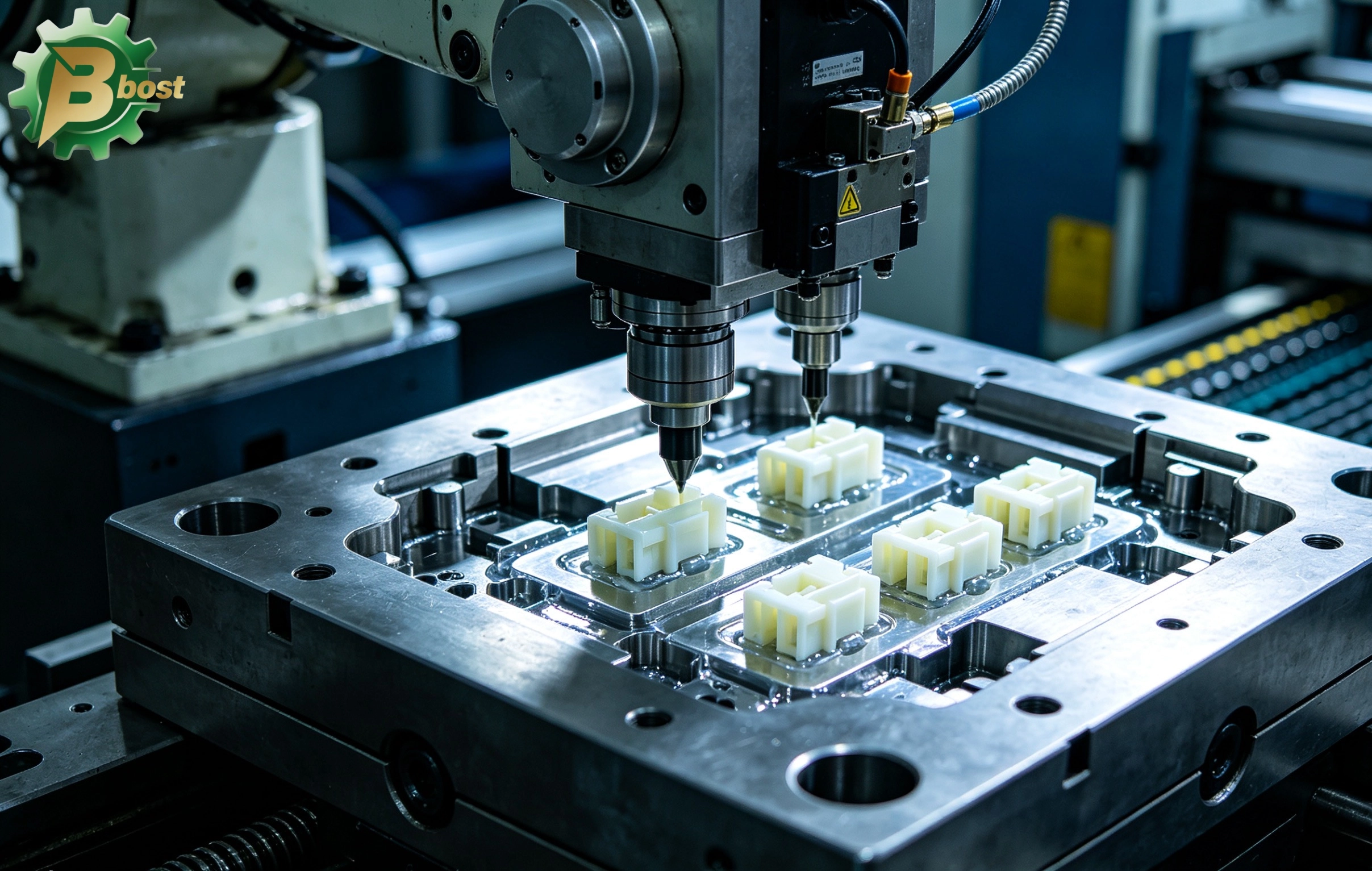
Before steel is cut, digital simulation is a mandatory step. Through Moldflow analysis, engineers determine the optimal gate location, predict filling balance, and identify possible weld lines.
2.2 The Trial Process (T1 to Top Production)
-
T1 Trial: To verify basic mold movement and preliminary part geometry.
-
T2/T3 Optimization: Adjusting molding parameters or fine-tuning mold details based on the FAIR (First Article Inspection Report).
-
Mass Production Approval: Production begins only after samples fully pass functional and assembly tests.
2.3 Secondary Processing Support
A full-service injection molding manufacturer often provides:
-
Ultrasonic Welding
-
Silk Screening / Pad Printing
-
Painting / Electroplating
-
Full Product Assembly
Chapter 3: Material Science – Choosing the Right Engineering Plastic
As a veteran injection molding manufacturer, GZ-Bost often advises clients: "There is no best plastic, only the most suitable one."
3.1 Common Resins and Applications
-
ABS: Excellent surface finish and impact resistance, commonly used for appliances and electronic housings.
-
PC (Polycarbonate): High transparency and strength, ideal for optical parts and medical components.
-
PA66+GF (Glass-filled Nylon): High mechanical strength and heat resistance, the preferred choice for automotive engine peripherals.
-
PEEK/PPS: Specialty engineering plastics for extreme industrial or aerospace environments.
3.2 Environmental Trends: Recycled and Bio-based Materials
With increasing ESG requirements, an injection molding manufacturer in 2026 must be capable of processing PCR (Post-Consumer Recycled) or bio-based plastics to help brands meet global environmental regulations.
Chapter 4: Cost Control and Pricing Transparency
Cost is a sensitive factor in B2B decision-making. Understanding the price structure of an injection molding manufacturer allows you to lead the negotiation.
4.1 Tooling Cost vs. Unit Price
This is a classic balancing act.
-
Low-Volume Projects: We suggest using soft steel or single-cavity molds to reduce upfront tooling investment.
-
High-Volume Projects: High-hardness steel and multi-cavity molds are essential. While the mold is more expensive, it significantly shortens cycle times and reduces the unit price.
4.2 Hidden Factors Influencing Quotes
-
Cycle Time: Every second counts in 2026 manufacturing.
-
Scrap Rate: Complex geometries or tight tolerances increase the risk of defects, driving up costs.
-
Packaging & Logistics: Don't forget to account for volumetric weight and protective packaging in international logistics.
Chapter 5: Quality Management Systems (QA & QC)
A qualified injection molding manufacturer must possess comprehensive compliance certifications.
-
ISO 9001: The baseline quality management standard.
-
IATF 16949: The mandatory entry ticket for the automotive industry.
-
ISO 13485: The gold standard for medical device manufacturing.
-
CMM & Vision Inspection: Ensuring every Critical-to-Quality (CTQ) dimension is backed by data, not just visual inspection.
Chapter 6: Supply Chain Communication – Secrets to Working with Overseas Manufacturers
For overseas clients looking for a Chinese injection molding manufacturer, communication is the biggest challenge.
-
Time Zone Management: Top suppliers have dedicated Project Managers (PM) to ensure replies within 24 hours.
-
Technical Proficiency: Engineering teams capable of reading English drawings and conducting technical discussions reduce misunderstandings by 90%.
-
Remote Factory Audits: In 2026, using 3D panoramic inspections or real-time video links, you can monitor production lines without a transcontinental flight.
Conclusion: Bringing Your Ideas to Life with GZ-Bost
Choosing the right injection molding manufacturer means your project is already halfway to success. In this industry, experience cannot be replicated, and detail determines the outcome.
As a leading injection molding manufacturer with over 10 years of experience, GZ-Bost remains committed to a technology-driven approach. We don't just provide high-quality custom injection molding parts; we are dedicated to creating value for our clients through process optimization.
Visit https://www.gz-bost.com today to get your free DFM report and instant quote. No matter what stage your project is in, our expert team is ready to provide the professional engineering support you need.
Recommended for you
The Peak Art of Custom Manufacturing According to Drawings: Comprehensive Guide to Precision Solutions for Custom Parts According to Drawing
Ending Mechanical Wear and Resonance: The Comprehensive Guide to Precision Customization and Mass Production of a Custom Rubber Pad
The Ultimate Armor for Smart Hardware: Advanced Customization and Precision Injection Molding Guide for a Custom Plastic Box
The Ultimate Weapon to Tame Vibration and Noise: Deep Dive into the Custom Process and Mass Production Logic of a Custom Rubber Bushing
Product Categories
FAQ
FAQs
How do I select the appropriate engineering plastic grade for my product?
Selection should be based on parameters such as load conditions (e.g., pressure/friction), temperature range, medium contact (e.g., oil/acid), and regulatory requirements (e.g., FDA/RoHS). Our engineers can provide free material selection consulting and sample testing.
What are the core advantages of Bost engineering plastics compared to ordinary plastics?
Bost engineering plastics feature ultra-high mechanical strength, high-temperature resistance (-50°C to 300°C), chemical corrosion resistance, and wear resistance. Compared to ordinary plastics, their service life is extended by 3 to 8 times, making them suitable for replacing metals in harsh environments.
Can Bost customize modified plastics with special properties?
Yes! We offer modification services such as reinforcement, flame retardancy, conductivity, wear resistance, and UV resistance, for example:
• Adding carbon fiber to enhance stiffness
• Reducing the coefficient of friction through PTFE modification
• Customizing food-grade or medical-grade certified materials
What is the delivery lead time? Do you offer global logistics?
Standard products: 5–15 working days; custom modifications: 2–4 weeks. We support global air/sea freight and provide export customs clearance documents (including REACH/UL certifications).
What is the minimum order quantity (MOQ)? Do you support small-batch trial production?
The MOQ for standard products is ≥100kg. We support small-batch trial production (as low as 20kg) and provide mold testing reports and performance data feedback.
You may also like
Custom Plastic Knobs Precision Injection Molded
More Details →
Custom Plastic Knobs Precision Injection Molded
Custom Injection Molded Parts from Drawings
More Details →
Custom Injection Molded Parts from Drawings
Underwater Camera Shell Custom Plastic Molding
More Details →
Underwater Camera Shell Custom Plastic Molding
Leave a Message
Have any questions or concerns about our products? Please leave us a message here, and our team will get back to you promptly.

24 hours quotes delivered
Submit CAD files, get quote in 24 hours

No MOQ required
From prototyping to high-volume

±0.02 mm Precision
Advanced CNC with full inspections

1,000+ tons in stock
26 materials ready to ship
© 2026 BOST. All Rights Reserved.