




 Scan QR Code
Send My Request
Comprehensive Analysis of Medical Injection Molding: How to Successfully Customize High-Precision Custom Medical Device Plastic Parts?
2026-07-09
Custom medical device plastic parts require precise specifications and reliable materials; this guide from Bost details how to leverage custom medical plastic injection molding for accuracy and compliance. Learn critical factors to select the right medical-grade plastic parts supplier and optimize production for high-performance devices.
-
- Material Selection: Constructing the Safety Foundation for Custom Medical Device Plastic Parts
- Comparison Table of Common Medical Injection Molding Materials & Applications
- Process Integration: From Precision Mold Design to Rigorous Injection Production
- 1. Compliance-Driven Mold Design
- 2. Precision Injection Molding and Parameter Control
- 3. ISO 7 / ISO 8 Cleanroom Environments
- Regulatory Compliance and Comprehensive Quality Control
- Partnering with a Professional Medical Injection Molder
In the medical device manufacturing sectors, safety and precision are the ultimate non-negotiable baselines. A microscopic void, a dimensional tolerance off by a few microns, or a trace amount of material leaching could directly compromise the clinical performance of a medical device and even jeopardize patient safety. Therefore, when global medical device OEMs search for a supplier capable of manufacturing custom medical device plastic parts, they are not just looking for a machine shop—they are seeking a technical partner with deep expertise in materials science, precision injection molding, and regulatory compliance.
High-quality custom medical device plastic parts are far from ordinary commercial plastics; they embed strict engineering logic from the very inception of their conceptual design. From the professional viewpoint of a veteran digital marketing and manufacturing director, this article will thoroughly analyze the technical barriers and core considerations that must be overcome when customizing medical-grade injection molded components, helping your products meet stringent medical regulations while achieving efficient commercial mass production.
Material Selection: Constructing the Safety Foundation for Custom Medical Device Plastic Parts
Medical environments are complex and variable; components may need to contact human tissue directly, face frequent exposure to aggressive disinfectants, or endure high-load mechanical stress within fast-spinning medical instruments. Therefore, when tailoring custom medical device plastic parts, the primary task is selecting the absolute right resin.
Medical-grade plastics must not only exhibit superior physical properties but also pass rigorous biocompatibility certifications such as USP Class VI or ISO 10993. Below is a comprehensive comparison of mainstream high-performance medical plastics and their application characteristics used in precision injection molding:
Comparison Table of Common Medical Injection Molding Materials & Applications
| Material Type | Biocompatibility & Certifications | Sterilization Tolerance | Key Mechanical & Physical Properties | Typical Medical Application Scenarios |
|---|---|---|---|---|
| PEEK (Polyetheretherketone) | Exceptional (Suitable for long-term implants) | Outstanding (Resists repeated autoclave & chemical sterilization) | Ultra-high strength, wear resistance, low density, radiolucent | Implants, surgical instrument handles, endoscopy components |
| PC (Polycarbonate) | Excellent (Compliant with medical standards) | Good (Resists Gamma ray & EtO sterilization) | High transparency, superb impact resistance, dimensional stability | Hemodialyzer housings, surgical tool viewports, fluid connectors |
| PP (Polypropylene) | Excellent (Low extractables, chemically inert) | Good (Resists autoclave & chemical sterilization) | Outstanding chemical resistance, highly cost-effective, fatigue resistance | Test tubes, syringe plungers, lab consumables, fluid packaging |
| ABS (Acrylonitrile Butadiene Styrene) | Good (Mainly used for non-contact structural parts) | Fair (Primarily tolerates EtO sterilization) | High structural strength, easy surface coating/post-processing, impact-resistant | Medical equipment enclosures, portable diagnostics housings, handheld grips |
In actual production planning, engineers must calibrate the injection molding process parameters according to the specific working conditions of the end product. For instance, if a component is intended for blood-contacting systems, PC custom medical device plastic parts must be tightly controlled for internal residual stress to prevent stress cracking upon subsequent exposure to chemical reagents.
Process Integration: From Precision Mold Design to Rigorous Injection Production
A flawless finished product originates from a perfect source. To achieve high-repetition manufacturing accuracy for custom medical device plastic parts, the deep integration of 模具设计 (mold design) and the injection molding process is central.
1. Compliance-Driven Mold Design
Medical plastic components often feature complex geometries and maintain zero tolerance for cosmetic flaws like flash, sink marks, or voids. During the mold design stage, advanced Moldflow analysis software must be utilized to accurately predict the flow behavior of the melt within the cavities.
-
Wall Thickness Optimization: Keep wall thicknesses uniform to eliminate warpage caused by differential cooling.
-
Gate and Venting Optimization: Proper gate positioning dramatically reduces molecular orientation stress, while efficient venting completely averts localized burns caused by trapped air, ensuring the physical structure of the custom medical device plastic parts remains pristine.
2. Precision Injection Molding and Parameter Control
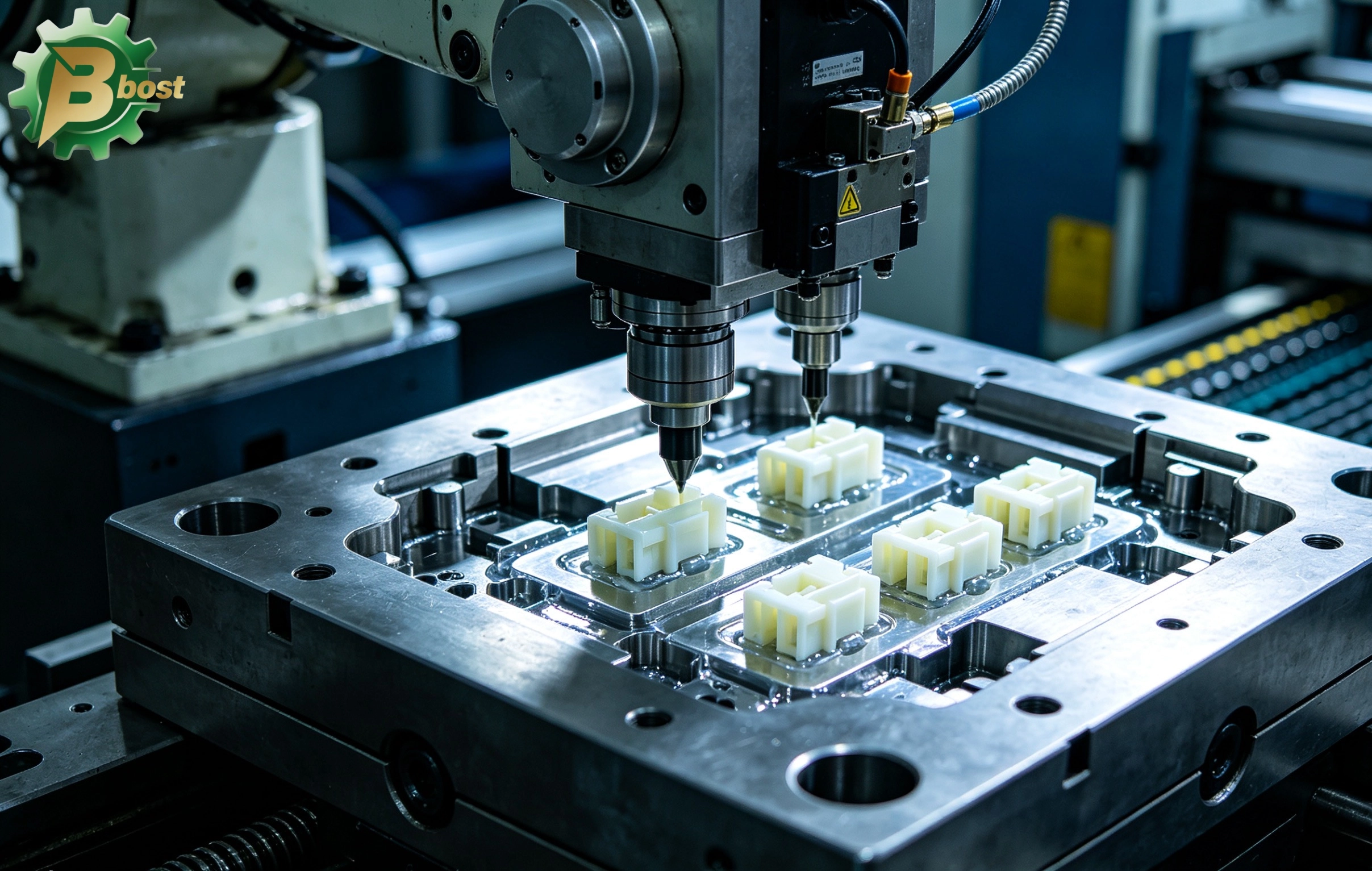
Medical-grade 精密注塑 (precision injection molding) demands ultimate repeatability from the equipment. By deploying all-electric injection molding machines, injection velocity, holding pressure, and mold temperature can be tightly locked within microscopic variance bands. Any slight process drift could cause dimensions to overshoot strict tolerances (typically required to be held within $\pm0.01\text{mm}$).
3. ISO 7 / ISO 8 Cleanroom Environments
Environmental contamination is fatal to medical-grade products. High-quality custom medical device plastic parts must be molded, un-molded via robotic arms, conveyed, and initially packaged within strictly managed cleanrooms to stringently govern particulate and microbial counts, ensuring pristine purity right out of the factory.
Regulatory Compliance and Comprehensive Quality Control
To enter the global medical marketplace, compliance is the only passport. The entire supply chain for manufacturing custom medical device plastic parts must operate seamlessly under the strict mandates of the ISO 13485 Medical Devices Quality Management System.
Suppliers are required to provide robust lot traceability—ranging from the raw resin’s Certificate of Analysis (COA) to real-time parameter logs from the injection molding machinery and final coordinate measuring machine (CMM) dimensional reports. Prior to mass production, rigorous IQ (Installation Qualification), OQ (Operational Qualification), and PQ (Performance Qualification) protocols must be executed to validate that the 注塑成型工艺 (injection molding process) possesses rock-solid stability and reproducibility over long-term production runs.
Partnering with a Professional Medical Injection Molder
Manufacturing exceptional custom medical device plastic parts is a systematic endeavor that demands not only top-tier technical hardware from the producer but also a rigorous attitude of reverence toward human life.
As industry veterans with years of experience in global digital marketing and precision manufacturing, we understand the time-to-market pressures and strict regulatory hurdles you face when advancing medical device projects. Guangzhou Bost (GZ-Bost) is dedicated to delivering one-stop, medical-grade injection molding solutions for global clients. From early-stage project feasibility analysis, DFM flow optimization, and high-precision 模具设计 (mold design), to 精密注塑 (precision injection molding) production inside Class 10,000 / 100,000 cleanrooms, we empower every part with the highest safety and reliability using stringent B2B industrial benchmarks.
We invite you to visit our official website at Guangzhou Bost and get in touch with our veteran engineering expert team. Submit your design blueprints today to receive a professional DFM assessment report and a highly competitive customized quote. Let us collaborate to construct the high-quality, secure components that empower the future of healthcare.
Recommended for you
The Peak Art of Custom Manufacturing According to Drawings: Comprehensive Guide to Precision Solutions for Custom Parts According to Drawing
Ending Mechanical Wear and Resonance: The Comprehensive Guide to Precision Customization and Mass Production of a Custom Rubber Pad
The Ultimate Armor for Smart Hardware: Advanced Customization and Precision Injection Molding Guide for a Custom Plastic Box
The Ultimate Weapon to Tame Vibration and Noise: Deep Dive into the Custom Process and Mass Production Logic of a Custom Rubber Bushing
Product Categories
FAQ
FAQs
How do I select the appropriate engineering plastic grade for my product?
Selection should be based on parameters such as load conditions (e.g., pressure/friction), temperature range, medium contact (e.g., oil/acid), and regulatory requirements (e.g., FDA/RoHS). Our engineers can provide free material selection consulting and sample testing.
What is the minimum order quantity (MOQ)? Do you support small-batch trial production?
The MOQ for standard products is ≥100kg. We support small-batch trial production (as low as 20kg) and provide mold testing reports and performance data feedback.
What is the delivery lead time? Do you offer global logistics?
Standard products: 5–15 working days; custom modifications: 2–4 weeks. We support global air/sea freight and provide export customs clearance documents (including REACH/UL certifications).
Can Bost customize modified plastics with special properties?
Yes! We offer modification services such as reinforcement, flame retardancy, conductivity, wear resistance, and UV resistance, for example:
• Adding carbon fiber to enhance stiffness
• Reducing the coefficient of friction through PTFE modification
• Customizing food-grade or medical-grade certified materials
What are the core advantages of Bost engineering plastics compared to ordinary plastics?
Bost engineering plastics feature ultra-high mechanical strength, high-temperature resistance (-50°C to 300°C), chemical corrosion resistance, and wear resistance. Compared to ordinary plastics, their service life is extended by 3 to 8 times, making them suitable for replacing metals in harsh environments.
You may also like
Custom Plastic Knobs Precision Injection Molded
More Details →
Custom Plastic Knobs Precision Injection Molded
Custom Injection Molded Parts from Drawings
More Details →
Custom Injection Molded Parts from Drawings
Underwater Camera Shell Custom Plastic Molding
More Details →
Underwater Camera Shell Custom Plastic Molding
Leave a Message
Have any questions or concerns about our products? Please leave us a message here, and our team will get back to you promptly.

24 hours quotes delivered
Submit CAD files, get quote in 24 hours

No MOQ required
From prototyping to high-volume

±0.02 mm Precision
Advanced CNC with full inspections

1,000+ tons in stock
26 materials ready to ship
© 2026 BOST. All Rights Reserved.