



 Scan QR Code
Send My Request
The Ultimate Armor for Smart Hardware: Advanced Customization and Precision Injection Molding Guide for a Custom Plastic Box
2026-09-04
Custom plastic box design and manufacturing demand precision and tailored solutions. Bost reveals advanced customization techniques and injection molding best practices to help you partner with a custom plastic box manufacturer that delivers durable, smart hardware enclosures built to exact specifications.
- Why Top-Tier Products Must Have a Dedicated Custom Plastic Box?
- 1. Breaking Homogenization: Reshaping Exclusive Brand Visual Identity
- 2. Ultimate Space Utilization: Perfect Fit for Irregular PCBs and High-Density Components
- 3. Specialized Physical Protection: Meeting IP Ratings and EMI Shielding Demands
- The 3 Injection Molding Process Barriers to Creating a Perfect Custom Plastic Box
- 1. Complex Geometries: Precision Tooling Design of Lifters and Sliders
- 2. The Nemesis of Cosmetic Defects: Weld Lines and Flow Mark Control
- 3. Extremely Strict Dimensional Stability: Conquering Warpage and Sink Marks
- Engineering Plastics Selection Guide for Custom Enclosures
- Partner with GZ-BOST: Thoroughly End Your Supply Chain Internal Friction
In the rapid iteration of the Internet of Things (IoT), industrial control systems, and high-end medical instruments, hardware R&D teams often pour 90% of their energy into PCB layout, algorithm optimization, and core sensor selection. However, when the product finally hits the market, the component that establishes the first physical contact with the user and constantly protects the fragile internal electronics is that seemingly inconspicuous custom plastic box.
Using a cheap, off-the-shelf public mold enclosure might seem like a shortcut, but reality is often brutal: public molds cannot achieve perfect PCB fitment, and loose assembly gaps allow dust and moisture to easily penetrate; a cookie-cutter industrial design makes your product fade among competitors; worse still, when the device needs to operate in extreme heat or highly electromagnetic environments, standard enclosures simply cannot provide the necessary flame retardancy and shielding.
In modern hardware development, a custom plastic box is no longer just a simple "packaging container," but a core component integrating structural mechanics, thermodynamics, EMI shielding, and industrial aesthetics. From the dual perspectives of senior tooling engineers and manufacturing experts, this article deeply dissects the underlying process logic of custom plastic enclosures and reveals how scientific mold development thoroughly eliminates hidden risks in mass production.
Why Top-Tier Products Must Have a Dedicated Custom Plastic Box?
Abandoning off-the-shelf public molds and choosing to invest time and capital into professional custom tooling is driven primarily by the need to solve the following three engineering and commercial pain points:
1. Breaking Homogenization: Reshaping Exclusive Brand Visual Identity
In the consumer electronics and smart home markets, Industrial Design (ID) is the primary productive force. Custom enclosures allow designers to freely express their creativity—whether through streamlined curved surfaces, complex 3D textures, or seamlessly integrated hidden LED windows. A high-quality custom plastic box instantly elevates the product's premium feel and establishes tremendous brand recognition.
2. Ultimate Space Utilization: Perfect Fit for Irregular PCBs and High-Density Components
Internal space in modern electronic devices is extremely precious. A custom plastic box allows for the precise design of internal bosses, ribs, and wiring routing channels tailored to the specific component distribution on the PCB. This tailor-made structure not only eliminates electronic component loosening caused by vibration but also reserves optimal air convection channels for high-heat chips (such as CPUs or communication basebands).
3. Specialized Physical Protection: Meeting IP Ratings and EMI Shielding Demands
For devices installed outdoors or in harsh industrial environments, the enclosure must possess extremely high protection ratings. Custom development can achieve perfect IP67 waterproofing by integrating a waterproof silicone ring directly with the hard shell via Two-shot Molding. Meanwhile, to combat internal electromagnetic interference, custom enclosures can undergo conductive paint spraying (EMI Shielding) post-molding—a deep functional integration that public molds simply cannot achieve.
The 3 Injection Molding Process Barriers to Creating a Perfect Custom Plastic Box
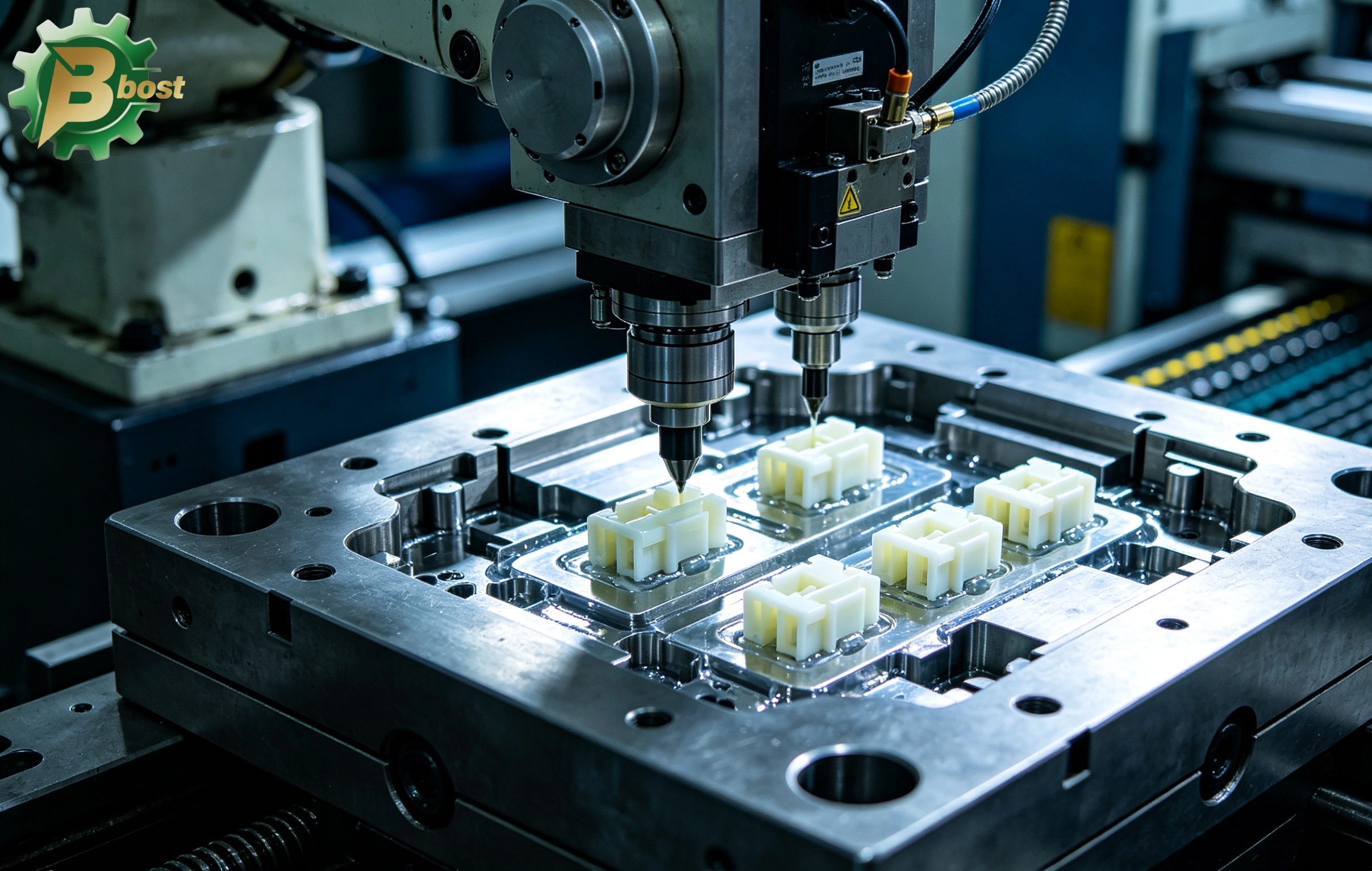
Transforming a beautiful 3D CAD drawing into millions of dimensionally flawless mass-produced plastic boxes is a battle that severely tests a factory's foundation in the injection molding process.
1. Complex Geometries: Precision Tooling Design of Lifters and Sliders
Most modern custom plastic box designs feature various side openings (like USB or Ethernet ports) and internal snap-fits. In the vertical direction of mold opening and closing, these structures are known as "undercuts."
To achieve smooth ejection of these undercuts, mold design engineers must incorporate precision sliders and lifters within the mold. If the CNC machining precision of these moving parts is inadequate, they will easily misalign under the high-pressure impact of injection. This results in sharp flash (burrs) around the ports, which not only affects assembly but can seriously scratch the user.
2. The Nemesis of Cosmetic Defects: Weld Lines and Flow Mark Control
For plastic boxes with multiple button holes or large screen cutouts, when high-temperature molten plastic encounters an obstacle, splits, and then merges back together in the cavity, weld lines are inevitable. If handled improperly, these marks are not only as ugly as cracks but also serve as the weakest points most likely to fracture under drop impact.
Professional manufacturing teams utilize Moldflow simulation software during the early DFM (Design for Manufacturability) phase. By optimizing gate locations, adding cold slug wells, and precisely tuning the injection machine's mold temperature and injection speed, they can relocate weld lines to non-cosmetic surfaces, or make them visually invisible through precision injection molding techniques.
3. Extremely Strict Dimensional Stability: Conquering Warpage and Sink Marks
Whether it is a router enclosure with top and bottom covers snapping together or a remote control box closing left-to-right, the assembly gap and flush must be controlled within 0.1mm. However, due to the shrinkage characteristics of cooling plastic, large flat surfaces are highly prone to warpage; meanwhile, the backsides of thick internal bosses are extremely susceptible to sink marks. This requires the injection workshop to not only use high-end molds with exceptional cooling channel designs but also rely on the extremely stable holding pressure control of all-electric injection machines.
Engineering Plastics Selection Guide for Custom Enclosures
Correct material selection is the first step in determining project success. Below are the four engineering plastics we most frequently recommend when developing a custom plastic box, provided for your reference:
| Plastic Material | Core Physical Advantages & Processing Traits | Typical Custom Plastic Box Scenarios | Design & Molding Notes |
|---|---|---|---|
| ABS | Excellent flowability, high dimensional stability, easily painted or electroplated, highly cost-effective. | Indoor smart home control boxes, standard remotes, router enclosures. | Average flame retardancy and weather resistance; not recommended for long-term outdoor UV exposure. |
| PC/ABS Alloy | Balances the impact strength of PC with the flowability of ABS; easily achieves UL94 V-0 flame retardancy. | Medical monitor housings, industrial power adapter boxes. | Requires extremely strict drying during the injection molding process; residual moisture causes silver streaks and performance degradation. |
| PC (Polycarbonate) | Ultimate smash and impact resistance, high temperature resistance, can be fully transparent. | Outdoor security camera housings, waterproof junction boxes, high-strength instrument cases. | High melt viscosity generates massive internal stress; highly prone to cracking if not annealed post-molding. |
| PA66 + GF (Glass Fiber) | Adding glass fiber provides extreme mechanical strength, oil resistance, high heat resistance, and excellent rigidity. | Automotive under-hood controller boxes, heavy-duty industrial sensor housings. | Glass fibers cause anisotropic shrinkage, highly prone to severe warpage; mold design is extremely challenging. |
Partner with GZ-BOST: Thoroughly End Your Supply Chain Internal Friction
When facing a highly challenging custom enclosure project, subcontracting mold development and injection production to different cheap factories is often the beginning of a disaster. Once the enclosure assembly exhibits oversized gaps or warpage, the endless finger-pointing between the toolmaker and the molder will indefinitely delay your product launch.
To break this deadlock, you need a strategic partner truly equipped with closed-loop manufacturing capabilities. Deeply rooted in the precision manufacturing sector of the Greater Bay Area for over a decade, Guangzhou Bost (GZ-BOST) focuses on providing top-tier one-stop injection molding solutions for global B2B clients.
From the moment your 3D drawings enter GZ-BOST, our bilingual engineering experts initiate rigorous DFM assessments. We polish molds in our self-built, high-precision CNC machining centers, and achieve high-volume precision injection molding using all-electric machines in our climate-controlled cleanrooms. Whether it involves complex lifter core-pulling or IP67 waterproof sealing grooves requiring extreme precision, the entire technical loop is closed internally at GZ-BOST. This thoroughly eliminates communication friction and compresses your R&D cycle by over 30%.
Do not let a mediocre enclosure limit the infinite potential of your hardware!
Visit our official website immediately: https://www.gz-bost.com, and upload your 3D drawings (STEP / IGES formats supported) on the "Contact Us" page. Our senior tooling engineers will provide you with a comprehensive DFM manufacturing assessment report and a highly market-competitive quote for tooling and mass production within 24 hours, completely free of charge! Let GZ-BOST's exquisite craftsmanship safeguard your next blockbuster hardware.
Recommended for you
The Peak Art of Custom Manufacturing According to Drawings: Comprehensive Guide to Precision Solutions for Custom Parts According to Drawing
Ending Mechanical Wear and Resonance: The Comprehensive Guide to Precision Customization and Mass Production of a Custom Rubber Pad
The Ultimate Weapon to Tame Vibration and Noise: Deep Dive into the Custom Process and Mass Production Logic of a Custom Rubber Bushing
Farewell to Public Mold Compromises: The Injection Molding Pitfall Avoidance Guide and Mass Production Strategy for the Perfect Custom Plastic Box
Product Categories
FAQ
FAQs
What are the core advantages of Bost engineering plastics compared to ordinary plastics?
Bost engineering plastics feature ultra-high mechanical strength, high-temperature resistance (-50°C to 300°C), chemical corrosion resistance, and wear resistance. Compared to ordinary plastics, their service life is extended by 3 to 8 times, making them suitable for replacing metals in harsh environments.
What is the minimum order quantity (MOQ)? Do you support small-batch trial production?
The MOQ for standard products is ≥100kg. We support small-batch trial production (as low as 20kg) and provide mold testing reports and performance data feedback.
How do I select the appropriate engineering plastic grade for my product?
Selection should be based on parameters such as load conditions (e.g., pressure/friction), temperature range, medium contact (e.g., oil/acid), and regulatory requirements (e.g., FDA/RoHS). Our engineers can provide free material selection consulting and sample testing.
Can Bost customize modified plastics with special properties?
Yes! We offer modification services such as reinforcement, flame retardancy, conductivity, wear resistance, and UV resistance, for example:
• Adding carbon fiber to enhance stiffness
• Reducing the coefficient of friction through PTFE modification
• Customizing food-grade or medical-grade certified materials
What is the delivery lead time? Do you offer global logistics?
Standard products: 5–15 working days; custom modifications: 2–4 weeks. We support global air/sea freight and provide export customs clearance documents (including REACH/UL certifications).
You may also like
Custom Plastic Knobs Precision Injection Molded
More Details →
Custom Plastic Knobs Precision Injection Molded
Custom Injection Molded Parts from Drawings
More Details →
Custom Injection Molded Parts from Drawings
Underwater Camera Shell Custom Plastic Molding
More Details →
Underwater Camera Shell Custom Plastic Molding
Leave a Message
Have any questions or concerns about our products? Please leave us a message here, and our team will get back to you promptly.

24 hours quotes delivered
Submit CAD files, get quote in 24 hours

No MOQ required
From prototyping to high-volume

±0.02 mm Precision
Advanced CNC with full inspections

1,000+ tons in stock
26 materials ready to ship
© 2026 BOST. All Rights Reserved.