




 Scan QR Code
Send My Request
Conquering Extreme Conditions: A Deep Dive into PEEK Injection Molding Challenges and Quality Control
2026-04-07
Discover how Bost tackles PEEK injection molding challenges with expert quality control. As leading PEEK injection molding suppliers, we offer custom PEEK injection molding services tailored to extreme conditions, ensuring precision and durability for your advanced applications.
- Introduction: Why is PEEK the "Hard Nut to Crack" in Plastic Processing?
- 1. The Art of Pre-treatment: A Small Error Leads to a Large Failure
- 2. Mold Design: Enduring the 400°C "Torture"
- 2.1 Steel Selection and Heat Treatment
- 2.2 Precision Temperature Control Systems
- 3. Injection Process: The Art of Balancing Pressure and Heat
- 4. Industry Pain Points: Why Choose GZ-BOST?
- 5. Quality Inspection: Rigor Beyond the Visual
- Conclusion: Finding Your Technical Strategic Partner
Introduction: Why is PEEK the "Hard Nut to Crack" in Plastic Processing?
In the kingdom of specialty engineering plastics, PEEK (Polyetheretherketone) is crowned the "King of Plastics" due to its extraordinary high-temperature resistance, chemical inertness, and high mechanical strength. However, for any PEEK injection molding provider, this material is as much a testament to capability as it is a massive technical challenge.
Many buyers encounter issues like uneven crystallization, dimensional instability, or even mold damage during initial development. This usually stems from a lack of deep understanding of PEEK’s physical behavior. As a long-term player in the industry, GZ-BOST has developed a comprehensive control system for PEEK injection molding through countless mold flow analyses and hands-on experience. This article takes you to the front lines of production to deconstruct every critical node in the birth of a high-performance PEEK part.
1. The Art of Pre-treatment: A Small Error Leads to a Large Failure
In a PEEK injection molding workshop, the first step is not turning on the machine, but "extreme drying." Although PEEK has very low moisture absorption, even a tiny fraction of a percent of water will instantly vaporize at processing temperatures near 400°C, causing silver streaks or micro-voids in the product.
We mandate that PEEK resin must be processed in a desiccant dryer at 150°C for at least 4 hours. An experienced technician observes the transparency of the pellets, knowing that any residual moisture will break the polymer’s molecular chains, compromising the tensile strength of the final part. This is not just a process requirement; it is a sign of respect for high-value raw materials.
2. Mold Design: Enduring the 400°C "Torture"
The requirements for molds in PEEK injection molding far exceed those of standard precision molding. Conventional mold steels can suffer from annealing softening or precision drift when exposed to mold temperatures above 180°C over long periods.
2.1 Steel Selection and Heat Treatment
We typically select premium hot-work steels like S136 or H13, subjected to multiple tempering cycles to ensure thermal stability. Fitting clearances must be adjusted at the micron level to account for PEEK's high flowability and prevent flash.
2.2 Precision Temperature Control Systems
The crystallinity of PEEK directly dictates its wear resistance. If the mold temperature is poorly controlled, parts will exhibit mottled color variations, signaling incomplete crystallization. By embedding high-power heating cartridges and maintaining temperature deviations within ±2°C, GZ-BOST ensures every PEEK injection molding component possesses a perfect crystalline structure.
3. Injection Process: The Art of Balancing Pressure and Heat
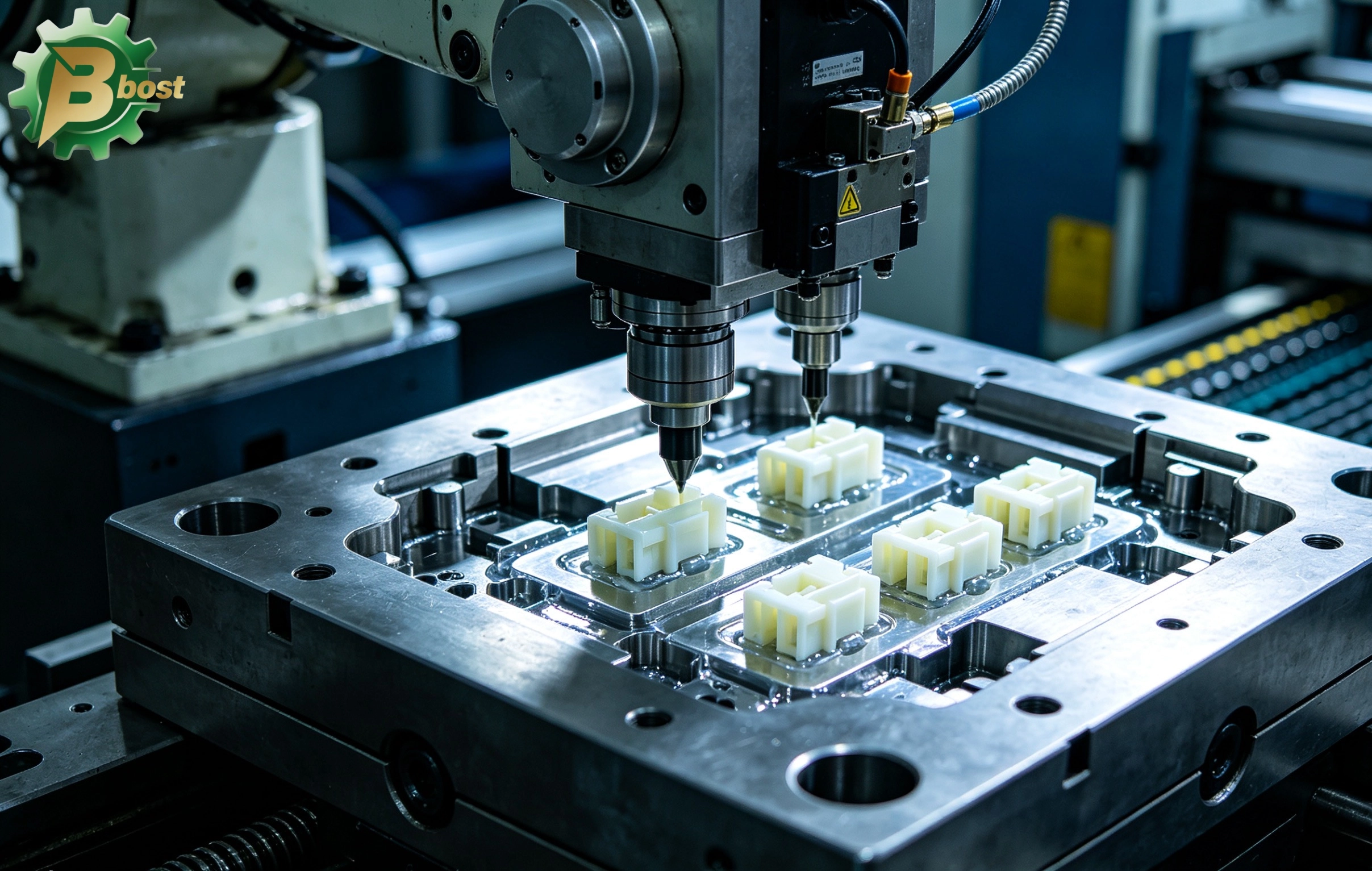
In actual PEEK injection molding production, machine selection and parameter settings are the core.
Because PEEK melt has high viscosity, it requires immense injection pressure and speed. However, excessive shear can lead to material degradation. Our engineers utilize "Scientific Molding" methods, monitoring injection pressure curves via sensors to find the "Golden Balance"—filling the cavity while maintaining molecular integrity.
Furthermore, given PEEK’s high cost, runner design must be as compact as possible. GZ-BOST optimizes gate types (such as sub-gates or pin-point gates) to minimize regrind waste while maintaining top-tier quality.
4. Industry Pain Points: Why Choose GZ-BOST?
In aerospace, parts must endure drastic temperature swings; in the medical sector, implant-grade PEEK parts demand extreme cleanliness. Many PEEK injection molding vendors can "mold" a part, but few can "optimize" it.
-
Metal-to-Plastic Conversion: We’ve helped clients replace stainless steel pump cores with PEEK, reducing weight by 70% while improving corrosion resistance.
-
Dimensional Compensation: For PEEK’s significant shrinkage rate, we use Moldflow analysis to pre-compensate during the tool-making phase, achieving precision fits of ±0.01mm.
5. Quality Inspection: Rigor Beyond the Visual
Every batch of PEEK injection molding orders at GZ-BOST undergoes rigorous performance testing. Beyond basic CMM dimensional inspection, we perform hardness and Heat Deflection Temperature (HDT) tests to ensure products will not creep under actual working conditions.
Conclusion: Finding Your Technical Strategic Partner
PEEK injection molding is not a simple contract manufacturing job; it is an engineering service involving precision manufacturing and material science. At GZ-BOST, we understand that every PEEK part carries the success or failure of our clients' high-value projects.
If you are looking for an injection molding expert who can handle high-difficulty PEEK projects with a rigorous quality management system, GZ-BOST is ready to support you.
Want to know if your PEEK design is manufacturable? Visit the GZ-BOST website to submit your 3D drawings. Our senior engineers will provide a free DFM evaluation and a highly competitive PEEK injection molding quote.
Recommended for you
The Peak Art of Custom Manufacturing According to Drawings: Comprehensive Guide to Precision Solutions for Custom Parts According to Drawing
Ending Mechanical Wear and Resonance: The Comprehensive Guide to Precision Customization and Mass Production of a Custom Rubber Pad
The Ultimate Armor for Smart Hardware: Advanced Customization and Precision Injection Molding Guide for a Custom Plastic Box
The Ultimate Weapon to Tame Vibration and Noise: Deep Dive into the Custom Process and Mass Production Logic of a Custom Rubber Bushing
Product Categories
FAQ
FAQs
How do I select the appropriate engineering plastic grade for my product?
Selection should be based on parameters such as load conditions (e.g., pressure/friction), temperature range, medium contact (e.g., oil/acid), and regulatory requirements (e.g., FDA/RoHS). Our engineers can provide free material selection consulting and sample testing.
What is the minimum order quantity (MOQ)? Do you support small-batch trial production?
The MOQ for standard products is ≥100kg. We support small-batch trial production (as low as 20kg) and provide mold testing reports and performance data feedback.
What are the core advantages of Bost engineering plastics compared to ordinary plastics?
Bost engineering plastics feature ultra-high mechanical strength, high-temperature resistance (-50°C to 300°C), chemical corrosion resistance, and wear resistance. Compared to ordinary plastics, their service life is extended by 3 to 8 times, making them suitable for replacing metals in harsh environments.
Can Bost customize modified plastics with special properties?
Yes! We offer modification services such as reinforcement, flame retardancy, conductivity, wear resistance, and UV resistance, for example:
• Adding carbon fiber to enhance stiffness
• Reducing the coefficient of friction through PTFE modification
• Customizing food-grade or medical-grade certified materials
What is the delivery lead time? Do you offer global logistics?
Standard products: 5–15 working days; custom modifications: 2–4 weeks. We support global air/sea freight and provide export customs clearance documents (including REACH/UL certifications).
You may also like
Custom Plastic Knobs Precision Injection Molded
More Details →
Custom Plastic Knobs Precision Injection Molded
Custom Injection Molded Parts from Drawings
More Details →
Custom Injection Molded Parts from Drawings
Underwater Camera Shell Custom Plastic Molding
More Details →
Underwater Camera Shell Custom Plastic Molding
Leave a Message
Have any questions or concerns about our products? Please leave us a message here, and our team will get back to you promptly.

24 hours quotes delivered
Submit CAD files, get quote in 24 hours

No MOQ required
From prototyping to high-volume

±0.02 mm Precision
Advanced CNC with full inspections

1,000+ tons in stock
26 materials ready to ship
© 2026 BOST. All Rights Reserved.