




 Scan QR Code
Send My Request
Deep Dive into Insert Molding: How to Achieve High-Efficiency Integration of Complex Components?
2026-03-31
Discover Bost’s expertise in insert molding, offering custom insert molding services that ensure high-efficiency integration of complex components. As leading insert molding suppliers for plastics, we deliver precision and quality tailored to your manufacturing needs.
In today’s manufacturing environment, where lightweight design, high integration, and cost optimization are paramount, traditional assembly methods are increasingly revealing their limitations. For many engineering managers, the challenge remains: how to ensure structural integrity while reducing the risks and costs associated with secondary assembly? Insert Molding offers the perfect solution to this dilemma.
As a specialist in precision manufacturing with years of expertise, GZ-Bost has witnessed countless enterprises achieve a leap in both product performance and production efficiency by optimizing their Insert Molding strategies. Today, we will dissect the core logic of this process from a professional perspective.
1. What is Insert Molding? It's More Than Just "Plastic + Part"
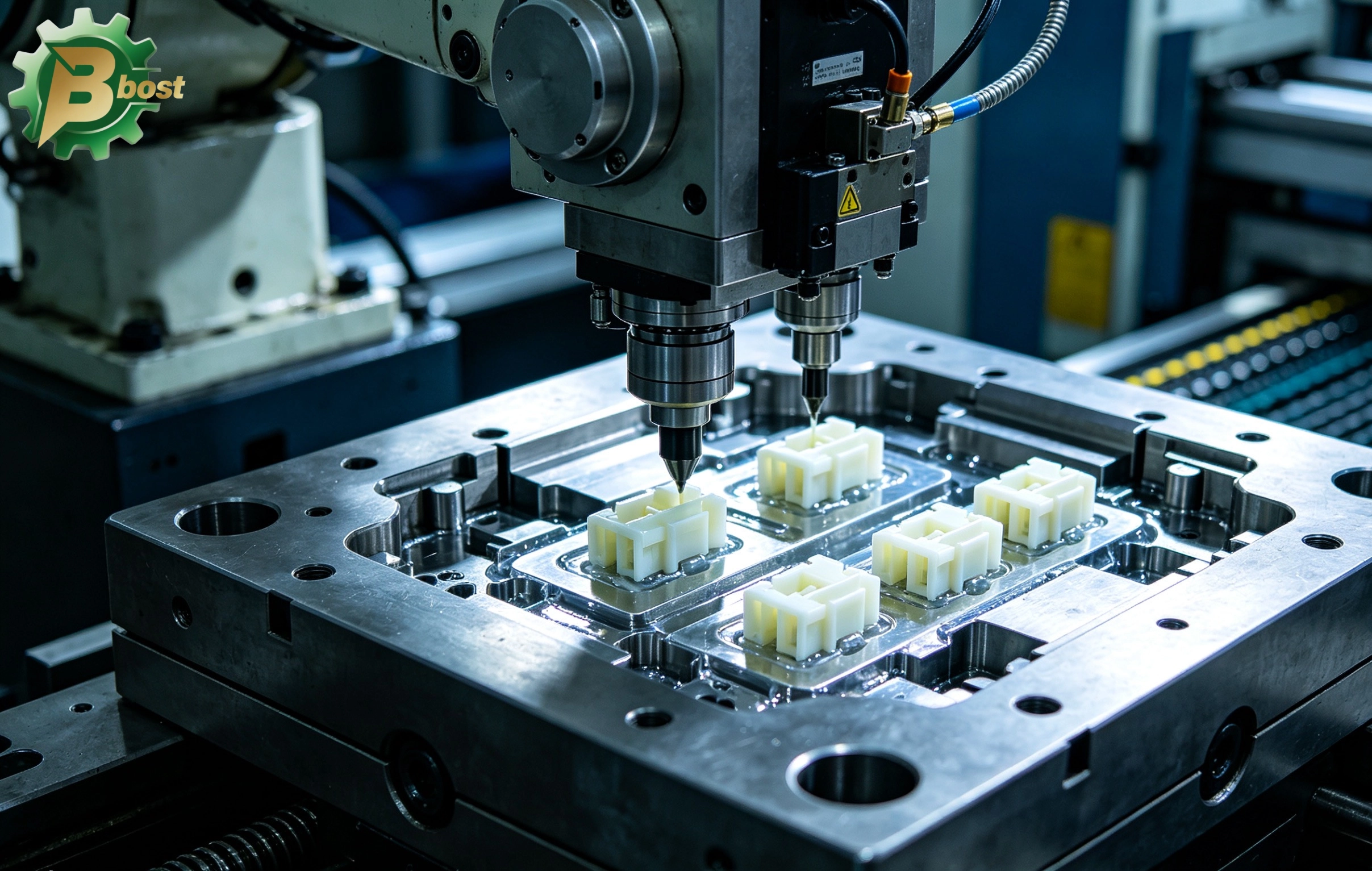
On the surface, Insert Molding refers to the process of placing pre-manufactured metal parts or other inserts into a mold before injection, then injecting plastic to create a single integrated component upon cooling. However, in the eyes of a senior engineer, it is a precise game of thermodynamics, mold design, and material science.
Compared to traditional "molding then assembly" approaches, the core value of Insert Molding lies in its "one-shot" nature. Whether it is threaded bushings, conductive connectors, or structural reinforcements, integration through this process yields a bond strength far superior to adhesive or heat staking. For B2B industrial products that require frequent disassembly or endure vibration—such as sensor housings or automotive interior parts—this process is virtually indispensable.
2. Core Advantages: Why Do Global Top Manufacturers Prefer Insert Molding?
If your project is transitioning from prototype development to mass production, understanding these advantages of Insert Molding will help you make a more informed decision:
1. Significant Enhancement of Structural Strength and Reliability
By embedding metal components directly into the plastic part, the mechanical locking force created as the plastic cools and shrinks ensures an incredibly tight bond. Compared to drilling and installing bushings post-production, Insert Molding effectively eliminates the risk of material stress cracking.
2. Massive Reduction in Labor Costs and Assembly Risks
Every assembly step represents an additional opportunity for error. By completing integration during the injection stage, companies can skip tedious manual assembly steps, reducing the probability of part misalignment, loosening, or loss.
3. Flexibility in Design and Lightweighting
Since there is no longer a need to reserve bulky assembly spaces or fastener locations, designers can further compress product dimensions. In fields like aerospace or precision medical devices, these savings in space and weight often translate directly into core competitiveness.
3. Technical Depth: Key Factors for Success in Insert Molding
A high-quality Insert Molding product is never an accident; it relies on rigorous production control protocols.
1. Mold Design Precision
During Insert Molding, the mold must secure the inserts precisely and stably. If an insert shifts by even 0.01mm under clamping pressure, it can lead to scrapped parts or even mold damage. At GZ-Bost, we utilize advanced flow analysis software to simulate the impact of plastic melt on inserts, ensuring the positioning remains rock-solid.
2. The Game of Material Compatibility
Not all plastics and metals are a "match made in heaven." We must consider whether the plastic's shrinkage rate will crush delicate inserts, or if the difference in thermal expansion coefficients between the two will lead to delamination under extreme temperatures. Typically, we recommend fiber-reinforced engineering plastics to match metal inserts.
3. Fine-Tuning Injection Molding Process Parameters
Control over temperature, pressure, and speed is vital. Excessive injection pressure can displace the insert, while temperatures that are too low will result in poor bonding at the interface. Experienced operators dynamically adjust the injection curve based on the pre-heating state of the inserts to ensure every part passes pull-force and airtightness tests.
4. Case Study: From Pain Point to Solution
We once worked with a client in the automotive electronics industry whose products frequently suffered from connector loosening in high-vibration environments. They were originally using a post-molding heat staking process, but the yield rate was only 85%.
After intervening, the GZ-Bost team recommended switching to an Insert Molding solution. We redesigned precision molds with positioning pins and selected a high-flow PBT material. The results were astounding: the assembly process was completely eliminated, the yield rate jumped to 99.8%, and the contact issues caused by vibration were permanently resolved.
5. Conclusion: Details Define the Boundaries of Integration
Insert Molding is more than just a production method; it is a design philosophy that optimizes the product lifecycle. In a competitive global market, process innovation in the details is often the source of profit.
Is your project facing challenges with low assembly efficiency or insufficient strength?
The professional engineering team at GZ-Bost is ready to provide you with full-spectrum support, from mold design to large-scale Insert Molding production. We don’t just manufacture plastic parts; we are dedicated to building high-reliability integrated solutions for you.
👉 Click here to speak with our Technical Director and get your customized quote
Or browse our website to view more industry-leading cases regarding precision injection molding.
Recommended for you
The Peak Art of Custom Manufacturing According to Drawings: Comprehensive Guide to Precision Solutions for Custom Parts According to Drawing
Ending Mechanical Wear and Resonance: The Comprehensive Guide to Precision Customization and Mass Production of a Custom Rubber Pad
The Ultimate Armor for Smart Hardware: Advanced Customization and Precision Injection Molding Guide for a Custom Plastic Box
The Ultimate Weapon to Tame Vibration and Noise: Deep Dive into the Custom Process and Mass Production Logic of a Custom Rubber Bushing
Product Categories
FAQ
FAQs
What is the minimum order quantity (MOQ)? Do you support small-batch trial production?
The MOQ for standard products is ≥100kg. We support small-batch trial production (as low as 20kg) and provide mold testing reports and performance data feedback.
What are the core advantages of Bost engineering plastics compared to ordinary plastics?
Bost engineering plastics feature ultra-high mechanical strength, high-temperature resistance (-50°C to 300°C), chemical corrosion resistance, and wear resistance. Compared to ordinary plastics, their service life is extended by 3 to 8 times, making them suitable for replacing metals in harsh environments.
Can Bost customize modified plastics with special properties?
Yes! We offer modification services such as reinforcement, flame retardancy, conductivity, wear resistance, and UV resistance, for example:
• Adding carbon fiber to enhance stiffness
• Reducing the coefficient of friction through PTFE modification
• Customizing food-grade or medical-grade certified materials
What is the delivery lead time? Do you offer global logistics?
Standard products: 5–15 working days; custom modifications: 2–4 weeks. We support global air/sea freight and provide export customs clearance documents (including REACH/UL certifications).
How do I select the appropriate engineering plastic grade for my product?
Selection should be based on parameters such as load conditions (e.g., pressure/friction), temperature range, medium contact (e.g., oil/acid), and regulatory requirements (e.g., FDA/RoHS). Our engineers can provide free material selection consulting and sample testing.
You may also like
Custom Plastic Knobs Precision Injection Molded
More Details →
Custom Plastic Knobs Precision Injection Molded
Custom Injection Molded Parts from Drawings
More Details →
Custom Injection Molded Parts from Drawings
Underwater Camera Shell Custom Plastic Molding
More Details →
Underwater Camera Shell Custom Plastic Molding
Leave a Message
Have any questions or concerns about our products? Please leave us a message here, and our team will get back to you promptly.

24 hours quotes delivered
Submit CAD files, get quote in 24 hours

No MOQ required
From prototyping to high-volume

±0.02 mm Precision
Advanced CNC with full inspections

1,000+ tons in stock
26 materials ready to ship
© 2026 BOST. All Rights Reserved.