




 Scan QR Code
Send My Request
Avoid the Pitfalls: 5 Dimensions for B2B Buyers When Selecting Insert Molding Suppliers
2026-03-31
Discover Bost’s expert guide on Insert Molding for B2B buyers. Learn 5 key dimensions to evaluate insert molding services for metal inserts, including essential design guidelines and tolerances. Make informed supplier choices to ensure quality and precision in your projects.
In the realm of precision manufacturing, Insert Molding has become the go-to process for automotive electronics, medical devices, and industrial control equipment due to its ability to seamlessly combine the strength of metal with the complex geometries of plastic. However, for B2B procurement managers or product engineers, choosing a qualified Insert Molding supplier is no easy task.
Often, superficial price advantages mask underlying risks such as insufficient mold precision, insert displacement, or material polarity mismatch. As experts with over a decade of experience in the injection molding industry, GZ-Bost has compiled this in-depth guide to help you vet high-authority suppliers from a professional perspective.
1. Robustness of Mold Design: The First Line of Defense Against Displacement
During the Insert Molding process, inserts (such as brass nuts, stainless steel pins, or PCBs) must remain absolutely stationary under the impact of high-speed, high-pressure molten plastic.
Key Audit Point: Ask the supplier how they ensure insert positioning. A top-tier supplier will demonstrate their use of mechanical locking structures or vacuum suction systems during the mold design phase.
Professional Insight: Observe the treatment of their mold parting lines. High-standard Insert Molding molds can control flash at the micron level, preventing plastic from seeping into metal threads or conductive contact surfaces—a nightmare for post-production assembly.
2. Degree of Automation: For Quality Consistency, Not Just Efficiency
For Insert Molding, manual placement of inserts is not only inefficient but also limited by human variables like temperature, humidity, and positioning deviations.
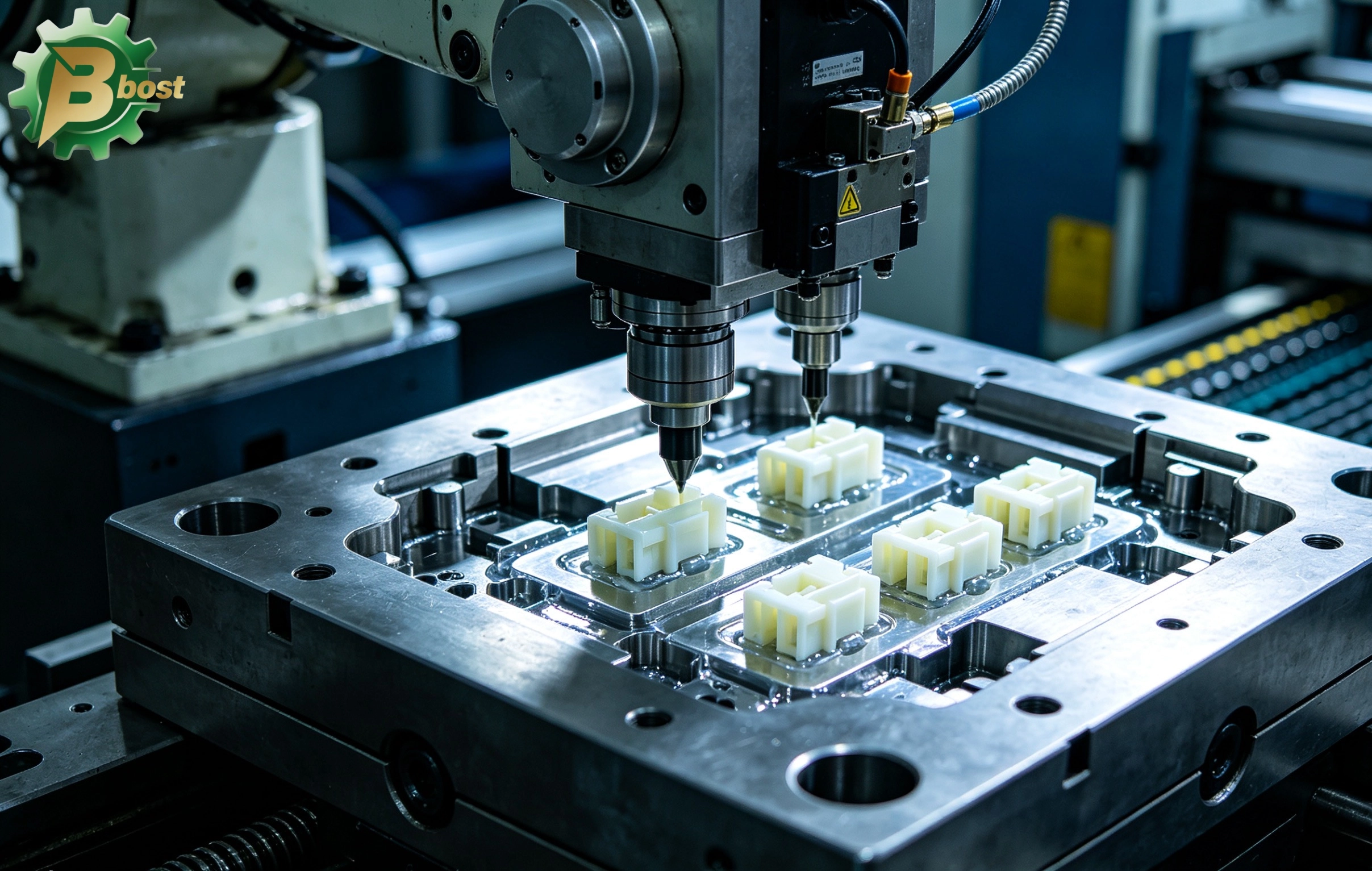
Key Audit Point: Is the facility equipped with 6-axis robots or dedicated automatic insert feeding systems?
Core Logic: Automation ensures that every cycle time is perfectly identical. This is critical for maintaining consistent crystallinity of the plastic around the insert and reducing thermal stress. At GZ-Bost, we prioritize automated solutions to eliminate human error and ensure highly uniform product attributes in mass production.
3. Depth of DFM (Design for Manufacturing) Involvement
A top-tier Insert Molding supplier should not just "process according to drawings"; they should intervene during the early design stages.
Critical Questions: Does the supplier suggest pre-heating for your inserts? Have they analyzed the compressive stress exerted by plastic shrinkage on the metal part?
Pro Tip: Excellent suppliers use Moldflow Analysis to predict the locations of air traps and weld lines. If a weld line appears where the insert bears the most stress, the product is highly susceptible to cracking during use. A partner who points out design flaws and offers modifications is the strategic ally you need.
4. Material Selection Logic and Interface Bonding Control
The success of Insert Molding largely depends on the physical/chemical bonding at the interface between plastic and metal.
Technical Terms: Inquire about "wettability" and "mechanical interlocking" solutions. For instance, do they recommend adding knurling or grooves to the metal insert surface?
Advanced Solutions: For products requiring high airtightness (like water pump impellers or sensor housings), does the supplier have experience with primer coating or plasma treatment? These details determine whether the product will delaminate or leak under extreme temperature fluctuations.
5. Quality Control System: From First Article Inspection to Lifecycle Tracking
The biggest fear in B2B procurement is "perfect samples, disastrous mass production."
Checklist: Does the supplier have X-ray inspection equipment to check for internal insert deformation? Do they have pull-force testers to verify bonding strength?
Transparency: An ideal partner should provide injection parameter records for every batch. At GZ-Bost, we implement strict batch tracking, ensuring every Insert Molding component is traceable back to the raw material batch and production shift records.
Conclusion: Find a Partner Who Understands the Process and the Product
Insert Molding is a complex system engineering task. A cheap supplier might save costs in the short term, but the resulting high scrap rates, assembly failures, and after-sales recalls carry a price tag that no business can afford.
Looking for a Reliable Insert Molding Manufacturing Solution?
GZ-Bost has over 10 years of experience in precision injection molding. We provide more than just mold making; we offer comprehensive technical consulting. From material optimization to automated mass production, we help you transform complex designs into highly competitive finished products.
👉 Consult our Technical Experts now for a free DFM evaluation report
Or visit our website to see how we empower Fortune 500 companies through precision injection molding processes.
Recommended for you
The Peak Art of Custom Manufacturing According to Drawings: Comprehensive Guide to Precision Solutions for Custom Parts According to Drawing
Ending Mechanical Wear and Resonance: The Comprehensive Guide to Precision Customization and Mass Production of a Custom Rubber Pad
The Ultimate Armor for Smart Hardware: Advanced Customization and Precision Injection Molding Guide for a Custom Plastic Box
The Ultimate Weapon to Tame Vibration and Noise: Deep Dive into the Custom Process and Mass Production Logic of a Custom Rubber Bushing
Product Categories
FAQ
FAQs
What is the delivery lead time? Do you offer global logistics?
Standard products: 5–15 working days; custom modifications: 2–4 weeks. We support global air/sea freight and provide export customs clearance documents (including REACH/UL certifications).
What is the minimum order quantity (MOQ)? Do you support small-batch trial production?
The MOQ for standard products is ≥100kg. We support small-batch trial production (as low as 20kg) and provide mold testing reports and performance data feedback.
How do I select the appropriate engineering plastic grade for my product?
Selection should be based on parameters such as load conditions (e.g., pressure/friction), temperature range, medium contact (e.g., oil/acid), and regulatory requirements (e.g., FDA/RoHS). Our engineers can provide free material selection consulting and sample testing.
What are the core advantages of Bost engineering plastics compared to ordinary plastics?
Bost engineering plastics feature ultra-high mechanical strength, high-temperature resistance (-50°C to 300°C), chemical corrosion resistance, and wear resistance. Compared to ordinary plastics, their service life is extended by 3 to 8 times, making them suitable for replacing metals in harsh environments.
Can Bost customize modified plastics with special properties?
Yes! We offer modification services such as reinforcement, flame retardancy, conductivity, wear resistance, and UV resistance, for example:
• Adding carbon fiber to enhance stiffness
• Reducing the coefficient of friction through PTFE modification
• Customizing food-grade or medical-grade certified materials
You may also like
Custom Plastic Knobs Precision Injection Molded
More Details →
Custom Plastic Knobs Precision Injection Molded
Custom Injection Molded Parts from Drawings
More Details →
Custom Injection Molded Parts from Drawings
Underwater Camera Shell Custom Plastic Molding
More Details →
Underwater Camera Shell Custom Plastic Molding
Leave a Message
Have any questions or concerns about our products? Please leave us a message here, and our team will get back to you promptly.

24 hours quotes delivered
Submit CAD files, get quote in 24 hours

No MOQ required
From prototyping to high-volume

±0.02 mm Precision
Advanced CNC with full inspections

1,000+ tons in stock
26 materials ready to ship
© 2026 BOST. All Rights Reserved.