




 Scan QR Code
Send My Request
Deep Guide: Optimizing Precision Manufacturing Performance and Cost Using Insert Molding
2026-04-15
Discover how Bost leverages expert insert molding techniques to optimize precision manufacturing performance while reducing insert molding cost and lead time. As a trusted insert molding contract manufacturer, we deliver efficient, high-quality solutions tailored to your production needs.
- Introduction: Why Insert Molding is the Preferred Choice for Complex Components?
- I. Core Advantages of Insert Molding: Beyond Traditional Assembly
- 1. Superior Mechanical Strength and Structural Stability
- 2. Significant Reduction in Assembly Costs and Human Error
- 3. Design Flexibility and Lightweighting
- II. Critical Decisions: Matching Insert Materials with Plastic Substrates
- III. Technical Barriers in Mold Design: The Key to Precision Injection
- 1. Precise Positioning and Support
- 2. Sophisticated Flash Control
- 3. Preheating Processes
- IV. Field Experience: Solving Typical Pain Points in Insert Molding
- V. Why Partner with GZ-BOST?
- Conclusion: Start Your Precision Manufacturing Transformation
Introduction: Why Insert Molding is the Preferred Choice for Complex Components?
In the pursuit of extreme precision and efficient assembly in modern manufacturing, the traditional "part processing + post-assembly" model faces severe challenges. Particularly when a product needs to combine the lightweight, insulating properties of plastic with the strength and conductivity of metal, Insert Molding stands out with its unparalleled advantages.
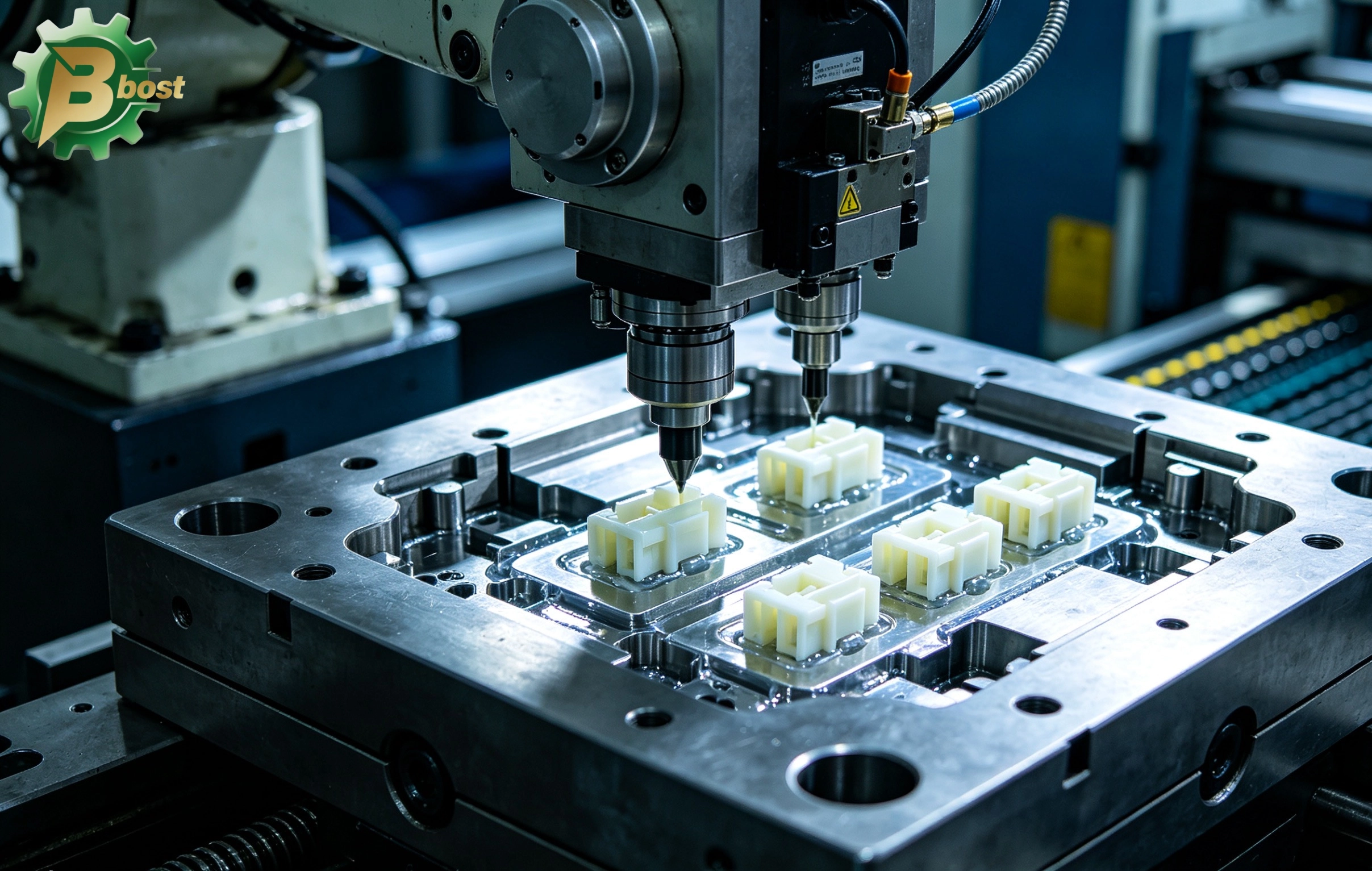
In essence, Insert Molding involves placing a pre-fabricated insert (typically metal threads, electronic terminals, or ceramic parts) into a mold, and then injecting molten plastic to encapsulate the insert. Once solidified, it forms an integrated part. This is not just simple addition; it is an engineering revolution concerning material fusion and structural optimization. For B2B procurement and project managers, understanding the depth of this process is key to shortening development cycles and enhancing product competitiveness.
I. Core Advantages of Insert Molding: Beyond Traditional Assembly
1. Superior Mechanical Strength and Structural Stability
Compared to threads installed post-production via ultrasonic welding or press-fitting, inserts molded directly during the Insert Molding process form a tighter physical lock with the plastic substrate. In high-vibration, high-load scenarios—such as automotive engine components—this integrated structure effectively prevents inserts from loosening or falling out.
2. Significant Reduction in Assembly Costs and Human Error
Reducing secondary assembly means fewer stations, fixtures, and potential human errors on the production line. While the cycle time for Insert Molding might be slightly longer at the molding stage, from a Total Cost of Ownership (TCO) perspective, it drastically reduces logistics, inventory management, and end-of-line assembly expenses.
3. Design Flexibility and Lightweighting
Using this process, engineers can implement metal functionality locally within a plastic part—for instance, local reinforcement for threads on a lightweight plastic housing or embedding precision sensors into medical catheters.
II. Critical Decisions: Matching Insert Materials with Plastic Substrates
In the practical production of Insert Molding, the difference in thermal expansion coefficients is the lifeline of yield rates. If the metal insert and the plastic shrinkage rate are mismatched, the product is highly susceptible to internal stress and cracking.
Below is a reference of common material combinations and applications we use at GZ-BOST:
| Insert Material | Plastic Substrate | Typical Application | Key Features |
| Brass Threads | PA66 (Nylon) / PPS | Valve Covers, Electronics | Excellent corrosion resistance and torque |
| Stainless Pins | PBT / LCP | Sensors, Precision Connectors | High precision, conductivity, and durability |
| Magnet | PA12 / PPS | BLDC Rotors, Sensor Drivers | Reduced magnetic loss, miniaturization |
| Copper Busbar | Flame Retardant PC / PBT | EV Battery Packs, Power Distribution | Insulation for complex high-current paths |
III. Technical Barriers in Mold Design: The Key to Precision Injection
When handling Insert Molding projects, the quality of the mold design determines 70% of the automation efficiency.
1. Precise Positioning and Support
The insert must remain "rock solid" within the mold cavity. If it shifts under the rush of high-pressure melt, the part becomes scrap. We typically employ vacuum adsorption, precision locating pins, or magnetic positioning technologies.
2. Sophisticated Flash Control
Because of manufacturing tolerances between metal parts and mold steel, the precision of the sealing area is vital. During design, we often reverse-calculate the mold dimensions based on the actual measured tolerances of the inserts to ensure no flash (excess material) is produced on the metal surface.
3. Preheating Processes
For certain thick-walled Insert Molding components, we recommend preheating the metal inserts. This slows the quenching effect when the melt hits the metal, enhancing bond strength and significantly reducing internal stress caused by temperature gradients.
IV. Field Experience: Solving Typical Pain Points in Insert Molding
Throughout years of service, we have found that many clients transition to Insert Molding and run into hidden traps.
-
Case: Leakage Issues in Sensor Connectors
A medical device client reported that their sensors suffered from micro-leaks between the metal terminals and the plastic under pressure tests.
-
Insight: This was caused by a lack of chemical bonding at the plastic-metal interface.
-
Solution: We introduced micro "anti-seepage grooves" (e.g., V-shaped grooves) on the metal surface to increase mechanical interlocking and used a specialized sealing resin.
-
-
Pain Point: Low Efficiency in Insert Placement
Manual placement makes cycle times unbearable and poses safety risks.
-
GZ-BOST Solution: We implemented 6-axis robotic arms and automated feeding systems. Using vision inspection systems to confirm insert orientation, we achieved 24-hour unmanned high-speed Insert Molding production, significantly reducing unit costs.
-
V. Why Partner with GZ-BOST?
With over 10 years of expertise in Insert Molding, GZ-BOST provides more than just manufacturing services.
We possess a complete fleet of Precision Injection machines and high-spec mold R&D centers. For high-difficulty inserts like Fluoroplastic (PFA/FEP), we have accumulated extensive experience in corrosion-resistant molds. Furthermore, our composite application of Over Molding and insert molding allows us to provide one-stop DFM support—from structural optimization to material selection.
Conclusion: Start Your Precision Manufacturing Transformation
Insert Molding is the essential path to achieving part miniaturization, high strength, and multi-functionality. Whether you need precision medical terminals or large automotive structural components, the right process path can save you tens of thousands in hidden costs.
If you are looking for a high-quality Insert Molding supplier or need a DFM assessment for your current part design, visit our official website: www.gz-bost.com.
[Contact our engineers now for a free quote], and let us transform your ideas into market-competitive products through exquisite injection molding craftsmanship.
Recommended for you
The Peak Art of Custom Manufacturing According to Drawings: Comprehensive Guide to Precision Solutions for Custom Parts According to Drawing
Ending Mechanical Wear and Resonance: The Comprehensive Guide to Precision Customization and Mass Production of a Custom Rubber Pad
The Ultimate Armor for Smart Hardware: Advanced Customization and Precision Injection Molding Guide for a Custom Plastic Box
The Ultimate Weapon to Tame Vibration and Noise: Deep Dive into the Custom Process and Mass Production Logic of a Custom Rubber Bushing
Product Categories
FAQ
FAQs
What is the delivery lead time? Do you offer global logistics?
Standard products: 5–15 working days; custom modifications: 2–4 weeks. We support global air/sea freight and provide export customs clearance documents (including REACH/UL certifications).
How do I select the appropriate engineering plastic grade for my product?
Selection should be based on parameters such as load conditions (e.g., pressure/friction), temperature range, medium contact (e.g., oil/acid), and regulatory requirements (e.g., FDA/RoHS). Our engineers can provide free material selection consulting and sample testing.
What are the core advantages of Bost engineering plastics compared to ordinary plastics?
Bost engineering plastics feature ultra-high mechanical strength, high-temperature resistance (-50°C to 300°C), chemical corrosion resistance, and wear resistance. Compared to ordinary plastics, their service life is extended by 3 to 8 times, making them suitable for replacing metals in harsh environments.
Can Bost customize modified plastics with special properties?
Yes! We offer modification services such as reinforcement, flame retardancy, conductivity, wear resistance, and UV resistance, for example:
• Adding carbon fiber to enhance stiffness
• Reducing the coefficient of friction through PTFE modification
• Customizing food-grade or medical-grade certified materials
What is the minimum order quantity (MOQ)? Do you support small-batch trial production?
The MOQ for standard products is ≥100kg. We support small-batch trial production (as low as 20kg) and provide mold testing reports and performance data feedback.
You may also like
Custom Plastic Knobs Precision Injection Molded
More Details →
Custom Plastic Knobs Precision Injection Molded
Custom Injection Molded Parts from Drawings
More Details →
Custom Injection Molded Parts from Drawings
Underwater Camera Shell Custom Plastic Molding
More Details →
Underwater Camera Shell Custom Plastic Molding
Leave a Message
Have any questions or concerns about our products? Please leave us a message here, and our team will get back to you promptly.

24 hours quotes delivered
Submit CAD files, get quote in 24 hours

No MOQ required
From prototyping to high-volume

±0.02 mm Precision
Advanced CNC with full inspections

1,000+ tons in stock
26 materials ready to ship
© 2026 BOST. All Rights Reserved.