




 Scan QR Code
Send My Request
In-Depth Analysis: How to Optimize Product Performance and Cost via High-Quality Insert Molding?
2026-04-03
Discover expert insights on optimizing product performance and reducing costs with high-quality insert molding. Bost, a leading insert molding manufacturer, shares proven strategies to enhance durability and efficiency in your manufacturing process. Maximize value with Bost’s insert molding solutions.
In modern precision manufacturing, finding a solution that balances structural integrity with simplified assembly is a common goal for every product engineer. The emergence of the Insert Molding process was specifically designed to break the limitations of traditional assembly. By pre-placing metal inserts, ceramics, or other plastic parts into a mold and then injecting molten plastic to form a unified part, this technology has demonstrated immense potential in enhancing product durability and design flexibility.
From a professional perspective, this article will explore the core advantages of Insert Molding, key technical challenges, and how to improve production efficiency through optimized mold design, helping your brand stand out in a competitive market.
1. Why is Insert Molding the Top Choice for Complex Industrial Parts?
Traditional secondary assembly processes often face issues such as loose joints, poor sealing, and high labor costs. The Insert Molding process achieves a "seamless connection" in a physical sense by encapsulating the insert directly during the injection cycle.
Superior Structural Strength: Compared to press-fit or welded installations, Insert Molding allows the plastic material to tightly shrink around the insert during cooling, providing excellent pull-out resistance and torque strength.
Significant Reduction in Assembly Costs: Because the molding is completed in one step within the mold, post-processing steps like fastening, gluing, or welding are eliminated. This not only shortens production cycles but also reduces defect rates caused by human error.
High Design Freedom: Whether for precision electronic connectors or robust automotive components, this process allows designers to perfectly combine the mechanical properties of metal with the lightweight characteristics of plastic.
2. The Core of Success: Mold Design and Material Compatibility
Not all inserts and plastics are a "perfect match." In actual production cases at https://gs.jurieo.com/gemini/official/search?q=gz-bost.com, we have found that successful Insert Molding projects depend on several critical dimensions:
A. Preheating and Positioning of Inserts
The positioning accuracy of the insert within the mold directly determines the concentricity and dimensional tolerance of the finished product. If the positioning is unstable, the high-pressure molten plastic will displace the insert, leading to scrap. Furthermore, for large metal inserts, proper preheating effectively reduces thermal stress and prevents cracking in the final part.
B. Differences in Coefficient of Thermal Expansion (CTE)
The difference in CTE between metal and plastic is significant. During the cooling stage, if the shrinkage rate is miscalculated, cracks or sink marks are likely to occur around the insert. Experienced injection molding experts balance this difference by adjusting mold temperatures or selecting modified reinforced materials (such as those with glass fiber additives).
C. Mold Venting and Injection Pressure
The presence of an insert makes the air flow path within the mold cavity more complex. If the venting design is inadequate, "gas trapping" can occur, leading to burn marks. Precisely controlling the injection pressure to ensure the plastic fills every tiny gap without damaging the insert is a key test of a factory's technical prowess.
3. Resolving Common Pain Points: Avoiding "Pitfalls" in Insert Molding
When communicating with B2B clients, we find that many projects encounter issues like "insert detachment" or "sealing failure" in the early stages.
Pain Point 1: Poor Sealing. In waterproof connectors or automotive sensors, the interface between plastic and metal is a high-risk area for leaks. The solution usually involves adding knurling or special chemical coatings to the metal insert's surface to increase contact area and bonding strength.
Pain Point 2: Damaged Inserts. For thin-walled or high-precision electronic inserts, excessive injection pressure can cause deformation. This requires us to use CAE flow simulation analysis during the mold design stage to optimize gate locations.
4. From Prototype to Mass Production: Process Control in Precision Molding
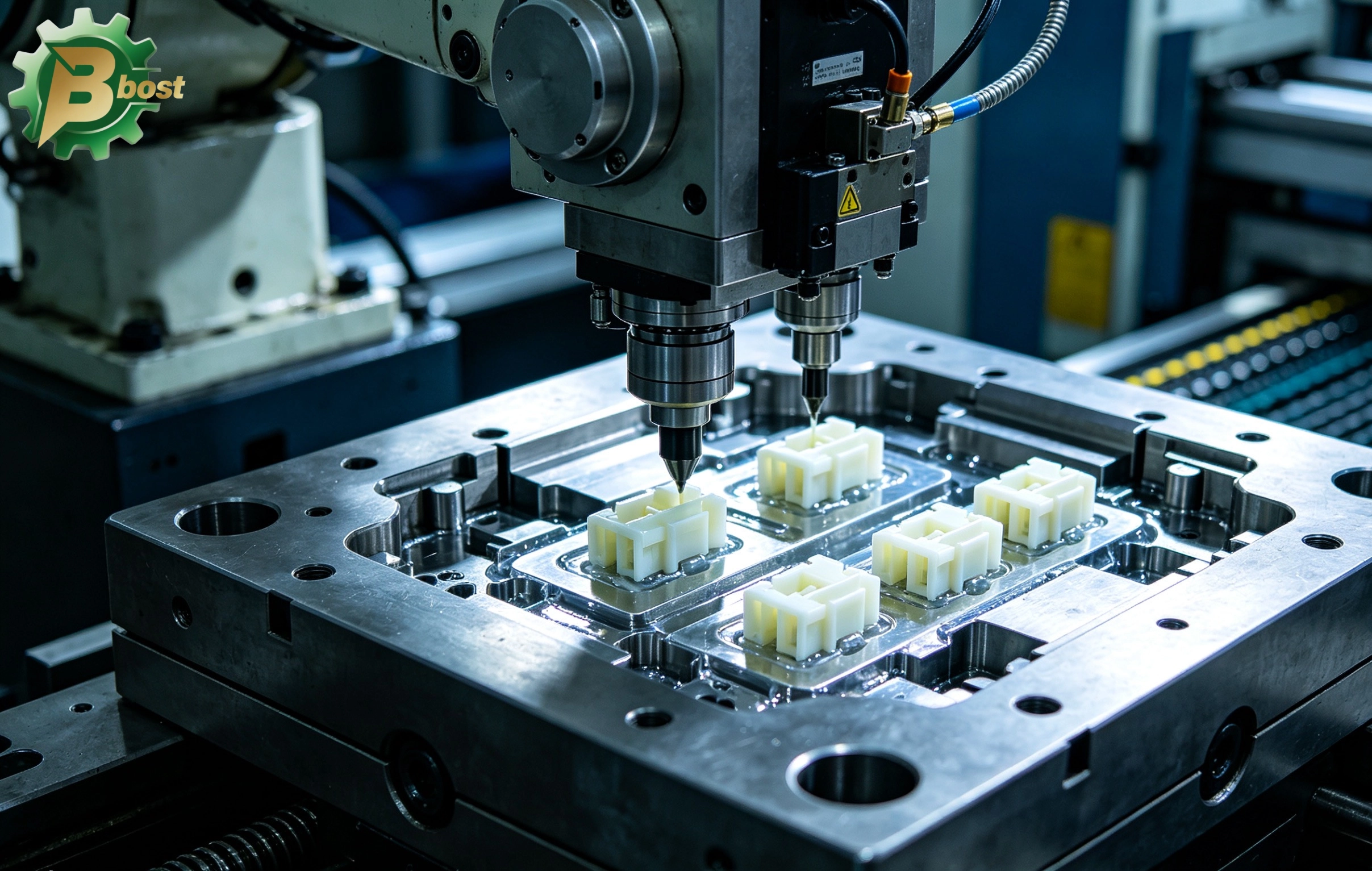
In the mass production of Insert Molding, stability is everything. The introduction of automated production lines is an inevitable trend. Using robotic arms for automated insert placement not only improves cycle time but also ensures that the angle and depth of every insert are perfectly consistent, thereby guaranteeing product uniformity.
Furthermore, a rigorous quality control process—including vision inspection systems and tensile testing—is the critical backbone ensuring that every batch of Insert Molding components delivered to customers meets high industry standards such as IATF 16949 or ISO 9001.
Conclusion: Choose a Professional Partner to Simplify Manufacturing
Insert Molding is more than just "plastic over metal"; it is a comprehensive art form that integrates material science, mechanics, and mold design. A mature solution can save your company significant post-assembly costs annually and markedly enhance the perceived quality of your brand among end-users.
As an expert deeply rooted in the injection molding industry for years, Guangzhou BOST is committed to providing global customers with one-stop services ranging from design optimization and mold manufacturing to large-scale production. If you are looking for a supplier capable of solving complex Insert Molding technical challenges, or wish to optimize the production of your existing products, please visit our official website at www.gz-bost.com to consult with our professional engineers. We look forward to creating more competitive industrial masterpieces together with you.
Recommended for you
The Peak Art of Custom Manufacturing According to Drawings: Comprehensive Guide to Precision Solutions for Custom Parts According to Drawing
Ending Mechanical Wear and Resonance: The Comprehensive Guide to Precision Customization and Mass Production of a Custom Rubber Pad
The Ultimate Armor for Smart Hardware: Advanced Customization and Precision Injection Molding Guide for a Custom Plastic Box
The Ultimate Weapon to Tame Vibration and Noise: Deep Dive into the Custom Process and Mass Production Logic of a Custom Rubber Bushing
Product Categories
FAQ
FAQs
How do I select the appropriate engineering plastic grade for my product?
Selection should be based on parameters such as load conditions (e.g., pressure/friction), temperature range, medium contact (e.g., oil/acid), and regulatory requirements (e.g., FDA/RoHS). Our engineers can provide free material selection consulting and sample testing.
What is the minimum order quantity (MOQ)? Do you support small-batch trial production?
The MOQ for standard products is ≥100kg. We support small-batch trial production (as low as 20kg) and provide mold testing reports and performance data feedback.
Can Bost customize modified plastics with special properties?
Yes! We offer modification services such as reinforcement, flame retardancy, conductivity, wear resistance, and UV resistance, for example:
• Adding carbon fiber to enhance stiffness
• Reducing the coefficient of friction through PTFE modification
• Customizing food-grade or medical-grade certified materials
What are the core advantages of Bost engineering plastics compared to ordinary plastics?
Bost engineering plastics feature ultra-high mechanical strength, high-temperature resistance (-50°C to 300°C), chemical corrosion resistance, and wear resistance. Compared to ordinary plastics, their service life is extended by 3 to 8 times, making them suitable for replacing metals in harsh environments.
What is the delivery lead time? Do you offer global logistics?
Standard products: 5–15 working days; custom modifications: 2–4 weeks. We support global air/sea freight and provide export customs clearance documents (including REACH/UL certifications).
You may also like
Custom Plastic Knobs Precision Injection Molded
More Details →
Custom Plastic Knobs Precision Injection Molded
Custom Injection Molded Parts from Drawings
More Details →
Custom Injection Molded Parts from Drawings
Underwater Camera Shell Custom Plastic Molding
More Details →
Underwater Camera Shell Custom Plastic Molding
Leave a Message
Have any questions or concerns about our products? Please leave us a message here, and our team will get back to you promptly.

24 hours quotes delivered
Submit CAD files, get quote in 24 hours

No MOQ required
From prototyping to high-volume

±0.02 mm Precision
Advanced CNC with full inspections

1,000+ tons in stock
26 materials ready to ship
© 2026 BOST. All Rights Reserved.