




 Scan QR Code
Send My Request
Deep Dive into Over Molding: How B2B Manufacturers Upgrade Products via Multi-Material Injection?
2026-04-03
Discover how Bost, leading overmolding suppliers for electronics, helps B2B manufacturers upgrade products through advanced multi-material injection. Explore overmolding quotes, lead times, and pricing to optimize your production with expert over molding solutions.
- 1. What is Over Molding? More Than Just Layering Plastics
- 2. Why Should Your Next Project Consider Over Molding?
- 1. Superior User Experience and Functionality
- 2. Simplified Assembly and Reduced Failure Risk
- 3. Aesthetics and Brand Premium
- 3. Technical Deep Dive: Key Factors for Over Molding Success
- 1. Material Compatibility
- 2. Precise Temperature and Injection Speed Control
- 3. Mold Venting and Flow Control
- 4. Case Study: How BOST Solved Sealing Issues for Precision Sensors
- 5. How to Choose Your Over Molding Partner?
- 6. Conclusion: Elevate Your Product to the Next Level
In the intersection of precision manufacturing and industrial design, one process is quietly transforming how we interact with products: Over Molding.
Whether it is the ergonomic handle of a medical surgical instrument, a critical seal in an automotive sensor, or the shock-resistant housing of a power tool, Over Molding is everywhere. For B2B buyers and product engineers seeking efficiency and cost reduction, this process is more than just a visual enhancement—it is a strategic tool to increase product value and simplify assembly. Today, from the perspective of a senior injection molding expert, we will break down this complex yet fascinating technology.
1. What is Over Molding? More Than Just Layering Plastics
Technically defined, Over Molding is a precision injection molding process where one material (typically a soft thermoplastic elastomer like TPE/TPU) is molded over a pre-shaped rigid substrate (usually ABS, PC, or Nylon) to create a single, durable, and multi-functional part.
This is fundamentally different from simple gluing. In high-level injection molding processes, the two materials bond tightly through chemical bonding or mechanical interlocking under controlled temperature and pressure. At BOST, we often say: "Excellent overmolding is about making two unrelated materials 'shake hands' at the molecular level."
2. Why Should Your Next Project Consider Over Molding?
Many clients worry about increased costs during initial consultations, but throughout the product lifecycle, Over Molding is often the more cost-effective choice.
1. Superior User Experience and Functionality
By using soft-touch overmolding on handles, you significantly improve grip and slip resistance. In the medical field, this reduces fatigue for healthcare workers during long operations; in industrial terminals, it provides vibration damping and protects internal electronics.
2. Simplified Assembly and Reduced Failure Risk
Traditional methods involve producing two parts and joining them via manual assembly or ultrasonic welding. Over Molding enables integrated molding, eliminating fasteners, adhesives, and assembly stations. More importantly, it eliminates risks caused by assembly tolerances, greatly enhancing sealing performance (waterproof and dustproof).
3. Aesthetics and Brand Premium
The combination of dual colors or multiple textures gives products a sophisticated, layered look. In the highly commoditized B2B market, a more professional appearance often translates into stronger market competitiveness.
3. Technical Deep Dive: Key Factors for Over Molding Success
Achieving high-quality overmolding is never as simple as "inject once, cover twice." During the mold design stage, we must navigate several technical pitfalls:
1. Material Compatibility
This is the soul of Over Molding. Not all materials can bond. If the melting points differ too much or chemical polarities don't match, delamination will occur. For instance, TPU has a natural affinity for PC, but if you switch to certain modified PPs, a specialized bonding agent is required.
2. Precise Temperature and Injection Speed Control
During the second injection, the substrate surface must reach a micro-molten state for optimal chemical bonding. If the temperature is too low, the bond will peel off like a "band-aid"; if too high, the rigid substrate will deform, leading to dimensional inaccuracies.
3. Mold Venting and Flow Control
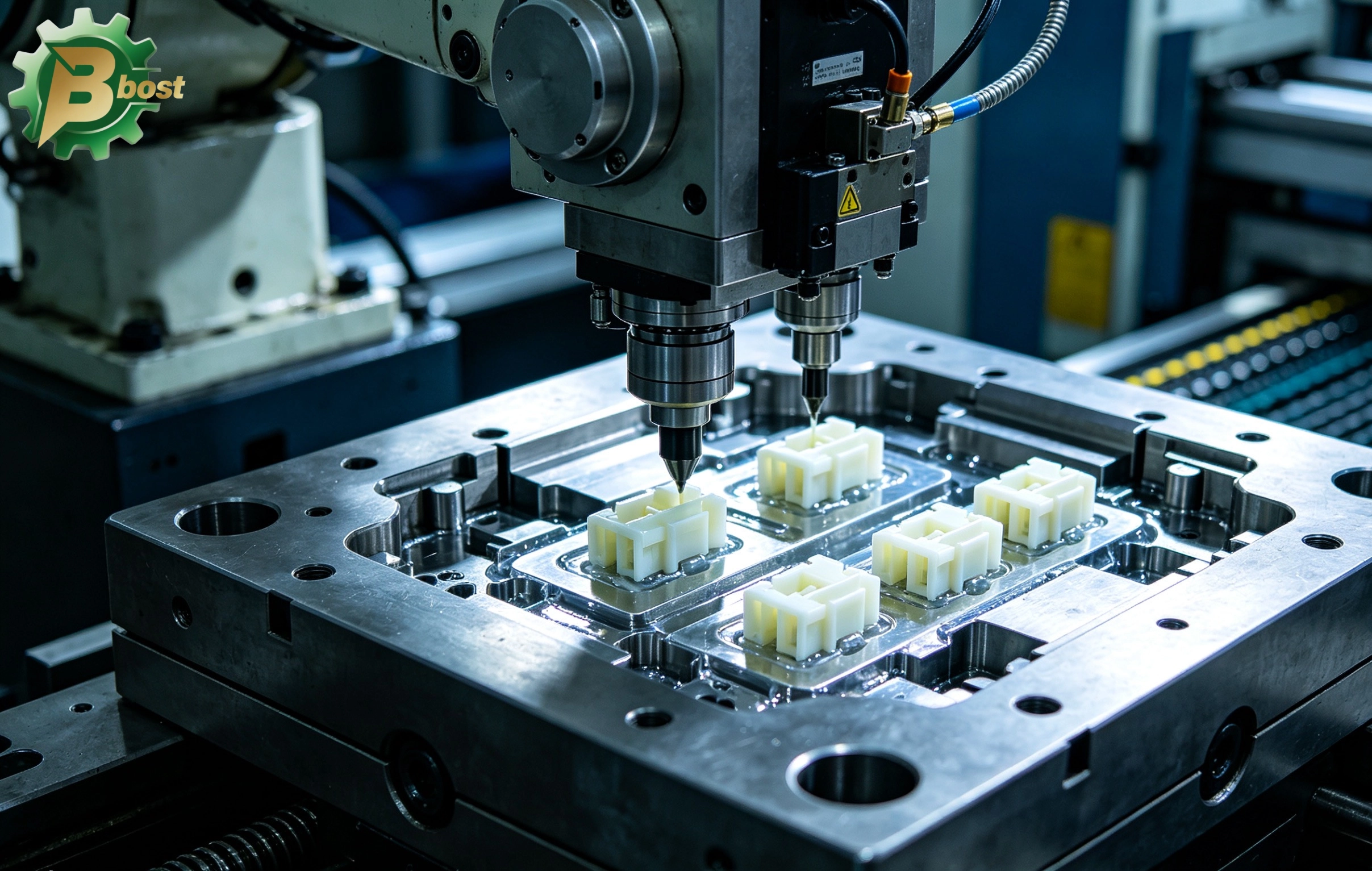
Due to the complex structures in Over Molding, venting space for the second shot is minimal. BOST’s engineering team utilizes CAE mold flow analysis to predict air trap risks and optimize gate locations, ensuring the soft resin fills every corner without bubbles.
4. Case Study: How BOST Solved Sealing Issues for Precision Sensors
Last year, a European automotive supplier approached us. Their sensors were failing due to water ingress in extreme environments, and traditional gaskets couldn't meet $IP67$ standards.
After evaluation, BOST developed an Over Molding solution: using high-stiffness PA66 as the substrate and overmolding with high-performance fluorinated elastomer. Through specialized mold sealing structures, we solved the common issue of flash on the substrate during high-pressure second shots. Ultimately, the product passed rigorous thermal shock tests, and the production cycle was shortened by $20\%$. This is the direct value of precision injection molding.
5. How to Choose Your Over Molding Partner?
When searching for "Over Molding suppliers" on Google, you will see thousands of options. But B2B cooperation is about trust and technical backing.
-
Experience: Have they handled complex material pairings?
-
Equipment: Do they possess high-precision multi-shot or vertical injection machines?
-
Response: How quickly do they react to mold design changes?
BOST understands that every mold carries a client's commercial reputation. We provide more than just parts; we provide a full-stack solution from material selection and DFM evaluation to final mass production.
6. Conclusion: Elevate Your Product to the Next Level
In an increasingly competitive manufacturing environment, Over Molding is a powerful tool to break through mediocrity and achieve product differentiation. If you are looking for ways to improve durability, aesthetics, or functionality, now is the best time to explore overmolding technology.
Want to find out if your product is suitable for Over Molding?
Visit the GZ-BOST Official Website now and click "Get a Quote" for a professional technical assessment. Our senior engineering team will provide tailored injection molding advice and competitive pricing within 24 hours. Let us inject core competitiveness into your project with our exquisite craftsmanship.
Recommended for you
The Peak Art of Custom Manufacturing According to Drawings: Comprehensive Guide to Precision Solutions for Custom Parts According to Drawing
Ending Mechanical Wear and Resonance: The Comprehensive Guide to Precision Customization and Mass Production of a Custom Rubber Pad
The Ultimate Armor for Smart Hardware: Advanced Customization and Precision Injection Molding Guide for a Custom Plastic Box
The Ultimate Weapon to Tame Vibration and Noise: Deep Dive into the Custom Process and Mass Production Logic of a Custom Rubber Bushing
Product Categories
FAQ
FAQs
What is the minimum order quantity (MOQ)? Do you support small-batch trial production?
The MOQ for standard products is ≥100kg. We support small-batch trial production (as low as 20kg) and provide mold testing reports and performance data feedback.
What are the core advantages of Bost engineering plastics compared to ordinary plastics?
Bost engineering plastics feature ultra-high mechanical strength, high-temperature resistance (-50°C to 300°C), chemical corrosion resistance, and wear resistance. Compared to ordinary plastics, their service life is extended by 3 to 8 times, making them suitable for replacing metals in harsh environments.
What is the delivery lead time? Do you offer global logistics?
Standard products: 5–15 working days; custom modifications: 2–4 weeks. We support global air/sea freight and provide export customs clearance documents (including REACH/UL certifications).
How do I select the appropriate engineering plastic grade for my product?
Selection should be based on parameters such as load conditions (e.g., pressure/friction), temperature range, medium contact (e.g., oil/acid), and regulatory requirements (e.g., FDA/RoHS). Our engineers can provide free material selection consulting and sample testing.
Can Bost customize modified plastics with special properties?
Yes! We offer modification services such as reinforcement, flame retardancy, conductivity, wear resistance, and UV resistance, for example:
• Adding carbon fiber to enhance stiffness
• Reducing the coefficient of friction through PTFE modification
• Customizing food-grade or medical-grade certified materials
You may also like
Custom Plastic Knobs Precision Injection Molded
More Details →
Custom Plastic Knobs Precision Injection Molded
Custom Injection Molded Parts from Drawings
More Details →
Custom Injection Molded Parts from Drawings
Underwater Camera Shell Custom Plastic Molding
More Details →
Underwater Camera Shell Custom Plastic Molding
Leave a Message
Have any questions or concerns about our products? Please leave us a message here, and our team will get back to you promptly.

24 hours quotes delivered
Submit CAD files, get quote in 24 hours

No MOQ required
From prototyping to high-volume

±0.02 mm Precision
Advanced CNC with full inspections

1,000+ tons in stock
26 materials ready to ship
© 2026 BOST. All Rights Reserved.