




 Scan QR Code
Send My Request
Optimizing B2B Procurement: The Core Guide to High-Standard Plastic Mold Manufacturing
2026-06-12
Plastic mold manufacturing demands precision and reliability; this guide from Bost details how to identify top custom plastic mold manufacturers and streamline procurement for consistent quality. Learn practical steps to optimize supplier selection and reduce production risks in B2B plastic mold sourcing.
- Why Exceptional Mold Design Is the Bedrock of High-Quality Molds
- 1. In-Depth Design for Manufacturability (DFM) Evaluation
- 2. Rigorous Moldflow Analysis
- Tooling Steel and Machining Accuracy: The Core Deciders of Plastic Mold Manufacturing Lifespan
- 1. Steel Purity and Heat Treatment Processes
- 2. Micron-Level Precision Machining Equipment
- Seamless Integration of Precision Injection Molding and Process Control
- Supply Chain Management Soft Skills: Transparency and On-Time Delivery
- Conclusion and Global Collaborative Solutions
In the real-world scenarios of B2B overseas contract manufacturing and multinational procurement, the biggest headache for product managers and purchasing directors is rarely the price itself, but rather the endless cycle of "mold modification hell." A quotation that seems attractively low often reveals fatal defects such as flash, sink marks, ejector marks, or severe deformation during the initial trial (T1) stage. This not only means an indefinite extension of the product development cycle but also risks missing critical market windows.
High-quality plastic mold manufacturing is by no means a matter of simple, repetitive machining; it is a systematic engineering discipline integrating material science, precision machining tech, and extensive mass-production experience. From a senior engineering perspective, this article provides an in-depth breakdown of how to evaluate and choose a truly world-class plastic mold manufacturing partner, helping your products build a definitive quality barrier in the global marketplace.
Why Exceptional Mold Design Is the Bedrock of High-Quality Molds
As the industry saying goes, "A good mold is designed, not adjusted on the injection machine." Throughout the entire lifecycle of plastic mold manufacturing, front-end mold design and engineering evaluation account for a decisive 70% of the outcome. If potential hazards are left unaddressed during the design phase, even the most flawless downstream precision machining and precise injection parameter tuning cannot fundamentally resolve structural defects in the molded parts.
1. In-Depth Design for Manufacturability (DFM) Evaluation
Upon receiving a customer's 3D CAD files, a professional mold manufacturer will never blindly jump into rough machining. A senior engineering team conducts a rigorous DFM review focusing on draft angles, wall thickness uniformity, and rib designs. For instance, if a localized wall section is found to be excessively thick, an experienced engineer will proactively suggest coring out material to prevent severe surface sink marks during the subsequent injection molding process.
2. Rigorous Moldflow Analysis
Utilizing cutting-edge moldflow analysis software allows engineers to 100% simulate the flow behavior of molten plastic inside the cavity before cutting the steel. By accurately calculating optimal gate locations, shear rates, V-P switchover points, and cooling circuit temperature differentials, potential issues like air traps, weld lines, and warpage caused by molecular orientation can be predicted and eliminated. This digitalized proactive intervention is an indispensable core standard in modern high-end plastic mold manufacturing.
Tooling Steel and Machining Accuracy: The Core Deciders of Plastic Mold Manufacturing Lifespan
Molds are rightfully dubbed the "Mother of Industries." Their material selection and machining accuracy directly lock in a product's lifecycle and per-piece production costs. For varying volume requirements, selection and processing strategies in plastic mold manufacturing are strictly categorized.
+------------------------+---------------------+----------------------+--------------------------------------+| SPI Tooling Class | Expected Cycles | Recommended Steel | Typical Application |+------------------------+---------------------+----------------------+--------------------------------------+| Class 101 (High Volume)| > 1,000,000 | S136, 718H (HRC 50+) | Automotive precision parts, medical || | | | consumables, long-term mass production|+------------------------+---------------------+----------------------+--------------------------------------+| Class 102 (Medium Vol) | 100,000 - 1,000,000 | P20, NAK80 | Consumer electronics enclosures, || | | | household appliance components |+------------------------+---------------------+----------------------+--------------------------------------+| Class 103 (Low Volume) | < 100,000 | Pre-hardened steel, | Market testing samples, initial || | | high-hardness Alum | low-scale pilot runs |+------------------------+---------------------+----------------------+--------------------------------------+1. Steel Purity and Heat Treatment Processes
Premium plastic mold manufacturing suppliers consistently insist on using tool steels from top-tier brands like ASSAB (Sweden) or DAIDO (Japan). Taking medical-grade or optical-grade high-gloss products as an example, vacuum-remelted S136 mirror-grade stainless steel must be utilized. Combined with precise quenching treatments that bring the mold core hardness uniformly above HRC 52, this ensures the cavity remains pristine and free from dimensional drift even after millions of high-pressure, high-speed cycles.
2. Micron-Level Precision Machining Equipment
High-tier manufacturing capabilities rely on top-flight hardware investments. In the production of precision injection molding tools, cavity tolerances typically need to be held within $\pm 0.005\text{ mm}$. This dictates that a facility must be equipped with high-precision, high-speed CNCs, slow-feed wire EDMs (such as Sodick or Mikron), and mirror EDM machines. Without these hardware foundations, any claim of "craftsmanship" remains a mere abstraction against micron-level deviations.
Seamless Integration of Precision Injection Molding and Process Control
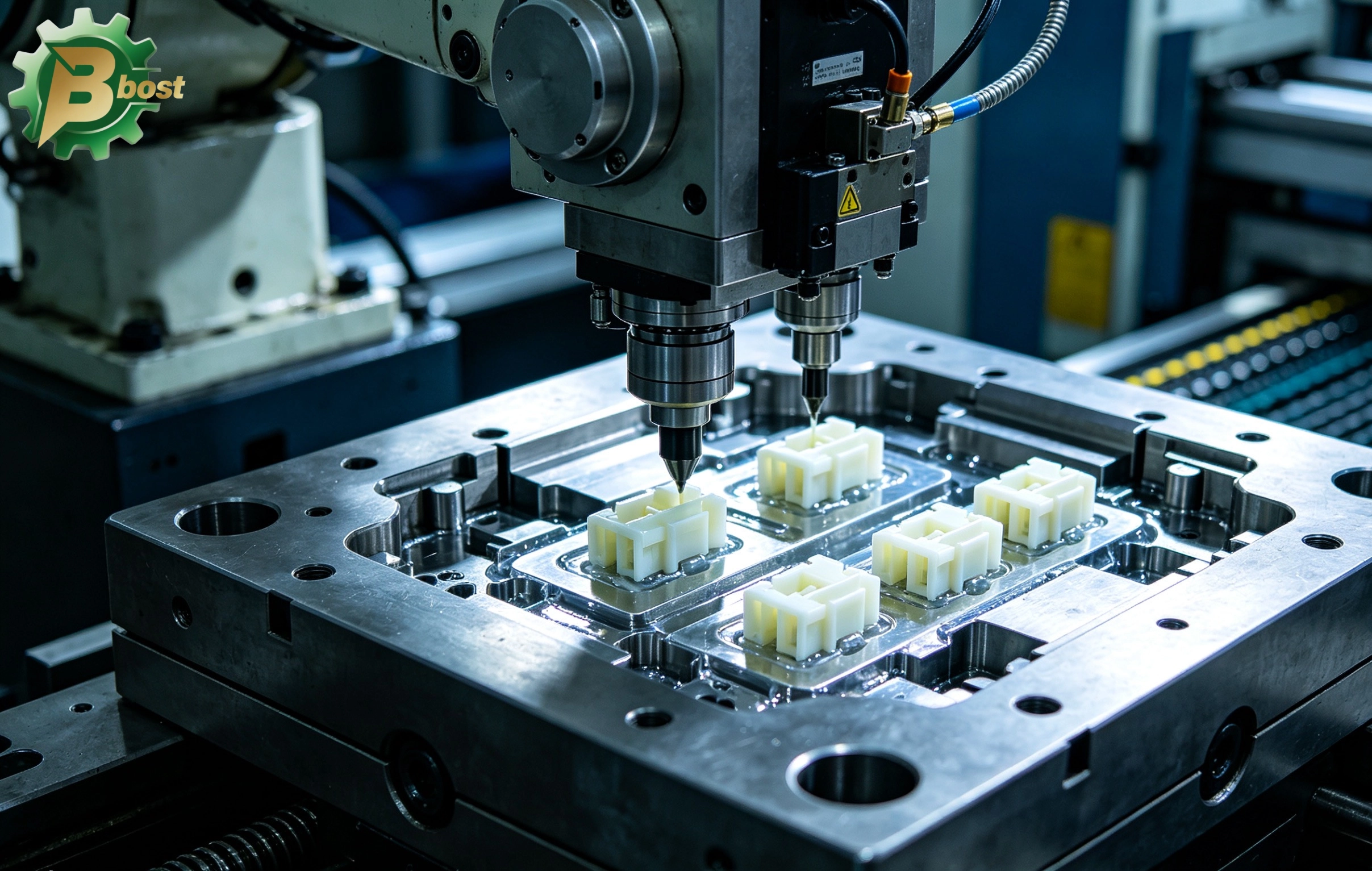
The ultimate validation of any mold occurs on the live production line. Exceptional plastic mold manufacturing providers do not simply stop at toolmaking; they are masters of long-term precision injection molding operations.
-
Scientific Molding Philosophy: This methodology rejects relying on an operator's intuition for machine adjustment. Instead, a professional team establishes rigorous Pressure-Velocity-Temperature (P-V-T) relationships and utilizes in-cavity pressure sensors to monitor the injection cycle in real time.
-
Optimal Cooling System Design: In the injection molding process, cooling time frequently accounts for 60% to 70% of the entire cycle. Implementing conformal cooling technology—where cooling channels closely follow the geometric contours of the cavity—not only slashes cycle times by over 20% but also dramatically minimizes residual stresses from uneven cooling, preventing parts from warping over time.
Supply Chain Management Soft Skills: Transparency and On-Time Delivery
In globalized B2B commerce, geographical distance and time zones frequently present communication chasms. For overseas buyers, a factory's soft skills are just as much a hard metric when qualifying a plastic mold manufacturing vendor.
Compliant and mature suppliers implement strict milestone management. From the Kick-Off Notice (DFM Approval) and weekly Project Status Reports (PSR, complete with machining photos and videos) to T1 sample reports (comprising comprehensive molding parameters and full dimensional inspection layouts), every critical node is digitalized and transparent. This highly professional communication methodology allows you to stay fully informed of your project's progress from across the globe, entirely eliminating the "information black hole."
Conclusion and Global Collaborative Solutions
Superior plastic mold manufacturing is not an expense; it is an asset capable of delivering substantial long-term returns. By selecting a specialized vendor with deep expertise in mold design, material application, and the injection molding process from the outset, you eliminate the hidden costs of months of repetitive tool modifications, ensuring your product wins the starting line in fierce international markets.
As an industry pioneer deeply rooted in precision manufacturing, Guangzhou Bost is dedicated to providing global clients with one-stop solutions spanning engineering evaluation, high-quality toolmaking, and mass-volume precision injection molding. If you are looking for a strategic partner in plastic mold manufacturing that can guarantee high precision, extreme reliability, and significantly compressed lead times, feel free to visit our official website at Guangzhou Bost to submit your RFQ, or contact our veteran engineering team directly for a tailored project quotation and technical consultation.
Recommended for you
The Peak Art of Custom Manufacturing According to Drawings: Comprehensive Guide to Precision Solutions for Custom Parts According to Drawing
Ending Mechanical Wear and Resonance: The Comprehensive Guide to Precision Customization and Mass Production of a Custom Rubber Pad
The Ultimate Armor for Smart Hardware: Advanced Customization and Precision Injection Molding Guide for a Custom Plastic Box
The Ultimate Weapon to Tame Vibration and Noise: Deep Dive into the Custom Process and Mass Production Logic of a Custom Rubber Bushing
Product Categories
FAQ
FAQs
What is the delivery lead time? Do you offer global logistics?
Standard products: 5–15 working days; custom modifications: 2–4 weeks. We support global air/sea freight and provide export customs clearance documents (including REACH/UL certifications).
What is the minimum order quantity (MOQ)? Do you support small-batch trial production?
The MOQ for standard products is ≥100kg. We support small-batch trial production (as low as 20kg) and provide mold testing reports and performance data feedback.
Can Best customize modified plastics with special properties?
Yes! We offer modification services such as reinforcement, flame retardancy, conductivity, wear resistance, and UV resistance, for example:
• Adding carbon fiber to enhance stiffness
• Reducing the coefficient of friction through PTFE modification
• Customizing food-grade or medical-grade certified materials
How do I select the appropriate engineering plastic grade for my product?
Selection should be based on parameters such as load conditions (e.g., pressure/friction), temperature range, medium contact (e.g., oil/acid), and regulatory requirements (e.g., FDA/RoHS). Our engineers can provide free material selection consulting and sample testing.
What are the core advantages of Best engineering plastics compared to ordinary plastics?
Best engineering plastics feature ultra-high mechanical strength, high-temperature resistance (-50°C to 300°C), chemical corrosion resistance, and wear resistance. Compared to ordinary plastics, their service life is extended by 3 to 8 times, making them suitable for replacing metals in harsh environments.
You may also like
Custom Plastic Knobs Precision Injection Molded
More Details →
Custom Plastic Knobs Precision Injection Molded
Custom Injection Molded Parts from Drawings
More Details →
Custom Injection Molded Parts from Drawings
Underwater Camera Shell Custom Plastic Molding
More Details →
Underwater Camera Shell Custom Plastic Molding
Leave a Message
Have any questions or concerns about our products? Please leave us a message here, and our team will get back to you promptly.

24 hours quotes delivered
Submit CAD files, get quote in 24 hours

No MOQ required
From prototyping to high-volume

±0.02 mm Precision
Advanced CNC with full inspections

1,000+ tons in stock
26 materials ready to ship
© 2026 BOST. All Rights Reserved.