




 Scan QR Code
Send My Request
Overcoming Manufacturing Barriers of Special Engineering Plastics: A Comprehensive Guide to PEEK Injection Molding Processes and Pain Points
2026-03-22
Discover expert insights on overcoming manufacturing barriers in PEEK injection molding. Bost offers solutions as top PEEK injection molding suppliers, delivering custom PEEK injection molded parts with precision and reliability. Optimize your production with our comprehensive guide today.
In today's high-end manufacturing sector, finding a material that can simultaneously withstand extreme high temperatures, resist severe chemical corrosion, and possess exceptional mechanical strength often racks the brains of product engineers. Polyetheretherketone (PEEK) is undoubtedly one of the special engineering plastics sitting at the very top of the pyramid. However, while the material's ceiling is extremely high, transforming these expensive resin pellets into high-precision final components is an immense challenge.
For many manufacturers, PEEK injection molding is not just a simple machine operation; it is more like an extreme test of thermodynamics, fluid dynamics, and materials science. Due to PEEK's high melting point and special crystallization characteristics, conventional injection molding experience often hits a wall here. Today, combining years of precision manufacturing experience, we will delve into the core pain points of PEEK injection molding and share how to achieve true high-quality delivery through scientific injection molding processes and top-tier mold design.
Why is PEEK Injection Molding So Challenging?
Many clients, when attempting to use PEEK materials for the first time, often encounter problems such as brittle products, black spots on the surface, severe dimensional shrinkage, or even internal voids. The root cause of these defects lies in the extremely demanding processing window of this material.
1. Extreme Temperature Requirements and Equipment Barriers
The processing temperature of ordinary engineering plastics (like ABS, PC) is usually between 200℃ and 300℃, while the melting point of PEEK is as high as 343℃. This means that during the PEEK injection molding process, the barrel's processing temperature typically needs to be set between 360℃ and 400℃.
This extreme high temperature is a massive test for the injection molding machine itself. Ordinary screws and barrels are highly susceptible to severe wear and tear under prolonged high temperatures and the friction of PEEK's extremely high melt viscosity. If the equipment's temperature control is not precise enough, leading to localized overheating, PEEK is highly prone to thermal degradation, ultimately forming black spots or carbonization marks on the product surface that cannot be eliminated. This is why precision injection molding must rely on top-tier injection equipment that has been specially modified and equipped with high-temperature, corrosion-resistant screws (such as bimetallic screws).
2. Controlling Crystallinity: The Lifeline Determining PEEK Performance
What many engineers do not understand is that PEEK is a semi-crystalline polymer. The final mechanical strength, wear resistance, and chemical resistance of the parts you produce through PEEK injection molding entirely depend on its "crystallinity."
If the mold temperature is too low, the PEEK melt cools too quickly upon contacting the mold cavity, and the material cannot fully crystallize. At this point, the molded product will typically appear translucent brown, rather than the opaque beige-brown (for pure resin) or black that PEEK should be. Such incompletely crystallized parts are not only extremely brittle but will also undergo secondary shrinkage once exposed to heat during subsequent use, leading to disastrous dimensional failure. Therefore, in a high-quality injection molding process, mold temperature controllers are often required to heat and stabilize the mold between 160℃ and 200℃ or even higher.
3. Rigorous Mold Design and Venting Systems
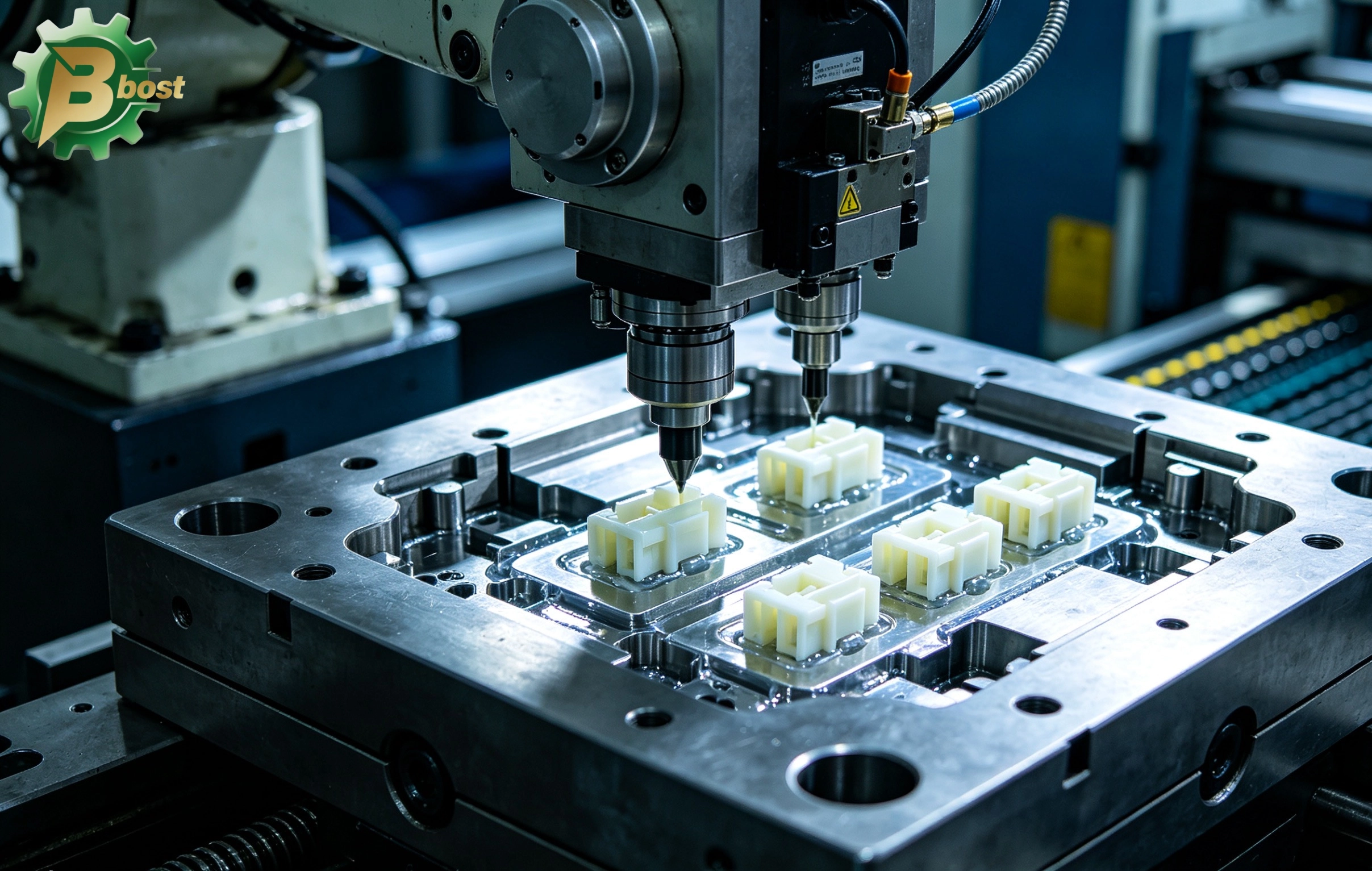
Because PEEK has a very high melt viscosity and poor fluidity during injection, this places extremely high demands on mold design. When designing PEEK molds, the runners must be as short and thick as possible to minimize pressure loss.
Furthermore, as the high-temperature melt enters the mold cavity, it rapidly compresses the air inside. If the mold venting design is unreasonable, the compressed air will instantly generate high temperatures of hundreds of degrees, causing the edges of the product to be directly scorched (known as trapped air burn). When performing precision injection molding, engineers must use mold flow analysis (Moldflow) in the early stages to accurately calculate the optimal gate location and vent depth (usually between 0.015mm and 0.02mm, which must vent air without causing flash). This severely tests the underlying expertise of the mold factory.
How to Ensure Zero-Defect Delivery in PEEK Injection Molding?
Facing these industry pain points, stably mass-producing high-quality PEEK parts requires not only hardware support but also a rigorous closed-loop process.
Highly Efficient Pre-Production Drying
PEEK possesses a certain degree of hygroscopicity. If the material contains even trace amounts of moisture, at a high temperature of 380℃, the moisture will instantly vaporize, causing the melt to foam. As a result, silver streaks will appear on the product surface, and voids will form inside, severely weakening the mechanical properties. Therefore, before initiating PEEK injection molding, the material must be baked in a desiccant dryer at 150℃ - 160℃ for at least 3 to 4 hours to ensure the moisture content drops below 0.02%.
Scientific Molding and Pack/Hold Transfer
During actual trial runs, our setup engineers strictly follow the principles of Scientific Molding. Given PEEK's relatively large cooling shrinkage rate (especially for pure PEEK without glass or carbon fiber reinforcement), accurately finding the V/P (Velocity/Pressure) transfer point is crucial. Transferring too early leads to short shots or surface sink marks; transferring too late causes excessive stress in the cavity, making it difficult to eject the product or even causing deformation. Through multi-stage injection speed control and stepped holding pressure, we are able to control the dimensional tolerances of PEEK parts within a highly narrow range.
Selection of Mold Steel
To cope with the high temperatures of PEEK and the strong corrosiveness and abrasiveness of some modified PEEK materials (such as those with 30% carbon fiber or glass fiber added), the cavities and cores of the mold must utilize high-hardness, high-temperature-resistant hot work tool steels (such as H13, S136, etc.). They must undergo strict vacuum quenching treatment to reach a hardness of over HRC 50, ensuring that the mold maintains extremely high dimensional precision even after hundreds of thousands of high-temperature and high-pressure cycles.
High-Performance Application Scenarios: Who is Paying for PEEK?
Precisely because these numerous technical hurdles have been overcome, components produced through high-quality PEEK injection molding are now shining brightly across major cutting-edge fields:
Medical Devices: With its excellent biocompatibility and resistance to repeated high-temperature and high-pressure steam sterilization, PEEK has become the preferred choice for surgical instrument handles, dental accessories, and even implants.
Aerospace: Under the trend of "replacing steel with plastic," PEEK is widely used to manufacture high-temperature-resistant cable brackets, seals, and fasteners around aircraft engines, achieving ultimate lightweighting.
Semiconductors and Electronics: PEEK's extremely low outgassing rate and exceptional insulation properties make it indispensable in semiconductor manufacturing equipment such as wafer carriers (CMP retaining rings) and test sockets.
Automotive Industry: Widely applied in high-load environments requiring wear and oil resistance, such as transmission thrust washers and brake system components.
Finding a Trustworthy PEEK Manufacturing Partner
PEEK injection molding is never a technology that can be easily mastered through "trial and error." High material costs (easily hundreds or even thousands of RMB per kilogram) mean that every piece of scrap generated during the production process consumes a massive amount of corporate profits. Therefore, selecting a factory that understands the material, is proficient in mold design, and possesses comprehensive temperature control and molding process equipment is of paramount importance.
As an injection molding expert deeply engaged in precision manufacturing for years, the BOST team is not only equipped with imported injection molding equipment optimized specifically for special high-temperature engineering plastics but also boasts an experienced mold design and process R&D team. From upfront Design for Manufacturability (DFM) analysis and precision machining of high-temperature molds to final mass production via PEEK injection molding, we are committed to providing global clients with one-stop, highly cost-effective turnkey solutions.
If you are currently developing new projects utilizing special engineering plastics like PEEK, PPS, or PEI, or if you are troubled by low yield rates and unstable dimensions of existing PEEK parts, do not let manufacturing bottlenecks delay your product launch plans.
Visit our official website now at https://www.gz-bost.com to get in touch with our senior engineering team. Let us deeply discuss your project requirements, get a free DFM evaluation and a customized quote, and use professional manufacturing technology to transform your engineering vision into perfect physical reality!
Recommended for you
The Peak Art of Custom Manufacturing According to Drawings: Comprehensive Guide to Precision Solutions for Custom Parts According to Drawing
Ending Mechanical Wear and Resonance: The Comprehensive Guide to Precision Customization and Mass Production of a Custom Rubber Pad
The Ultimate Armor for Smart Hardware: Advanced Customization and Precision Injection Molding Guide for a Custom Plastic Box
The Ultimate Weapon to Tame Vibration and Noise: Deep Dive into the Custom Process and Mass Production Logic of a Custom Rubber Bushing
Product Categories
FAQ
FAQs
What are the core advantages of Bost engineering plastics compared to ordinary plastics?
Bost engineering plastics feature ultra-high mechanical strength, high-temperature resistance (-50°C to 300°C), chemical corrosion resistance, and wear resistance. Compared to ordinary plastics, their service life is extended by 3 to 8 times, making them suitable for replacing metals in harsh environments.
What is the minimum order quantity (MOQ)? Do you support small-batch trial production?
The MOQ for standard products is ≥100kg. We support small-batch trial production (as low as 20kg) and provide mold testing reports and performance data feedback.
Can Bost customize modified plastics with special properties?
Yes! We offer modification services such as reinforcement, flame retardancy, conductivity, wear resistance, and UV resistance, for example:
• Adding carbon fiber to enhance stiffness
• Reducing the coefficient of friction through PTFE modification
• Customizing food-grade or medical-grade certified materials
What is the delivery lead time? Do you offer global logistics?
Standard products: 5–15 working days; custom modifications: 2–4 weeks. We support global air/sea freight and provide export customs clearance documents (including REACH/UL certifications).
How do I select the appropriate engineering plastic grade for my product?
Selection should be based on parameters such as load conditions (e.g., pressure/friction), temperature range, medium contact (e.g., oil/acid), and regulatory requirements (e.g., FDA/RoHS). Our engineers can provide free material selection consulting and sample testing.
You may also like
Custom Plastic Knobs Precision Injection Molded
More Details →
Custom Plastic Knobs Precision Injection Molded
Custom Injection Molded Parts from Drawings
More Details →
Custom Injection Molded Parts from Drawings
Underwater Camera Shell Custom Plastic Molding
More Details →
Underwater Camera Shell Custom Plastic Molding
Leave a Message
Have any questions or concerns about our products? Please leave us a message here, and our team will get back to you promptly.

24 hours quotes delivered
Submit CAD files, get quote in 24 hours

No MOQ required
From prototyping to high-volume

±0.02 mm Precision
Advanced CNC with full inspections

1,000+ tons in stock
26 materials ready to ship
© 2026 BOST. All Rights Reserved.