




 Scan QR Code
Send My Request
In-Depth Analysis: How to Break Through High-End Manufacturing Bottlenecks by Optimizing the PEEK Injection Molding Process?
2026-03-22
Discover how Bost, a leading PEEK injection molding supplier, helps optimize processes to overcome high-end manufacturing bottlenecks. Explore strategies to reduce PEEK injection molding cost per part and enhance efficiency for superior product quality and competitive advantage.
In today's high-end manufacturing sector, "replacing steel with plastic" is no longer an empty slogan; it is a tangible industrial revolution. From pressure-resistant seals in deep-sea exploration equipment to spinal fusion cages for human implants, and lightweight brackets around aerospace engines, a specialty engineering plastic called Polyetheretherketone (PEEK) is occupying an irreplaceable position.
However, understanding materials and understanding processing are two entirely different things. When engineers excitedly mark "PEEK" on product blueprints, they often underestimate the difficulty of transforming it from pellets into high-precision parts. PEEK injection molding is widely recognized as one of the technologies at the very top of the plastic processing pyramid. Its demanding requirements for equipment, extremely narrow processing windows, and high material costs deter countless inexperienced injection molding factories.
Today, drawing on over a decade of experience in precision manufacturing, we will deeply analyze the core difficulties of PEEK injection molding and share how to truly unleash the ultimate performance of this "king of plastics" by optimizing the injection molding process and mold design on the actual shop floor.
Why is PEEK Injection Molding a Rigorous Engineering Challenge?
Taming a material with a melting point up to 343°C and a continuous use temperature of 260°C is by no means easy. Conventional PC or ABS injection molding experience is almost entirely invalid in the face of PEEK. When discussing PEEK injection molding, we typically face three core barriers.
1. Extreme Temperature Management Requirements
The processing temperature for PEEK usually needs to be set between 360°C and 400°C. This requires the injection molding machine to be equipped with a specially made high-temperature resistant screw and barrel. Ordinary bimetallic screws are prone to wear and even carbonization under such high temperatures and the extreme mechanical shear forces of PEEK. Furthermore, PEEK resin is highly susceptible to thermal degradation if the residence time at high temperatures is too long, resulting in black specks on the part surface or a cliff-like drop in mechanical properties. Therefore, precisely controlling the melt residence time within the barrel is a required course for every setup technician.
2. The Life-and-Death Line of Crystallinity
Unlike amorphous plastics, PEEK is a semi-crystalline polymer. You will often see this phenomenon on the shop floor: PEEK parts coming out of the same mold might sometimes be translucent amber, and other times pure opaque brownish-tan. The difference lies in "crystallinity."
During the PEEK injection molding process, if the mold temperature is too low and the melt cools too quickly, the material will not have time to crystallize and will appear in a state of low crystallinity (amber). At this point, the PEEK is brittle, and its chemical and heat resistance are greatly compromised. To obtain perfect mechanical properties, it must be allowed to crystallize fully, which is why PEEK injection molding often requires an extremely specialized mold temperature control system.
3. High Cost of Trial and Error
The price of raw PEEK resin is dozens, even hundreds of times that of ordinary engineering plastics. In standard injection molding processes, a scrap rate of a few percentage points might be tolerable; but on a PEEK production line, a high scrap rate means the direct evaporation of profits. This forces us to achieve "Right First Time" during the preliminary mold design and mold flow analysis stages.
Key Elements of Mold Design for PEEK in Precision Injection Molding
To obtain a perfect PEEK part, 70% of the credit goes to the preliminary mold design. For this high-temperature, high-viscosity specialty engineering plastic, traditional mold structures are fundamentally inadequate.
Steel Selection and Heat Treatment for High-Temperature Molds
Because PEEK injection molding requires maintaining the mold temperature between 160°C and 220°C, ordinary mold steel is extremely prone to annealing and deformation under such long-term high-temperature thermal cycling. Therefore, we usually must select high-quality, high-hardness, and high-heat-resistant steels such as S136 or H13, and subject them to strict vacuum quenching to achieve a hardness of HRC52 or above. This is the only way to ensure the dimensional stability of the mold during mass production.
Complex Heating and Insulation System Design
Heating a mold to 200°C and maintaining a uniform temperature across all cavities is a massive challenge.
Heating Method: We typically employ a dual solution combining high-power cartridge heaters with high-temperature oil temperature controllers.
Thermal Isolation: High-quality insulation boards (usually 10-15mm thick or more) must be installed between the mold and the injection molding machine platens. Otherwise, heat will rapidly dissipate into the machine, which not only prevents the mold temperature from rising but also damages the hydraulic seals of the injection machine.
Gating System and Venting Optimization
Although PEEK melt has a certain degree of fluidity at high temperatures, it solidifies extremely rapidly. In precision injection molding, to prevent cold slugs from entering the cavity and affecting product strength, sufficiently large and well-designed cold slug wells must be incorporated. The main sprue and runners should be as thick and short as possible to minimize pressure loss.
Simultaneously, PEEK is highly prone to air entrapment under high-speed injection, leading to localized burning (the diesel effect). Therefore, extremely precise vents must be machined on the parting lines and around ejector pins—they must be able to exhaust gas rapidly while ensuring the depth does not exceed 0.02mm, preventing the formation of difficult-to-remove high-temperature flash.
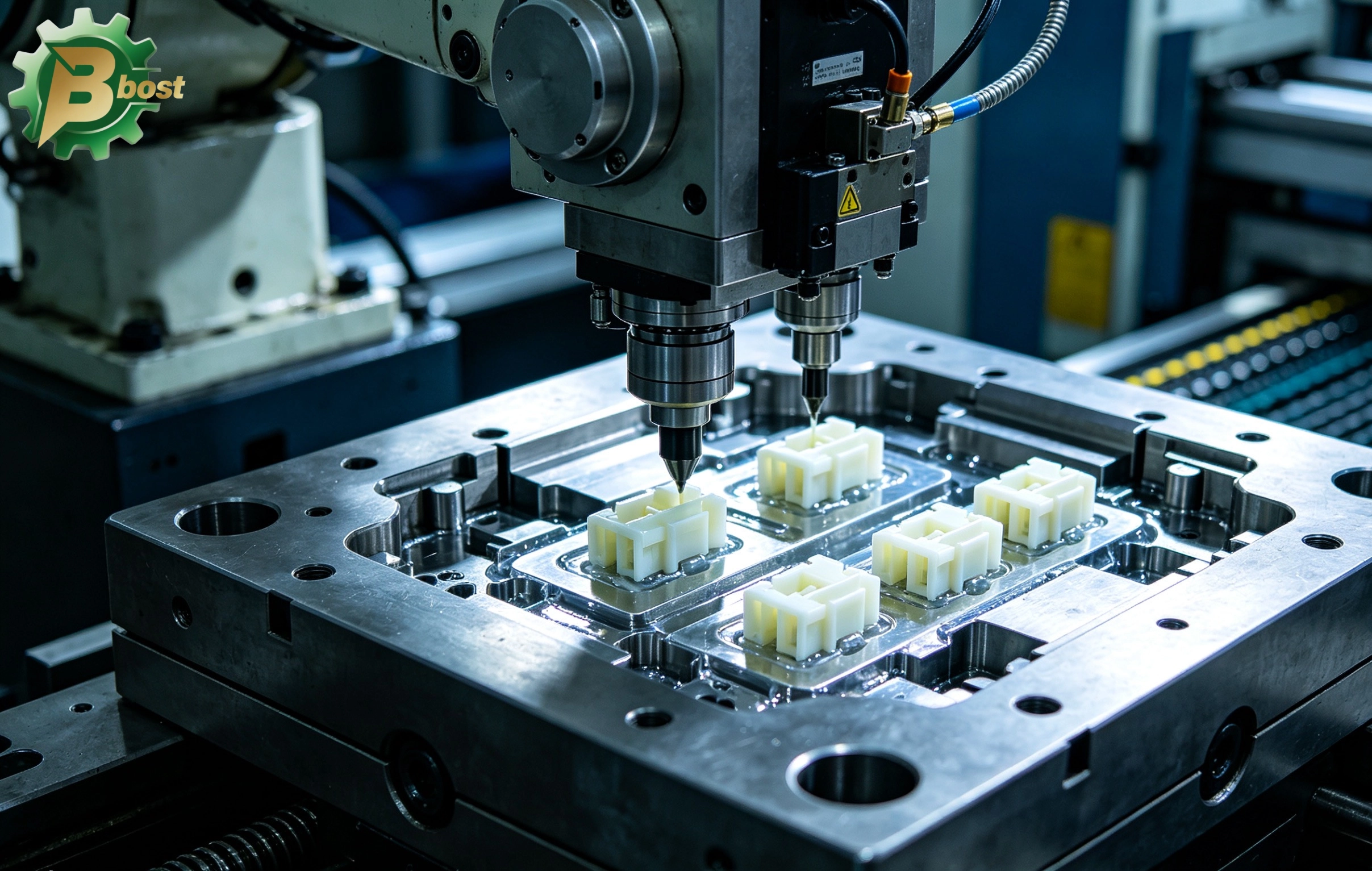
Practical Parameter Tuning for the PEEK Injection Molding Process
Once the equipment and mold are in place, the final step is parameter calibration. When executing actual PEEK injection molding, our engineers typically focus on the following dimensions:
1. Stepped Barrel Temperature Settings
To prevent PEEK from melting prematurely at the feed throat, which causes "bridging," a stepped heating profile is usually adopted. It gradually increases from around 300°C at the feed zone to about 380°C at the metering zone. The nozzle temperature is usually set slightly higher to ensure the melt has optimal fluidity.
2. The Game of Injection Speed and Pressure
PEEK has a high viscosity, normally requiring medium to high injection pressure (often 100-150 MPa or even higher) to fully pack the cavity. However, in terms of speed control, we tend to use a "slow-fast-slow" multi-stage injection strategy. Initially slow to prevent melt fracture and jetting; fast in the middle stages to fill thin-walled areas; and decelerating at the end to facilitate venting and prevent flash.
3. The Golden Ratio of Packing Pressure and Cooling Time
During the packing phase of PEEK injection molding, the pressure setting directly dictates the shrinkage rate and internal residual stress of the part. Since PEEK's shrinkage rate is typically between 1.0% and 2.0%, withdrawing packing pressure too early will lead to surface sink marks and internal voids. Conversely, holding pressure for too long will cause stress concentration near the gate, leading to product cracking. The setting of cooling time depends entirely on wall thickness and crystallization requirements; the cooling cycle must never be forcibly shortened merely to chase production volume.
Finding a Reliable PEEK Manufacturing Partner
From the analysis above, it is not difficult to see that processing PEEK is not only a science but also an art that relies on profound accumulated experience. From the selection of mold steel and fluid analysis of hot runners to the precise control of those few degrees of temperature difference on the shop floor, an oversight in any single link will lead to substandard mechanical properties or out-of-tolerance dimensions in the finished product.
For enterprises in medical devices, aerospace, automotive electronics, and other demanding fields, your supplier must possess comprehensive specialized high-temperature injection molding equipment, a rigorously verified mold manufacturing system, and an engineering team deeply familiar with the characteristics of PEEK materials.
At BOST, we don't just understand plastics; we know exactly how to make high-difficulty engineering plastics work for you. We are equipped with professional high-temperature precision injection molding machines and boast over a decade of experience in injection molding process optimization and mold design. Whether you are plagued by PEEK part shrinkage and deformation, or are looking for a reliable partner from prototype sampling to high-volume production, we can provide you with highly competitive solutions.
If you are currently developing projects using high-performance materials or have encountered technical bottlenecks with PEEK injection molding, please visit our official website immediately at https://www.gz-bost.com to get a free DFM (Design for Manufacturability) evaluation and quote. Let our engineering team escort your high-end products to success.
Recommended for you
The Peak Art of Custom Manufacturing According to Drawings: Comprehensive Guide to Precision Solutions for Custom Parts According to Drawing
Ending Mechanical Wear and Resonance: The Comprehensive Guide to Precision Customization and Mass Production of a Custom Rubber Pad
The Ultimate Armor for Smart Hardware: Advanced Customization and Precision Injection Molding Guide for a Custom Plastic Box
The Ultimate Weapon to Tame Vibration and Noise: Deep Dive into the Custom Process and Mass Production Logic of a Custom Rubber Bushing
Product Categories
FAQ
FAQs
How do I select the appropriate engineering plastic grade for my product?
Selection should be based on parameters such as load conditions (e.g., pressure/friction), temperature range, medium contact (e.g., oil/acid), and regulatory requirements (e.g., FDA/RoHS). Our engineers can provide free material selection consulting and sample testing.
What is the minimum order quantity (MOQ)? Do you support small-batch trial production?
The MOQ for standard products is ≥100kg. We support small-batch trial production (as low as 20kg) and provide mold testing reports and performance data feedback.
What are the core advantages of Bost engineering plastics compared to ordinary plastics?
Bost engineering plastics feature ultra-high mechanical strength, high-temperature resistance (-50°C to 300°C), chemical corrosion resistance, and wear resistance. Compared to ordinary plastics, their service life is extended by 3 to 8 times, making them suitable for replacing metals in harsh environments.
Can Bost customize modified plastics with special properties?
Yes! We offer modification services such as reinforcement, flame retardancy, conductivity, wear resistance, and UV resistance, for example:
• Adding carbon fiber to enhance stiffness
• Reducing the coefficient of friction through PTFE modification
• Customizing food-grade or medical-grade certified materials
What is the delivery lead time? Do you offer global logistics?
Standard products: 5–15 working days; custom modifications: 2–4 weeks. We support global air/sea freight and provide export customs clearance documents (including REACH/UL certifications).
You may also like
Custom Plastic Knobs Precision Injection Molded
More Details →
Custom Plastic Knobs Precision Injection Molded
Custom Injection Molded Parts from Drawings
More Details →
Custom Injection Molded Parts from Drawings
Underwater Camera Shell Custom Plastic Molding
More Details →
Underwater Camera Shell Custom Plastic Molding
Leave a Message
Have any questions or concerns about our products? Please leave us a message here, and our team will get back to you promptly.

24 hours quotes delivered
Submit CAD files, get quote in 24 hours

No MOQ required
From prototyping to high-volume

±0.02 mm Precision
Advanced CNC with full inspections

1,000+ tons in stock
26 materials ready to ship
© 2026 BOST. All Rights Reserved.