




 Scan QR Code
Send My Request
The Definitive Guide to PEEK Injection Molding: From Material Properties to Precision Engineering
2026-03-18
Discover Bost’s definitive guide to PEEK injection molding, covering essential material properties and precision engineering techniques. Explore our expert PEEK injection molding services and custom PEEK injection molded parts tailored to your exact specifications. Quality and innovation guaranteed.
In the realms of aerospace, medical implants, and semiconductor manufacturing, the search for a metal-replacement material with extreme durability often leads to a single answer: PEEK (Polyetheretherketone). However, possessing high-quality resin is only the first step. The true challenge lies in the PEEK injection molding process—the high-stakes art of transforming this expensive resin into high-performance components without compromising its structural integrity.
As a semi-crystalline, ultra-heat-resistant thermoplastic, PEEK has an incredibly narrow processing window. Even a minor oversight can result in uneven crystallization, warping, or brittle failure. Today, we will deconstruct every technical aspect of PEEK processing to help you avoid costly mistakes during the project development phase.
Why is PEEK Injection Molding the Choice for Extreme Conditions?
Before diving into the technicalities, it is crucial to understand why PEEK justifies such a significant investment. PEEK offers not only a high continuous service temperature (approximately 260°C) but also exceptional chemical resistance and mechanical strength.
When executing PEEK injection molding, we leverage its superior tribological properties for wear-resistant bearings and its biocompatibility for orthopedic implants. The secret to PEEK's performance lies in its "crystallinity," which directly dictates the strength and chemical resistance of the final part. Therefore, every process parameter must revolve around one core objective: controlled crystallization.
Crucial Pre-Molding Preparation: Drying and Preheating
Many failures in PEEK injection molding are decided before the mold even closes. PEEK is slightly hygroscopic; while the percentage is low, even trace amounts of moisture can cause hydrolysis at high temperatures, severing molecular chains and leading to a catastrophic drop in mechanical properties.
Deep Drying: We recommend treating the resin in a desiccant dryer at 150°C for at least 4-6 hours.
Equipment Preheating: The injection barrel must be capable of maintaining stable temperatures between 360°C and 400°C. This requires specialized ceramic heating bands and high-efficiency insulation.
Mold Design: The Make-or-Break Factor
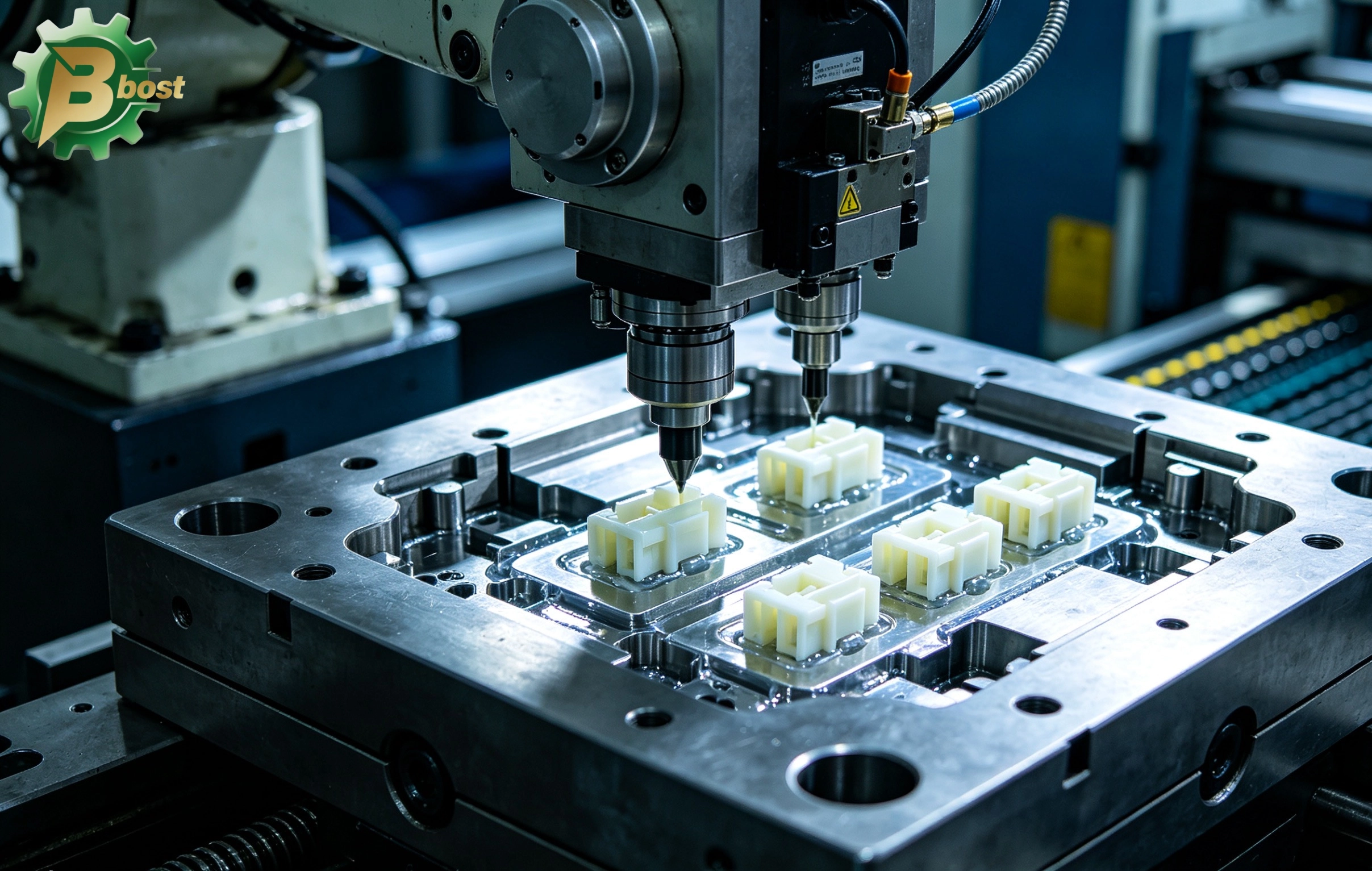
In the PEEK injection molding process, the mold is far more than a shaping tool; it is a precise "thermal management system."
1. The Challenge of High Mold Temperatures
PEEK requires mold temperatures typically ranging from 160°C to 200°C. If the mold temperature is too low, the melt quenches upon contact with the cavity, forming an amorphous surface. This results in a dull appearance and dimensional shrinkage later in the part's lifecycle due to secondary crystallization. We utilize oil-heating circulation systems to ensure uniform temperature distribution.
2. Runner and Gate Design
Because PEEK melt has high viscosity and solidifies rapidly, mold design must minimize pressure loss. Utilizing large-diameter runners and cylindrical gates is highly recommended. At GZ-BOST, we use Moldflow simulation to optimize gate placement, ensuring that weld lines do not occur at critical stress points of the component.
Fine-Tuning Precision Injection Parameters
Successful PEEK injection molding depends on a delicate balance of pressure and velocity.
Injection Pressure: High pressures (sometimes exceeding 100 MPa) are often necessary to fill thin-walled sections.
Packing Strategy: Hold times must be sufficient to compensate for shrinkage during cooling. However, excessive residual stress can cause the part to crack during post-molding heat treatment.
Screw Speed: Rotation should be kept low to prevent shear heating, which can degrade the polymer.
On the production floor, experienced technicians visually judge crystallinity by the part’s color—ranging from beige to light brown. Inconsistencies in shade often indicate uneven mold temperatures.
Troubleshooting Common Issues: Black Spots and Voids
In PEEK injection molding production, black spots (carbonization) and voids (internal shrinkage) are the two most common headaches.
Black spots typically stem from stagnant material in "dead spots" within the barrel or excessive residence time at high temperatures. Therefore, a specialized purging compound (like PEI or high-viscosity PP) must be used before any machine downtime.
Voids, on the other hand, are solved by optimizing gate size and packing pressure. For thick-walled parts, a slow-cooling protocol is sometimes necessary to ensure the interior and exterior crystallize at the same rate.
Why Choose GZ-BOST for PEEK Manufacturing?
In the global supply chain, thousands of companies offer injection molding, but only a handful master PEEK injection molding. GZ-BOST’s advantage lies in our ability to provide "Design for Manufacturability" (DFM) consultancy alongside fabrication.
Extensive Industry Experience: From aerospace connectors to surgical handles, we have built a massive database of PEEK process parameters.
In-house Precision Tooling: Our mold shop can process H13 and other high-performance tool steels, ensuring that molds maintain micron-level precision even at 200°C.
Rigorous Quality Control: Every batch undergoes 3D scanning and stress testing to ensure that the parts delivered to our clients are fail-safe in extreme environments.
Conclusion and Call to Action
PEEK molding is not just a manufacturing process; it is a specialized art of balancing temperature and time. If you are facing performance issues with current parts, struggling with metal-to-plastic conversion, or dealing with low yields from existing suppliers, GZ-BOST is ready to assist.
If you have a PEEK project blueprint or technical challenge, visit our official website at https://www.gz-bost.com for an online technical evaluation or contact our engineering experts directly for a detailed quote. Let's build breakthrough high-performance plastic solutions together.
Recommended for you
The Peak Art of Custom Manufacturing According to Drawings: Comprehensive Guide to Precision Solutions for Custom Parts According to Drawing
Ending Mechanical Wear and Resonance: The Comprehensive Guide to Precision Customization and Mass Production of a Custom Rubber Pad
The Ultimate Armor for Smart Hardware: Advanced Customization and Precision Injection Molding Guide for a Custom Plastic Box
The Ultimate Weapon to Tame Vibration and Noise: Deep Dive into the Custom Process and Mass Production Logic of a Custom Rubber Bushing
Product Categories
FAQ
FAQs
What is the minimum order quantity (MOQ)? Do you support small-batch trial production?
The MOQ for standard products is ≥100kg. We support small-batch trial production (as low as 20kg) and provide mold testing reports and performance data feedback.
What are the core advantages of Bost engineering plastics compared to ordinary plastics?
Bost engineering plastics feature ultra-high mechanical strength, high-temperature resistance (-50°C to 300°C), chemical corrosion resistance, and wear resistance. Compared to ordinary plastics, their service life is extended by 3 to 8 times, making them suitable for replacing metals in harsh environments.
What is the delivery lead time? Do you offer global logistics?
Standard products: 5–15 working days; custom modifications: 2–4 weeks. We support global air/sea freight and provide export customs clearance documents (including REACH/UL certifications).
How do I select the appropriate engineering plastic grade for my product?
Selection should be based on parameters such as load conditions (e.g., pressure/friction), temperature range, medium contact (e.g., oil/acid), and regulatory requirements (e.g., FDA/RoHS). Our engineers can provide free material selection consulting and sample testing.
Can Bost customize modified plastics with special properties?
Yes! We offer modification services such as reinforcement, flame retardancy, conductivity, wear resistance, and UV resistance, for example:
• Adding carbon fiber to enhance stiffness
• Reducing the coefficient of friction through PTFE modification
• Customizing food-grade or medical-grade certified materials
You may also like
Custom Plastic Knobs Precision Injection Molded
More Details →
Custom Plastic Knobs Precision Injection Molded
Custom Injection Molded Parts from Drawings
More Details →
Custom Injection Molded Parts from Drawings
Underwater Camera Shell Custom Plastic Molding
More Details →
Underwater Camera Shell Custom Plastic Molding
Leave a Message
Have any questions or concerns about our products? Please leave us a message here, and our team will get back to you promptly.

24 hours quotes delivered
Submit CAD files, get quote in 24 hours

No MOQ required
From prototyping to high-volume

±0.02 mm Precision
Advanced CNC with full inspections

1,000+ tons in stock
26 materials ready to ship
© 2026 BOST. All Rights Reserved.