




 Scan QR Code
Send My Request
A Comprehensive Guide to Custom Plastic Parts: How to Optimize Design, Reduce Costs, and Ensure Delivery Quality?
2026-03-18
Discover Bost’s comprehensive guide to custom plastic parts. Learn how to optimize design, reduce costs, and ensure delivery quality with our expert tips. As leading specialty engineering plastics suppliers, we help you buy specialty engineering plastics online efficiently and reliably.
- Why Does Design Dictate 80% of Production Costs for Custom Plastic Parts?
- 1. Wall Thickness Uniformity and Optimization
- 2. The Subtle Art of Draft Angles
- Precision Injection Molding: From Engineering Plastics to High-Value Components
- The Science of Material Selection
- The Logic of Mold Design
- Quality Control in Production: Refusing "Good Enough"
- Three Practical Tips to Lower Procurement Costs for Custom Plastic Parts
- Conclusion: Beyond Manufacturing, We Are Your Technical Backbone
In today's global manufacturing supply chain, sourcing high-quality custom plastic parts is far more than just issuing a purchase order. For R&D engineers and procurement decision-makers, the path from a conceptual sketch to a finished bulk product is fraught with variables: improper material selection, mold design flaws, or dimensional instability during production. Every minor oversight can lead to weeks of lead-time delays and tens of thousands of dollars in wasted costs.
As a professional manufacturing service provider deeply rooted in the injection molding industry for years, GZ-BOST has witnessed countless products transform from "lab prototypes" into "market hits." Today, we will dive deep into how to balance technical parameters with commercial costs during the production of custom plastic parts.
Why Does Design Dictate 80% of Production Costs for Custom Plastic Parts?
There is a golden rule in the injection molding industry: 80% of a product's cost is determined at the design stage. When you begin designing custom plastic parts, any slight adjustment to wall thickness or draft angles directly impacts the subsequent cycle time and yield rate.
1. Wall Thickness Uniformity and Optimization
Many novice designers tend to make parts thick and solid to increase strength. However, in injection molding, uneven wall thickness is the primary culprit behind sink marks and warping. By replacing thick walls with properly designed ribs, you not only save on expensive engineering plastic resins but also significantly reduce cooling time, boosting production efficiency.
2. The Subtle Art of Draft Angles
Without sufficient draft angles, custom plastic parts can be scratched during ejection or, worse, cause damage to the mold itself. Generally, a draft angle of 1° to 2° is foundational, but for parts with textured surfaces, even more precise calculations are required.
Precision Injection Molding: From Engineering Plastics to High-Value Components
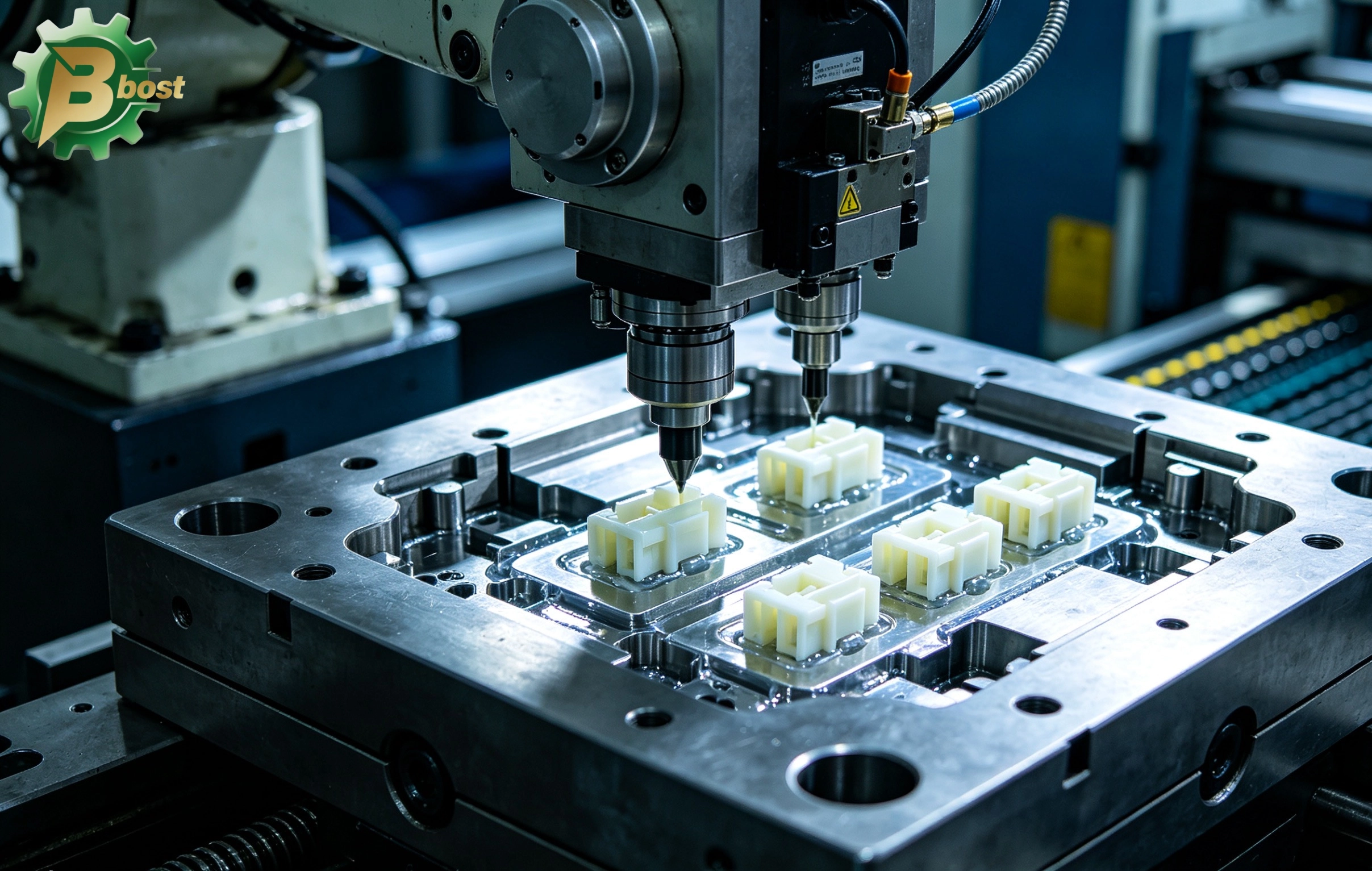
Achieving high-quality custom plastic parts hinges on the ultimate control of the injection molding process. We are not just processing plastic; we are managing a physical equilibrium of temperature, pressure, and time.
The Science of Material Selection
Depending on the application environment (such as high-temperature resistance, UV stability, or medical-grade biocompatibility), material choices vary wildly. From commodity resins like PP and ABS to high-performance polymers like PEEK or PPS, each material behaves differently in the mold. At GZ-BOST, we provide professional material modification suggestions based on the specific performance requirements of your custom plastic parts.
The Logic of Mold Design
The mold is the heart of injection molding. Excellent mold design requires anticipating the flow path of the molten resin within the cavity. Through Moldflow Analysis, we can identify potential air traps and weld lines before the mold is even built, resolving 90% of quality risks before physical manufacturing begins.
Quality Control in Production: Refusing "Good Enough"
For overseas clients purchasing custom plastic parts, the biggest pain point in cross-border supply chains is consistency. It is a common industry malady where the First Article (FA) sample is perfect, but the bulk production suffers from dimensional deviations.
At GZ-BOST, we implement rigorous dynamic monitoring:
-
Scientific Injection Molding: We use sensors to record injection pressure curves in real-time, ensuring that the physical properties of every single shot are identical.
-
Precision Inspection Equipment: Equipped with CMM (Coordinate Measuring Machines) and optical screening systems, we maintain the tolerances of custom plastic parts strictly within the micron-level requirements of our clients' blueprints.
Three Practical Tips to Lower Procurement Costs for Custom Plastic Parts
-
Phased Tooling: During the product validation phase, consider aluminum or soft steel molds for small-batch trial production. Once market feedback is stable, invest in expensive hardened steel multi-cavity molds for mass production.
-
Reduce Secondary Operations: Design custom plastic parts with self-tapping screw bosses or snap-fit joints to eliminate the need for ultrasonic welding or adhesive bonding later.
-
Choose a One-Stop Partner: Finding a supplier that integrates mold design, injection molding, surface finishing (such as silk screening or plating), and assembly can dramatically reduce communication costs and logistical waste.
Conclusion: Beyond Manufacturing, We Are Your Technical Backbone
Behind every custom plastic parts order lies the brand reputation of our clients. GZ-BOST is more than just a contract manufacturer; we are your engineering partner. From optimizing DFM reports to ensuring the stability of high-volume deliveries, we are committed to making precision manufacturing simple and transparent.
If you are looking for a reliable manufacturing solution for your custom plastic parts, or if you have encountered technical bottlenecks in an existing project, please visit our official website at https://www.gz-bost.com.
Click here to get a free technical consultation and a precise quote. Our engineering team will provide in-depth feedback within 24 hours.
Recommended for you
The Peak Art of Custom Manufacturing According to Drawings: Comprehensive Guide to Precision Solutions for Custom Parts According to Drawing
Ending Mechanical Wear and Resonance: The Comprehensive Guide to Precision Customization and Mass Production of a Custom Rubber Pad
The Ultimate Armor for Smart Hardware: Advanced Customization and Precision Injection Molding Guide for a Custom Plastic Box
The Ultimate Weapon to Tame Vibration and Noise: Deep Dive into the Custom Process and Mass Production Logic of a Custom Rubber Bushing
Product Categories
FAQ
FAQs
How do I select the appropriate engineering plastic grade for my product?
Selection should be based on parameters such as load conditions (e.g., pressure/friction), temperature range, medium contact (e.g., oil/acid), and regulatory requirements (e.g., FDA/RoHS). Our engineers can provide free material selection consulting and sample testing.
What is the delivery lead time? Do you offer global logistics?
Standard products: 5–15 working days; custom modifications: 2–4 weeks. We support global air/sea freight and provide export customs clearance documents (including REACH/UL certifications).
What are the core advantages of Bost engineering plastics compared to ordinary plastics?
Bost engineering plastics feature ultra-high mechanical strength, high-temperature resistance (-50°C to 300°C), chemical corrosion resistance, and wear resistance. Compared to ordinary plastics, their service life is extended by 3 to 8 times, making them suitable for replacing metals in harsh environments.
What is the minimum order quantity (MOQ)? Do you support small-batch trial production?
The MOQ for standard products is ≥100kg. We support small-batch trial production (as low as 20kg) and provide mold testing reports and performance data feedback.
Can Bost customize modified plastics with special properties?
Yes! We offer modification services such as reinforcement, flame retardancy, conductivity, wear resistance, and UV resistance, for example:
• Adding carbon fiber to enhance stiffness
• Reducing the coefficient of friction through PTFE modification
• Customizing food-grade or medical-grade certified materials
You may also like
Custom Plastic Knobs Precision Injection Molded
More Details →
Custom Plastic Knobs Precision Injection Molded
Custom Injection Molded Parts from Drawings
More Details →
Custom Injection Molded Parts from Drawings
Underwater Camera Shell Custom Plastic Molding
More Details →
Underwater Camera Shell Custom Plastic Molding
Leave a Message
Have any questions or concerns about our products? Please leave us a message here, and our team will get back to you promptly.

24 hours quotes delivered
Submit CAD files, get quote in 24 hours

No MOQ required
From prototyping to high-volume

±0.02 mm Precision
Advanced CNC with full inspections

1,000+ tons in stock
26 materials ready to ship
© 2026 BOST. All Rights Reserved.