




 Scan QR Code
Send My Request
The Expert Guide to Sourcing Custom Plastic Parts: From Design Optimization to Global Delivery
2026-03-24
Discover Bost’s expert guide to sourcing custom plastic parts, covering design optimization to global delivery. As a trusted custom plastic parts manufacturer, we ensure quality, precision, and timely solutions tailored to your needs. Partner with Bost for seamless, efficient production worldwide.
In the highly sophisticated landscape of global manufacturing, the procurement of custom plastic parts is more than a simple transaction—it is a deep collaboration involving material science, precision mold design, and production process management. Whether for innovative products from startups or industrial-grade equipment for Fortune 500 companies, the quality of plastic components often dictates the longevity of the end product.
This guide provides a practical handbook for global procurement managers, product engineers, and supply chain directors to help you achieve optimal cost-performance while ensuring high-quality project realization.
1. Requirement Definition: The First Step of Your Custom Journey
Before sourcing custom plastic parts, a clear requirement checklist is the foundation for avoiding rework and extra costs later.
1. Define the Application Environment
Physical and chemical properties of plastics vary widely. Do the parts need to be exposed to strong UV light? Must they withstand high temperatures in an automotive engine bay? Are there medical-grade contact standards? Defining these environmental parameters helps us precisely lock in the most suitable resin among thousands.
2. Estimated Annual Volume
Volume dictates the tooling investment strategy. For trial projects under 1,000 units, Rapid Tooling or soft molds are better choices. For mass production exceeding 100,000 units annually, high-performance hardened steel molds (such as S136 or NAK80) are essential to ensure dimensional consistency over millions of cycles.
2. DFM (Design for Manufacturing): The Core Logic of Cost Reduction
In the total lifecycle cost of custom plastic parts, approximately 70% is determined during the design phase. As a professional partner, we always emphasize the importance of DFM analysis.
1. Optimize Wall Thickness
Wall thickness is the most sensitive variable in injection molding. Excessive thickness leads to sink marks and extended cooling times (increasing unit price); insufficient thickness leads to short shots. The ideal design seeks uniform wall thickness and utilizes ribs for structural strength rather than simply increasing thickness.
2. Precise Draft Angles
To ensure that custom plastic parts are not scratched during ejection, appropriate draft angles are crucial. For polished surfaces, 1° to 2° is usually required; for textured surfaces, 3° to 5° or more may be necessary.
3. Avoid Deep Cavities and Narrow Slots
These features increase mold machining difficulty (requiring expensive EDM) and lead to uneven cooling. By optimizing the structure to break deep cavities into simpler geometries, production efficiency can be significantly improved.
3. Material Science: Choosing the "Soul" for Your Custom Plastic Parts
Material selection should not be based solely on unit price, but on processing performance and long-term reliability.
High-Performance Engineering Plastics: Such as PEEK and PPS, suitable for extreme environments like aerospace or oil drilling, offering high mechanical strength and chemical resistance.
Commodity Plastics: Such as ABS, PP, and PS, which are the mainstays for custom plastic parts in consumer electronics and household appliances due to good processability and cost advantages.
Transparent Materials: Such as PC or PMMA, irreplaceable in optical lenses and medical windows, but requiring a strictly dust-free production environment.
4. Mold Manufacturing: Precise Transformation from Drawing to Steel
The mold is the mother of custom plastic parts. A high-quality mold must not only be dimensionally precise but also have an excellent temperature control system.
1. Moldflow Analysis
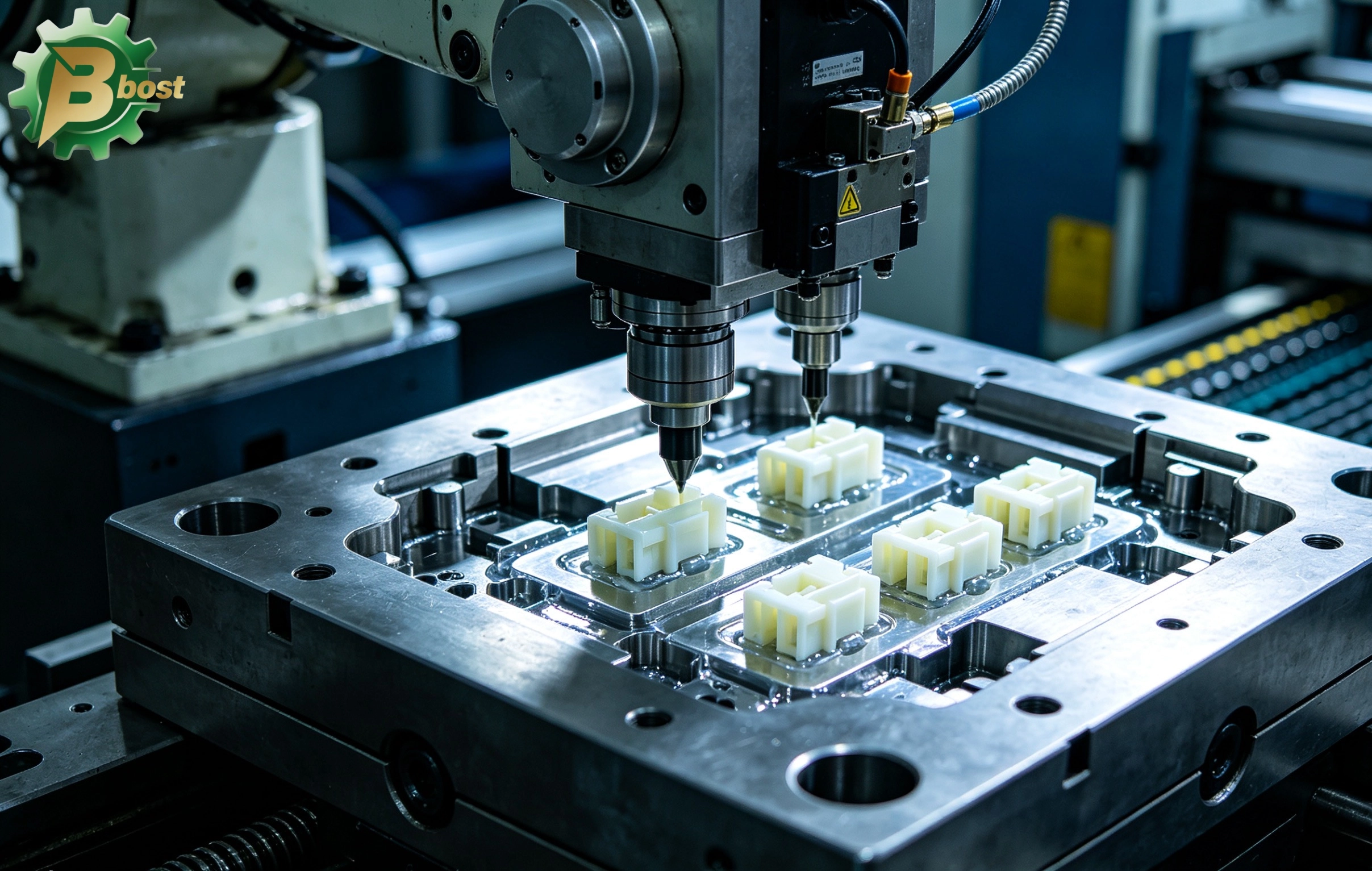
Before cutting steel, we use simulation software to predict how plastic melt flows within the cavity. This helps us anticipate air traps, weld lines, and warpage risks, resolving issues in the virtual phase rather than at the trial site.
2. Conformal Cooling Technology
For complex custom plastic parts, traditional straight cooling holes cannot reach every corner. Utilizing 3D-printed conformal cooling channels can improve cooling efficiency by over 30% and significantly reduce deformation caused by internal stress.
5. Quality Management Systems: Localizing International Standards
In B2B trade, trust is built on traceable quality records. For every batch of custom plastic parts, we establish a rigorous closed-loop control:
IQC (Incoming Quality Control): Every batch of resin must be accompanied by an original COA (Certificate of Analysis) and undergo moisture content testing.
IPQC (In-Process Quality Control): Real-time parameters such as pressure, temperature, and time are recorded to ensure "process freezing."
FAI (First Article Inspection): Utilizing Coordinate Measuring Machines (CMM) for full-scale scans of critical dimensions ensures matching with 3D drawings.
6. Why Choose a High-End Injection Molding Partner in China?
In the context of global supply chain restructuring, China's injection molding industry has shifted from "low-price competition" to "technical integration and rapid response."
An excellent partner (such as GZ-BOST) provides value beyond manufacturing:
End-to-End One-Stop Service: From conceptual design and prototyping to mold making and finished products.
Seamless Cross-Border Communication: A proficient English technical support team ensures no misunderstandings in DFM feedback and progress reporting.
Agile Supply Chain Ecosystem: Whether it's surface painting, silk-screening, or ultrasonic welding, efficient collaboration can be completed within a 50km radius.
Conclusion: Moving Toward a Successful Manufacturing Partnership
Procuring high-quality custom plastic parts is a systematic project. By deeply participating in the design phase, rigorously selecting materials, and relying on suppliers with an international vision, your project will gain a significant competitive edge.
If you are looking for an injection molding partner who understands your technical needs, provides in-depth engineering support, and ensures delivery quality, please visit our official website immediately: https://www.gz-bost.com.
Our engineering team is ready to provide you with a free DFM review and customized quote within 24 hours. Let us work together to connect infinite possibilities with precision manufacturing!
Recommended for you
The Peak Art of Custom Manufacturing According to Drawings: Comprehensive Guide to Precision Solutions for Custom Parts According to Drawing
Ending Mechanical Wear and Resonance: The Comprehensive Guide to Precision Customization and Mass Production of a Custom Rubber Pad
The Ultimate Armor for Smart Hardware: Advanced Customization and Precision Injection Molding Guide for a Custom Plastic Box
The Ultimate Weapon to Tame Vibration and Noise: Deep Dive into the Custom Process and Mass Production Logic of a Custom Rubber Bushing
Product Categories
FAQ
FAQs
What is the delivery lead time? Do you offer global logistics?
Standard products: 5–15 working days; custom modifications: 2–4 weeks. We support global air/sea freight and provide export customs clearance documents (including REACH/UL certifications).
What are the core advantages of Bost engineering plastics compared to ordinary plastics?
Bost engineering plastics feature ultra-high mechanical strength, high-temperature resistance (-50°C to 300°C), chemical corrosion resistance, and wear resistance. Compared to ordinary plastics, their service life is extended by 3 to 8 times, making them suitable for replacing metals in harsh environments.
Can Bost customize modified plastics with special properties?
Yes! We offer modification services such as reinforcement, flame retardancy, conductivity, wear resistance, and UV resistance, for example:
• Adding carbon fiber to enhance stiffness
• Reducing the coefficient of friction through PTFE modification
• Customizing food-grade or medical-grade certified materials
How do I select the appropriate engineering plastic grade for my product?
Selection should be based on parameters such as load conditions (e.g., pressure/friction), temperature range, medium contact (e.g., oil/acid), and regulatory requirements (e.g., FDA/RoHS). Our engineers can provide free material selection consulting and sample testing.
What is the minimum order quantity (MOQ)? Do you support small-batch trial production?
The MOQ for standard products is ≥100kg. We support small-batch trial production (as low as 20kg) and provide mold testing reports and performance data feedback.
You may also like
Custom Plastic Knobs Precision Injection Molded
More Details →
Custom Plastic Knobs Precision Injection Molded
Custom Injection Molded Parts from Drawings
More Details →
Custom Injection Molded Parts from Drawings
Underwater Camera Shell Custom Plastic Molding
More Details →
Underwater Camera Shell Custom Plastic Molding
Leave a Message
Have any questions or concerns about our products? Please leave us a message here, and our team will get back to you promptly.

24 hours quotes delivered
Submit CAD files, get quote in 24 hours

No MOQ required
From prototyping to high-volume

±0.02 mm Precision
Advanced CNC with full inspections

1,000+ tons in stock
26 materials ready to ship
© 2026 BOST. All Rights Reserved.