




 Scan QR Code
Send My Request
The Ultimate Engineering Guide: Mastering High Performance Plastic Injection Molding
2026-04-01
Discover expert insights in high performance plastic injection molding with Bost. As a leading high performance plastic injection molding company, we specialize in high performance PEEK plastic injection molding, delivering precision and durability for advanced engineering solutions.
- 1. Defining High-Performance Plastics: Beyond Commodity Limits
- 2. Core Process Challenges in High Performance Plastic Injection Molding
- 1. Extreme Melt and Mold Temperatures
- 2. Shear Stress and Rheological Control
- 3. The Tug-of-War Between Venting and Carbonization
- 3. Mold Engineering: The "Invisible Backbone" of Performance
- 1. Corrosion and Wear Resistance of Steel
- 2. Precision Cooling System Design
- 4. Analysis of Industry Pain Points: Why Do Your Parts Fail?
- 5. How to Choose the Right High-Performance Molding Supplier?
- 6. Conclusion and Future Outlook
In the microscopic world of modern industrial manufacturing, standard injection molding processes have reached their physical limits. As aerospace, medical implants, and new energy vehicles demand lighter weight and resistance to extreme environments, high performance plastic injection molding has evolved from a niche specialty into a cornerstone of global top-tier manufacturing.
For global procurement managers and chief engineers, choosing high-performance plastic injection is not just about acquiring a part; it is about ensuring absolute reliability under extreme pressure, high heat, and chemical corrosion. This guide provides an in-depth breakdown of the core logic behind this high-barrier field.
1. Defining High-Performance Plastics: Beyond Commodity Limits
Before discussing high performance plastic injection molding, we must clarify the scope of "high performance." Unlike commodity plastics like Polyethylene (PE) or Polypropylene (PP), high-performance polymers (such as PEEK, PPS, LCP, PEI, and PPA) sit at the top of the material pyramid.
Common characteristics include:
-
Continuous Operating Temperature: Typically above $150$°C, with some exceeding $250$°C.
-
Mechanical Modulus: Maintaining high rigidity and creep resistance even at elevated temperatures.
-
Chemical Stability: Ability to resist strong acids, bases, and various organic solvents.
At GZ-BOST, we have found that the process of molding these materials is essentially a "race against temperature and stress."
2. Core Process Challenges in High Performance Plastic Injection Molding
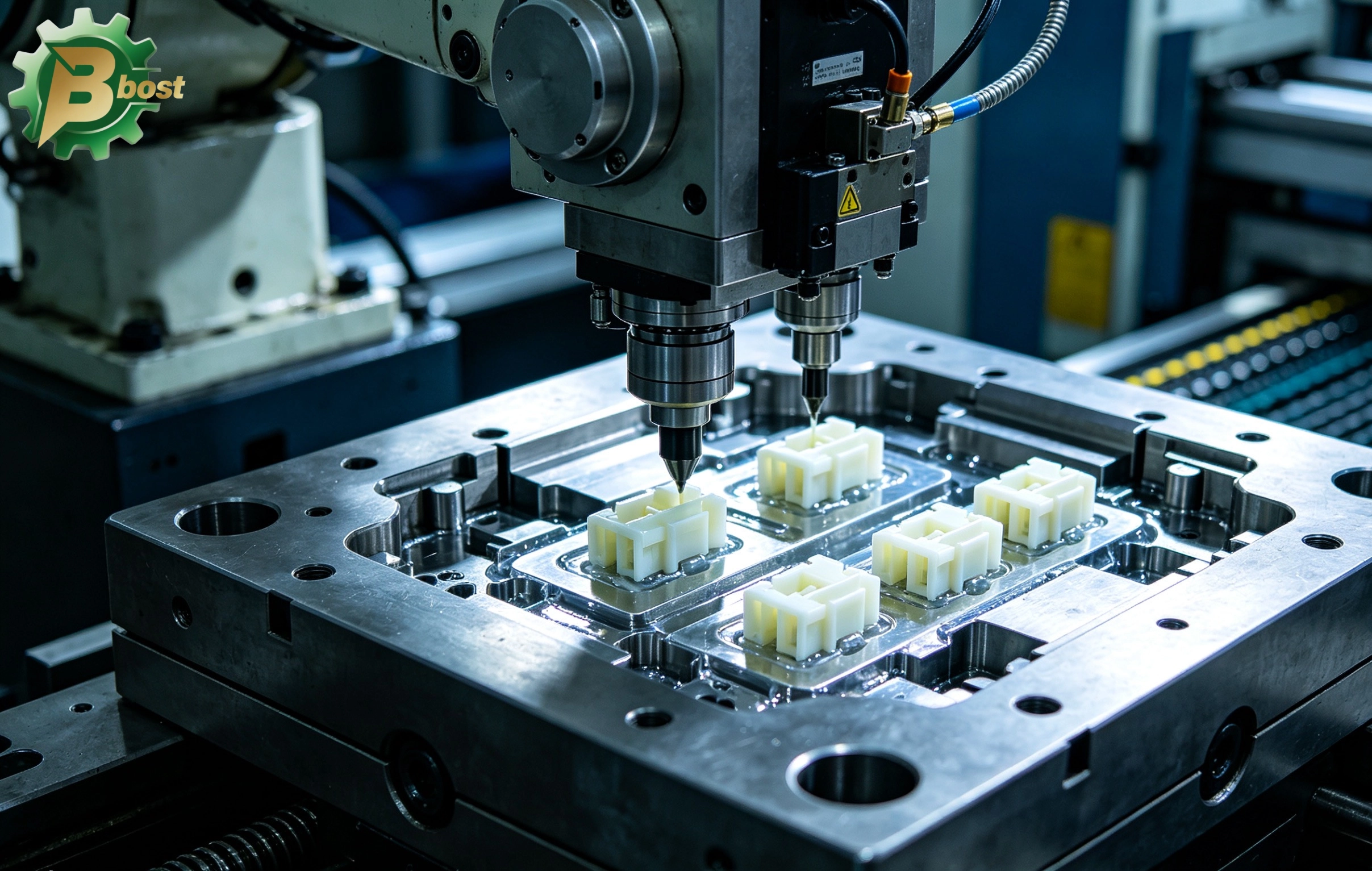
Achieving high-quality high performance plastic injection molding is far more than simply dumping raw material into a hopper. It places rigorous demands on equipment and process parameters.
1. Extreme Melt and Mold Temperatures
High-performance plastics have exceptionally high melting points. For example, PEEK melts at approximately $343$°C. This means the injection molding machine's barrel heating system must stably maintain temperatures between $380$°C and $400$°C.
Even more critical is the mold temperature. Traditional water cooling is useless for high-performance molding. We must utilize high-power oil heaters or electrical heating systems to maintain mold temperatures between $150$°C and $200$°C. If the mold temperature is insufficient, the polymer molecular chains cannot achieve orderly crystallization, resulting in dark surface finishes, increased brittleness, and severe dimensional shrinkage during subsequent use.
2. Shear Stress and Rheological Control
High-performance polymers often possess high melt viscosity. During high performance plastic injection molding, if the injection speed is too fast, excessive shear stress can cause molecular chain scission, degrading material properties. If it is too slow, the material will solidify before filling the cavity.
At GZ-BOST, we employ multi-stage injection speed control combined with real-time pressure sensor data. By optimizing gate design to balance shear rates within the runners, we ensure the uniformity of the part's internal structure.
3. The Tug-of-War Between Venting and Carbonization
Because processing temperatures are close to the material's degradation point, any air trapped within the mold cavity will be instantly compressed and heated, causing localized "burn marks" or carbonization. Therefore, the precision of venting channels must reach the $0.01$mm level—effective enough to exhaust air but tight enough to prevent flash.
3. Mold Engineering: The "Invisible Backbone" of Performance
In the realm of high performance plastic injection molding, there is a saying: "The mold is the mother of the product." High-performance plastics are far more abrasive and corrosive to molds than standard resins.
1. Corrosion and Wear Resistance of Steel
Many high-performance plastics (like PPS) release acidic gases when heated or contain high percentages of glass/carbon fiber fillers. This poses a double challenge for mold steel. We typically select ESR (Electroslag Remelting) treated specialty steels with nano-coatings to extend mold life and maintain micron-level tolerances.
2. Precision Cooling System Design
Unlike standard molding that seeks "fast cooling," high performance plastic injection molding seeks "uniform temperature control." We design complex Conformal Cooling channels inside the mold to ensure that thick and thin walls crystallize synchronously. This eliminates internal stress and prevents warping after the part is ejected.
4. Analysis of Industry Pain Points: Why Do Your Parts Fail?
As veteran injection molding experts, we frequently receive technical inquiries regarding high performance plastic injection molding failures from other suppliers:
-
Pain Point A: Dimensional Instability. Parts shrink after being stored for a month. This is usually due to insufficient crystallization during molding; the parts undergo slow secondary crystallization at room temperature.
-
Pain Point B: Brittle Fracture. Parts snap easily under load. Cross-sectional analysis often reveals internal micro-voids caused by insufficient injection pressure or excessive use of regrind material.
-
Pain Point C: Surface Flow Marks. For optical or sensor housings, flow marks interfere with performance. This stems from a failure to control the melt fracture phenomenon.
At GZ-BOST, we mitigate these risks through DFM (Design for Manufacturing) audits, using Moldflow Analysis to predict and eliminate these issues before the mold is even cut.
5. How to Choose the Right High-Performance Molding Supplier?
For B2B procurement professionals looking for a high performance plastic injection molding partner, consider these three dimensions:
-
Hardware Configuration: Does the supplier have precision machines with bimetallic screws and dedicated high-temperature heaters?
-
Engineering Experience: Do they have actual case studies with PEEK or LCP? Can they provide full material property reports and molding parameter logs?
-
Quality Inspection: Do they utilize CMMs, X-ray flaw detection, or Scanning Electron Microscopy (SEM) to verify the internal quality of high-performance parts?
6. Conclusion and Future Outlook
As Industry $4.0$ progresses, high performance plastic injection molding is moving toward intelligence. By embedding sensors within the mold, we can capture real-time changes in melt pressure and temperature.
GZ-BOST remains at the forefront of injection technology. We understand that high-performance parts often carry the success or failure of a client’s entire project. Whether you need a high-temperature resistant sensor housing or a biocompatible medical component, we provide engineering support that exceeds expectations.
Optimize Your Next High-Performance Molding Project
Don't let material selection or processing bottlenecks limit your innovation. If you are looking for a high performance plastic injection molding service provider that offers everything from design optimization to mass production, visit our website at www.gz-bost.com.
Click here to [Contact our Technical Director] for a professional project evaluation and instant quote. Let GZ-BOST be your solid technical backup in the global competition.
Recommended for you
The Peak Art of Custom Manufacturing According to Drawings: Comprehensive Guide to Precision Solutions for Custom Parts According to Drawing
Ending Mechanical Wear and Resonance: The Comprehensive Guide to Precision Customization and Mass Production of a Custom Rubber Pad
The Ultimate Armor for Smart Hardware: Advanced Customization and Precision Injection Molding Guide for a Custom Plastic Box
The Ultimate Weapon to Tame Vibration and Noise: Deep Dive into the Custom Process and Mass Production Logic of a Custom Rubber Bushing
Product Categories
FAQ
FAQs
What is the minimum order quantity (MOQ)? Do you support small-batch trial production?
The MOQ for standard products is ≥100kg. We support small-batch trial production (as low as 20kg) and provide mold testing reports and performance data feedback.
What are the core advantages of Bost engineering plastics compared to ordinary plastics?
Bost engineering plastics feature ultra-high mechanical strength, high-temperature resistance (-50°C to 300°C), chemical corrosion resistance, and wear resistance. Compared to ordinary plastics, their service life is extended by 3 to 8 times, making them suitable for replacing metals in harsh environments.
How do I select the appropriate engineering plastic grade for my product?
Selection should be based on parameters such as load conditions (e.g., pressure/friction), temperature range, medium contact (e.g., oil/acid), and regulatory requirements (e.g., FDA/RoHS). Our engineers can provide free material selection consulting and sample testing.
What is the delivery lead time? Do you offer global logistics?
Standard products: 5–15 working days; custom modifications: 2–4 weeks. We support global air/sea freight and provide export customs clearance documents (including REACH/UL certifications).
Can Bost customize modified plastics with special properties?
Yes! We offer modification services such as reinforcement, flame retardancy, conductivity, wear resistance, and UV resistance, for example:
• Adding carbon fiber to enhance stiffness
• Reducing the coefficient of friction through PTFE modification
• Customizing food-grade or medical-grade certified materials
You may also like
Custom Plastic Knobs Precision Injection Molded
More Details →
Custom Plastic Knobs Precision Injection Molded
Custom Injection Molded Parts from Drawings
More Details →
Custom Injection Molded Parts from Drawings
Underwater Camera Shell Custom Plastic Molding
More Details →
Underwater Camera Shell Custom Plastic Molding
Leave a Message
Have any questions or concerns about our products? Please leave us a message here, and our team will get back to you promptly.

24 hours quotes delivered
Submit CAD files, get quote in 24 hours

No MOQ required
From prototyping to high-volume

±0.02 mm Precision
Advanced CNC with full inspections

1,000+ tons in stock
26 materials ready to ship
© 2026 BOST. All Rights Reserved.