




 Scan QR Code
Send My Request
The Ultimate Guide: Overcoming Industrial Challenges with High Performance Plastic Injection Molding
2026-04-01
Discover how Bost’s high performance plastic injection molding service tackles industrial challenges with precision and durability. Our expert solutions ensure superior quality and efficiency, making us your trusted partner for advanced molding needs. Elevate your production with Bost today.
- 1. What Truly Defines High Performance Plastic Injection Molding?
- 2. Three Critical Dimensions for Successful High Performance Plastic Injection Molding
- 1. Superior Mold Design and Steel Selection
- 2. Dynamic Temperature Control: Beyond Simple Heating
- 3. Pressure Transmission and Specialized Machine Configurations
- 3. Solving Complex Industry Application Puzzles
- 4. Why B2B Clients Prefer GZ-BOST?
In the precision coordinates of modern manufacturing, standard plastic injection molding can no longer meet the demands of cutting-edge sectors. When parts must maintain dimensional stability at temperatures exceeding $200$°C or resist aggressive chemical corrosion, high performance plastic injection molding becomes the essential bridge across the technological divide. For overseas engineers seeking reliable partners, understanding the processing characteristics of high-performance plastics is not just a requirement for quality—it is a requirement for safety.
1. What Truly Defines High Performance Plastic Injection Molding?
High-performance plastics, such as PEEK, PPS, LCP, or reinforced Nylons, are fundamentally different from commodity plastics like PP or ABS. They sit at the apex of the material pyramid. Implementing high performance plastic injection molding is not as simple as swapping out raw materials; it involves a complex engineering ecosystem including extreme temperature control, high-hardness mold steels, and a deep grasp of material rheology.
At GZ-BOST, we frequently encounter clients coming to us with "failed projects" from traditional molders: parts deforming under heat, stress cracks, or surface finishes that fail to meet the requirements of precision sensors. The root cause of these pain points is often a supplier's lack of deep understanding regarding the molecular chain behavior of high-performance polymers.
2. Three Critical Dimensions for Successful High Performance Plastic Injection Molding
1. Superior Mold Design and Steel Selection
High-performance plastics often come with high melting points and extreme abrasiveness (especially materials filled with carbon or glass fibers). Traditional 718 or P20 mold steels wear down rapidly when facing these materials.
-
Mold Hardness: We typically utilize H13 or S136 precision steel with vacuum quenching to ensure micron-level accuracy remains intact even under high-pressure cycles.
-
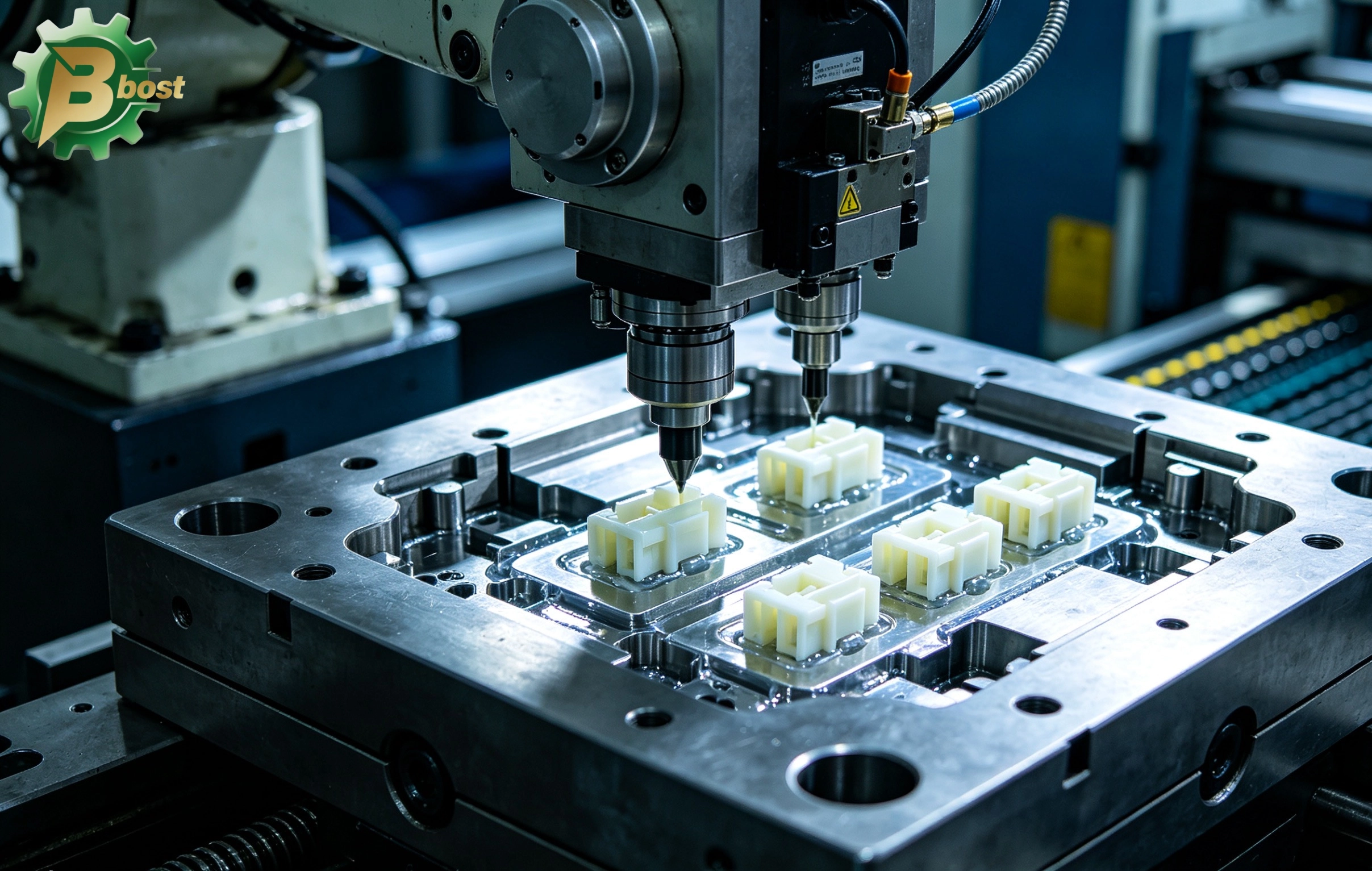
Venting Optimization: High-performance plastics are prone to gas generation during high-speed injection. If venting is inadequate, parts will exhibit burn marks at the edges. The precision processes at GZ-BOST utilize segmented venting channels to ensure perfect surface quality even at high fill rates.
2. Dynamic Temperature Control: Beyond Simple Heating
In achieving high-quality high performance plastic injection molding, temperature compensation is the core. For instance, with PEEK, if the mold temperature does not reach at least $160$°C, the material will not crystallize fully. This means the part's physical strength will degrade significantly over time after leaving the mold. Our oil-temperature control systems maintain fluctuations within $\pm 1$°C, providing the "industrial backbone" for batch-to-batch consistency.
3. Pressure Transmission and Specialized Machine Configurations
The melt viscosity of high-performance polymers is exceptionally high, challenging the injection pressure and screw design of molding machines. Standard machines often lack the power, leading to "short shots." Our production lines are equipped with specialized corrosion-resistant and wear-resistant screws, ensuring no metal flake contamination occurs during high-pressure injection.
3. Solving Complex Industry Application Puzzles
The application scenarios for high-performance plastic injection are typically "zero tolerance."
-
Medical Industry: Requires strict biocompatibility. Our high performance plastic injection molding conducted in cleanroom environments ensures that surgical tool handles can withstand high-temperature sterilization without any chemical leaching.
-
Aerospace: Lightweighting is an eternal theme. By replacing aluminum alloys with high-performance carbon-fiber composites, we help clients reduce part weight by $40\%$ while maintaining equivalent rigidity.
-
Automotive Components: As temperatures rise in fuel systems and EV battery components, the application of PPS and PPA becomes vital. Precision molding ensures that connectors do not fail due to fatigue over a 10-year lifespan.
4. Why B2B Clients Prefer GZ-BOST?
In the context of overseas digital marketing, trust is built on transparent technical capability. GZ-BOST is more than just an OEM factory; we are your DFM (Design for Manufacturing) consultant.
Many times, a client’s initial design is impractical for high performance plastic injection molding. Our engineering team performs in-depth Moldflow Analysis before mold cutting to predict potential shrinkage, voids, or warping, eliminating issues at the design stage. This proactive professional intervention saves clients weeks or even months of rework time.
Get Your Custom Injection Molding Solution
Are you struggling with processing issues in high-performance plastics? Or is your current supplier unable to meet your rigorous precision requirements?
As veteran experts in high performance plastic injection molding, GZ-BOST is ready to provide a one-stop service from mold design to mass production. Visit our official website at www.gz-bost.com to learn more technical details. You can also click [Get an Instant Quote] directly; our Technical Director will provide a free DFM evaluation and advice within 24 hours.
Recommended for you
The Peak Art of Custom Manufacturing According to Drawings: Comprehensive Guide to Precision Solutions for Custom Parts According to Drawing
Ending Mechanical Wear and Resonance: The Comprehensive Guide to Precision Customization and Mass Production of a Custom Rubber Pad
The Ultimate Armor for Smart Hardware: Advanced Customization and Precision Injection Molding Guide for a Custom Plastic Box
The Ultimate Weapon to Tame Vibration and Noise: Deep Dive into the Custom Process and Mass Production Logic of a Custom Rubber Bushing
Product Categories
FAQ
FAQs
How do I select the appropriate engineering plastic grade for my product?
Selection should be based on parameters such as load conditions (e.g., pressure/friction), temperature range, medium contact (e.g., oil/acid), and regulatory requirements (e.g., FDA/RoHS). Our engineers can provide free material selection consulting and sample testing.
What is the delivery lead time? Do you offer global logistics?
Standard products: 5–15 working days; custom modifications: 2–4 weeks. We support global air/sea freight and provide export customs clearance documents (including REACH/UL certifications).
Can Bost customize modified plastics with special properties?
Yes! We offer modification services such as reinforcement, flame retardancy, conductivity, wear resistance, and UV resistance, for example:
• Adding carbon fiber to enhance stiffness
• Reducing the coefficient of friction through PTFE modification
• Customizing food-grade or medical-grade certified materials
What is the minimum order quantity (MOQ)? Do you support small-batch trial production?
The MOQ for standard products is ≥100kg. We support small-batch trial production (as low as 20kg) and provide mold testing reports and performance data feedback.
What are the core advantages of Bost engineering plastics compared to ordinary plastics?
Bost engineering plastics feature ultra-high mechanical strength, high-temperature resistance (-50°C to 300°C), chemical corrosion resistance, and wear resistance. Compared to ordinary plastics, their service life is extended by 3 to 8 times, making them suitable for replacing metals in harsh environments.
You may also like
Custom Plastic Knobs Precision Injection Molded
More Details →
Custom Plastic Knobs Precision Injection Molded
Custom Injection Molded Parts from Drawings
More Details →
Custom Injection Molded Parts from Drawings
Underwater Camera Shell Custom Plastic Molding
More Details →
Underwater Camera Shell Custom Plastic Molding
Leave a Message
Have any questions or concerns about our products? Please leave us a message here, and our team will get back to you promptly.

24 hours quotes delivered
Submit CAD files, get quote in 24 hours

No MOQ required
From prototyping to high-volume

±0.02 mm Precision
Advanced CNC with full inspections

1,000+ tons in stock
26 materials ready to ship
© 2026 BOST. All Rights Reserved.