




 Scan QR Code
Send My Request
Ultimate Guide: How to Successfully Deliver a Custom Plastic Injection Molding Project?
2026-04-16
Discover Bost’s Ultimate Guide to successfully deliver your custom plastic injection molding project. Learn expert tips, best practices, and key steps to ensure precision, quality, and timely results for your manufacturing needs. Optimize your project with Bost’s trusted solutions.
- 1. Defining Custom Injection Molding: What Makes It "Custom"?
- 2. The Four Critical Phases of a Custom Project
- Phase 1: DFM (Design for Manufacturing) Analysis
- Phase 2: Moldflow Simulation
- Phase 3: Sampling and T1 Approval
- Phase 4: Mass Production & Quality Control
- 3. Cost Analysis: How to Plan Your Project Budget?
- 4. Solving the Top 3 Technical Pain Points
- 5. Global Sourcing: Why Partner with GZ-Bost?
- 6. Conclusion: Turning Your Ideas into Reality
In the context of modern manufacturing, custom plastic injection molding is hailed as the ultimate bridge between a product vision and a physical reality. Whether your concept is a minimalist consumer electronics enclosure or a complex medical valve with intricate internal threads, custom molding provides the perfect path from prototype to million-unit mass production.
However, the sheer number of variables in the molding process can be daunting. This guide aims to clear the air, providing a comprehensive strategy from technical decisions and cost control to quality evaluation.
1. Defining Custom Injection Molding: What Makes It "Custom"?
Unlike off-the-shelf plastic production, the core of custom plastic injection molding lies in "made-to-measure" adaptability.
-
Exclusive Mold Assets: Each tool is a proprietary physical asset custom-built based on your 3D files (such as STEP or IGES).
-
Performance-Driven Materials: We can select or compound specific resins—adding UV stabilizers, glass fiber reinforcement, flame retardants, or anti-microbial agents—to meet your exact environment.
-
Precision Secondary Operations: Custom services often include silk-screening, ultrasonic welding, laser marking, and clean-room assembly.
2. The Four Critical Phases of a Custom Project
A successful custom plastic injection molding project typically follows a rigorous roadmap:
Phase 1: DFM (Design for Manufacturing) Analysis
The most critical step. Before cutting steel, we analyze wall thickness distribution, draft angles, and potential undercuts.
Key Insight: 80% of production defects (like sink marks or warping) are actually "designed in" during the early drafting stages.
Phase 2: Moldflow Simulation
By digitally simulating the flow of molten plastic through the mold, we can predict weld line locations and ensure the aesthetic faces of the part remain flawless.
Phase 3: Sampling and T1 Approval
Once the mold is completed, we run the first production test. T1 samples are sent to the client to verify dimensions, tolerances, and surface finishes.
Phase 4: Mass Production & Quality Control
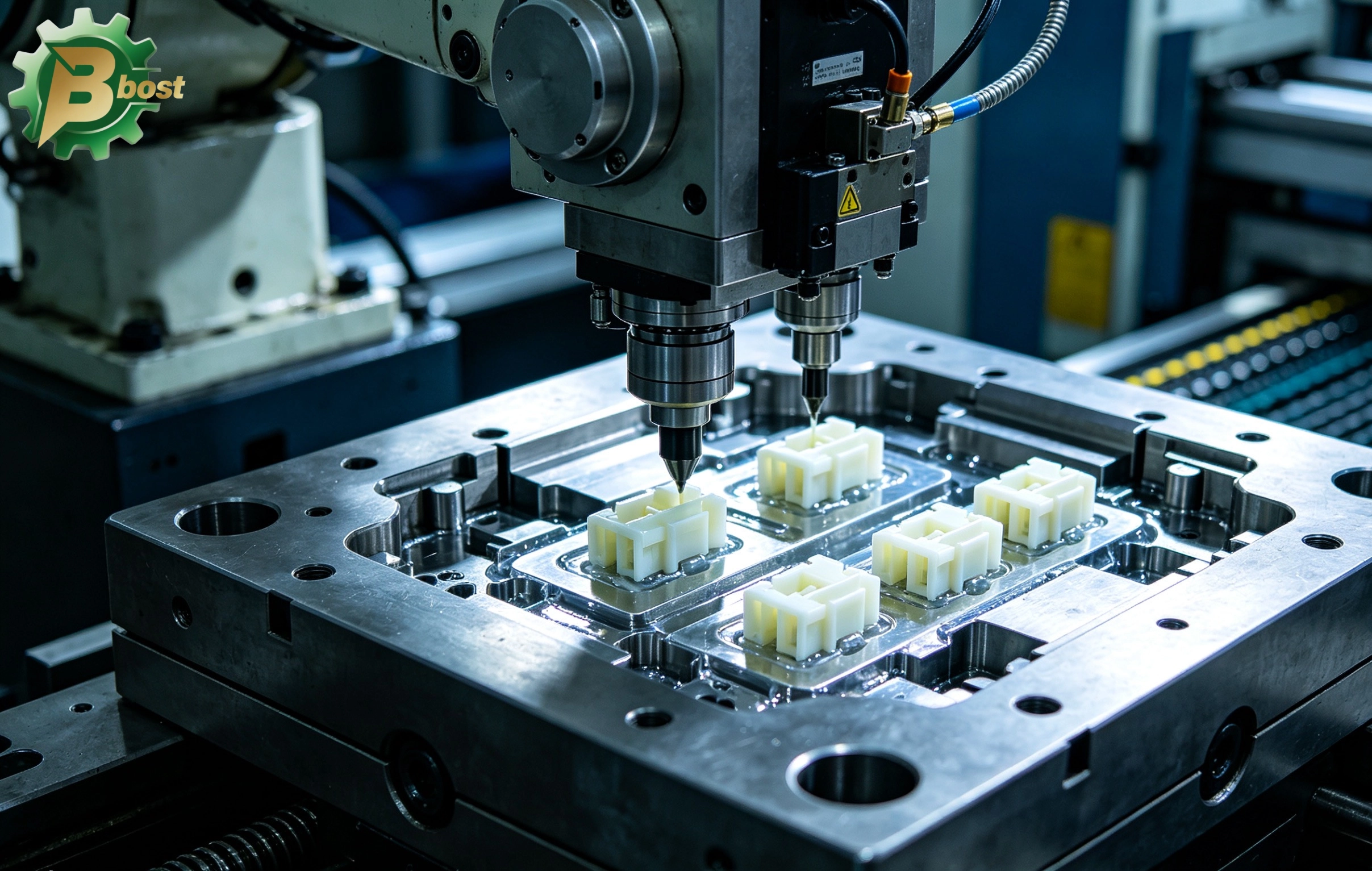
In the automated production phase, robotic arms and in-line inspection equipment ensure that every single cycle of the custom plastic injection molding process is identical.
3. Cost Analysis: How to Plan Your Project Budget?
To give you a clear expectation of the investment involved in custom plastic injection molding, please refer to the table below:
| Cost Component | Influencing Factors | Weight | Optimization Advice |
| Tooling Fee (NRE) | Mold material, cavity count, complexity | High initial cost | For long-term projects, hardened steel molds offer a better ROI |
| Material Cost | Resin unit price, part weight, scrap rate | Ongoing cost | Optimize wall thickness to reduce unnecessary material usage |
| Processing Fee | Machine tonnage, Cycle Time | Medium | Optimizing the cooling system to shave seconds off the cycle is key |
| Post-Processing | Painting, assembly, special packaging | Variable | Consider functional integration during design to eliminate assembly steps |
4. Solving the Top 3 Technical Pain Points
When managing custom plastic injection molding projects, we frequently encounter—and solve—these challenges:
-
Challenge: Dimensional Deviation.
-
Solution: For high-shrinkage materials like POM or PE, we calculate precise shrinkage allowances in the mold design and utilize high-precision mold temperature controllers.
-
-
Challenge: Surface Scratches or Ejector Marks.
-
Solution: Increasing draft angles and optimizing ejector pin placement to hidden non-aesthetic surfaces.
-
-
Challenge: Material Degradation or Yellowing.
-
Solution: Strictly controlling back pressure and melt temperature to prevent heat-sensitive resins from remaining in the barrel for too long.
-
5. Global Sourcing: Why Partner with GZ-Bost?
As an expert in custom plastic injection molding serving global clients, GZ-Bost offers core advantages in technology and service:
-
Engineering-First Mentality: We don't just "execute" drawings; our engineers proactively suggest cost-saving improvements.
-
Supply Chain Integration: Located in the heart of the Pearl River Delta, we have rapid access to mold steel and specialty resins.
-
Compliance and Certification: We follow strict ISO 9001 standards, providing COA material reports and dimensional measurements for every batch.
6. Conclusion: Turning Your Ideas into Reality
Custom plastic injection molding is a high-stakes, high-reward technical decision. Choosing a partner who can understand your technical requirements and maintains rigorous process control is the ultimate guarantee of success.
If you have a new project in development or your current custom parts are facing quality bottlenecks, GZ-Bost is ready to help.
Ready to get your tailored solution?
Visit our website at https://www.gz-bost.com to submit your requirements.
Limited Offer: Contact us today to receive a Free DFM Analysis Report reviewed by our senior technical directors. Let’s work together to make your product stand out through expert custom plastic injection molding!
Recommended for you
The Peak Art of Custom Manufacturing According to Drawings: Comprehensive Guide to Precision Solutions for Custom Parts According to Drawing
Ending Mechanical Wear and Resonance: The Comprehensive Guide to Precision Customization and Mass Production of a Custom Rubber Pad
The Ultimate Armor for Smart Hardware: Advanced Customization and Precision Injection Molding Guide for a Custom Plastic Box
The Ultimate Weapon to Tame Vibration and Noise: Deep Dive into the Custom Process and Mass Production Logic of a Custom Rubber Bushing
Product Categories
FAQ
FAQs
Can Bost customize modified plastics with special properties?
Yes! We offer modification services such as reinforcement, flame retardancy, conductivity, wear resistance, and UV resistance, for example:
• Adding carbon fiber to enhance stiffness
• Reducing the coefficient of friction through PTFE modification
• Customizing food-grade or medical-grade certified materials
What are the core advantages of Bost engineering plastics compared to ordinary plastics?
Bost engineering plastics feature ultra-high mechanical strength, high-temperature resistance (-50°C to 300°C), chemical corrosion resistance, and wear resistance. Compared to ordinary plastics, their service life is extended by 3 to 8 times, making them suitable for replacing metals in harsh environments.
How do I select the appropriate engineering plastic grade for my product?
Selection should be based on parameters such as load conditions (e.g., pressure/friction), temperature range, medium contact (e.g., oil/acid), and regulatory requirements (e.g., FDA/RoHS). Our engineers can provide free material selection consulting and sample testing.
What is the minimum order quantity (MOQ)? Do you support small-batch trial production?
The MOQ for standard products is ≥100kg. We support small-batch trial production (as low as 20kg) and provide mold testing reports and performance data feedback.
What is the delivery lead time? Do you offer global logistics?
Standard products: 5–15 working days; custom modifications: 2–4 weeks. We support global air/sea freight and provide export customs clearance documents (including REACH/UL certifications).
You may also like
Custom Plastic Knobs Precision Injection Molded
More Details →
Custom Plastic Knobs Precision Injection Molded
Custom Injection Molded Parts from Drawings
More Details →
Custom Injection Molded Parts from Drawings
Underwater Camera Shell Custom Plastic Molding
More Details →
Underwater Camera Shell Custom Plastic Molding
Leave a Message
Have any questions or concerns about our products? Please leave us a message here, and our team will get back to you promptly.

24 hours quotes delivered
Submit CAD files, get quote in 24 hours

No MOQ required
From prototyping to high-volume

±0.02 mm Precision
Advanced CNC with full inspections

1,000+ tons in stock
26 materials ready to ship
© 2026 BOST. All Rights Reserved.