




 Scan QR Code
Send My Request
A Deep Dive: How to Ensure Your Custom Plastic Injection Molding Project Succeeds on the First Try?
2026-03-12
Meta Description for
Ensure your custom plastic injection molding project succeeds on the first try with Bost. Our expert guide covers critical steps—from design for manufacturability (DFM) to material selection and precision tooling—to streamline your process, reduce costs, and guarantee flawless parts. Partner with confidence.
- 1. It Starts with a Dialogue: Why Your Custom Injection Molded Part Needs an In-Depth Design Review
- 2. The "Marriage" of Mold and Material: Choose the Right Material, Then Make the Mold "Accommodate" It
- 2.1 The Compromise Between Flow and Gate Design
- 2.2 "Divide and Conquer" Temperature Control
- 3. The "Closed Loop" of Process Control: From "Feel" to "Data"
- 3.1 The Baseline: The Viscosity Curve
- 3.2 Cavity Pressure Monitoring: An "ECG" for Your Mold
- Conclusion: Find a Partner Who Understands "Systems Engineering"
With over a decade of experience in the injection molding industry, one of the most common procurement frustrations I hear is: "Why is it that the drawings look fine and the mold is made, but the final custom plastic parts just don't meet expectations?"
This question often involves a complex interplay of material selection, mold design, process control, and cost. Today, setting aside abstract theories, we'll deconstruct three core aspects that must be finalized before a successful custom plastic injection molding project kicks off, based on real cases we've handled.
1. It Starts with a Dialogue: Why Your Custom Injection Molded Part Needs an In-Depth Design Review
Often, clients come with 3D CAD files and ask, "Based on this, how soon can you deliver?" But experienced injection molding engineers typically counter with questions like: "What is the final operating environment for this part? Does it require chemical resistance or need to withstand long-term mechanical stress?"
This isn't a redundant step; it's the very soul of custom injection molding. Unlike standard off-the-shelf parts, every custom plastic injection molding project is unique. A material's shrinkage behavior, crystallization kinetics, and even glass fiber orientation can vary dramatically based on the part's geometry.
Real-World Pain Point Case
Last year, a medical device company needed to replicate a critical PEEK insulator. Their previous supplier had gone out of business, leaving only the drawings. During the DFM (Design for Manufacturing) analysis, the接手 injection molding factory identified a crucial oversight: the original drawings specified PEEK but completely ignored the internal stresses generated in precision injection molding at the transitions between thick and thin sections.
Engineers recommended a slight adjustment to the rib thickness and optimized the gate location. The final product was not only a perfect replacement but also showed a 30% improvement in fatigue life.
Advice for Procurement Teams
Before any mold steel is cut, spend an hour in a "design review" with an injection molding engineer. Discuss: Which dimensions are truly critical "functional" dimensions? Where might slight sink marks be acceptable? This communication is a low-cost, high-efficiency best practice for launching a successful custom injection molding project.
2. The "Marriage" of Mold and Material: Choose the Right Material, Then Make the Mold "Accommodate" It
Once the design is frozen, the next critical step is matching the mold design to the material's characteristics. Think of it as a marriage where the material has its own personality, and the mold must understand and guide it.
2.1 The Compromise Between Flow and Gate Design
Imagine choosing a high-flow material like PPS with 40% glass fiber. Its flow characteristic is like water—fast, but also prone to creating flash. For this material, the requirements for mold venting depth and clamping force at the gate are completely different from standard materials.
Technical Insight
For glass-fiber reinforced materials, gate location directly dictates the fiber orientation inside the part, which in turn influences warpage. When designing the mold, experienced engineers use mold flow analysis software to "see" weld lines in advance. By adjusting the number of gates or using sequential valve gate control in hot runners, they can steer these weld lines to areas under the least stress.
This is the true value of mold design—not just creating a cavity, but planning the optimal flow path for the material.
2.2 "Divide and Conquer" Temperature Control
When working with high-performance engineering plastics like PEEK or PEI, mold temperature is no longer a "close enough" parameter. PEEK typically requires mold temperatures between 160°C and 180°C to achieve optimal crystallinity and mechanical properties.
Practical Experience
To achieve this, sophisticated mold suppliers design molds with multiple independent oil circuits or heating zones. They provide "precision heating" to critical areas while efficiently cooling non-critical zones. This dynamic mold temperature control technology is a powerful tool for solving dimensional instability and surface quality issues in precision injection molded parts.
3. The "Closed Loop" of Process Control: From "Feel" to "Data"
Even with a perfect match between mold and material, minor fluctuations during production can ruin your yield. This is why we emphasize scientific molding.
3.1 The Baseline: The Viscosity Curve
Every batch of raw material has slight variations in its melt flow index. In a well-managed injection molding facility, every time a new mold runs, they perform a "viscosity curve test." This test identifies the material's "sweet spot" within that specific mold—the range of injection speeds where the filling pressure is most stable.
The Value
Locking in this sweet spot establishes the production baseline. No matter who operates the machine, as long as parameters stay within this validated window, product quality remains reliable.
3.2 Cavity Pressure Monitoring: An "ECG" for Your Mold
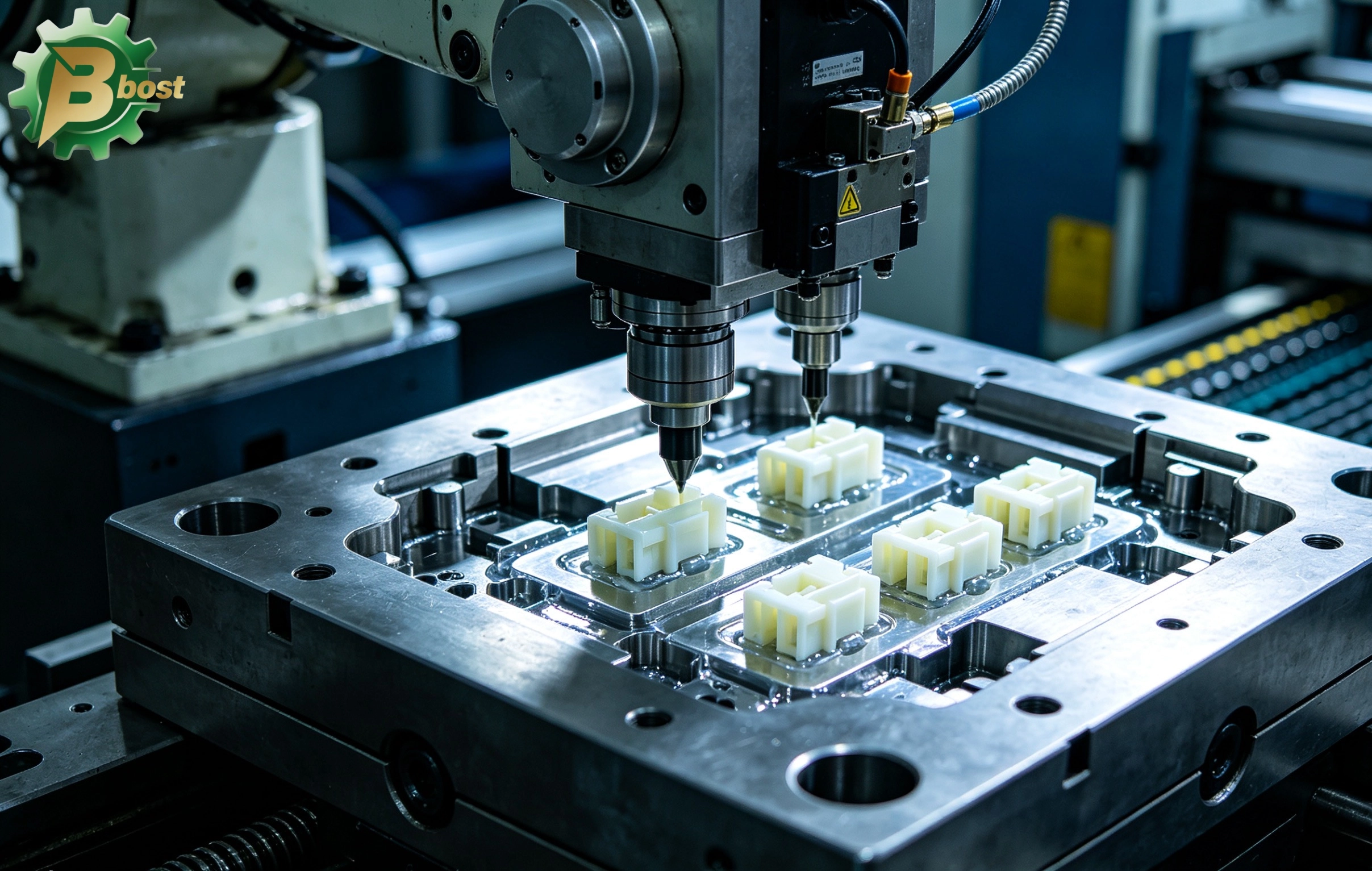
Some advanced injection molding shops also install pressure sensors inside the mold cavity. These sensors monitor the state of the molten plastic in real-time during the filling and packing phases.
Pain Point Solution
When the cavity pressure curve shows abnormal fluctuations (e.g., a pressure spike due to poor venting), the system automatically triggers an alarm and can even eject the suspect part. This is far more proactive than relying on human inspection to spot "burning" or "short shots." It truly achieves "defect prevention" rather than "defect screening."
Conclusion: Find a Partner Who Understands "Systems Engineering"
Reflecting on the three points above, a successful custom plastic injection molding project is far more than just "opening a mold and making a few samples." It requires a supplier with a systematic engineering mindset: one who understands your application (material selection), optimizes part manufacturability (mold design), and locks in stable processes with data (process control).
If you're seeking such a partner—an injection molding expert who considers everything from material properties and mold flow to production yield—we welcome further discussion. We specialize in tackling custom injection molding challenges with high-performance engineering plastics like PEEK, PEI, and PPS, and always offer a free DFM analysis to help identify and solve potential problems early in your project.
Please contact us through our website to discuss how we can transform your design concepts into stable, reliable injection molded parts.
Recommended for you
The Peak Art of Custom Manufacturing According to Drawings: Comprehensive Guide to Precision Solutions for Custom Parts According to Drawing
Ending Mechanical Wear and Resonance: The Comprehensive Guide to Precision Customization and Mass Production of a Custom Rubber Pad
The Ultimate Armor for Smart Hardware: Advanced Customization and Precision Injection Molding Guide for a Custom Plastic Box
The Ultimate Weapon to Tame Vibration and Noise: Deep Dive into the Custom Process and Mass Production Logic of a Custom Rubber Bushing
Product Categories
FAQ
FAQs
What is the minimum order quantity (MOQ)? Do you support small-batch trial production?
The MOQ for standard products is ≥100kg. We support small-batch trial production (as low as 20kg) and provide mold testing reports and performance data feedback.
How do I select the appropriate engineering plastic grade for my product?
Selection should be based on parameters such as load conditions (e.g., pressure/friction), temperature range, medium contact (e.g., oil/acid), and regulatory requirements (e.g., FDA/RoHS). Our engineers can provide free material selection consulting and sample testing.
What are the core advantages of Best engineering plastics compared to ordinary plastics?
Best engineering plastics feature ultra-high mechanical strength, high-temperature resistance (-50°C to 300°C), chemical corrosion resistance, and wear resistance. Compared to ordinary plastics, their service life is extended by 3 to 8 times, making them suitable for replacing metals in harsh environments.
Can Best customize modified plastics with special properties?
Yes! We offer modification services such as reinforcement, flame retardancy, conductivity, wear resistance, and UV resistance, for example:
• Adding carbon fiber to enhance stiffness
• Reducing the coefficient of friction through PTFE modification
• Customizing food-grade or medical-grade certified materials
What is the delivery lead time? Do you offer global logistics?
Standard products: 5–15 working days; custom modifications: 2–4 weeks. We support global air/sea freight and provide export customs clearance documents (including REACH/UL certifications).
You may also like
Custom Plastic Knobs Precision Injection Molded
More Details →
Custom Plastic Knobs Precision Injection Molded
Custom Injection Molded Parts from Drawings
More Details →
Custom Injection Molded Parts from Drawings
Underwater Camera Shell Custom Plastic Molding
More Details →
Underwater Camera Shell Custom Plastic Molding
Leave a Message
Have any questions or concerns about our products? Please leave us a message here, and our team will get back to you promptly.

24 hours quotes delivered
Submit CAD files, get quote in 24 hours

No MOQ required
From prototyping to high-volume

±0.02 mm Precision
Advanced CNC with full inspections

1,000+ tons in stock
26 materials ready to ship
© 2026 BOST. All Rights Reserved.