




 Scan QR Code
Send My Request
Breaking the Single-Material Limit: Exploring How Over Molding Reshapes Modern Product Design and Manufacturing
2026-04-09
Discover how Bost’s expert overmolding services for electronics break single-material limits, enhancing product design and manufacturing. Explore innovative over molding techniques that improve durability, functionality, and aesthetics in modern electronics. Elevate your products with Bost today.
- What is True Over Molding? By No Means a Simple "Two-Step Process"
- Overcoming the Core Technical Pain Points of Over Molding: Why Do Some Projects Fail?
- Pain Point 1: The Myth of Material Compatibility and "Chemical Bonding"
- Pain Point 2: Flash Control and Mechanical Interlocking in Mold Design
- Pain Point 3: Heat Balance in the Precision Injection Molding Process
- The Revolutionary Commercial Value Over Molding Brings to B2B Manufacturing
- Real Production Scenario: BOST's Practical Insights
- Partner with BOST: Customize Your Exclusive Over Molding Solution
In today's rapidly changing industrial manufacturing and consumer electronics markets, product competition has long evolved from simple functional comparisons to a comprehensive consideration of user experience, durability, and production efficiency. Whether it is a demanding medical device, an industrial-grade handheld device requiring shock resistance, or a power tool pursuing ultimate ergonomic grip, designers are striving to perfectly integrate "rigid support" with a "soft touch."
The traditional manufacturing mindset is usually to produce hard shells and soft protective covers separately, and then conduct secondary assembly through manual gluing, snapping, or screwing. However, this outdated process not only consumes huge labor costs but also frequently exposes fatal defects such as gap cracking and component detachment when faced with extreme temperatures, high-frequency vibrations, or strict waterproof requirements. To thoroughly solve this pain point, Over Molding (two-shot molding/insert molding) technology emerged. As a plastics injection molding expert deeply cultivating overseas markets for years, BOST (https://www.gz-bost.com) profoundly understands how to utilize advanced injection molding processes to enhance product value. Today, we will deeply deconstruct the core technical logic of Over Molding for you, to see how it can build a solid market moat for your next product project.
What is True Over Molding? By No Means a Simple "Two-Step Process"
Many junior buyers or product developers often view Over Molding as a simple superposition of processes—nothing more than molding a plastic part first, and then wrapping a layer of soft rubber around it. But if you step into a truly high-end manufacturing workshop, you will find that the truth is far from that.
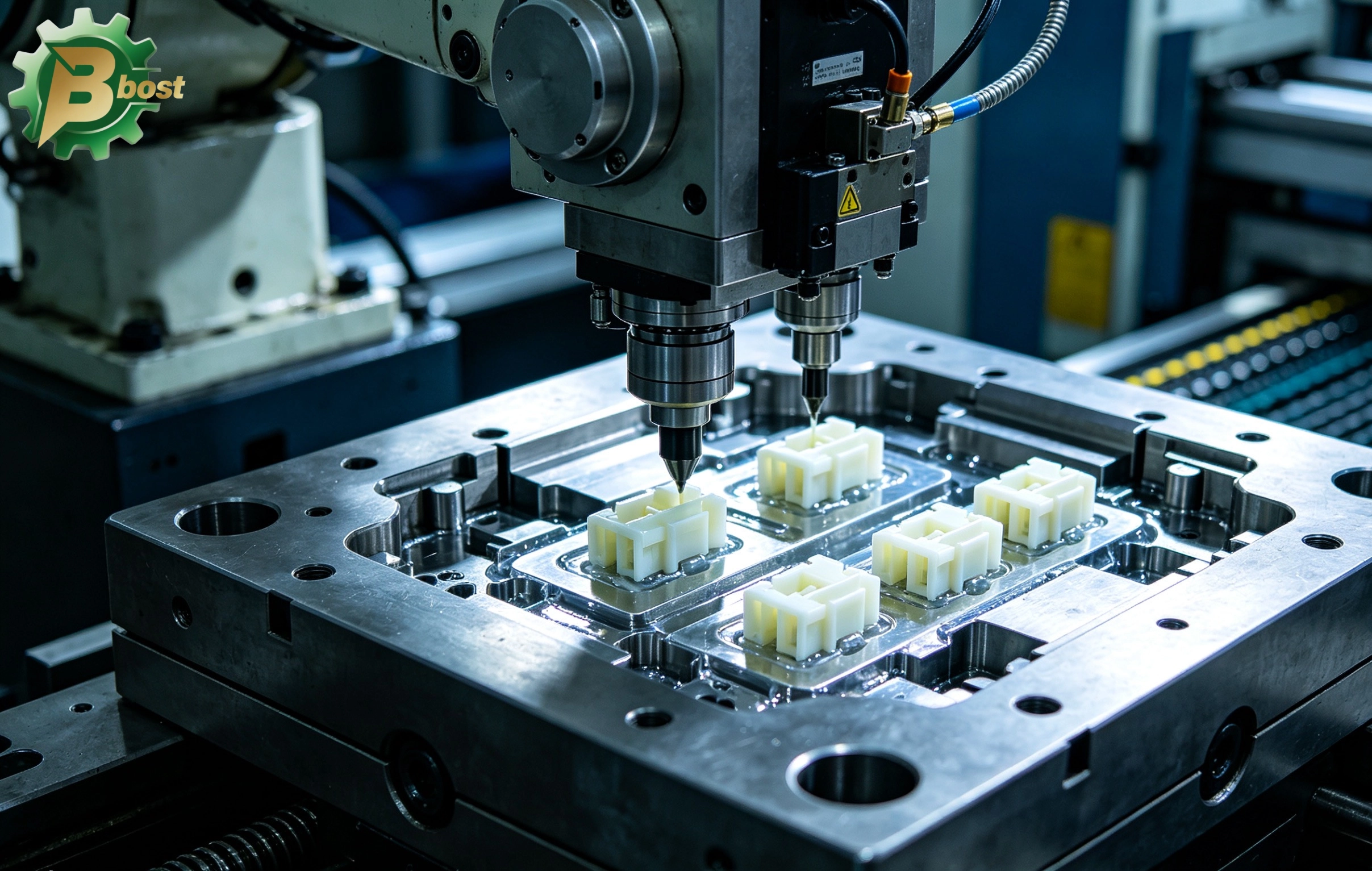
Over Molding is a highly integrated multi-material molding technology. It typically uses a rigid plastic (such as PC, ABS, PA66) as a skeleton or substrate, and subsequently, in another set of molds or a two-color injection molding machine, injects and overmolds a second material (usually an elastomer like TPE, TPU, or silicone) onto specific areas of the substrate. Its ultimate goal is to allow the two materials to undergo local melting and cross-linking at the contact interface through the high temperature and high pressure during the injection process, thereby forming an unbreakable Chemical Bonding, making it an inseparable single robust component.
Overcoming the Core Technical Pain Points of Over Molding: Why Do Some Projects Fail?
In the actual production workshop, the scrap rate of Over Molding is often several times that of single-color injection molding. If the preliminary evaluation is insufficient, the product may experience severe "delamination" or "peeling" within a few months after leaving the factory. To build a perfect overmolded product, we must cross the following three major technical barriers.
Pain Point 1: The Myth of Material Compatibility and "Chemical Bonding"
This is the number one killer leading to Over Molding failure. Different plastic polymers have different surface energies and molecular structures. Just like water and oil cannot mix, if the chemical polarities of the rigid and soft plastics do not match, there will be zero adhesion between them. For example, ABS and PC are excellent substrates; they have superb affinity with TPU or certain TPEs, and can form perfect molecular-level bonding after injection. But if you choose an extremely smooth and chemically inert material like POM or PP, conventional soft rubber will struggle to adhere. Professional injection molding engineers must use material property data sheets at the very beginning of the project to accurately match resin formulas for you, or even introduce special modifiers to activate the surface activity of the materials.
Pain Point 2: Flash Control and Mechanical Interlocking in Mold Design
During the soft material injection phase, the pre-molded rigid substrate actually acts as a "partial mold cavity." This places extremely stringent requirements on mold design. If the dimensional tolerance of the substrate is too large, or the Shut-off Area of the mold is not precisely designed, the high-pressure soft melt will overflow along tiny gaps, forming Flash that is difficult to clean and severely affects the appearance. Furthermore, to cope with peeling forces in extreme usage environments, senior mold teams will never rely solely on chemical bonding. At BOST, we ingeniously design undercuts, through-holes, or chamfered grooves on the rigid substrate. When the soft material flows through these complex structures and cools to solidify, it forms a physical "mechanical interlock," completely eliminating the hidden danger of delamination.
Pain Point 3: Heat Balance in the Precision Injection Molding Process
The adjustment of injection molding process parameters in Over Molding is akin to the art of walking a tightrope. The injection temperature of the soft material must be high enough to instantly melt the micrometer-thick skin on the surface of the rigid substrate to promote the fusion of the two materials; but at the same time, the temperature and injection pressure must absolutely not be too high, otherwise, it will cause the substrate to thermally deform, release internal stress, or even be directly "washed out." This requires the equipment to have outstanding precision injection molding capabilities, capable of seamlessly switching between multi-stage injection speeds and pressures.
The Revolutionary Commercial Value Over Molding Brings to B2B Manufacturing
Given the high technical threshold of Over Molding, why do top global hardware brands still flock to it? The answer lies in its unparalleled comprehensive Return on Investment (ROI).
-
Eliminating Secondary Assembly, Significantly Reducing Supply Chain Costs: By completing the material combination in the mold at one time, enterprises completely eliminate the cumbersome downstream processes of manual gluing, assembly, and screw locking. This not only drastically shortens the production cycle but also eliminates the assembly defect rate caused by human operational errors.
-
Achieving Outstanding Waterproof, Dustproof, and Shock-Absorbing Performance: For outdoor equipment or medical instruments that need to meet IP67 or even IP68 protection ratings, Over Molding can form a truly seamless seal, completely blocking the intrusion of moisture and dust. Meanwhile, the external elastomer layer acts like a "bumper," perfectly absorbing impact energy during drops to protect the fragile electronic components inside.
-
Enhancing Brand Texture and Ergonomic Experience: Adding a soft rubber with excellent anti-slip tactile feel onto monotonous rigid plastic, and utilizing material color contrast to create a strong visual impact, can instantly elevate the appearance level of the product, creating a higher premium space for your brand.
Real Production Scenario: BOST's Practical Insights
Let's look at a case of an industrial handheld barcode scanner. Our client previously used a design scheme of an "ABS shell + a subsequently added silicone protective sleeve." In the complex environment of logistics warehousing, the silicone sleeve frequently loosened and fell off due to workers' frequent plugging and friction, causing the shell to shatter directly when the device was dropped, keeping the repair rate stubbornly high.
After the BOST engineering team stepped in, we decisively upgraded it to an integrated Over Molding solution. Through precise Moldflow Analysis, we optimized the gate locations and water cooling system of the two-shot mold, ensuring that when the TPE soft rubber overmolded the ABS skeleton, it neither generated trapped air nor formed anything less than a perfect shut-off. The final delivered scanner housing not only passed the 2-meter drop test onto concrete with a perfect score, but its compact structure and excellent grip feel also won high praise from end-users.
Partner with BOST: Customize Your Exclusive Over Molding Solution
Whether coping with rigorous industrial-grade drop tests or pursuing the ultimate consumer-grade tactile feel, a successful Over Molding project is never just a simple patchwork of two injection molding machines and two sets of molds. It requires a professional team that understands the chemical polarity of polymer materials, is proficient in complex mold design structures, and masters cutting-edge injection molding processes to escort your project all the way.
As your trustworthy manufacturing partner, BOST possesses a complete two-shot/overmolding injection equipment matrix and a stringent quality control system. We not only execute production but are also committed to helping you avoid design risks during the product development phase, ensuring that your innovative blueprints can be transformed into mass-produced entities with high quality and low costs.
Is your product currently facing challenges of loose structures, waterproof failures, or poor grip? Do not let outdated assembly processes drag down your excellent design. Visit our official website https://www.gz-bost.com immediately to learn more about our successful cases in Over Molding and precision injection molding. Feel free to contact the senior engineering team at BOST anytime to get a free DFM (Design for Manufacturability) evaluation and highly competitive project quotes. Let us use professional injection molding technology to inject formidable competitive confidence into your products!
Recommended for you
The Peak Art of Custom Manufacturing According to Drawings: Comprehensive Guide to Precision Solutions for Custom Parts According to Drawing
Ending Mechanical Wear and Resonance: The Comprehensive Guide to Precision Customization and Mass Production of a Custom Rubber Pad
The Ultimate Armor for Smart Hardware: Advanced Customization and Precision Injection Molding Guide for a Custom Plastic Box
The Ultimate Weapon to Tame Vibration and Noise: Deep Dive into the Custom Process and Mass Production Logic of a Custom Rubber Bushing
Product Categories
FAQ
FAQs
How do I select the appropriate engineering plastic grade for my product?
Selection should be based on parameters such as load conditions (e.g., pressure/friction), temperature range, medium contact (e.g., oil/acid), and regulatory requirements (e.g., FDA/RoHS). Our engineers can provide free material selection consulting and sample testing.
What are the core advantages of Bost engineering plastics compared to ordinary plastics?
Bost engineering plastics feature ultra-high mechanical strength, high-temperature resistance (-50°C to 300°C), chemical corrosion resistance, and wear resistance. Compared to ordinary plastics, their service life is extended by 3 to 8 times, making them suitable for replacing metals in harsh environments.
What is the minimum order quantity (MOQ)? Do you support small-batch trial production?
The MOQ for standard products is ≥100kg. We support small-batch trial production (as low as 20kg) and provide mold testing reports and performance data feedback.
What is the delivery lead time? Do you offer global logistics?
Standard products: 5–15 working days; custom modifications: 2–4 weeks. We support global air/sea freight and provide export customs clearance documents (including REACH/UL certifications).
Can Bost customize modified plastics with special properties?
Yes! We offer modification services such as reinforcement, flame retardancy, conductivity, wear resistance, and UV resistance, for example:
• Adding carbon fiber to enhance stiffness
• Reducing the coefficient of friction through PTFE modification
• Customizing food-grade or medical-grade certified materials
You may also like
Custom Plastic Knobs Precision Injection Molded
More Details →
Custom Plastic Knobs Precision Injection Molded
Custom Injection Molded Parts from Drawings
More Details →
Custom Injection Molded Parts from Drawings
Underwater Camera Shell Custom Plastic Molding
More Details →
Underwater Camera Shell Custom Plastic Molding
Leave a Message
Have any questions or concerns about our products? Please leave us a message here, and our team will get back to you promptly.

24 hours quotes delivered
Submit CAD files, get quote in 24 hours

No MOQ required
From prototyping to high-volume

±0.02 mm Precision
Advanced CNC with full inspections

1,000+ tons in stock
26 materials ready to ship
© 2026 BOST. All Rights Reserved.