




 Scan QR Code
Send My Request
Advanced Product Design Guide: Comprehensive Analysis of the Overmolding Process and Material Compatibility Strategies
2026-04-09
Discover Bost’s Advanced Product Design Guide for Insert Molding, offering a comprehensive analysis of the overmolding process and material compatibility strategies. Enhance your product development with expert insights to optimize design and manufacturing efficiency.
- Unveiling Overmolding: What Exactly Is It?
- In-Depth Comparison Guide: Overmolding vs. Insert Molding
- The Core Barriers Determining the Success of Overmolding: Materials and Mold Design
- 1. Crossing the "Chemical Chasm": Selecting Material Compatibility
- 2. "Shut-off" and Mechanical Interlocking in Precision Mold Design
- 3. The Perfect Balance of Injection Molding Process Parameters
- Real-World Scenario: How Overmolding Saved a Product Failing Drop Tests
- Partner with BOST: Turning Complex Design Visions into Reality
In today's fiercely competitive industrial manufacturing and consumer electronics markets, the success of a product no longer depends solely on singular functionality. Engineers and designers face increasingly high demands: products must not only be rugged and durable but also possess excellent ergonomic feel, superior waterproof sealing performance, and shock-absorbing capabilities. To perfectly integrate the characteristics of "rigidity" and "flexibility" on the same component, traditional glue bonding or mechanical assembly has become inadequate.
At this point, Overmolding (two-shot molding/two-color injection) technology has become the breakthrough method for high-end manufacturing. As an expert deeply engaged in precision injection molding and mold design for many years, BOST (https://www.gz-bost.com) assists global clients daily in overcoming complex material bonding challenges. This guide will take you deep into the core engineering logic of Overmolding. Through intuitive comparisons and real-world pain point analysis, we will help you avoid pitfalls in your next product development cycle and achieve the perfect realization of your design.
Unveiling Overmolding: What Exactly Is It?
Overmolding is an advanced multi-material injection molding process. Simply put, it involves injecting a layer of soft elastomer (such as TPE, TPU, or silicone) or another plastic material over an already molded rigid plastic substrate.
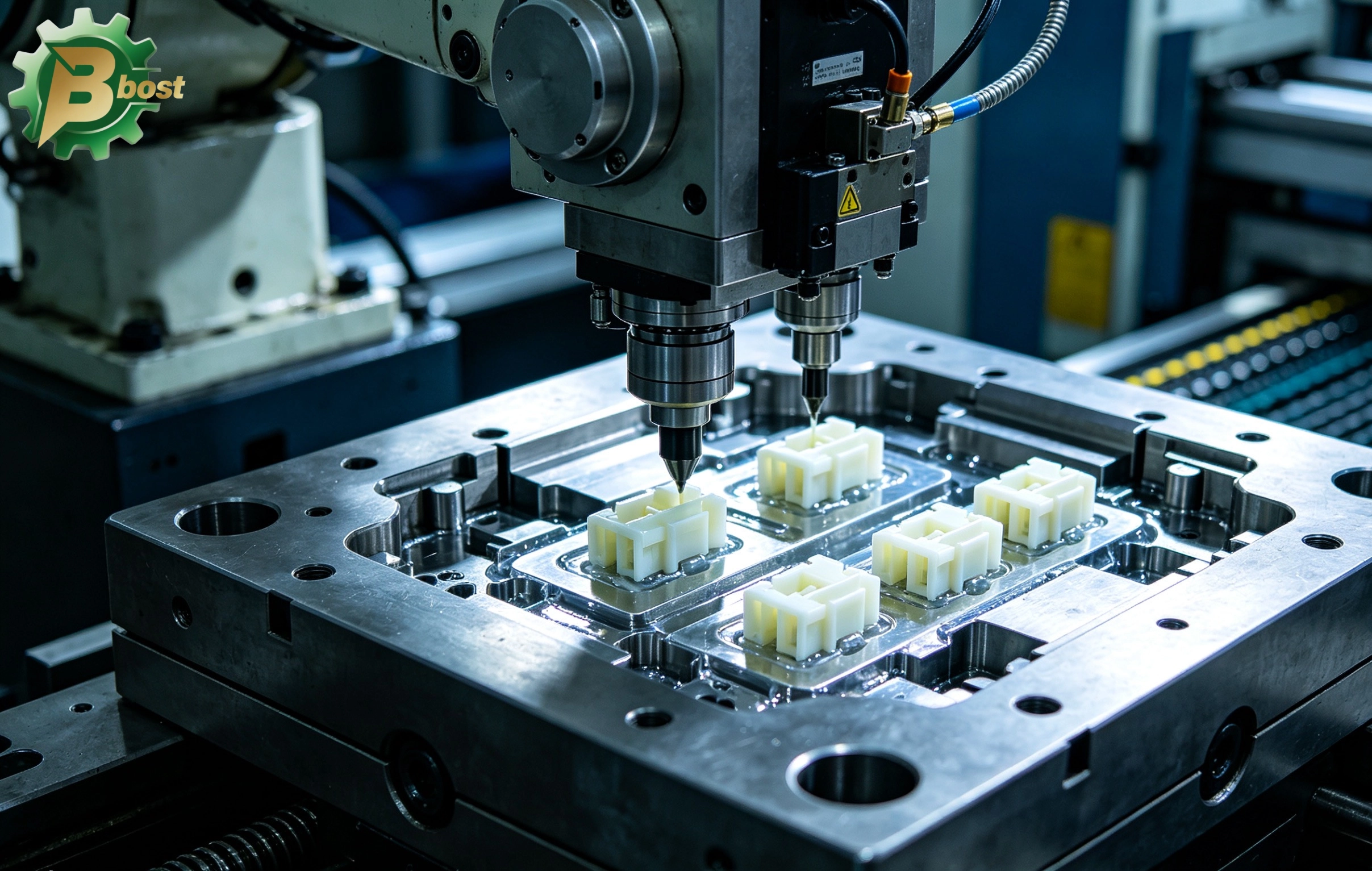
This process is typically executed in two ways: One is "Two-Shot Molding," where the continuous injection of rigid and soft plastics is completed on the same injection molding machine equipped with two injection barrels, through the rotation of the mold or the movement of sliders; the other is "Pick-and-Place Overmolding," where the rigid substrate is first molded on a standard injection molding machine, and then a robotic arm or operator places it into another mold for the injection of the soft material. Regardless of the method used, the ultimate goal is to permanently fuse two different materials together through chemical bonding or mechanical interlocking.
In-Depth Comparison Guide: Overmolding vs. Insert Molding
Many buyers and designers who are new to complex injection molding processes often confuse Overmolding with Insert Molding, which we mentioned in our previous article. To make your process selection clearer, we have compiled the following engineering comparison guide table:
| Comparison Dimension | Overmolding | Insert Molding |
| Base Substrate | Usually a pre-molded rigid plastic (e.g., PC, ABS, PA) | Usually a metal part, hardware nut, PCB, or filter mesh |
| Overmold Material | Usually a soft elastomer (TPE, TPU, LSR) or another plastic | Any conventional thermoplastic or thermosetting resin/plastic |
| Core Bonding Principle | Highly dependent on chemical compatibility (molecular bonding) between materials + mechanical interlocking | Mainly relies on the physical mechanical encapsulation and locking of the metal part as the plastic cools and shrinks |
| Primary Pain Points Solved | Improving grip ergonomics, adding anti-slip and shock-absorbing functions, achieving dual-color appearance, providing waterproof sealing | Enhancing thread structural strength, achieving conductive connections, reducing post-molding manual assembly of hardware |
| Typical Applications | Power tool handles (hard shell + soft grip), medical device enclosures, waterproof sealing gaskets | Automotive plastic housings with brass nuts, sensor connectors, medical catheter joints |
The Core Barriers Determining the Success of Overmolding: Materials and Mold Design
On the surface, Overmolding just seems like an extra injection process, but in actual engineering workshops, its scrap rate is often several times that of single-color injection molding. To build a high-quality overmolded product that fits seamlessly without peeling, three major technical barriers must be overcome.
1. Crossing the "Chemical Chasm": Selecting Material Compatibility
This is the most common reason for Overmolding failure. If the rigid substrate and the soft material are chemically repulsive (like water and oil), they cannot form a strong molecular bond, and the product will easily experience peeling after being subjected to external force or aging.
Professional injection molding engineers will conduct strict material matching at the early stage of the project. For example, ABS or PC substrates have excellent chemical affinity with TPU, achieving a perfect weld; but if your substrate is POM or PP with extremely low surface energy, conventional TPE will struggle to adhere. At BOST, we precisely blend modified materials based on customers' performance requirements to ensure optimal interfacial bonding strength.
2. "Shut-off" and Mechanical Interlocking in Precision Mold Design
During the soft material injection phase, the rigid substrate actually acts as a "partial mold cavity." If the dimensional tolerance of the substrate is too large, or the shut-off area in the mold design is not precise enough, the high-pressure soft melt will overflow, forming Flash that is difficult to clean.
Furthermore, to combat peeling forces in extreme environments, excellent mold engineers never rely solely on chemical bonding. We design clever undercuts, through-holes, or grooves on the substrate, allowing the soft material to flow through these structures and solidify during injection, forming an unbreakable physical "mechanical interlock."
3. The Perfect Balance of Injection Molding Process Parameters
When performing Overmolding, the adjustment of the precision injection molding process is truly an art. The injection temperature of the soft material must be high enough to melt the ultra-thin surface layer of the rigid substrate to promote a chemical reaction; but the temperature must absolutely not be too high, otherwise it will cause the substrate to soften, deform, or even burn. This requires the injection molding machine to have extremely high-precision temperature control and multi-stage injection speed adjustment capabilities, coupled with the precise assistance of a mold temperature controller.
Real-World Scenario: How Overmolding Saved a Product Failing Drop Tests
Let's share a real medical device enclosure case. A North American client developed a handheld ultrasound detector with an enclosure made of pure PC material. During the 1.5-meter drop test required by the FDA, the product housing frequently cracked, and doctors reported that it was slippery to hold for long periods.
After the BOST team stepped in, we upgraded the enclosure scheme to Overmolding. We retained the internal robust PC substrate skeleton and overmolded a layer of medical-grade TPE soft rubber on the grip area and the anti-collision areas at the corners.
-
On the Mold Side: We designed through-holes at the corners of the PC substrate, allowing the TPE melt to penetrate from the outer surface to the inner surface, forming a double lock.
-
On the Process Side: We optimized the cooling water layout of the two-shot mold to ensure that the temperature of the TPE when it contacted the PC surface was exactly within the optimal "bonding window."
The improved product not only passed the drop test with flying colors (the soft material perfectly absorbed the impact energy), but its excellent anti-slip tactile feel also became the core selling point of the product in the market.
Partner with BOST: Turning Complex Design Visions into Reality
Whether it is enhancing the aesthetic added value of a product or meeting stringent industrial-grade protection requirements, Overmolding is an extremely powerful engineering weapon. However, this process places almost harsh demands on the supplier's engineering background, mold precision, and the stability of the molding equipment.
As your reliable manufacturing partner, BOST possesses an advanced two-shot injection molding equipment system and an R&D team deeply versed in the properties of polymer materials. We do not just execute drawings; we are committed to solving problems for you during the product DFM (Design for Manufacturability) stage, ensuring that the combination of every material is impeccable.
Are you looking for solutions to your product's sealing, shock absorption, or tactile feel issues?
Do not let the limitations of manufacturing processes compromise your outstanding design. Visit our official website https://www.gz-bost.com today to explore more industry cases regarding our Overmolding and precision injection molding. You are welcome to submit your 3D drawings; BOST's senior engineering team will provide you with a free feasibility analysis and a highly competitive customized quote. Let us work together to inject the powerful competitiveness of "rigidity and flexibility" into your products!
Recommended for you
The Peak Art of Custom Manufacturing According to Drawings: Comprehensive Guide to Precision Solutions for Custom Parts According to Drawing
Ending Mechanical Wear and Resonance: The Comprehensive Guide to Precision Customization and Mass Production of a Custom Rubber Pad
The Ultimate Armor for Smart Hardware: Advanced Customization and Precision Injection Molding Guide for a Custom Plastic Box
The Ultimate Weapon to Tame Vibration and Noise: Deep Dive into the Custom Process and Mass Production Logic of a Custom Rubber Bushing
Product Categories
FAQ
FAQs
Can Bost customize modified plastics with special properties?
Yes! We offer modification services such as reinforcement, flame retardancy, conductivity, wear resistance, and UV resistance, for example:
• Adding carbon fiber to enhance stiffness
• Reducing the coefficient of friction through PTFE modification
• Customizing food-grade or medical-grade certified materials
What is the delivery lead time? Do you offer global logistics?
Standard products: 5–15 working days; custom modifications: 2–4 weeks. We support global air/sea freight and provide export customs clearance documents (including REACH/UL certifications).
How do I select the appropriate engineering plastic grade for my product?
Selection should be based on parameters such as load conditions (e.g., pressure/friction), temperature range, medium contact (e.g., oil/acid), and regulatory requirements (e.g., FDA/RoHS). Our engineers can provide free material selection consulting and sample testing.
What are the core advantages of Bost engineering plastics compared to ordinary plastics?
Bost engineering plastics feature ultra-high mechanical strength, high-temperature resistance (-50°C to 300°C), chemical corrosion resistance, and wear resistance. Compared to ordinary plastics, their service life is extended by 3 to 8 times, making them suitable for replacing metals in harsh environments.
What is the minimum order quantity (MOQ)? Do you support small-batch trial production?
The MOQ for standard products is ≥100kg. We support small-batch trial production (as low as 20kg) and provide mold testing reports and performance data feedback.
You may also like
Custom Plastic Knobs Precision Injection Molded
More Details →
Custom Plastic Knobs Precision Injection Molded
Custom Injection Molded Parts from Drawings
More Details →
Custom Injection Molded Parts from Drawings
Underwater Camera Shell Custom Plastic Molding
More Details →
Underwater Camera Shell Custom Plastic Molding
Leave a Message
Have any questions or concerns about our products? Please leave us a message here, and our team will get back to you promptly.

24 hours quotes delivered
Submit CAD files, get quote in 24 hours

No MOQ required
From prototyping to high-volume

±0.02 mm Precision
Advanced CNC with full inspections

1,000+ tons in stock
26 materials ready to ship
© 2026 BOST. All Rights Reserved.