



 Scan QR Code
Send My Request
Deep Dive: How Prototype Injection Molding Accelerates Product Development and Mitigates Mass Production Risks
2026-05-07
Prototype injection molding, prototype injection molding services, and rapid prototype injection molding streamline product development by enabling quick design validation and reducing costly errors before mass production. Bost explains how these methods lower risks and speed up market readiness with precise, scalable solutions.
- What is Prototype Injection Molding?
- Why is Prototype Injection Molding Critical for Your Project?
- 1. Genuine Material Performance Validation
- 2. Identifying Potential DFM (Design for Manufacturing) Flaws
- 3. Rapid Time-to-Market
- Process Comparison: Which Prototyping Solution Fits You?
- Three Key Strategies to Optimize Prototype Injection Molding
- 1. Adopt Aluminum Tooling or Soft Mold Strategies
- 2. Simplify Mold Structure: Hand-load Inserts
- 3. Focus on Wall Thickness and Draft Angles
- Solving Industry Pain Points: Balancing Cost and Precision
- Why Choose Bost as Your Prototype Injection Molding Partner?
In a rapidly evolving market, the speed of hardware product iteration often determines a company's survival. From the initial creative sketch to the final product on the shelf, there is a massive technical gap: How do you ensure your design won't suffer structural failure during thousands of real-world uses?
While 3D printing and CNC machining are excellent tools for preliminary validation, prototype injection molding becomes the indispensable bridge connecting R&D to mass production when physical material properties, assembly tolerances, and cost projections are at stake.
What is Prototype Injection Molding?
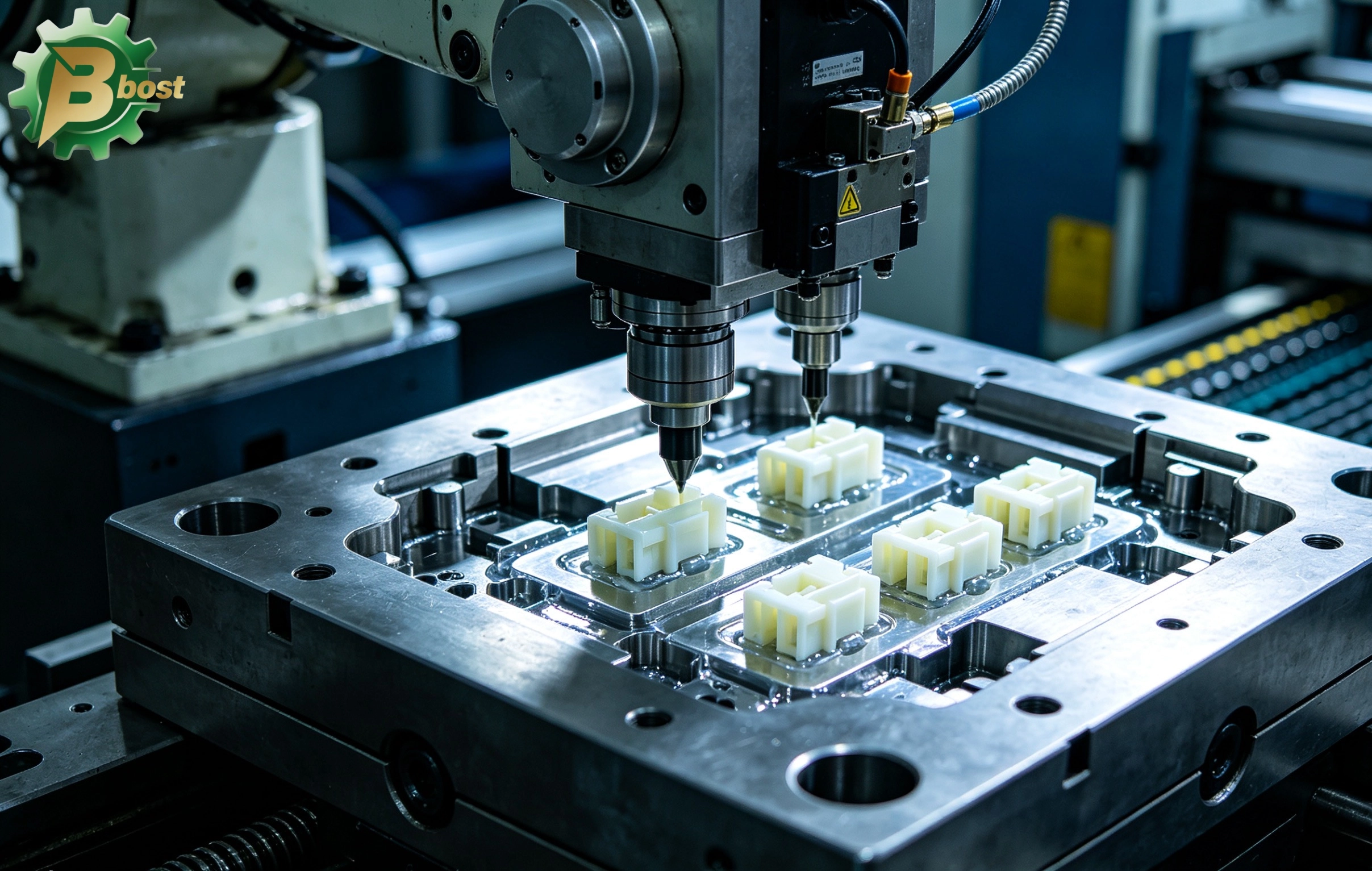
Prototype injection molding is a process that utilizes rapid tooling technology to manufacture plastic parts that are identical in material and performance to final production parts within a short timeframe (typically 1-3 weeks).
Unlike traditional production tooling, which can cost tens of thousands of dollars and take months to complete, prototype molding usually employs aluminum or pre-hardened steel (like P20). The goal is to obtain authentic physical validation of product functionality through a low-cost initial investment.
Why is Prototype Injection Molding Critical for Your Project?
Throughout our years of service at Bost (Guangzhou Bost), we have seen far too many cases of mass production failure caused by skipping the prototype molding stage. Here are the three core values that make this process irreplaceable:
1. Genuine Material Performance Validation
This is a barrier 3D printing cannot cross. If your part needs to withstand high temperatures, high pressure, or possess specific chemical resistance, only parts produced via prototype injection molding using real engineering plastics (such as PEEK, PPS, or glass-filled Nylon) provide meaningful data on tensile strength, impact resistance, and shrinkage.
2. Identifying Potential DFM (Design for Manufacturing) Flaws
Before committing to mass production molds, prototype molding exposes design defects early. Issues like sink marks from uneven wall thickness, scorching due to poor venting, or flow lines from improper gate placement can be identified. Fixing these issues during the prototype injection molding phase costs only 5% or less of what it would cost during mass production.
3. Rapid Time-to-Market
For products requiring UL, FDA, or CE certification, regulatory bodies typically demand test samples made from the final material. With rapid prototype molding, you can begin weeks of reliability testing while the mass production molds are still being built, gaining a significant competitive edge.
Process Comparison: Which Prototyping Solution Fits You?
To help you clarify the pros and cons of different solutions, we have summarized them below:
| Dimension | 3D Printing (SLA/FDM) | CNC Machining | Prototype Injection Molding |
|---|---|---|---|
| Cost per Part | Very Low | Medium | Higher (Includes Tooling) |
| Material Choice | Limited (Resins, etc.) | Broad (Solid Plate) | Extensive (All Injection Grades) |
| Part Complexity | Extremely High | Medium | High (Must consider demolding) |
| Lead Time | 1-2 Days | 3-5 Days | 1-2 Weeks |
| Physical Strength | Weak (Anisotropic) | Strong | Strongest (Same as mass prod) |
| Ideal Quantity | 1-5 pcs | 5-20 pcs | 50-2,000 pcs |
Three Key Strategies to Optimize Prototype Injection Molding
As a professional prototype injection molding service provider, we recommend engineers focus on the following points during the design phase to ensure efficient delivery:
1. Adopt Aluminum Tooling or Soft Mold Strategies
In prototype injection molding, using 7075 aluminum as the mold material is the industry standard. Aluminum transfers heat 3-5 times faster than steel, which means not only faster mold fabrication but also shorter cooling cycles during injection, drastically improving sampling efficiency.
2. Simplify Mold Structure: Hand-load Inserts
To save thousands of dollars on automatic sliders or lifters, we can design manual inserts during the prototype stage. While this increases the per-part labor cost, the overall project cost drops significantly for demand quantities between 100-500 pieces.
3. Focus on Wall Thickness and Draft Angles
Even a prototype must follow the basic physical laws of injection molding. Maintaining uniform wall thickness and a draft angle of at least 0.5° to 1° ensures smooth part ejection and prevents surface scratches, which is vital for verifying aesthetic parts.
Solving Industry Pain Points: Balancing Cost and Precision
Many B2B customers worry about two main issues when searching for a prototype injection molding supplier: non-transparent pricing and precision failing to meet production standards.
At Bost, we solve these pain points through:
-
Real-time DFM Feedback: We provide detailed manufacturability analysis within 24 hours of receiving your STEP files.
-
Moldflow Analysis: We simulate the injection process before mold making to predict potential warping, killing risks at the design stage.
-
Bridge Tooling Concept: Our prototype molds are not just for samples; they can support up to 10,000 shots, serving as a "backup" during your mass production ramp-up to ensure an uninterrupted supply chain.
Why Choose Bost as Your Prototype Injection Molding Partner?
At Bost (Guangzhou Bost), we understand that every prototype represents an innovative dream. Our advantage lies not only in our advanced injection machines and CNC centers but in our deep understanding of "rapid response."
-
Extreme Speed: Deliver T1 samples in as fast as 7 days.
-
Precision Guaranteed: Tolerance control down to ±0.05mm, meeting the strict requirements of electronics and medical devices.
-
One-Stop Shop: From prototype injection molding to secondary operations like silk-screening, painting, and assembly, we provide comprehensive post-processing solutions.
Don't let long development cycles erode your competitiveness.
If you are developing a new product or need rapid validation of an existing design, consult our technical experts today. We will provide the most cost-effective prototype injection molding solution to help your product move swiftly from the lab to the market.
Click here to upload your 3D drawings for a free quote. Our engineering team is ready to accelerate your innovation!
Recommended for you
The Peak Art of Custom Manufacturing According to Drawings: Comprehensive Guide to Precision Solutions for Custom Parts According to Drawing
Ending Mechanical Wear and Resonance: The Comprehensive Guide to Precision Customization and Mass Production of a Custom Rubber Pad
The Ultimate Armor for Smart Hardware: Advanced Customization and Precision Injection Molding Guide for a Custom Plastic Box
The Ultimate Weapon to Tame Vibration and Noise: Deep Dive into the Custom Process and Mass Production Logic of a Custom Rubber Bushing
Product Categories
FAQ
FAQs
What is the delivery lead time? Do you offer global logistics?
Standard products: 5–15 working days; custom modifications: 2–4 weeks. We support global air/sea freight and provide export customs clearance documents (including REACH/UL certifications).
What are the core advantages of Bost engineering plastics compared to ordinary plastics?
Bost engineering plastics feature ultra-high mechanical strength, high-temperature resistance (-50°C to 300°C), chemical corrosion resistance, and wear resistance. Compared to ordinary plastics, their service life is extended by 3 to 8 times, making them suitable for replacing metals in harsh environments.
Can Bost customize modified plastics with special properties?
Yes! We offer modification services such as reinforcement, flame retardancy, conductivity, wear resistance, and UV resistance, for example:
• Adding carbon fiber to enhance stiffness
• Reducing the coefficient of friction through PTFE modification
• Customizing food-grade or medical-grade certified materials
What is the minimum order quantity (MOQ)? Do you support small-batch trial production?
The MOQ for standard products is ≥100kg. We support small-batch trial production (as low as 20kg) and provide mold testing reports and performance data feedback.
How do I select the appropriate engineering plastic grade for my product?
Selection should be based on parameters such as load conditions (e.g., pressure/friction), temperature range, medium contact (e.g., oil/acid), and regulatory requirements (e.g., FDA/RoHS). Our engineers can provide free material selection consulting and sample testing.
You may also like
Custom Plastic Knobs Precision Injection Molded
More Details →
Custom Plastic Knobs Precision Injection Molded
Custom Injection Molded Parts from Drawings
More Details →
Custom Injection Molded Parts from Drawings
Underwater Camera Shell Custom Plastic Molding
More Details →
Underwater Camera Shell Custom Plastic Molding
Leave a Message
Have any questions or concerns about our products? Please leave us a message here, and our team will get back to you promptly.

24 hours quotes delivered
Submit CAD files, get quote in 24 hours

No MOQ required
From prototyping to high-volume

±0.02 mm Precision
Advanced CNC with full inspections

1,000+ tons in stock
26 materials ready to ship
© 2026 BOST. All Rights Reserved.