




 Scan QR Code
Send My Request
In-Depth Analysis: Rubber Compression Molding — The Ultimate Guide to Cost Reduction and Quality Enhancement for Large Industrial Parts
2026-05-07
Rubber compression molding techniques and cost-saving strategies are detailed to boost quality in large industrial parts. Bost’s insights guide you through selecting the right rubber compression molding manufacturer to optimize production efficiency and product durability.
- What is Rubber Compression Molding?
- The Five Core Stages of Compression Molding:
- Critical Factors Influencing Rubber Injection Molding
- The Science of Material Selection
- The Ingenuity of Mold Design
- Solving Production Pain Points: Addressing Common Quality Challenges
- Issue 1: Scorching
- Issue 2: Short Shots
- Issue 3: Bubbles and Voids
- Future Trends: Smart and Green Manufacturing
- Why Partner with Bost?
In today’s global industrial manufacturing chain, finding a process that guarantees physical performance while effectively controlling upfront investment is a prerequisite for every project manager. Despite the rapid advancements in injection molding, rubber compression molding remains a core pillar of the industry due to its irreplaceable economic efficiency and reliability, especially when manufacturing heavy, large, or geometrically simple elastomer components.
This article provides a comprehensive breakdown of the technical essence, cost benefits, and optimization paths of rubber compression molding within the context of digital manufacturing in 2026.
What is Rubber Compression Molding?
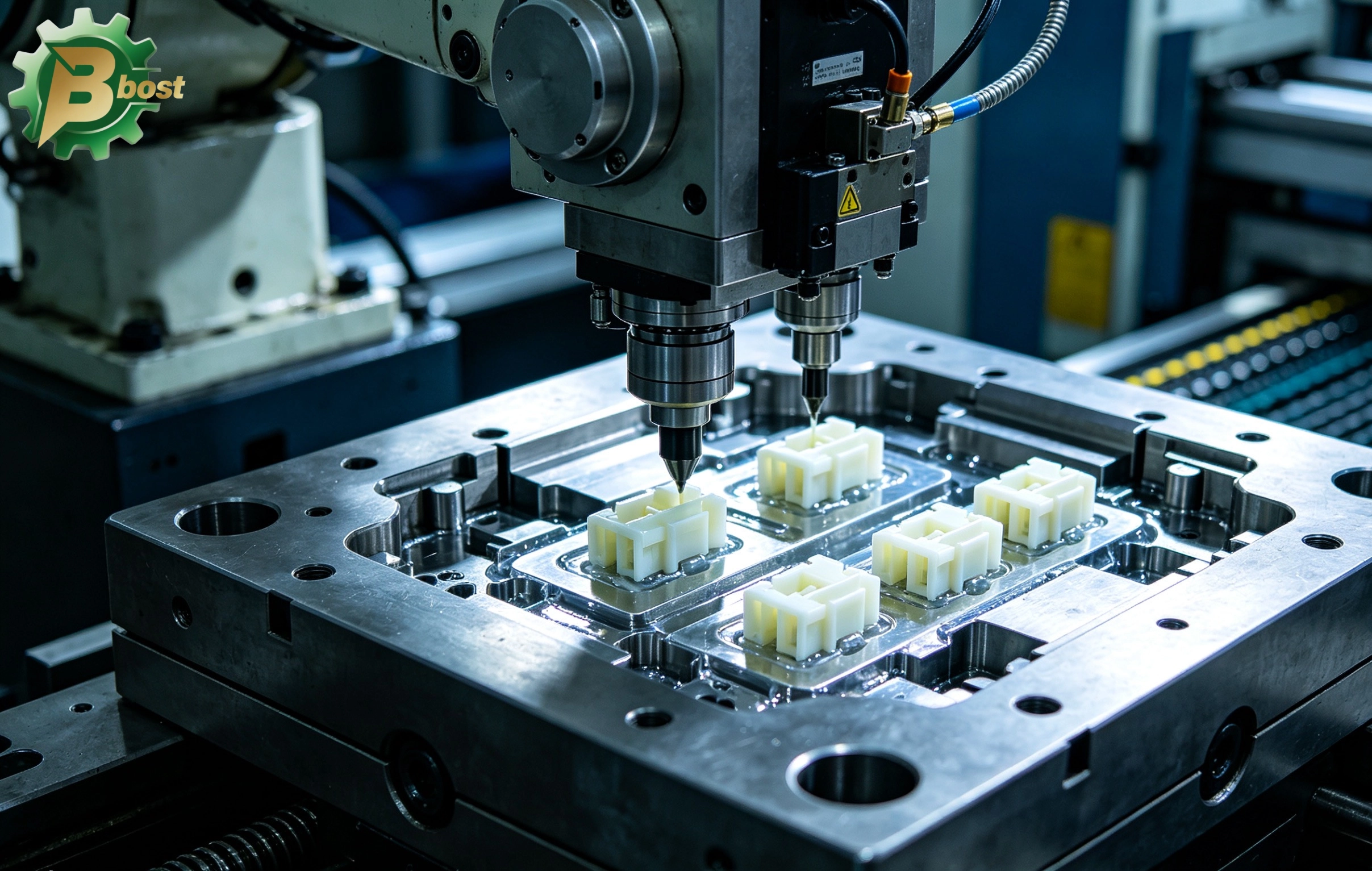
Rubber compression molding is the most traditional and time-proven method of rubber processing. The fundamental principle involves placing a pre-weighed and shaped piece of unvulcanized rubber (known as a "preform") into a heated mold cavity. By closing the mold under massive pressure using a press, the rubber softens and flows to fill the entire cavity, subsequently undergoing a vulcanization (curing) reaction under constant pressure and temperature.
The Five Core Stages of Compression Molding:
-
Preforming: Shaping raw rubber into specific weights and forms, which is crucial for finished part consistency.
-
Loading: Placing the preforms into the heated mold cavities manually or via simple mechanical aids.
-
Compression: The mold closes, and pressure—often reaching hundreds of tons—is applied.
-
Curing: Maintaining the mold at temperatures between 140°C and 200°C to allow the rubber Low (High Automation)| High | Medium |
| Part Complexity | Very Complex Geometries | Simple Shapes Only | Complex Shapes |
| Flash Control | Excellent | Poor | Good |
| Material Waste Rate | Low | High | Medium |
Critical Factors Influencing Rubber Injection Molding
Achieving high-quality rubber injection molding requires more than just having the machinery. It involves the synergy of material science, mold design, and process parameters.
The Science of Material Selection
Different application scenarios have vastly different requirements for rubber materials. For instance, seals around automotive engines require excellent oil and heat resistance (like NBR or FKM), while medical-grade respiratory masks require highly biocompatible liquid silicone rubber (LSR). During rubber injection molding, the Mooney Scorch time and viscosity of the compound must be precisely matched with the injection machine’s pressure parameters.
The Ingenuity of Mold Design
The mold is the heart of the injection process. An excellent mold design for rubber injection molding must consider:
-
Venting System: To prevent air from being trapped in the cavity, which causes scorching or short shots.
-
Runner Balance: Ensuring each cavity in a multi-cavity mold fills simultaneously to maintain product consistency.
-
Cooling/Heating Systems: Precise temperature control is the safeguard against under-curing or over-curing.
Solving Production Pain Points: Addressing Common Quality Challenges
In our long-term B2B service experience, we find that customer concerns often center on several key issues:
Issue 1: Scorching
If the compound stays in the barrel for too long or at too high a temperature before entering the cavity, premature vulcanization occurs. The solution is to optimize the screw speed and precisely control the temperature zones of the barrel in the rubber injection molding machine.
Issue 2: Short Shots
When injection pressure is insufficient or venting is poor, the compound cannot fill complex edges. This requires optimizing the mold's vent grooves or adjusting the injection machine's pressure curve.
Issue 3: Bubbles and Voids
This is usually related to moisture or low-molecular volatiles in the compound. By using vacuum-assisted rubber injection molding technology, gas interference can be effectively eliminated, enhancing the density of the product.
Future Trends: Smart and Green Manufacturing
With the advancement of Industry 4.0, rubber injection molding is transforming toward intelligence. By embedding sensors in the mold to monitor cavity pressure and temperature in real-time, production systems can automatically compensate for fluctuations caused by environmental changes. Furthermore, the use of recyclable thermoplastic elastomers (TPE/TPV) demonstrates great potential for meeting environmental standards.
Why Partner with Bost?
At Bost (Guangzhou Bost), we are more than just an injection molding manufacturer; we are your engineering partner.
We understand that every tiny detail in the rubber injection molding process correlates with the success or failure of your end product. With over 15 years of experience in precision mold manufacturing and world-leading injection equipment, we provide:
-
DFM (Design for Manufacturing) Analysis: Optimizing part structures before mold making to reduce production risks.
-
Custom Material Formulations: Developing exclusive rubber compounds based on your specific working conditions (chemical resistance, weatherability, hardness, etc.).
-
Fully Automated Production Lines: Ensuring stable delivery and high consistency for high-volume orders.
If you are looking for a rubber injection molding solution provider capable of solving complex technical challenges and providing highly competitive quotes, contact our technical team today.
Click here to get a free quote or technical consultation and let’s start your next precision manufacturing project together.
Recommended for you
The Peak Art of Custom Manufacturing According to Drawings: Comprehensive Guide to Precision Solutions for Custom Parts According to Drawing
Ending Mechanical Wear and Resonance: The Comprehensive Guide to Precision Customization and Mass Production of a Custom Rubber Pad
The Ultimate Armor for Smart Hardware: Advanced Customization and Precision Injection Molding Guide for a Custom Plastic Box
The Ultimate Weapon to Tame Vibration and Noise: Deep Dive into the Custom Process and Mass Production Logic of a Custom Rubber Bushing
Product Categories
FAQ
FAQs
What is the delivery lead time? Do you offer global logistics?
Standard products: 5–15 working days; custom modifications: 2–4 weeks. We support global air/sea freight and provide export customs clearance documents (including REACH/UL certifications).
What are the core advantages of Bost engineering plastics compared to ordinary plastics?
Bost engineering plastics feature ultra-high mechanical strength, high-temperature resistance (-50°C to 300°C), chemical corrosion resistance, and wear resistance. Compared to ordinary plastics, their service life is extended by 3 to 8 times, making them suitable for replacing metals in harsh environments.
Can Bost customize modified plastics with special properties?
Yes! We offer modification services such as reinforcement, flame retardancy, conductivity, wear resistance, and UV resistance, for example:
• Adding carbon fiber to enhance stiffness
• Reducing the coefficient of friction through PTFE modification
• Customizing food-grade or medical-grade certified materials
What is the minimum order quantity (MOQ)? Do you support small-batch trial production?
The MOQ for standard products is ≥100kg. We support small-batch trial production (as low as 20kg) and provide mold testing reports and performance data feedback.
How do I select the appropriate engineering plastic grade for my product?
Selection should be based on parameters such as load conditions (e.g., pressure/friction), temperature range, medium contact (e.g., oil/acid), and regulatory requirements (e.g., FDA/RoHS). Our engineers can provide free material selection consulting and sample testing.
You may also like
Custom Plastic Knobs Precision Injection Molded
More Details →
Custom Plastic Knobs Precision Injection Molded
Custom Injection Molded Parts from Drawings
More Details →
Custom Injection Molded Parts from Drawings
Underwater Camera Shell Custom Plastic Molding
More Details →
Underwater Camera Shell Custom Plastic Molding
Leave a Message
Have any questions or concerns about our products? Please leave us a message here, and our team will get back to you promptly.

24 hours quotes delivered
Submit CAD files, get quote in 24 hours

No MOQ required
From prototyping to high-volume

±0.02 mm Precision
Advanced CNC with full inspections

1,000+ tons in stock
26 materials ready to ship
© 2026 BOST. All Rights Reserved.