




 Scan QR Code
Send My Request
Delivering High-Quality Custom Injection Molded Parts: The Winning Formula from Engineering Design to Zero-Defect Mass Production
2026-07-27
Custom injection molded parts require precision from design to production. Bost reveals how a top custom injection molded parts manufacturer ensures zero-defect mass production through engineering best practices and streamlined custom injection molding services.
- 1. Three Major Engineering Challenges of Custom Molded Parts
- 1. Complex Geometric Shrinkage and Dimensional Distortion
- 2. Severe Thermal Expansion and Assembly Interference
- 3. Cosmetic Defects and Narrow Processing Windows
- 2. Key Strategies for Ensuring "Zero-Defect" Custom Parts
- 3. Partner with Bost: Your Engineering Backbone for Custom Molding
In high-tech industries such as medical devices, automotive electronics, and premium consumer goods, custom injection molded parts are often the critical components that determine a product's ultimate success. As highlighted by the core focus in file.png, customization signifies more than just unique geometries; it represents the relentless pursuit of tight tolerances, specialized material properties, and complex surface finishes.
As a premier global provider of a one stop plastic injection molding service, Guangzhou Bost (Bost) is dedicated to helping engineers bridge the gap between prototype design and high-volume manufacturing. This article delves into the core engineering elements and quality control strategies necessary for developing premium custom injection molded components.
1. Three Major Engineering Challenges of Custom Molded Parts
Unlike standard off-the-shelf components, every custom molded part is a novel physics experiment. Engineers typically face the following challenges:
1. Complex Geometric Shrinkage and Dimensional Distortion
Different polymer resins exhibit vastly different shrinkage rates during the cooling and solidification phase (e.g., semi-crystalline polymers like POM shrink significantly more than amorphous polymers like PC). If the mold design fails to accurately compensate for this shrinkage, or if the part features uneven wall thicknesses, severe internal stresses will develop, leading to warpage and dimensional failure.
2. Severe Thermal Expansion and Assembly Interference
In precision assemblies (such as insert molding or metal-plastic composite structures), the Coefficient of Thermal Expansion (CTE) must be rigorously evaluated. The linear thermal expansion is calculated as:
$$ \Delta L = \alpha L_0 \Delta T $$
Where $\alpha$ is the coefficient of linear expansion, $L_0$ is the initial length, and $\Delta T$ is the change in temperature. If the difference in $\alpha$ between the plastic and metal components is too great, custom injection molded parts are highly susceptible to stress cracking or seal failure in extreme environments (such as an automotive engine bay).
3. Cosmetic Defects and Narrow Processing Windows
For custom parts demanding high-gloss SPI finishes or complex textures, surface defects like weld lines, flow marks, and flash are catastrophic. Preventing these flaws requires the injection molding process to operate within an exceptionally narrow window of melt temperature and injection pressure.
2. Key Strategies for Ensuring "Zero-Defect" Custom Parts
To reliably transform digital blueprints into flawless physical entities, Bost implements the following systematic strategies:
| Core Control Phase | Potential Risks | Bost's Engineering Solution |
|---|---|---|
| Upfront DFM Analysis | Abrupt wall thickness changes causing sink marks and internal voids. | Deploying 3D Moldflow analytics to optimize gate locations and guide the strategic implementation of coring and structural ribs. |
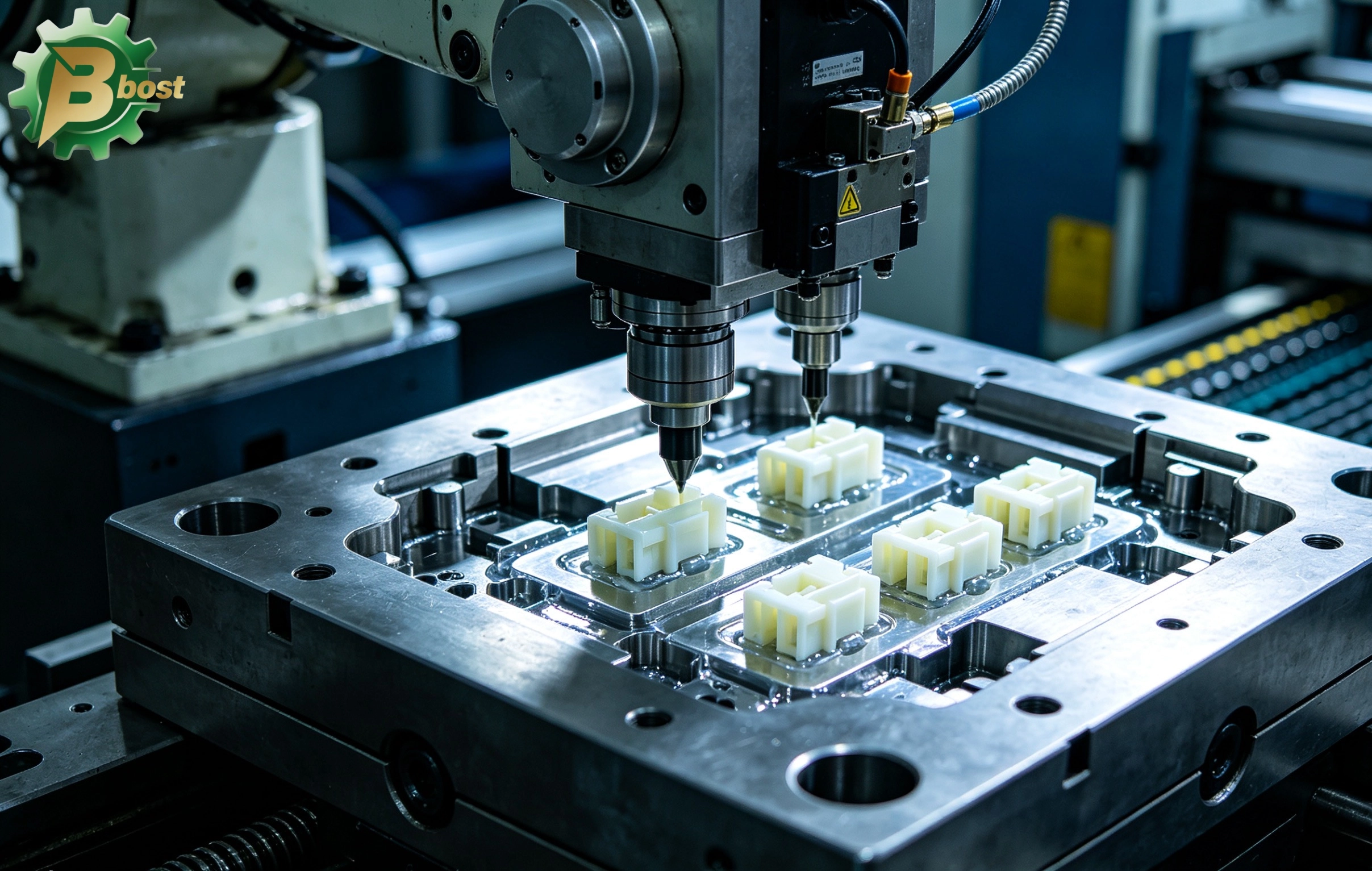
| Precision Tooling | Insufficient tooling accuracy resulting in flash and out-of-tolerance parts. | Utilizing high-precision CNC and Wire EDM machining to hold core/cavity tolerances at the micron level, integrated with conformal cooling channels. |
| Advanced Material Selection | Standard resins failing to meet high-heat or chemical resistance demands. | Tailoring polymer formulations (e.g., PEEK, PPS, or high-glass-filled PA66) to ensure physical properties perfectly match the application environment. |
| Scientific Molding Control | Traditional "trial-and-error" processing causing massive batch-to-batch inconsistencies. | Embedding in-cavity pressure transducers to trigger precise Velocity-to-Pressure (V/P) switchovers, guaranteeing identical shot weights and dimensions every cycle. |
3. Partner with Bost: Your Engineering Backbone for Custom Molding
Whether you are developing ruggedized housings for a custom plastic connector or highly precise components for surgical instruments, partnering with a supplier that possesses full-stack engineering capabilities is critical.
Guangzhou Bost (Bost) provides an end-to-end manufacturing ecosystem—from advanced mold design to scientific injection molding—backed by a comprehensive Coordinate Measuring Machine (CMM) metrology lab and rigorous First Article Inspection (FAI) protocols. Operating under ISO 9001 certification, we ensure that every custom injection molded part we deliver can withstand the toughest market demands.
Discover our custom manufacturing capabilities and successful case studies at www.gz-bost.com.
To help me tailor our next discussion, what specific industry or operating environment are you designing these custom injection molded parts for?
Recommended for you
The Peak Art of Custom Manufacturing According to Drawings: Comprehensive Guide to Precision Solutions for Custom Parts According to Drawing
Ending Mechanical Wear and Resonance: The Comprehensive Guide to Precision Customization and Mass Production of a Custom Rubber Pad
The Ultimate Armor for Smart Hardware: Advanced Customization and Precision Injection Molding Guide for a Custom Plastic Box
The Ultimate Weapon to Tame Vibration and Noise: Deep Dive into the Custom Process and Mass Production Logic of a Custom Rubber Bushing
Product Categories
FAQ
FAQs
Can Best customize modified plastics with special properties?
Yes! We offer modification services such as reinforcement, flame retardancy, conductivity, wear resistance, and UV resistance, for example:
• Adding carbon fiber to enhance stiffness
• Reducing the coefficient of friction through PTFE modification
• Customizing food-grade or medical-grade certified materials
What is the delivery lead time? Do you offer global logistics?
Standard products: 5–15 working days; custom modifications: 2–4 weeks. We support global air/sea freight and provide export customs clearance documents (including REACH/UL certifications).
What is the minimum order quantity (MOQ)? Do you support small-batch trial production?
The MOQ for standard products is ≥100kg. We support small-batch trial production (as low as 20kg) and provide mold testing reports and performance data feedback.
What are the core advantages of Best engineering plastics compared to ordinary plastics?
Best engineering plastics feature ultra-high mechanical strength, high-temperature resistance (-50°C to 300°C), chemical corrosion resistance, and wear resistance. Compared to ordinary plastics, their service life is extended by 3 to 8 times, making them suitable for replacing metals in harsh environments.
How do I select the appropriate engineering plastic grade for my product?
Selection should be based on parameters such as load conditions (e.g., pressure/friction), temperature range, medium contact (e.g., oil/acid), and regulatory requirements (e.g., FDA/RoHS). Our engineers can provide free material selection consulting and sample testing.
You may also like
Custom Plastic Knobs Precision Injection Molded
More Details →
Custom Plastic Knobs Precision Injection Molded
Custom Injection Molded Parts from Drawings
More Details →
Custom Injection Molded Parts from Drawings
Underwater Camera Shell Custom Plastic Molding
More Details →
Underwater Camera Shell Custom Plastic Molding
Leave a Message
Have any questions or concerns about our products? Please leave us a message here, and our team will get back to you promptly.

24 hours quotes delivered
Submit CAD files, get quote in 24 hours

No MOQ required
From prototyping to high-volume

±0.02 mm Precision
Advanced CNC with full inspections

1,000+ tons in stock
26 materials ready to ship
© 2026 BOST. All Rights Reserved.