




 Scan QR Code
Send My Request
Precision Foundation for Signals and Power: Complete Manufacturing Guide for Custom Plastic Connectors
2026-09-01
Custom plastic connector design and manufacturing processes are detailed to ensure precision in signal and power applications. Bost outlines key production techniques, material selection, and quality standards critical for any custom plastic connector manufacturer or supplier aiming for reliability and performance.
In high-frequency 5G communications, new energy vehicle BMS platforms, and medical diagnostic equipment, a custom plastic connector serves as a vital neural node for critical systems. Ultra-thin wall thicknesses, high-density pin pitches, and harsh operating conditions make manufacturing connectors far more demanding than standard injection-molded components. A microscopic dimension drift or minor flash can compromise electrical isolation, degrade signals, or cause costly system failures.
To pass stringent compliance tests and scale seamlessly into mass production, partnering with a full-stack one stop plastic injection molding service provider has become the preferred strategy for global hardware leaders.
Overcoming the 3 Manufacturing Barriers of Custom Plastic Connectors
Producing a high-reliability custom connector requires engineering teams to solve material, structural, and process challenges within micron-scale constraints:
-
Micro-Miniaturization & Micron-Level Tolerances: Modern connector pin pitches are shrinking below 0.3mm, with isolation partition walls dropping under 0.15mm. High-temperature resin flowing through micro-cavities easily causes short shots or flash. Tooling precision must reach the $\pm 0.005\text{ mm}$ threshold to prevent pin misalignment or electrical shorts.
-
Thermal Endurance & Flame Retardancy: Connectors mounted via SMT must withstand 260°C lead-free reflow soldering while meeting UL94 V-0 flame-retardant standards. Standard engineering polymers tend to warp, blister, or lose dielectric strength under extreme heat.
-
High-Precision Insert Molding: Many connectors require delicate stamped copper pins to be pre-placed into mold cavities before resin injection. High injection pressure can bend or dislodge these tiny metal inserts, demanding sub-micron mold indexing and precise machine pressure profiling.
Core Engineering Plastics Comparison for Connectors
During the DFM (Design for Manufacturability) phase, material selection directly dictates electrical performance and moldability. The following matrix compares three primary polymers used in connector manufacturing:
| Evaluation Dimension | LCP (Liquid Crystal Polymer) | PBT (Polybutylene Terephthalate) | PA66 (Modified Nylon 66) |
|---|---|---|---|
| Reflow Resistance | Outstanding (Short exposure up to 300°C) | Poor (Unsuitable for SMT 260°C reflow) | Good (Requires glass-fiber reinforcement for HDT) |
| Thin-Wall Flowability | Excellent (Ideal for ultra-thin walls $< 0.3\text{ mm}$) | Fair (Limited flow length) | Good |
| Dimensional Stability | Superior (Moisture absorption $< 0.02%$) | Good | Moderate (Hygral expansion affects tight tolerances) |
| Typical Applications | 5G high-frequency connectors, mobile B2B sockets | Automotive wire harness connectors, header blocks | Industrial terminal blocks, wear-resistant insulators |
Why Custom Plastic Connectors Require a One-Stop Injection Molding Service
In a fragmented supply chain, tooling shops, injection molders, and stamping vendors operate in isolation. When a finished connector exhibits inconsistent insertion forces or seal leakage, vendors often blame each other—toolmakers point to material shrinkage, molders cite stamping variations, and designers question process parameters.
A single-source one stop plastic injection molding service eliminates this risk through:
-
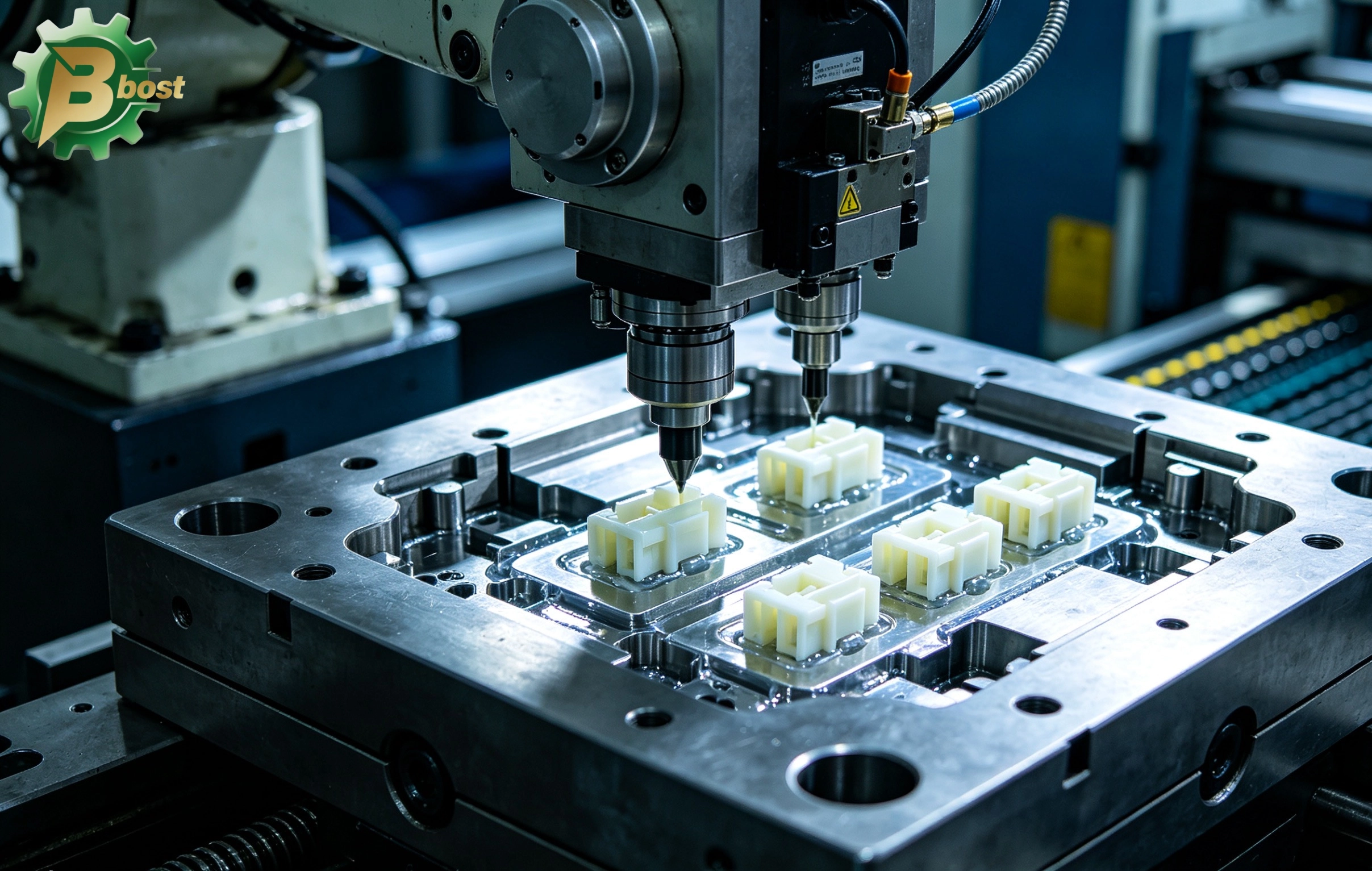
Integrated DFM Co-Design: Senior tooling engineers conduct early Moldflow simulations to predict air traps and weld line locations, optimizing gate positions and cooling channels prior to steel cutting.
-
Closed-Loop Tooling & Machining: In-house Makino CNC and Sodick wire-EDM machines allow micro-level mold tuning under one roof, guaranteeing flash-free insert molding.
-
Full-Process Quality Traceability: Automated CCD vision inspection systems and inline leak testing operate under a unified ISO quality framework from insert loading to final packaging.
Partner with GZ-BOST: Your Trusted Precision Connector Manufacturing Expert
As an industry leader in high-precision manufacturing, Guangzhou Bost (GZ-BOST) delivers reliable one stop plastic injection molding service solutions to global electronics, automotive, and medical sector leaders.
Equipped with high-precision tooling centers and all-electric injection molding machinery, GZ-BOST specializes in thin-wall molding and complex insert molding using high-performance resins like LCP, PPS, and PEI. Whether developing high-density PCB headers or ruggedized waterproof automotive housings, our bilingual engineering team helps you navigate manufacturing challenges early to ensure rapid prototyping and reliable mass production.
Visit our website today at https://www.gz-bost.com to upload your 3D CAD models (STEP / IGES format). GZ-BOST's engineering experts will return a comprehensive DFM manufacturability review and competitive turnkey quote within 24 hours.
Recommended for you
The Peak Art of Custom Manufacturing According to Drawings: Comprehensive Guide to Precision Solutions for Custom Parts According to Drawing
Ending Mechanical Wear and Resonance: The Comprehensive Guide to Precision Customization and Mass Production of a Custom Rubber Pad
The Ultimate Armor for Smart Hardware: Advanced Customization and Precision Injection Molding Guide for a Custom Plastic Box
The Ultimate Weapon to Tame Vibration and Noise: Deep Dive into the Custom Process and Mass Production Logic of a Custom Rubber Bushing
Product Categories
FAQ
FAQs
What is the delivery lead time? Do you offer global logistics?
Standard products: 5–15 working days; custom modifications: 2–4 weeks. We support global air/sea freight and provide export customs clearance documents (including REACH/UL certifications).
Can Bost customize modified plastics with special properties?
Yes! We offer modification services such as reinforcement, flame retardancy, conductivity, wear resistance, and UV resistance, for example:
• Adding carbon fiber to enhance stiffness
• Reducing the coefficient of friction through PTFE modification
• Customizing food-grade or medical-grade certified materials
What are the core advantages of Bost engineering plastics compared to ordinary plastics?
Bost engineering plastics feature ultra-high mechanical strength, high-temperature resistance (-50°C to 300°C), chemical corrosion resistance, and wear resistance. Compared to ordinary plastics, their service life is extended by 3 to 8 times, making them suitable for replacing metals in harsh environments.
How do I select the appropriate engineering plastic grade for my product?
Selection should be based on parameters such as load conditions (e.g., pressure/friction), temperature range, medium contact (e.g., oil/acid), and regulatory requirements (e.g., FDA/RoHS). Our engineers can provide free material selection consulting and sample testing.
What is the minimum order quantity (MOQ)? Do you support small-batch trial production?
The MOQ for standard products is ≥100kg. We support small-batch trial production (as low as 20kg) and provide mold testing reports and performance data feedback.
You may also like
Custom Plastic Knobs Precision Injection Molded
More Details →
Custom Plastic Knobs Precision Injection Molded
Custom Injection Molded Parts from Drawings
More Details →
Custom Injection Molded Parts from Drawings
Underwater Camera Shell Custom Plastic Molding
More Details →
Underwater Camera Shell Custom Plastic Molding
Leave a Message
Have any questions or concerns about our products? Please leave us a message here, and our team will get back to you promptly.

24 hours quotes delivered
Submit CAD files, get quote in 24 hours

No MOQ required
From prototyping to high-volume

±0.02 mm Precision
Advanced CNC with full inspections

1,000+ tons in stock
26 materials ready to ship
© 2026 BOST. All Rights Reserved.