




 Scan QR Code
Send My Request
Electronic & Industrial Equipment Enclosure Customization Guide: How to Craft the Perfect Custom Plastic Enclosure via Precision Injection Molding?
2026-07-09
Custom plastic enclosure design demands precision and expertise—this guide by Bost details how to achieve optimal results using injection molding techniques. Learn key factors in selecting a custom plastic enclosure manufacturer to ensure durability, fit, and functionality for electronic and industrial equipment.
-
- Material Selection: Constructing the Foundation for Custom Plastic Enclosure Performance and IP Ratings
- Comparison Table of Common Custom Plastic Enclosure Materials & Applications
- From Mold to Injection: Three Core Process Controls for High-Quality Custom Plastic Enclosure Manufacturing
- 1. Success-Defining Mold Design
- 2. Defect Mitigation in Precision Injection Molding
- 3. Functional Surface Post-Processing
- Supply Chain Insight: Mitigating Tooling Risks and Total Costs via DFM Assessments
- Partner with Guangzhou Bost (GZ-Bost) for Future-Enabling Custom Enclosures
In today's hardware development and industrial manufacturing landscapes, the market success of an electronic product or industrial device depends not only on the functionality of its internal printed circuit board (PCB) but also largely on its "armor"—the protective housing or enclosure. As products become more highly integrated and operating environments grow increasingly severe, standard off-the-shelf plastic boxes have long failed to satisfy the rigorous demands of modern hardware regarding interface layouts, thermal dissipation, waterproofing, impact resistance, and electromagnetic compatibility (EMI).
For this reason, developing a dedicated custom plastic enclosure has become an essential path for countless smart hardware, medical instrument, automotive electronics, and industrial control enterprises on their road to product commercialization. A high-quality custom plastic enclosure does more than just provide robust physical protection for fragile internal electronics; it serves as the central medium for elevating brand texture and realizing human-machine interface designs.
However, enclosure customization is far from a simple "machining according to blueprints" routine. It is a systematic discipline spanning industrial design, materials science, precision (mold design), and the injection molding process. Due to a lack of frontline manufacturing experience, many R&D teams overlook the fluid characteristics of polymer melts during the early design stage. This frequently leads to severe defects like housing warpage, surface sink marks, and out-of-tolerance assembly dimensions after the mold is opened—not only delaying time-to-market but also incurring exorbitant mold modification fees.
Drawing upon more than 10 years of experience in global B2B digital marketing and precision manufacturing, this article will thoroughly deconstruct how to successfully customize a high-standard, high-return custom plastic enclosure from four core dimensions: material selection, structural design, mold manufacturing, and injection molding techniques.
Material Selection: Constructing the Foundation for Custom Plastic Enclosure Performance and IP Ratings
Different application scenarios impose drastically diverse physical and chemical requirements on a custom plastic enclosure. For example, handheld medical devices demand resistance to chemical disinfectants and superb impact resilience; conversely, power grid monitoring equipment installed outdoors faces strict mandatory indexes for ultraviolet (UV) endurance and dust/water protection (IP ratings).
Selecting the correct raw plastic resin is the primary step in mitigating post-production failure risks when launching a customization project. In the field of 精密注塑 (precision injection molding), engineering plastics commonly used to manufacture high-performance enclosures possess distinct characteristics.
Comparison Table of Common Custom Plastic Enclosure Materials & Applications
| Material Type | Impact Strength & Rigidness | Flame & Temperature Resistance | Weathering & UV Resistance | Typical Application Scenarios |
|---|---|---|---|---|
| ABS (Acrylonitrile Butadiene Styrene) | Excellent; high impact resistance and good rigidity | General (Can achieve UL94-V0 rating through modification) | Fairly weak; prone to yellowing and aging under long-term exposure | Consumer electronics housings, smart home gateways, indoor instruments |
| PC (Polycarbonate) | Extremely high; unparalleled drop resistance with "bulletproof plastic" reputation | Outstanding; high heat deflection temperature, inherently flame-retardant | Moderate; requires anti-UV additives for outdoor exposure | Medical equipment housings, high-end rugged phone cases, transparent viewports |
| ABS + PC Alloy | Combines the excellent fluidity of ABS with the toughness and heat resistance of PC | Good; highly responsive to flame-retardant modification | Moderate; ideal for demanding indoor and semi-outdoor environments | Automotive dashboards, industrial handheld terminals, POS enclosures |
| Nylon (Polyamide PA6/PA66) | Exceptionally high; strength rivals metals when modified with glass fiber (GF) | Outstanding; high temperature and wear resistance | Good; note that its high moisture absorption may cause slight dimensional drift | Automotive engine-perimeter shrouds, heavy-duty industrial connectors, power tool housings |
| PBT (Polybutylene Terephthalate) | Good; highly rigid with superior chemical corrosion resistance | Superb electrical insulation and thermal aging resistance | Excellent; maintains ultra-high dimensional stability | High-performance electrical switches, EV charging gun enclosures |
When tailoring a custom plastic enclosure, enterprises must balance cost against operating environments. For instance, if your product must pass strict UL94-V0 flame-retardant certification, using modified PC or ABS+PC alloys yields excellent cost-performance ratios. Meanwhile, when considering high-frequency wireless signal transmission, you must avoid specific metallic fillers in the enclosure material that could disrupt signal integrity.
From Mold to Injection: Three Core Process Controls for High-Quality Custom Plastic Enclosure Manufacturing
Once the appropriate material is finalized, perfectly translating 3D models from blueprints into high-precision physical components rests upon the deep integration of (mold design) and the injection molding process. Enclosure products typically feature large-area thin-wall structures alongside complex internal assembly bosses and reinforcement ribs, presenting massive challenges to injection molding window optimization.
1. Success-Defining Mold Design
An exceptional(mold design) neutralizes 90% of manufacturing defects before production begins. When designing a mold for a custom plastic enclosure, injection engineering prerequisites must be stringently followed:
-
Adequate Draft Angles: Enclosure products are usually deep. To guarantee smooth ejection and avert surface scuffs, the outer walls must maintain a draft angle of at least $1^\circ$ to $2^\circ$. If the surface calls for a texture finish, the draft angle must be increased accordingly.
-
Uniform Wall Thickness: Uneven wall thickness is the primary culprit behind non-uniform polymer cooling, which triggers part warpage and surface "sink marks." Designers should keep the global wall thickness of the enclosure as uniform as possible, ensuring the thickness of internal reinforcement ribs is held within 60% of the nominal wall thickness.
2. Defect Mitigation in Precision Injection Molding
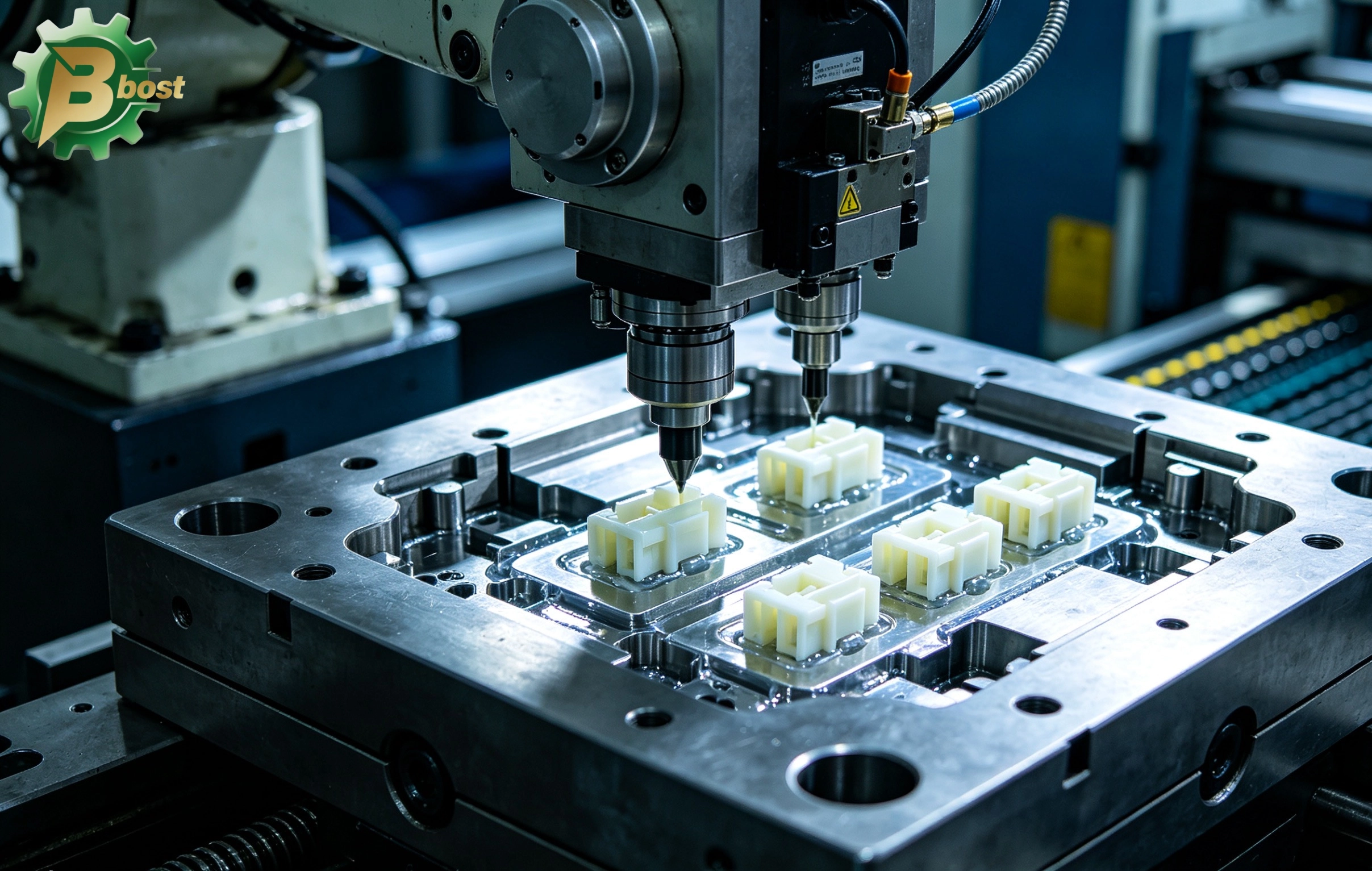
As the visible "face" of a product, cosmetic defects on an enclosure are strictly intolerable. During high-volume manufacturing of a custom plastic enclosure, high-precision machinery like all-electric injection molding units provides exceptionally stable injection pressures and velocities.
To eliminate common housing defects like knit lines (weld lines) and air traps, engineers utilize Moldflow analysis software to precisely position the gates. Concurrently, for enclosures with expansive flat planes, mold temperatures and packing times must be meticulously regulated to lock dimensional tolerances within a tight $\pm0.05\text{mm}$ range, guaranteeing a seamless fit when mating upper and lower shells.
3. Functional Surface Post-Processing
To endow a custom plastic enclosure with added value that transcends ordinary plastics, secondary processing techniques are paramount.
-
EMI Shielding: For electronic enclosures containing high-frequency radiation sources, the inner cavity can be sprayed with conductive paint (such as silver-copper paint) or undergo vacuum plating, thereby creating an electromagnetic shielding barrier inside the housing.
-
Overmolding (Double-Shot Injection): Utilizing advanced (injection molding processes), a rigid ABS/PC housing can be seamlessly bonded with soft TPE/TPU elastomers. This process is frequently utilized to engineer premium enclosures featuring anti-slip grips, shock-absorbing bezels, or integrated waterproof gaskets.
Supply Chain Insight: Mitigating Tooling Risks and Total Costs via DFM Assessments
For global B2B procurement managers, custom enclosures always represent a significant upfront tooling capital expenditure. How can this investment risk be minimized? The answer lies in partnering with a professional injection molder capable of providing thorough Design for Manufacturability (DFM) analysis.
Before you release your initial custom plastic enclosure designs to production, an expert engineering team will provide a comprehensive DFM report. This documentation clearly identifies latent hazards in the drawings—such as sharp internal corners (which cause stress concentration and cracking), overly thick wall sections, or zero-draft undercuts (which necessitate adding sliders or lifters, thereby inflating mold fabrication costs). Rectifying these design vulnerabilities prior to steel cutting saves thousands of dollars in modification expenses and weeks of precious lead time.
Partner with Guangzhou Bost (GZ-Bost) for Future-Enabling Custom Enclosures
Manufacturing a custom plastic enclosure that flawlessly protects your core technology while captivating end-users visually requires unwavering reverence for every manufacturing detail.
As industry veterans backed by over a decade of global digital marketing and precision manufacturing expertise, Guangzhou Bost (GZ-Bost) is fully committed to delivering comprehensive, one-stop plastic enclosure solutions for hardware innovators worldwide. From early-stage structural optimization and precision (mold design) to high-quality (precision injection molding) executed inside Class 10,000 cleanrooms, followed by EMI coating, ultrasonic welding, and final box-build assembly—we rigidly execute the ISO 9001 Quality Management System to ensure every enclosure delivered possesses rock-solid quality and ultimate craftsmanship aesthetics.
Whether you are pioneering next-generation medical instruments, new energy EV charging piles, or smart IoT terminals, our engineering expert team stands ready to transform your concepts into mass-production-ready, market-competitive realities.
We invite you to visit our official website at Guangzhou Bost to explore more of our success stories. Submit your 3D STEP files today to receive a complimentary professional DFM assessment report and a highly competitive custom quote. Let us deploy our rigorous industrial benchmarks to tailor an impeccable, beautiful enclosure for your hardware products.
Recommended for you
The Peak Art of Custom Manufacturing According to Drawings: Comprehensive Guide to Precision Solutions for Custom Parts According to Drawing
Ending Mechanical Wear and Resonance: The Comprehensive Guide to Precision Customization and Mass Production of a Custom Rubber Pad
The Ultimate Armor for Smart Hardware: Advanced Customization and Precision Injection Molding Guide for a Custom Plastic Box
The Ultimate Weapon to Tame Vibration and Noise: Deep Dive into the Custom Process and Mass Production Logic of a Custom Rubber Bushing
Product Categories
FAQ
FAQs
What is the minimum order quantity (MOQ)? Do you support small-batch trial production?
The MOQ for standard products is ≥100kg. We support small-batch trial production (as low as 20kg) and provide mold testing reports and performance data feedback.
What is the delivery lead time? Do you offer global logistics?
Standard products: 5–15 working days; custom modifications: 2–4 weeks. We support global air/sea freight and provide export customs clearance documents (including REACH/UL certifications).
What are the core advantages of Bost engineering plastics compared to ordinary plastics?
Bost engineering plastics feature ultra-high mechanical strength, high-temperature resistance (-50°C to 300°C), chemical corrosion resistance, and wear resistance. Compared to ordinary plastics, their service life is extended by 3 to 8 times, making them suitable for replacing metals in harsh environments.
How do I select the appropriate engineering plastic grade for my product?
Selection should be based on parameters such as load conditions (e.g., pressure/friction), temperature range, medium contact (e.g., oil/acid), and regulatory requirements (e.g., FDA/RoHS). Our engineers can provide free material selection consulting and sample testing.
Can Bost customize modified plastics with special properties?
Yes! We offer modification services such as reinforcement, flame retardancy, conductivity, wear resistance, and UV resistance, for example:
• Adding carbon fiber to enhance stiffness
• Reducing the coefficient of friction through PTFE modification
• Customizing food-grade or medical-grade certified materials
You may also like
Custom Plastic Knobs Precision Injection Molded
More Details →
Custom Plastic Knobs Precision Injection Molded
Custom Injection Molded Parts from Drawings
More Details →
Custom Injection Molded Parts from Drawings
Underwater Camera Shell Custom Plastic Molding
More Details →
Underwater Camera Shell Custom Plastic Molding
Leave a Message
Have any questions or concerns about our products? Please leave us a message here, and our team will get back to you promptly.

24 hours quotes delivered
Submit CAD files, get quote in 24 hours

No MOQ required
From prototyping to high-volume

±0.02 mm Precision
Advanced CNC with full inspections

1,000+ tons in stock
26 materials ready to ship
© 2026 BOST. All Rights Reserved.