




 Scan QR Code
Send My Request
Evaluating a High-Quality Injection Mold Manufacturer: A Comprehensive B2B Technical Audit and Procurement Guide
2026-06-12
Injection mold manufacturer, injection mold manufacturer for plastics, and precision plastic injection mold supplier criteria are detailed to help you conduct a thorough B2B technical audit. Bost’s guide equips procurement teams with clear benchmarks to identify quality, reliability, and efficiency in supplier selection.
- 1. What Core Engineering Capabilities Should an Elite Injection Mold Manufacturer Possess?
- Comprehensive Design for Manufacturability (DFM) Assessment
- Advanced Parametric Moldflow Simulations
- 2. Assets and Machining Accuracy Audit: Scrutinizing the Production Floor
- Micron-Level Machining Capabilities
- Closed-Loop Metrology Systems
- 3. From Sampling to Scale: Evaluating Injection Molding Processes and Quality Control
- 4. Supply Chain Management Soft Skills: Eliminating the Collaboration "Black Box"
- Conclusion: Secure Your Global Manufacturing Advantage
For multinational procurement directors and hardware development engineers, qualifying the right offshore contract manufacturer within the global supply chain can feel like navigating through a dense fog. Especially in the realm of high-precision manufacturing, visually appealing websites and deceptively low quotations frequently mask critical engineering deficiencies. Partnering with an unqualified injection mold manufacturer not only results in defective tools plagued by flash, sink marks, or severe deformation, but it also triggers endless cycles of mold modifications that delay product launches, causing businesses to miss critical market windows.
In today's B2B global sourcing ecosystem, evaluating an injection mold manufacturer has evolved far beyond basic factory tours and static machinery checklists. High-standard tooling procurement is essentially a technical audit of a vendor's engineering design capabilities, micron-level machining limits, scientific molding control, and digital project management protocols. This comprehensive guide outlines the methodology required to fully audit and select a world-class injection mold manufacturer capable of securing your product's competitive edge.
1. What Core Engineering Capabilities Should an Elite Injection Mold Manufacturer Possess?
An undeniable axiom within the toolmaking industry states: "70% of a mold's ultimate quality is determined during the initial design and engineering phase." If a tool contains inherent design flaws, utilizing the most advanced machining centers downstream cannot salvage its performance. Therefore, the first step in auditing an injection mold manufacturer is directly scrutinizing the technical acumen of their engineering department.
Comprehensive Design for Manufacturability (DFM) Assessment
Upon receiving your 3D CAD files, a professional provider will never prematurely rush into scheduling machine time. Their senior engineering team will initiate a rigorous DFM review, systematically analyzing draft angles, wall-thickness uniformity, rib-to-wall ratios, and potential assembly interferences. For instance, when analyzing a complex consumer electronics enclosure, an experienced engineer will proactively flag localized thick sections prone to surface sink marks and propose optimal alternatives, such as material coring or weight-reduction modifications. This proactive (mold design) optimization serves as the most effective defense against post-production modifications.
Advanced Parametric Moldflow Simulations
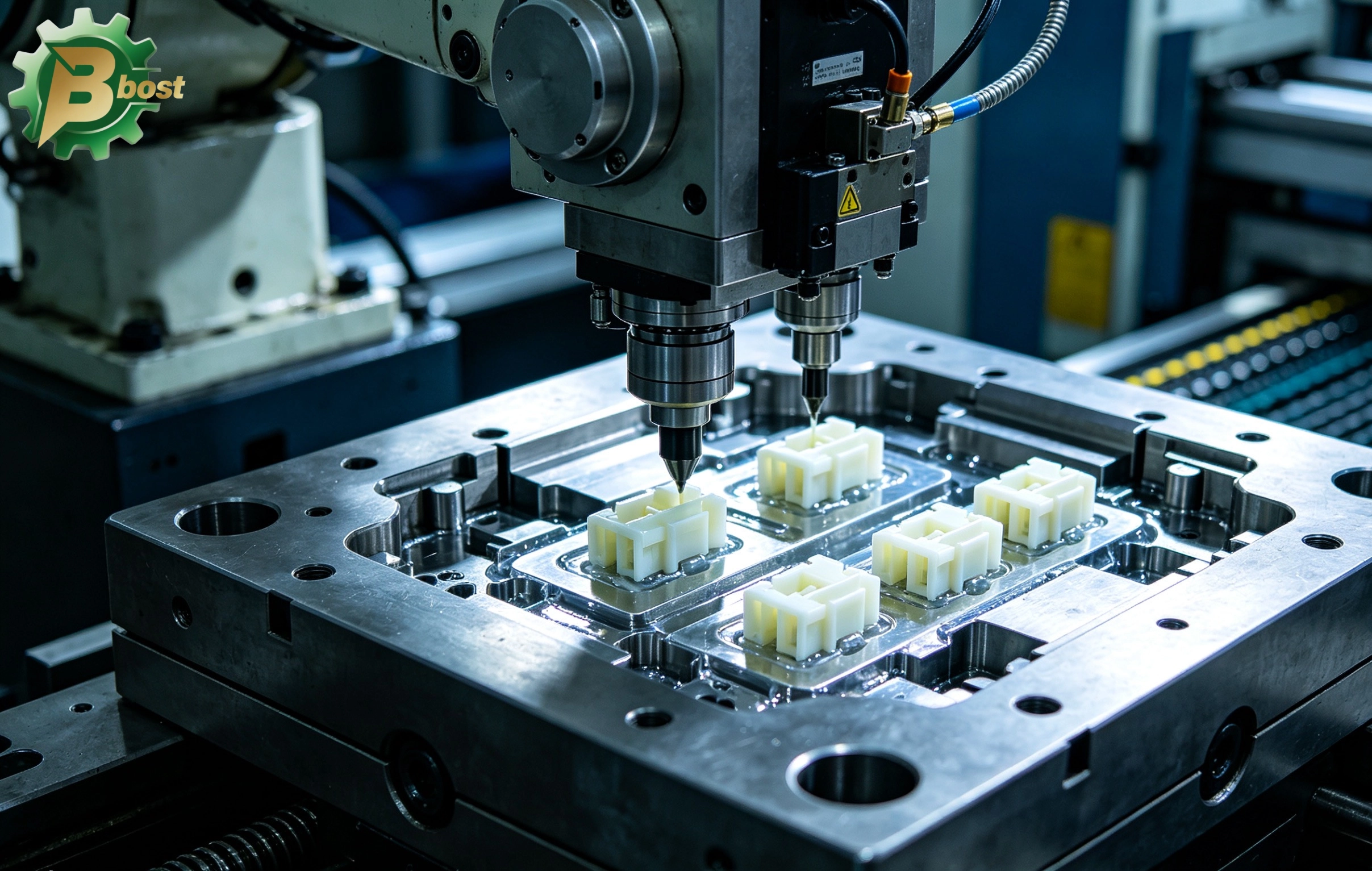
A high-tier injection mold manufacturer relies heavily on empirical data rather than trial-and-error operator adjustments. Utilizing state-of-the-art Moldflow analysis software, the engineering team can simulate 100% of the molten plastic's flow path within the cavity before any steel is cut.
-
Optimal Gate Placement: Accurately calculating shear rates prevents material degradation caused by localized frictional overheating and eliminates aesthetic defects like jetting.
-
Air Venting Diagnostics: Predicting the final filling zones allows engineers to design micron-level venting slots along the perimeter, entirely eliminating localized burn marks caused by trapped gasses.
-
Molecular Orientation & Warpage Prediction: Analyzing the anisotropic shrinkage of long-fiber or amorphous resins during cooling allows the team to adjust packing curves and runner balance, bringing part warpage well within nominal design tolerances.
2. Assets and Machining Accuracy Audit: Scrutinizing the Production Floor
While state-of-the-art machinery is not a standalone guarantee of success, a facility lacking advanced machine tools cannot produce molds that meet international standards for (precision injection molding). During an on-site or virtual facility audit of an injection mold manufacturer, pay close attention to the hardware architecture and tolerance capabilities within the machining shop.
To enable procurement teams to evaluate vendor tiers at a glance, the following table matrix contrasts typical classifications of an injection mold manufacturer:
| Audit Metrics | Tier 1 (High-Precision / Global Standards) | Tier 2 (Mid-Market Tooling Shop) | Tier 3 (Low-Cost / Low-Quality Workshop) |
|---|---|---|---|
| Typical Machining Equipment | Makino/Mikron High-Speed CNCs, Sodick/AgieCharmilles Slow-Feed EDMs, Mirror Finish EDMs | High-Quality Taiwanese or Domestic CNCs, Medium-Wire EDMs, Standard EDM Systems | Refurbished Second-Hand CNCs, Fast-Wire Cutters, Manual Radial Milling Machines |
| Cavity Machining Tolerances | Range from ±0.005 mm to ±0.002 mm | Range from ±0.02 mm to ±0.01 mm | Exceeds ±0.05 mm (Relies heavily on manual fitting) |
| Metrology Equipment (QC) | Zeiss CMMs, 2.5D Optical Measuring Systems, Spectrometers, Hardness Testers | Domestic CMMs, Standard Optical Projectors, Digital Micrometers | Vernier Calipers, Basic Micrometers (Lacking routine calibration) |
| Primary Target Industries | Medical Consumables, Precision Automotive Structures, High-End Optical Lenses, Thin-Wall Packaging | Consumer Electronics Enclosures, Home Appliance Components, Toy Housings | Low-End Plastic Commodities, Low-Precision Industrial Parts |
| Guaranteed Tooling Lifespan | Minimum 1,000,000 cycles (SPI Class 101) | 100,000 to 500,000 cycles (SPI Class 102/103) | Under 50,000 cycles (Prone to flash early on) |
Micron-Level Machining Capabilities
In (precision injection molding) applications—such as smartphone SIM card trays or micro-connectors—the mating tolerances of mold cavity inserts must be held within extremely narrow bounds. This dictates that a premier injection mold manufacturer must deploy high-speed CNC centers (with spindle speeds typically exceeding 20,000 rpm) capable of cutting hardened tool steels. Furthermore, slow-feed wire EDMs and mirror EDMs ensure that deep cavities and sharp internal corners achieve flawless surface finishes directly from the machine, eliminating manual polishing stages that risk distorting geometric profiles.
Closed-Loop Metrology Systems
You cannot manufacture what you cannot measure. A professional mold manufacturer maintains a climate-controlled quality laboratory equipped with Tier-1 Coordinate Measuring Machines (CMM) like Zeiss. From incoming raw material spectroscopy and post-heat treatment hardness checks to 3D coordinate verification of machined graphite electrodes, every operational step must form a data loop, preventing dimensional deviations from passing downstream.
3. From Sampling to Scale: Evaluating Injection Molding Processes and Quality Control
A high-performance tool's ultimate purpose is to operate reliably across long-term, high-frequency, and high-pressure (injection molding processes). Consequently, an injection mold manufacturer with a holistic manufacturing viewpoint must also be a production specialist.
-
Execution of Scientific Molding Frameworks: Leading manufacturers reject the practice of operators manually tweaking machine pressures and velocities during T1 sample runs just to extract an superficially acceptable component. Instead, they implement Scientific Molding methodologies. By conducting viscosity studies, fill-balance evaluations, cavity pressure window assessments, and gate freeze tests, they establish a robust and forgiving processing window.
-
Conformal Cooling Pathways: Within modern (injection molding processes), cooling times frequently account for over 60% of the entire cycle. Top-tier providers leverage metal 3D printing technologies to manufacture conformal cooling channels that track the geometric contours of the part's surface. This configuration ensures rapid thermal dissipation in isolated zones unreachable by traditional straight-line cross-drilling. This technology slashes cycle times by 15% to 30% and neutralizes residual internal stresses caused by thermal deltas, ensuring part-to-part consistency across massive production runs.
4. Supply Chain Management Soft Skills: Eliminating the Collaboration "Black Box"
For international buyers, physical distances and time-zone deltas can create communication anxieties. Is the project progressing according to schedule after the initial deposit? Why wasn't a sample trial failure proactively communicated? These communication barriers represent hidden operational risks that can jeopardize time-to-market schedules.
A mature, globally integrated injection mold manufacturer utilizes structured B2B project management protocols:
-
Visualized Milestone Tracking: Providers supply interactive Gantt charts and transmit comprehensive Project Status Reports (PSR) weekly, complete with real-time photographs and video logs from the production floor, ensuring buyers have complete visibility into every manufacturing stage.
-
Engineering-Grade Bilingual Communication: Project Managers (PMs) communicate fluently in English directly with the buyer's hardware engineering team, eliminating the misunderstandings that often occur when technical data is passed through standard sales personnel who lack engineering backgrounds.
-
Comprehensive Traceability and Trial Documentation: Providers deliver extensive First Article Inspection (FAI) layouts, CPK capability studies, and comprehensive machine setting logs, securing the critical data documentation needed if the tool is eventually transferred for localized production.
Conclusion: Secure Your Global Manufacturing Advantage
Selecting the right injection mold manufacturer means choosing a long-term operational partner for your product line. While low-cost tooling may appear to optimize initial Capital Expenditure (CapEx), the hidden Operational Expenditures (OpEx) generated by unexpected machine downtime, parts scrap, and repeated cross-border sampling loops will ultimately erode your profit margins. Securing a high-standard vendor with deep expertise in (mold design), precision machining, and advanced (injection molding processes) from the outset ensures your products remain competitive through high-frequency market iterations.
As an industry pioneer with extensive experience in precision tooling fabrication and global contract manufacturing, Guangzhou Bost is dedicated to serving as a trusted, strategic injection mold manufacturer for international clients. Driven by an international engineering squad, a modern facility featuring elite machine tool brands, and a commitment to Scientific Molding and ISO quality systems, we manage your project from early-stage DFM optimization to high-precision mass production. Guangzhou Bost provides a transparent, end-to-end manufacturing solution that bridges cultural and time-zone barriers.
If you have an upcoming product launch requiring a technical feasibility review, or if your current supply chain is facing quality or delivery constraints, we invite you to visit our official platform at Guangzhou Bost to submit your CAD files and RFQ specifications. Our engineering director team will deliver a complimentary, tailored DFM design review and a highly competitive project quotation within 24 hours.
Recommended for you
The Peak Art of Custom Manufacturing According to Drawings: Comprehensive Guide to Precision Solutions for Custom Parts According to Drawing
Ending Mechanical Wear and Resonance: The Comprehensive Guide to Precision Customization and Mass Production of a Custom Rubber Pad
The Ultimate Armor for Smart Hardware: Advanced Customization and Precision Injection Molding Guide for a Custom Plastic Box
The Ultimate Weapon to Tame Vibration and Noise: Deep Dive into the Custom Process and Mass Production Logic of a Custom Rubber Bushing
Product Categories
FAQ
FAQs
What is the delivery lead time? Do you offer global logistics?
Standard products: 5–15 working days; custom modifications: 2–4 weeks. We support global air/sea freight and provide export customs clearance documents (including REACH/UL certifications).
Can Best customize modified plastics with special properties?
Yes! We offer modification services such as reinforcement, flame retardancy, conductivity, wear resistance, and UV resistance, for example:
• Adding carbon fiber to enhance stiffness
• Reducing the coefficient of friction through PTFE modification
• Customizing food-grade or medical-grade certified materials
How do I select the appropriate engineering plastic grade for my product?
Selection should be based on parameters such as load conditions (e.g., pressure/friction), temperature range, medium contact (e.g., oil/acid), and regulatory requirements (e.g., FDA/RoHS). Our engineers can provide free material selection consulting and sample testing.
What are the core advantages of Best engineering plastics compared to ordinary plastics?
Best engineering plastics feature ultra-high mechanical strength, high-temperature resistance (-50°C to 300°C), chemical corrosion resistance, and wear resistance. Compared to ordinary plastics, their service life is extended by 3 to 8 times, making them suitable for replacing metals in harsh environments.
What is the minimum order quantity (MOQ)? Do you support small-batch trial production?
The MOQ for standard products is ≥100kg. We support small-batch trial production (as low as 20kg) and provide mold testing reports and performance data feedback.
You may also like
Custom Plastic Knobs Precision Injection Molded
More Details →
Custom Plastic Knobs Precision Injection Molded
Custom Injection Molded Parts from Drawings
More Details →
Custom Injection Molded Parts from Drawings
Underwater Camera Shell Custom Plastic Molding
More Details →
Underwater Camera Shell Custom Plastic Molding
Leave a Message
Have any questions or concerns about our products? Please leave us a message here, and our team will get back to you promptly.

24 hours quotes delivered
Submit CAD files, get quote in 24 hours

No MOQ required
From prototyping to high-volume

±0.02 mm Precision
Advanced CNC with full inspections

1,000+ tons in stock
26 materials ready to ship
© 2026 BOST. All Rights Reserved.