




 Scan QR Code
Send My Request
Mitigating Risks and Controlling Costs: The 2026 Global B2B Guide to Plastic Mold Manufacturing and Quality Assurance
2026-06-12
Plastic mold manufacturing challenges and cost drivers are dissected to help custom plastic injection mold manufacturers reduce risks and improve quality control. Bost’s 2026 guide delivers precise plastic mold manufacturing cost estimate methods and practical strategies for efficient, cost-effective production.
- The Four Primary Cost Drivers within Plastic Mold Manufacturing
- 1. Tooling Steel Selection and Lifecycle Warranties
- 2. Cavitation Strategy (Single vs. Multi-Cavity Layouts)
- 3. Geometric Complexity (Sliders, Lifters, and Core Pulls)
- 4. Feed Systems: Cold Runner vs. Hot Runner Technology
- Eliminating Deficiencies Early: Core Pillars of High-Quality Mold Design
- Comprehensive DFM (Design for Manufacturability) Audits
- Predictive Moldflow Simulations
- Machinery Hardware and Process Auditing: The Backbone of Precision Molding
- 1. Micron-Level Machining Capabilities
- 2. Executing "Scientific Molding" Principles
- Transparent Project Management: Eliminating the Global Collaboration "Black Hole"
- Conclusion: Secure Your Global Manufacturing Edge with a Specialized Partner
For global procurement directors, project engineers, and product managers, converting a 3D product design into a fully scaled retail product is a high-stakes journey. The most perilous stage in this process is tooling development. In global contract manufacturing, without face-to-face synchronization and technical alignment, overseas buyers frequently fall into a destructive cycle characterized by low-bid wins, non-stop tool modifications, and missed market deadlines.
High-standard plastic mold manufacturing is never just a unidirectional machining process; it is a meticulous engineering strategy that dictates final part quality and per-piece manufacturing costs right from the design board. This comprehensive guide outlines the underlying engineering logic and strategic considerations you must navigate when qualifying a high-tier injection toolmaker in China, enabling your projects to achieve the sweet spot between upfront budgeting, speed-to-market, and part consistency.
The Four Primary Cost Drivers within Plastic Mold Manufacturing
When broadcasting an RFQ (Request for Quote) to prospective vendors, evaluating bids solely on the gross figure is highly deceptive. A top-tier plastic mold manufacturing provider evaluates your project based on the Total Cost of Ownership (TCO) across the product's expected lifecycle, delivering a transparent, tiered pricing architecture. Tooling capital expenditures (CapEx) are heavily driven by four core factors:
1. Tooling Steel Selection and Lifecycle Warranties
Tooling steel represents the single biggest material expense and dictates the structural lifespan of your tool. For long-lifecycle consumer electronics or automotive components requiring more than 1,000,000 cycles, mold cores must utilize premium tool steels from world-class foundries like Groditz (Germany) or ASSAB (Sweden)—such as hardened S136 or 2344. Conversely, for low-volume pilot production runs under 100,000 units, selecting pre-hardened steels like P20 or 718H optimizes your initial CapEx without compromising early-stage quality.
2. Cavitation Strategy (Single vs. Multi-Cavity Layouts)
Should your tool feature a single-cavity configuration or a highly productive multi-cavity (e.g., 4-cavity or 8-cavity) configuration? Balancing this choice requires analyzing the dynamic relationship between initial tooling investments and ongoing injection molding process unit fees. While multi-cavity tooling commands a premium due to complex machining and tighter tolerancing, it multiplies your throughput and dramatically slashes per-part cycle costs during sustained mass production.
3. Geometric Complexity (Sliders, Lifters, and Core Pulls)
If your part design includes side-wall holes, complex undercuts, or internal snap-fits, the plastic mold manufacturing architecture must incorporate mechanical moving parts like sliders or lifters. The more complex the part geometries, the more machine hours, meticulous bench assembly, and manual fitting are required, which exponentially impacts both fabrication costs and initial sample trial risks.
4. Feed Systems: Cold Runner vs. Hot Runner Technology
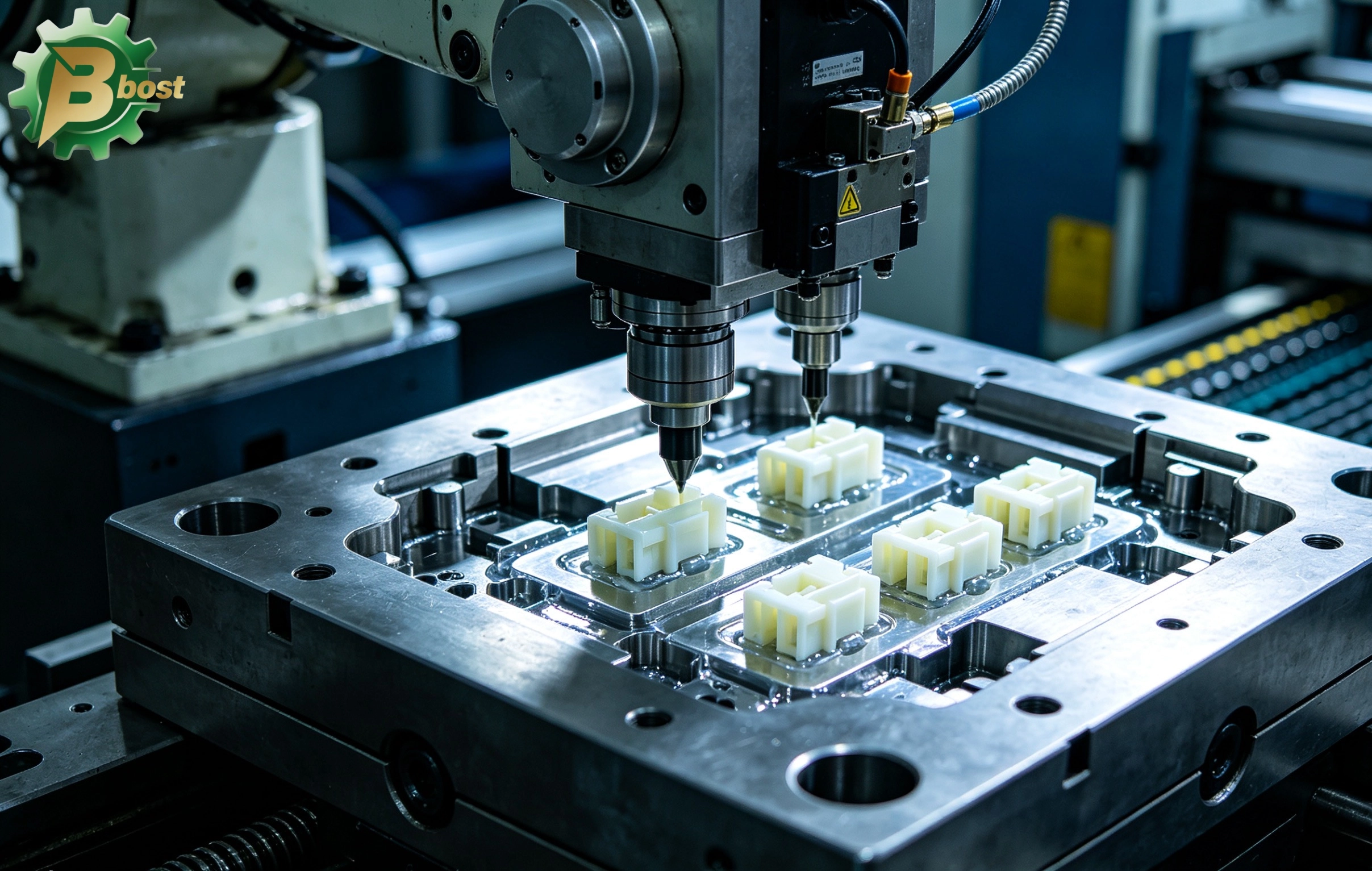
Cold runner layouts are cost-effective to engineer but generate plastic scrap with every single cycle. This wastes resin and lengthens the overall injection molding process cycle time. Implementing a premium hot runner system (such as YUDO or Mold-Masters), despite increasing the initial mold price, eliminates runner scrap entirely. This yields dramatic material cost savings over time, especially when molding high-performance, expensive engineering resins.
Eliminating Deficiencies Early: Core Pillars of High-Quality Mold Design
Seasoned manufacturing experts know that post-production issues—such as part warpage, out-of-tolerance dimensions, or severe knit lines—are almost always set in stone during the initial mold design stage. A qualified plastic mold manufacturing facility must possess the engineering acumen to mitigate structural issues before a single block of steel is cut.
Comprehensive DFM (Design for Manufacturability) Audits
Upon receiving your 3D CAD models, an elite engineering team does not simply jump straight into programming. They generate an exhaustive DFM report, reviewing draft angles, wall-thickness uniformity, and structural integrity under a microscope. For example, if a snap-fit root lacks a generous radius, engineers will flag that the section may snap due to stress concentration during 精密注塑 (precision injection molding), providing proactive design adjustments to optimize structural integrity.
Predictive Moldflow Simulations
High-tier plastic mold manufacturing depends on data-driven engineering rather than guesswork. Advanced Moldflow analysis simulates melt-front behavior inside the cavity during high-pressure injection. The table below outlines how predictive simulations resolve major B2B manufacturing pain points prior to tool steel cutting:
| Potential Part Defect | Primary Root Cause | Moldflow Engineering Solution |
|---|---|---|
| Weld Lines / Knit Lines | Convergence of multiple melt fronts at sub-optimal temperatures | Adjusting gate locations/sizes to shift weld locations and elevate fusion temperatures |
| Sink Marks | Negative pressure pulling material inward during localized cooling of thick walls | Re-engineering conformal cooling pathways or modifying wall transitions |
| Air Traps / Burn Marks | Compressed ambient air trapped in blind pockets under high velocity | Placing micro-venting slots precisely along the final filling perimeters |
| Part Warpage | Uneven volumetric shrinkage rates generating massive residual internal stresses | Establishing scientific P-V-T processing profiles and optimizing packing curves |
Machinery Hardware and Process Auditing: The Backbone of Precision Molding
As an international buyer, you cannot be on the factory floor every day to supervise your build. Therefore, conducting a thorough audit of the vendor's machine tool assets and their methodology for long-term manufacturing control is essential.
1. Micron-Level Machining Capabilities
High-precision plastic mold manufacturing requires heavy machinery engineered to hold extreme tolerances. The presence of Makino high-speed CNC centers, Makino mirror EDMs, and Sodick slow-feed wire-cutting machines serves as a tangible baseline for a supplier's capability to deliver high-end precision injection molding tools. Maintaining cavity tolerances within $\pm 0.005\text{ mm}$ guarantees long-term part interchangeability and tight assembly stack-ups across multi-million piece product runs.
2. Executing "Scientific Molding" Principles
A flawless tool is only half the equation; it must run smoothly across consecutive injection molding process campaigns. Elite manufacturers don't rely on an operator's trial-and-error adjustments during sampling phases. Instead, they implement strict Scientific Molding methodologies. By recording in-cavity pressure profiles and actual melt temperatures, they establish a robust, wide "processing window." This ensures that even if ambient factory temperatures fluctuated or resin lots varied slightly, the machine automatically normalizes the process, yielding identical part dimensions from delivery to delivery.
Transparent Project Management: Eliminating the Global Collaboration "Black Hole"
Operating across multiple time zones, languages, and cultures, the greatest fear for overseas procurement managers is a supplier going completely silent after receiving a down payment, or delivering bad news only when the final production deadline has already arrived.
A mature B2B manufacturing partner addresses this anxiety via strict, structured milestone reporting protocols. From project kickoff, you are provided with a dedicated Gantt chart tracking every stage of development. Every week, project engineers transmit a comprehensive Project Status Report (PSR) enriched with real-time photographs and video clips from the machining floor. This gives you complete visibility into rough milling, finishing, EDM, and final assembly from anywhere in the world. Within 24 hours of a T1 trial, you receive a bilingual molding parameter log, a comprehensive First Article Inspection (FAI) layout, and high-definition video captures of the sampled components. This transparency minimizes communication overhead and secures predictable timelines for your market launch.
Conclusion: Secure Your Global Manufacturing Edge with a Specialized Partner
In an industrial landscape where time-to-market efficiency and zero-defect quality govern market success, securing a strategic partner who seamlessly unites advanced engineering, material sciences, world-class plastic mold manufacturing, and high-volume precision injection molding is a major competitive advantage.
As an industry pioneer located within South China's premier manufacturing corridor, Guangzhou Bost is dedicated to the success of international B2B buyers. Driven by an elite international engineering squad, an array of premium machine tools, and rigorous quality assurance systems, we deliver turnkey engineering solutions—from early-stage DFM optimizations and high-tolerance tool builds to mass-production execution.
If you have an upcoming product launch requiring a comprehensive engineering assessment, or are currently navigating quality bottlenecks with your active vendor base, we invite you to visit our official platform at Guangzhou Bost. Submit your CAD files today to receive a complimentary DFM feasibility review along with a highly competitive project quotation tailored to your operational requirements.
Recommended for you
The Peak Art of Custom Manufacturing According to Drawings: Comprehensive Guide to Precision Solutions for Custom Parts According to Drawing
Ending Mechanical Wear and Resonance: The Comprehensive Guide to Precision Customization and Mass Production of a Custom Rubber Pad
The Ultimate Armor for Smart Hardware: Advanced Customization and Precision Injection Molding Guide for a Custom Plastic Box
The Ultimate Weapon to Tame Vibration and Noise: Deep Dive into the Custom Process and Mass Production Logic of a Custom Rubber Bushing
Product Categories
FAQ
FAQs
Can Best customize modified plastics with special properties?
Yes! We offer modification services such as reinforcement, flame retardancy, conductivity, wear resistance, and UV resistance, for example:
• Adding carbon fiber to enhance stiffness
• Reducing the coefficient of friction through PTFE modification
• Customizing food-grade or medical-grade certified materials
What are the core advantages of Best engineering plastics compared to ordinary plastics?
Best engineering plastics feature ultra-high mechanical strength, high-temperature resistance (-50°C to 300°C), chemical corrosion resistance, and wear resistance. Compared to ordinary plastics, their service life is extended by 3 to 8 times, making them suitable for replacing metals in harsh environments.
What is the delivery lead time? Do you offer global logistics?
Standard products: 5–15 working days; custom modifications: 2–4 weeks. We support global air/sea freight and provide export customs clearance documents (including REACH/UL certifications).
How do I select the appropriate engineering plastic grade for my product?
Selection should be based on parameters such as load conditions (e.g., pressure/friction), temperature range, medium contact (e.g., oil/acid), and regulatory requirements (e.g., FDA/RoHS). Our engineers can provide free material selection consulting and sample testing.
What is the minimum order quantity (MOQ)? Do you support small-batch trial production?
The MOQ for standard products is ≥100kg. We support small-batch trial production (as low as 20kg) and provide mold testing reports and performance data feedback.
You may also like
Custom Plastic Knobs Precision Injection Molded
More Details →
Custom Plastic Knobs Precision Injection Molded
Custom Injection Molded Parts from Drawings
More Details →
Custom Injection Molded Parts from Drawings
Underwater Camera Shell Custom Plastic Molding
More Details →
Underwater Camera Shell Custom Plastic Molding
Leave a Message
Have any questions or concerns about our products? Please leave us a message here, and our team will get back to you promptly.

24 hours quotes delivered
Submit CAD files, get quote in 24 hours

No MOQ required
From prototyping to high-volume

±0.02 mm Precision
Advanced CNC with full inspections

1,000+ tons in stock
26 materials ready to ship
© 2026 BOST. All Rights Reserved.