




 Scan QR Code
Send My Request
How Plastic Mold Manufacturing Affects the Quality, Cost, and Lead Time of Injection Molded Parts
2026-05-25
Plastic mold manufacturing shapes the quality, cost, and lead time of injection molded parts. Bost reveals how choosing the right custom plastic injection mold manufacturer impacts your plastic mold manufacturing cost estimate and delivery timelines for optimized production.
- Why Plastic Mold Manufacturing Is the Core of an Injection Molding Project
- Controlling Cost from Mold Design
- Material Selection Determines Long-Term Part Performance
- Precision Injection Molding Requires Higher Mold Standards
- How to Choose the Right Plastic Mold Manufacturing Supplier
- How Bost Supports Overseas Injection Molding Projects
- Conclusion
In an injection molding project, many buyers first focus on unit price. However, what truly determines the success of a project is often the early-stage plastic mold manufacturing process. A mold may look like only a production tool, but in reality, it determines dimensional stability, surface finish, assembly accuracy, material utilization, and long-term production efficiency. For industries such as automotive, electronics, medical devices, and mechanical components, small differences in mold manufacturing can directly affect whether an entire batch of products passes assembly and testing.
Bost provides overseas customers with custom engineering plastic parts, precision injection molding, overmolding, insert molding, and sealing solutions. For B2B customers who need stable long-term supply, choosing a supplier that understands materials, product structure, molds, and mass production is more important than simply looking for a low-cost factory.
Why Plastic Mold Manufacturing Is the Core of an Injection Molding Project
When developing a new product, many customers provide 2D drawings, 3D files, or samples first, and then request a quotation. But if the supplier only quotes according to the drawing without evaluating mold design, draft angle, wall thickness, shrinkage rate, gate location, and parting line, problems such as deformation, flash, sink marks, assembly interference, and unstable dimensions may appear later.
Professional plastic mold manufacturing is not just mold making. It means building the manufacturing solution based on the final application. For example, a plastic guide part used in mechanical equipment must consider wear resistance and dimensional stability. A plastic housing used in electronic devices must pay more attention to insulation, surface texture, and snap-fit strength. Different applications require different mold steel, cooling systems, venting designs, and injection molding processes.
Controlling Cost from Mold Design
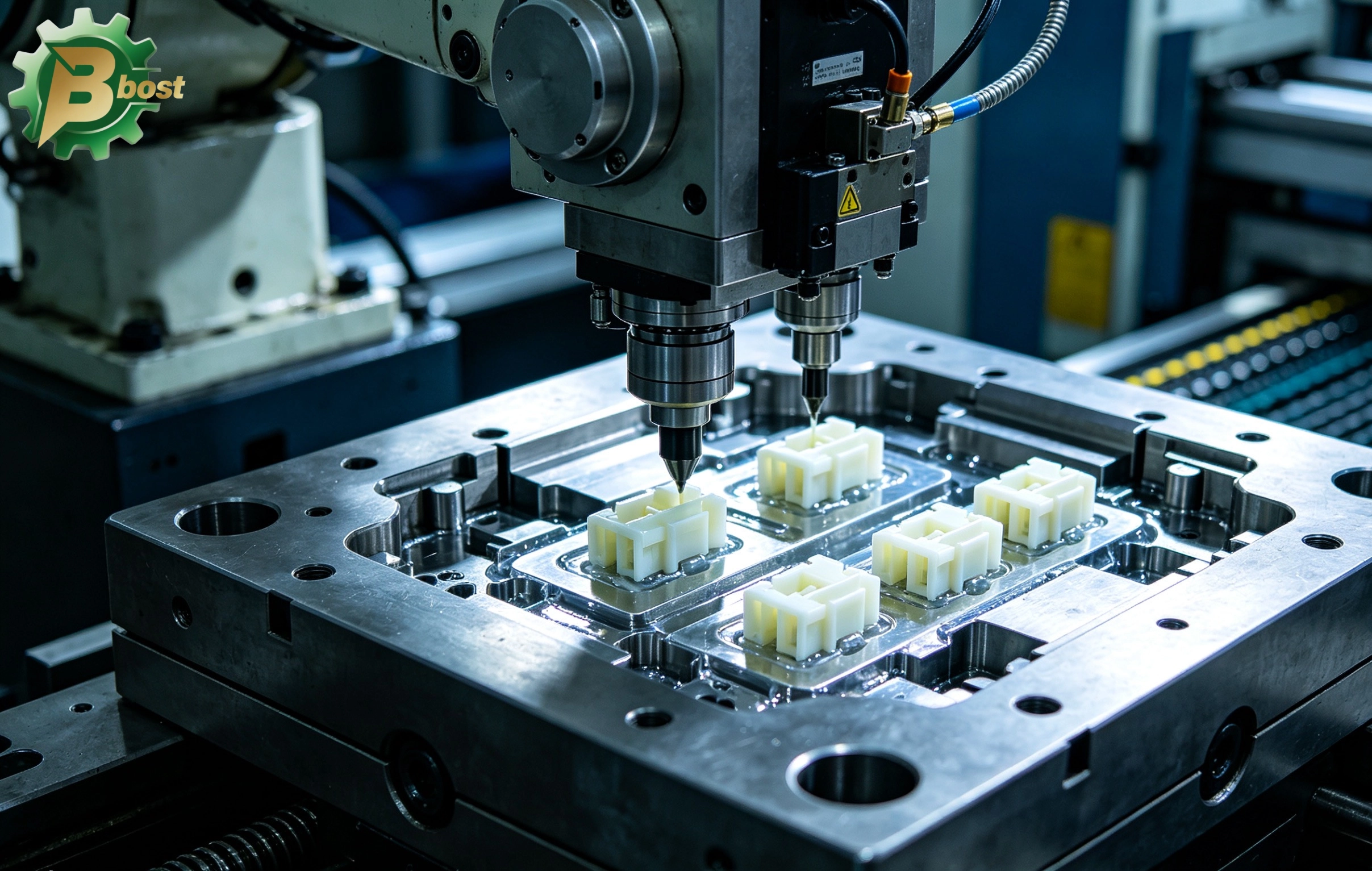
In real production, cost problems often do not appear during quotation. They appear after the first mold trial. Some structures have uneven wall thickness and are prone to sink marks. Some deep-cavity designs are difficult to release and require lifters or sliders. Some assembly areas have overly tight tolerances, causing lower yield during production. Once these issues enter the mold machining stage, any modification will increase both time and cost.
| Project Stage | Common Issue | Optimization Focus | Value for Customers |
|---|---|---|---|
| Product Design | Uneven wall thickness, too many sharp corners | DFM analysis, structure optimization | Reduce mold trial risks |
| Mold Design | Improper gate location | Parting line, cooling, venting design | Improve molding stability |
| Mold Trial | Sink marks, flash, deformation | Parameter adjustment and local mold modification | Shorten development cycle |
| Mass Production | Dimensional variation, unstable yield | Process control and inspection | Ensure stable delivery |
This is why high-quality plastic mold manufacturing must be combined with DFM evaluation. Finding problems in advance is usually far more cost-effective than repeated mold modifications later.
Material Selection Determines Long-Term Part Performance
For plastic injection molded parts, being moldable is not enough. Parts used in industrial applications must meet requirements for temperature resistance, friction, chemical corrosion, load, insulation, or biocompatibility. Common materials include ABS, PA, POM, TPE, PVDF, PEEK, PEI, and PTFE. Different materials have different shrinkage rates, processing temperatures, flow properties, and molding windows.
During plastic mold manufacturing, material parameters must be included in the design logic from the beginning. For example, high-performance engineering plastics such as PEEK require higher mold temperature and more stable processing control. TPE overmolded parts require careful evaluation of bonding strength between soft and hard materials. Insert molding must consider metal insert positioning, thermal expansion, and encapsulation strength. If the material is not selected correctly, even a highly precise mold may fail to deliver a part suitable for the actual application.
Precision Injection Molding Requires Higher Mold Standards
For small structural parts, sealing components, electronic parts, and medical device components, the challenge of precision injection molding is not only small size, but also tighter tolerance control. Mold cavity accuracy, temperature balance, ejection system, and injection parameters all affect the final dimensions.
A typical example is a sealing-related part. The customer may only see a simple plastic groove or an O-ring installation position. But if the groove width, groove depth, or chamfer design is not reasonable, the final assembly may suffer from sealing failure, difficult installation, or rework. A professional engineering team will evaluate the assembly relationship at the early stage instead of waiting until the product has already been produced. This engineering capability is one of the key differences between plastic mold manufacturing suppliers.
How to Choose the Right Plastic Mold Manufacturing Supplier
When overseas buyers choose a supplier, they should focus on several key points: whether the supplier can read and analyze 2D and 3D drawings, whether it provides DFM feedback, whether it understands engineering plastics and specialty plastics, whether it can support samples, low-volume production, and mass production, and whether it has stable quality control and delivery procedures.
Low-cost molds may look attractive at the beginning. However, if frequent mold modifications, low yield, and delayed delivery occur later, the total cost will be much higher. A reliable plastic mold manufacturing supplier should help customers reduce uncertainty before mold making, maintain stable quality during production, and continuously optimize cost after mass production begins.
How Bost Supports Overseas Injection Molding Projects
Bost’s value is not limited to plastic part processing. The company combines material experience, mold design, injection molding processes, and quality control to provide complete solutions for customers. From drawing evaluation, material recommendation, mold manufacturing, mold trial confirmation, to mass production delivery, every step is planned around the actual application of the product.
If you are developing engineering plastic parts, overmolded parts, insert molded parts, sealing structures, or custom injection molded components, you can send your drawings, samples, or project requirements to the Bost team. Based on product structure, material performance, application environment, and purchasing goals, Bost can provide a more production-ready plastic mold manufacturing solution.
Conclusion
For B2B injection molding projects, a mold is not a one-time cost. It is a basic asset that affects the entire product life cycle. Good plastic mold manufacturing reduces trial-and-error, improves yield, shortens lead time, and helps products remain stable in real applications. Choosing the right injection molding partner means building a stronger foundation for mass production quality and supply chain efficiency.
To learn more about injection molding solutions or request a project quotation, visit the Bost website and submit your drawings and requirements.
Recommended for you
The Peak Art of Custom Manufacturing According to Drawings: Comprehensive Guide to Precision Solutions for Custom Parts According to Drawing
Ending Mechanical Wear and Resonance: The Comprehensive Guide to Precision Customization and Mass Production of a Custom Rubber Pad
The Ultimate Armor for Smart Hardware: Advanced Customization and Precision Injection Molding Guide for a Custom Plastic Box
The Ultimate Weapon to Tame Vibration and Noise: Deep Dive into the Custom Process and Mass Production Logic of a Custom Rubber Bushing
Product Categories
FAQ
FAQs
Can Bost customize modified plastics with special properties?
Yes! We offer modification services such as reinforcement, flame retardancy, conductivity, wear resistance, and UV resistance, for example:
• Adding carbon fiber to enhance stiffness
• Reducing the coefficient of friction through PTFE modification
• Customizing food-grade or medical-grade certified materials
What is the delivery lead time? Do you offer global logistics?
Standard products: 5–15 working days; custom modifications: 2–4 weeks. We support global air/sea freight and provide export customs clearance documents (including REACH/UL certifications).
How do I select the appropriate engineering plastic grade for my product?
Selection should be based on parameters such as load conditions (e.g., pressure/friction), temperature range, medium contact (e.g., oil/acid), and regulatory requirements (e.g., FDA/RoHS). Our engineers can provide free material selection consulting and sample testing.
What are the core advantages of Bost engineering plastics compared to ordinary plastics?
Bost engineering plastics feature ultra-high mechanical strength, high-temperature resistance (-50°C to 300°C), chemical corrosion resistance, and wear resistance. Compared to ordinary plastics, their service life is extended by 3 to 8 times, making them suitable for replacing metals in harsh environments.
What is the minimum order quantity (MOQ)? Do you support small-batch trial production?
The MOQ for standard products is ≥100kg. We support small-batch trial production (as low as 20kg) and provide mold testing reports and performance data feedback.
You may also like
Custom Plastic Knobs Precision Injection Molded
More Details →
Custom Plastic Knobs Precision Injection Molded
Custom Injection Molded Parts from Drawings
More Details →
Custom Injection Molded Parts from Drawings
Underwater Camera Shell Custom Plastic Molding
More Details →
Underwater Camera Shell Custom Plastic Molding
Leave a Message
Have any questions or concerns about our products? Please leave us a message here, and our team will get back to you promptly.

24 hours quotes delivered
Submit CAD files, get quote in 24 hours

No MOQ required
From prototyping to high-volume

±0.02 mm Precision
Advanced CNC with full inspections

1,000+ tons in stock
26 materials ready to ship
© 2026 BOST. All Rights Reserved.