




 Scan QR Code
Send My Request
In-Depth Analysis: How Overseas Buyers Balance Quality and Cost in Plastic Parts with Mold Opening via Precision Injection Molding
2026-06-01
Plastic parts with mold opening and custom injection molded parts with mold opening require precise cost-quality balancing. Bost reveals how overseas buyers optimize production through targeted material choices and mold design strategies to ensure high-quality outcomes without overspending.
- 1. From Blueprint to Steel Stamp: Why Mold Design Dictates the Fate of Plastic Parts with Mold Opening
- 1. Front-End Intervention of DFM (Design for Manufacturability)
- 2. Digital Validation via Moldflow Analysis
- 2. Dynamic Balance Between Material Selection and Tool Life: The Core Logic of Custom Manufacturing
- 3. Scientific Injection Molding Process: The Critical Path to Eradicating Surface Defects
- 1. Rigorous Control of the Molding Trio: Temperature, Pressure, and Time
- 2. Automated Poka-Yoke and Full Inspection Protocols
- 4. Minimizing Total Cost of Sourcing: Aligning with a Partner Who Understands B2B Pain Points
- Conclusion & Call to Action (CTA)
In the real-world scenarios of overseas B2B custom procurement, project engineers and purchasing managers frequently encounter a frustrating reality: a design blueprint looks nearly flawless on paper, but once actual production begins, issues like delivery delays, surface sink marks, and dimensional out-of-tolerance run rampant. For industrial and consumer components that heavily rely on customized tooling, opting for plastic parts with mold opening services is not merely a technical decision—it is a critical business strategy involving full-lifecycle cost control and supply chain synergy.
The success of a high-stakes injection molded part project is often determined long before the first cut is made into the tooling steel. From the perspective of a veteran digital marketing expert and injection molding engineer, this article will dissect how to achieve the efficient delivery of top-tier plastic components through front-end mold design optimization and scientific injection molding processes.
1. From Blueprint to Steel Stamp: Why Mold Design Dictates the Fate of Plastic Parts with Mold Opening
In the injection molding industry, the mold is justly crowned the "Mother of Industries." Many overseas buyers fixate solely on the unit part price during the RFQ stage, overlooking the fact that tool design is the absolute bottleneck governing subsequent mass-production yield rates and long-term expenses.
1. Front-End Intervention of DFM (Design for Manufacturability)
A mature manufacturing supplier will never blindly rush into tool fabrication upon receiving a client’s 3D CAD files. Instead, our engineering team initiates a rigorous DFM analysis. For instance, we audit the wall thickness for uniformity. If the wall thickness variance is too drastic, vacuum voids or surface sink marks will inevitably manifest in the thicker sections during cooling, compromising both the aesthetics and structural integrity of the plastic parts with mold opening. Introducing structural ribs or optimizing the draft angle early in the design stage fundamentally prevents part stripping damage down the line.
2. Digital Validation via Moldflow Analysis
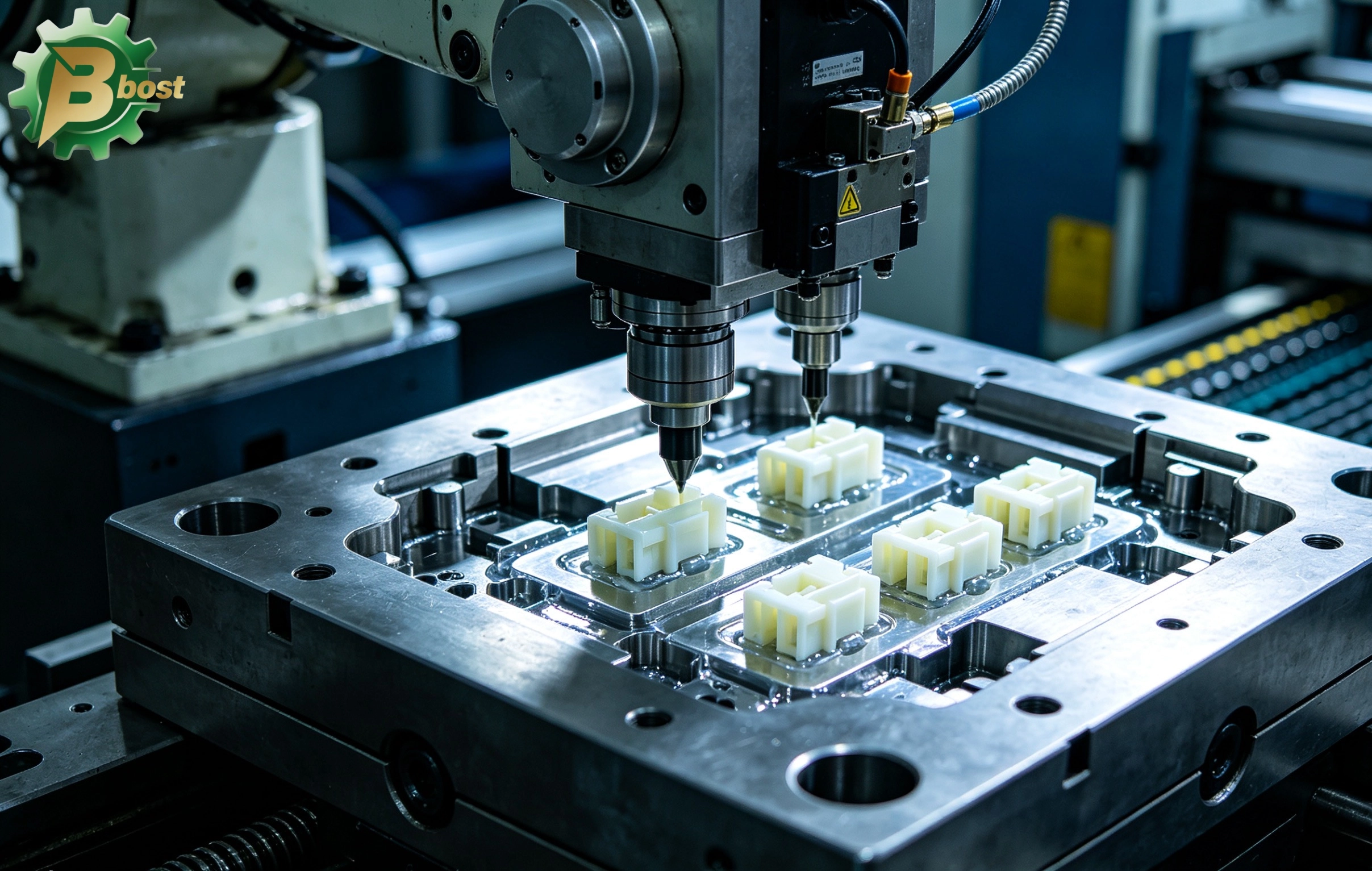
Prior to cutting steel, simulating the flow behavior of molten resin within the cavities using professional Moldflow software is paramount. It accurately predicts the positioning of knit lines, potential air traps, and gate pressure distribution. For plastic parts with mold opening projects characterized by intricate geometries, a scientifically calculated gate location ensures a more uniform molecular alignment of long glass fibers or specialized engineering resins, thereby drastically mitigating part warping induced by residual internal stress.
2. Dynamic Balance Between Material Selection and Tool Life: The Core Logic of Custom Manufacturing
Varying product applications demand drastically divergent criteria for both mold steel types and raw plastic materials. When planning a plastic parts with mold opening project, blindly chasing ultra-expensive materials or excessively compressing the tooling budget are equally counterproductive approaches.
To enable supply chain managers and procurement engineers to visualize and evaluate project investments more intuitively, we have synthesized the following professional comparison matrix regarding mold classification and material matching:
| Production Scale & Requirement Level | Recommended Tool Steel | Applicable Engineering Plastics (Examples) | Mold Design Life (Shots) | Core Technical Focus & Advantages |
|---|---|---|---|---|
| Prototype / Low-Volume Trial | P20, 718H (Pre-hardened Steel) | ABS, PP, PC, TPE | 50,000 - 100,000 | Rapid tooling turnaround, low fabrication cost; ideal for market validation and early prototyping. |
| Medium-Volume Industrial Production | NAK80, H13 (Hot-work Tool Steel) | PA66+GF, PC/ABS, PMMA | 100,000 - 500,000 | Excellent wear and impact resistance, high dimensional stability; perfect for functional components. |
| High-Precision / Mass Production | S136 (Mirror-finish Rust-resistant Steel), M310 | PEEK, LCP, PPS, High-gloss Mirror PC | Over 500,000 | Superb corrosion resistance and mirror-polish performance; tailored for medical, electronic, and high-aesthetic precision parts. |
In real-world manufacturing, if your product utilizes highly abrasive glass-fiber reinforced nylon (PA+GF), but a lower-hardness pre-hardened steel mold is mistakenly selected, the cavities will erode after just a tens of thousands of cycles. This erosion results in flash and dimensional discrepancies in the finished plastic parts with mold opening.
3. Scientific Injection Molding Process: The Critical Path to Eradicating Surface Defects
A high-quality mold accounts for only half the battle. How to fully unlock the potential of that tooling through precision tuning on the injection shop floor serves as the true benchmark of a factory's underlying capabilities.
1. Rigorous Control of the Molding Trio: Temperature, Pressure, and Time
In precision injection molding, melt temperature, injection pressure, and holding time must establish a closed-loop control system. Taking plastic parts with mold opening utilizing high-performance engineering plastics as an example, the packing and holding phase is extraordinarily critical. If holding pressure is insufficient, the plastic material cannot be replenished in time during cooling contraction, causing surface depressions. Conversely, excessive packing pressure introduces excessive internal residual stress, making the parts prone to cracking or deformation under the high-temperature conditions of overseas container shipping.
2. Automated Poka-Yoke and Full Inspection Protocols
Modern injection molding facilities have outgrown their historical over-reliance on manual shop-floor experience. When manufacturing high-precision plastic parts with mold opening, embedding pressure and cavity temperature sensors inside the mold allows real-time monitoring of every single injection curve. Should the data deviate from preset tolerances, a robotic arm automatically segregates the non-conforming parts. Furthermore, integrated CCD visual inspection systems perform second-level online checks for critical diameters and cosmetic defects, guaranteeing impeccable consistency across every delivered batch.
4. Minimizing Total Cost of Sourcing: Aligning with a Partner Who Understands B2B Pain Points
For overseas buyers, the hidden costs of procuring plastic parts with mold opening often lurk within communication friction, repetitive mold reworks, and the time squandered on failed quality inspections.
A seasoned overseas digital marketing and engineering support team must not only comprehend full-English GD&T (Geometric Dimensioning and Tolerancing) prints but also possess comprehensive project management capabilities. From the-proof packaging design—the professionalism of each link directly shapes the buyer's overall procurement experience and project execution speed.
Whether handling automotive structural components, medical device enclosures, or high-density electronic interconnects, the genuine competitive edge lies in seamlessly weaving "Lean Manufacturing" into every millisecond and every micron of tool making and injection molding.
Conclusion & Call to Action (CTA)
Developing custom overseas plastic components is a marathon. By executing front-end design interventions, scientific tool steel selection, and stringent scientific injection molding process controls, you can heavily slash quality risks and rework costs after production kickoff.
If you are currently searching for a powerful manufacturer capable of providing a turnkey solution for high-quality plastic parts with mold opening, please visit our official website: Guangzhou Bost Co., Ltd. (GZ-Bost). Our team of engineering specialists boasts extensive experience in delivering overseas B2B projects and stands ready to provide you with a complimentary DFM evaluation and an accurate project quotation. Let us empower your global supply chain with our elite precision injection molding expertise!
Recommended for you
The Peak Art of Custom Manufacturing According to Drawings: Comprehensive Guide to Precision Solutions for Custom Parts According to Drawing
Ending Mechanical Wear and Resonance: The Comprehensive Guide to Precision Customization and Mass Production of a Custom Rubber Pad
The Ultimate Armor for Smart Hardware: Advanced Customization and Precision Injection Molding Guide for a Custom Plastic Box
The Ultimate Weapon to Tame Vibration and Noise: Deep Dive into the Custom Process and Mass Production Logic of a Custom Rubber Bushing
Product Categories
FAQ
FAQs
What is the minimum order quantity (MOQ)? Do you support small-batch trial production?
The MOQ for standard products is ≥100kg. We support small-batch trial production (as low as 20kg) and provide mold testing reports and performance data feedback.
What is the delivery lead time? Do you offer global logistics?
Standard products: 5–15 working days; custom modifications: 2–4 weeks. We support global air/sea freight and provide export customs clearance documents (including REACH/UL certifications).
How do I select the appropriate engineering plastic grade for my product?
Selection should be based on parameters such as load conditions (e.g., pressure/friction), temperature range, medium contact (e.g., oil/acid), and regulatory requirements (e.g., FDA/RoHS). Our engineers can provide free material selection consulting and sample testing.
What are the core advantages of Bost engineering plastics compared to ordinary plastics?
Bost engineering plastics feature ultra-high mechanical strength, high-temperature resistance (-50°C to 300°C), chemical corrosion resistance, and wear resistance. Compared to ordinary plastics, their service life is extended by 3 to 8 times, making them suitable for replacing metals in harsh environments.
Can Bost customize modified plastics with special properties?
Yes! We offer modification services such as reinforcement, flame retardancy, conductivity, wear resistance, and UV resistance, for example:
• Adding carbon fiber to enhance stiffness
• Reducing the coefficient of friction through PTFE modification
• Customizing food-grade or medical-grade certified materials
You may also like
Custom Plastic Knobs Precision Injection Molded
More Details →
Custom Plastic Knobs Precision Injection Molded
Custom Injection Molded Parts from Drawings
More Details →
Custom Injection Molded Parts from Drawings
Underwater Camera Shell Custom Plastic Molding
More Details →
Underwater Camera Shell Custom Plastic Molding
Leave a Message
Have any questions or concerns about our products? Please leave us a message here, and our team will get back to you promptly.

24 hours quotes delivered
Submit CAD files, get quote in 24 hours

No MOQ required
From prototyping to high-volume

±0.02 mm Precision
Advanced CNC with full inspections

1,000+ tons in stock
26 materials ready to ship
© 2026 BOST. All Rights Reserved.