




 Scan QR Code
Send My Request
In-depth Analysis: How to Achieve a Win-Win Situation in Product Quality and Cost through Injection Molding Optimization?
2026-04-16
Discover how Bost, a leading precision injection molded parts manufacturer and low volume injection molding supplier, achieves a win-win in product quality and cost. Explore expert injection molding optimization strategies to enhance efficiency and value in your production process.
- I. The "Three Pillars" of Injection Molding Quality
- 1. Precision in Mold Design
- 2. Material Selection and Drying
- 3. Scientific Setting of Process Parameters
- II. Technology Comparison: Why Precision Molding is the Future
- III. Addressing Customer Pain Points: Solving Common Defects
- Sink Marks and Voids
- Flash
- Silver Streaks and Bubbles
- IV. Cost Reduction: How to Optimize Your Injection Molding Project?
- V. Conclusion: Choosing a Professional Injection Molding Partner
In today's highly competitive global manufacturing landscape—spanning industries like automotive, medical devices, and consumer electronics—Injection Molding is more than just a basic processing method. It is the core link that determines a product's time-to-market and cost structure. As a professional supplier deeply rooted in the industry, GZ-Bost understands that when customers look for a partner, they aren't just asking "can you do it?" but rather "how can you do it better, cheaper, and faster?"
This article will provide a professional breakdown of the key influencing factors in the Injection Molding process and offer actionable optimization solutions to help your products stand out in the market.
I. The "Three Pillars" of Injection Molding Quality
In actual production scenarios, a minor parameter fluctuation can lead to the scrapping of an entire batch. To achieve high yield rates, balance must be reached across these three dimensions:
1. Precision in Mold Design
The mold is the soul of Injection Molding. Excellent mold design must account for the balance of the cooling system. If cooling is uneven, the product is highly prone to warping and deformation after ejection. Furthermore, the selection of the Gate position directly affects the melt flow trajectory, which determines whether the product surface will have gas marks or weld lines.
2. Material Selection and Drying
From PP and ABS to high-performance PEEK or PPS, different resins react differently to temperature and pressure. Many production issues stem not from the machine, but from excessive moisture in the raw material. For engineering plastics, a rigorous drying process is a prerequisite for ensuring stable physical properties.
3. Scientific Setting of Process Parameters
This includes injection pressure, holding pressure, back pressure, and cycle time. Experienced engineers utilize multi-stage pressure control during the Injection Molding process based on the wall thickness distribution to eliminate shrinkage issues.
II. Technology Comparison: Why Precision Molding is the Future
To help you better understand the positioning of different molding solutions, we have compiled the following table. You can use this as a benchmark when choosing a supplier based on your product’s end-use application.
| Evaluation Metric | Traditional Injection Molding | High-Precision Injection Molding (GZ-Bost Standard) | Impact on Product Performance |
| Tolerance Control | ±0.1mm to ±0.2mm | ±0.01mm to ±0.05mm | Affects assembly precision and sealing |
| Surface Quality | Visible weld lines, bubbles | Mirror-finish or uniform texture | Determines aesthetic appeal of electronics |
| Mold Life | 100k - 300k cycles | 500k - 1M+ cycles | Reduces long-term unit cost |
| Wall Uniformity | Moderate, prone to sink marks | Excellent, optimized via flow analysis | Impacts mechanical strength of parts |
III. Addressing Customer Pain Points: Solving Common Defects
Through communication with numerous international B2B clients, we’ve found that "delivery delays" and "poor batch consistency" are the biggest pain points. These issues often stem from the following technical bottlenecks:
Sink Marks and Voids
These usually occur at thick-to-thin transitions. The solution lies not just in increasing holding pressure, but in optimizing the Design for Manufacturing (DFM) stage. We advise clients to thin out ribs or improve cooling efficiency to root out these issues.
Flash
When the clamping force is insufficient or the mold is heavily worn, melt enters the parting line. This not only increases manual trimming costs but indicates a loss of process control. In our Injection Molding production, we use closed-loop control systems to monitor clamping force fluctuations in real-time, ensuring crisp edges on every part.
Silver Streaks and Bubbles
This is often related to improper material handling or excessive injection speeds. When dealing with high-performance engineering plastics, vacuum venting systems and precise drying equipment are indispensable.
IV. Cost Reduction: How to Optimize Your Injection Molding Project?
Many procurement managers mistakenly believe that lowering the unit price is the only way to save money. However, true cost optimization comes from shortening the "Cycle Time" and reducing the "Scrap Rate."
-
Cycle Time Optimization: Cooling time accounts for over 60% of the injection cycle. By optimizing internal mold water lines (such as using Conformal Cooling), the cycle can be shortened by 15%-20%.
-
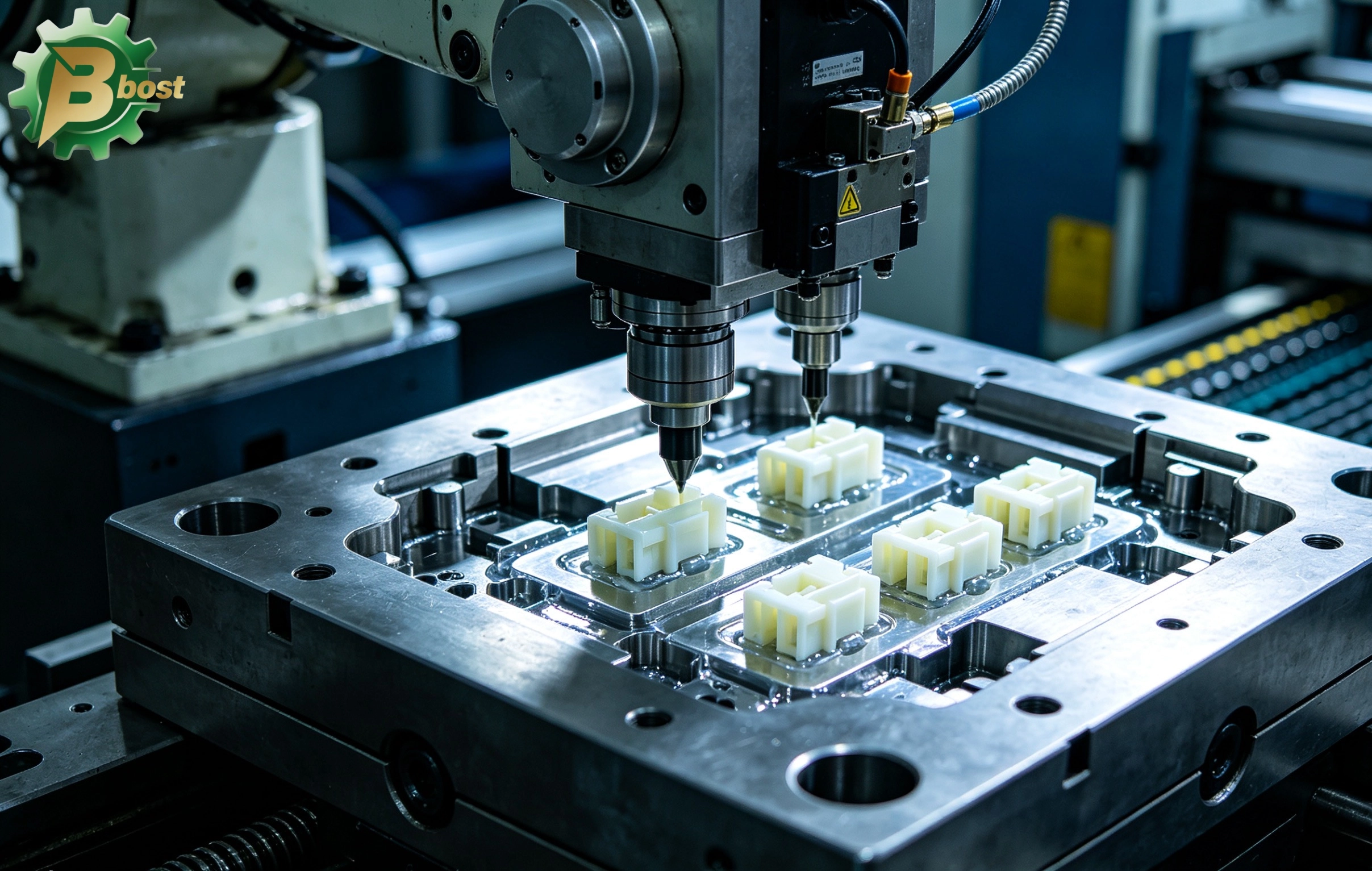
Automated Production: Implementing robotic arms for part removal and in-line inspection significantly reduces secondary damage caused by human factors and ensures consistency during 24-hour continuous production.
V. Conclusion: Choosing a Professional Injection Molding Partner
Injection Molding is by no means a simple "heat and squeeze" process; it is a sophisticated art that blends material science, fluid dynamics, and precision mechanical engineering. At GZ-Bost, we are committed to transforming every gram of raw material into a competitive, high-quality component.
If you are currently facing challenges in product development or are looking for a partner who can provide high-precision and high-stability solutions, visit our website at https://www.gz-bost.com. You can submit your drawings online, and our engineering team will provide a professional Injection Molding feasibility assessment and quote within 24 hours.
Recommended for you
The Peak Art of Custom Manufacturing According to Drawings: Comprehensive Guide to Precision Solutions for Custom Parts According to Drawing
Ending Mechanical Wear and Resonance: The Comprehensive Guide to Precision Customization and Mass Production of a Custom Rubber Pad
The Ultimate Armor for Smart Hardware: Advanced Customization and Precision Injection Molding Guide for a Custom Plastic Box
The Ultimate Weapon to Tame Vibration and Noise: Deep Dive into the Custom Process and Mass Production Logic of a Custom Rubber Bushing
Product Categories
FAQ
FAQs
What is the delivery lead time? Do you offer global logistics?
Standard products: 5–15 working days; custom modifications: 2–4 weeks. We support global air/sea freight and provide export customs clearance documents (including REACH/UL certifications).
What are the core advantages of Bost engineering plastics compared to ordinary plastics?
Bost engineering plastics feature ultra-high mechanical strength, high-temperature resistance (-50°C to 300°C), chemical corrosion resistance, and wear resistance. Compared to ordinary plastics, their service life is extended by 3 to 8 times, making them suitable for replacing metals in harsh environments.
How do I select the appropriate engineering plastic grade for my product?
Selection should be based on parameters such as load conditions (e.g., pressure/friction), temperature range, medium contact (e.g., oil/acid), and regulatory requirements (e.g., FDA/RoHS). Our engineers can provide free material selection consulting and sample testing.
Can Bost customize modified plastics with special properties?
Yes! We offer modification services such as reinforcement, flame retardancy, conductivity, wear resistance, and UV resistance, for example:
• Adding carbon fiber to enhance stiffness
• Reducing the coefficient of friction through PTFE modification
• Customizing food-grade or medical-grade certified materials
What is the minimum order quantity (MOQ)? Do you support small-batch trial production?
The MOQ for standard products is ≥100kg. We support small-batch trial production (as low as 20kg) and provide mold testing reports and performance data feedback.
You may also like
Custom Plastic Knobs Precision Injection Molded
More Details →
Custom Plastic Knobs Precision Injection Molded
Custom Injection Molded Parts from Drawings
More Details →
Custom Injection Molded Parts from Drawings
Underwater Camera Shell Custom Plastic Molding
More Details →
Underwater Camera Shell Custom Plastic Molding
Leave a Message
Have any questions or concerns about our products? Please leave us a message here, and our team will get back to you promptly.

24 hours quotes delivered
Submit CAD files, get quote in 24 hours

No MOQ required
From prototyping to high-volume

±0.02 mm Precision
Advanced CNC with full inspections

1,000+ tons in stock
26 materials ready to ship
© 2026 BOST. All Rights Reserved.