




 Scan QR Code
Send My Request
In-depth Analysis: How to Create High-Strength Custom Plastic Brackets Through Precision Injection Molding
2026-05-20
Custom plastic bracket design and manufacturing require precise injection molding techniques to ensure high strength and durability. Bost details key methods for custom plastic bracket manufacturers to optimize material selection, mold design, and processing parameters for superior custom injection molded plastic brackets.
- Why is the Custom Plastic Bracket Increasingly Favored in Modern Manufacturing?
- The Three Core Pillars of Crafting a High-Quality Custom Plastic Bracket
- 1. Scientific Early-Stage Mold Design
- 2. Precise Material Selection and Matching
- 3. Advanced Precision Injection Molding Process
- Solving Your Injection Molding Pain Points: Why Choose GZ-BOST?
In the modern landscape of industrial design and manufacturing, a bracket, though often a minor component within an overall product structure, plays a core role in fixing, supporting, and connecting. As the trend of lightweighting sweeps across multiple industries—such as automotive, medical devices, consumer electronics, and aerospace—traditional metal brackets are being replaced by engineering plastics at an astonishing rate.
However, successfully developing and mass-producing a custom plastic bracket that meets high standards and strict requirements is no easy task. When searching for a reliable supplier, many procurement managers and engineers frequently encounter headaches such as excessive dimensional tolerances, breakage under load, or severe sink marks on the surface. These issues, which appear to be late-stage quality defects, are actually hidden dangers planted during the early stages of design and process selection.
As a professional manufacturing factory deeply rooted in the injection molding industry for years, today we will provide you with an in-depth analysis of how to create the perfect custom plastic bracket from multiple core dimensions: material characteristics, mold design, and precision injection. We will also provide a troubleshooting guide to help you avoid common pitfalls.
Why is the Custom Plastic Bracket Increasingly Favored in Modern Manufacturing?
Before delving into the technical details, we must first understand the underlying logic of this market shift. Why are more and more R&D teams replacing metal parts with a custom plastic bracket in their BOM (Bill of Materials)?
The first reason is extreme lightweighting. Under the same volume, the weight of engineering plastics is only one-sixth to one-seventh that of steel. Even when compared with aluminum alloys, plastics offer a significant weight reduction advantage. For new energy vehicles and portable medical equipment, this translates to improved battery life and a leap in user experience.
The second reason is high design freedom and cost control. Metal processing often requires complex CNC procedures (turning, milling, planing, grinding) or die-casting processes. Limited by machining tools, many complex internal irregular structures are difficult to realize. In contrast, mature injection molding processes can form extremely complex geometric shapes in a single shot, perfectly integrating snap-fits, ribs, and threaded holes. Once the mold enters mass production, the marginal cost of a single custom plastic bracket drops exponentially, greatly enhancing the product's market competitiveness.
Furthermore, plastics inherently possess excellent insulation, corrosion resistance, and customizable color appearances—added values that are difficult for traditional metals to match.
The Three Core Pillars of Crafting a High-Quality Custom Plastic Bracket
To produce a custom plastic bracket that maintains physical strength in harsh environments while achieving perfect fitment on the assembly line, the key lies in the seamless integration of the following three core stages.
1. Scientific Early-Stage Mold Design
As the industry saying goes, "Seven parts mold, three parts injection." The soul of a high-precision custom plastic bracket lies in mold design. Bracket products usually need to withstand tension, shear, or torque; therefore, mechanical distribution must be fully considered during the design phase.
-
Clever Use of Ribs: To increase the structural strength of the bracket without blindly increasing wall thickness (which causes uneven cooling and surface shrinkage), professional mold engineers design reasonable ribs in stress-concentrated areas. The thickness of the ribs should typically be controlled between 50% and 70% of the main wall thickness.
-
Design of Draft Angles: To ensure that the custom plastic bracket is not scratched or deformed during ejection, a draft angle of at least 1 to 2 degrees must be reserved during design. For brackets requiring a textured surface, this angle needs to be further increased.
-
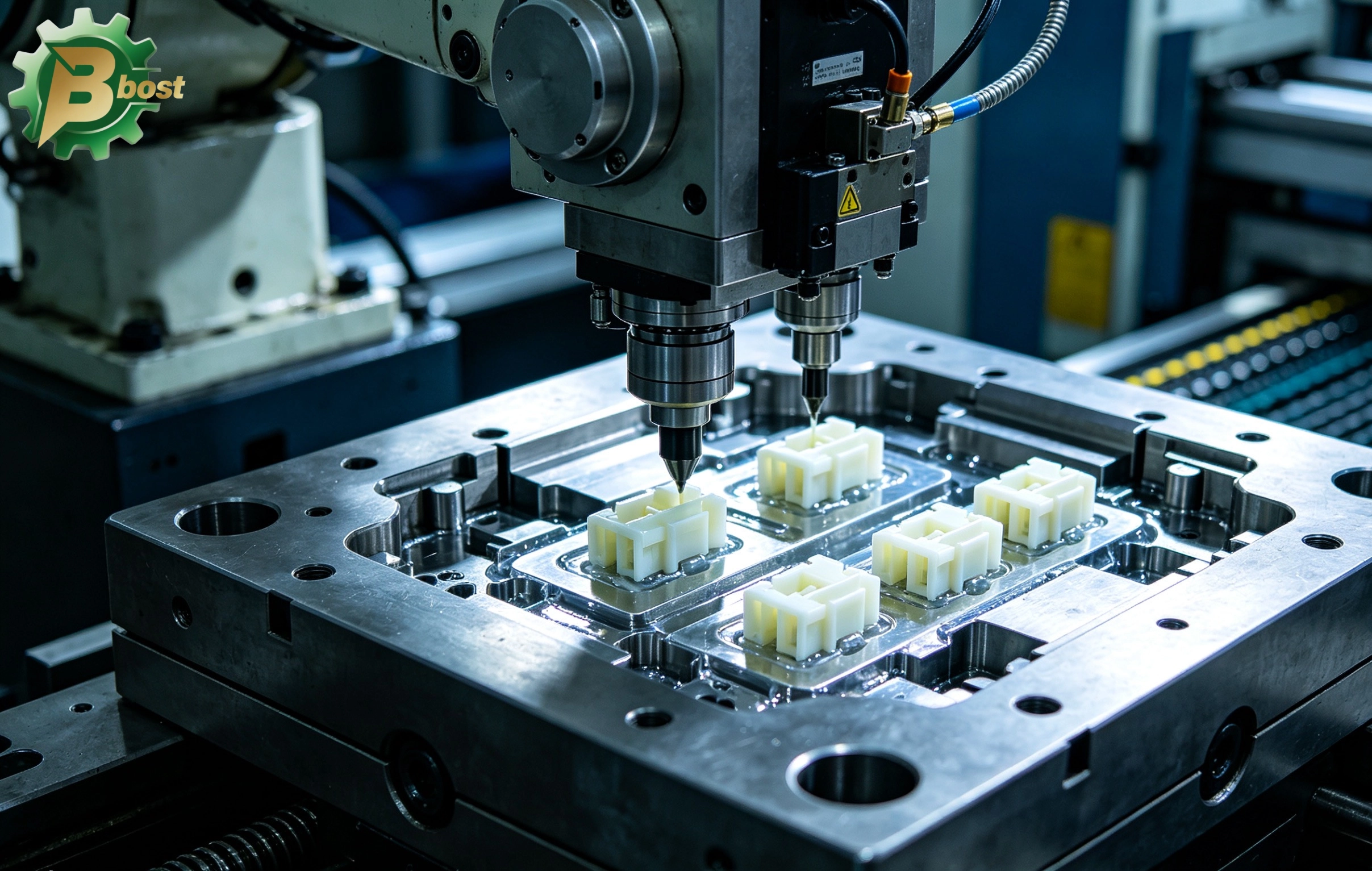
Precise Positioning of the Gate: The location of the gate directly determines the flow path of molten plastic in the mold cavity and the formation location of weld lines. For load-bearing custom plastic brackets, we must use Moldflow analysis to ensure that weld lines avoid the core stress areas of the product, preventing fracture from these weak points during use.
2. Precise Material Selection and Matching
Different application scenarios have vastly different physical performance requirements for a custom plastic bracket. Choosing the wrong material will lead to product failure, no matter how perfect the mold and process are. To give engineers a clear understanding at a glance during selection, we have compiled the following comparison table of common engineering plastics:
| Material | Core Advantages | Typical Bracket Applications | Cost |
| ABS | Excellent impact resistance, easy for surface treatments (e.g., plating, painting), good dimensional stability. | Internal brackets for consumer electronics, home appliance mounting bases. | Medium-Low |
| PC (Polycarbonate) | Superior mechanical strength, high impact resistance, excellent high-temperature resistance (approx. 120°C). | Medical device structural brackets, automotive headlight internal brackets. | Higher |
| PA66 + GF (Nylon + Glass Fiber) | Extremely high tensile strength and rigidity, excellent wear resistance, resistant to grease and chemical solvents. | Automotive engine bay peripheral brackets, heavy machinery load-bearing brackets. | Medium-High |
| POM (Acetal/Delrin) | Outstanding fatigue resistance, known as "metal in plastics," good self-lubrication, low friction coefficient. | Precision transmission brackets requiring frequent disassembly or involving sliding friction. | Medium |
In actual production, to further enhance the strength of a custom plastic bracket, we frequently advise clients to adopt glass fiber (GF) reinforced materials. For example, PA66 added with 30% glass fiber can achieve a strength comparable to some die-cast aluminum alloys.
3. Advanced Precision Injection Molding Process
Once materials and molds are ready, the final test falls on the precision injection stage. This is not simply melting plastic and shooting it into a mold; it is a complex dynamic balancing process involving four dimensions: temperature, pressure, speed, and time.
For a custom plastic bracket, dimensional stability and warping are the most common pain points.
During production, we use closed-loop controlled high-precision injection molding machines to strictly set multi-stage injection speeds and holding pressures. If the wall thickness of the bracket is uneven, the melt will experience a differential shrinkage during cooling, leading to product warping. At this point, professional technicians will optimize the cooling water temperature (e.g., using different temperature controls for the fixed and moving halves of the mold) and precisely set the holding pressure time. This maximizes the offset of shrinkage stress, ensuring that every custom plastic bracket leaving the factory meets stringent tolerance standards.
Solving Your Injection Molding Pain Points: Why Choose GZ-BOST?
Many companies only realize the importance of choosing an injection molding factory with a deep engineering background after suffering through supplier delivery delays, stubbornly high defect rates, and expensive communication costs.
At GZ-BOST, we are not just an OEM that "manufactures according to drawings"; we are your manufacturing partner. Starting from the moment you have a conceptual drawing of a custom plastic bracket, our engineering team will step in. We conduct Design for Manufacturability (DFM) reviews to identify potential risks such as shrinkage, trapped air, and deformation in advance, providing optimized solutions. This front-loaded professional service can save you weeks of trial-and-error time and tens of thousands of dollars in mold modification costs.
We possess over a decade of practical experience in mold design, precision machining, and the injection molding of highly difficult engineering plastics. Equipped with a full set of modern processing and testing equipment, we ensure that your custom plastic bracket maintains absolute and consistent high quality—whether in the prototype stage of a few dozen pieces or the mass production stage of millions.
Are you ready to transform your design into a perfect physical product?
Do not let unprofessional manufacturing processes become the bottleneck restricting your product's success. If you are currently facing R&D challenges with a custom plastic bracket, or if you are looking for a long-term partner with more stable quality and optimized costs, please visit our official website immediately: https://www.gz-bost.com. Contact GZ-BOST's team of engineering experts to get a free project evaluation and a detailed quotation. Let us empower your product's competitiveness with our professional injection molding solutions!
Recommended for you
The Peak Art of Custom Manufacturing According to Drawings: Comprehensive Guide to Precision Solutions for Custom Parts According to Drawing
Ending Mechanical Wear and Resonance: The Comprehensive Guide to Precision Customization and Mass Production of a Custom Rubber Pad
The Ultimate Armor for Smart Hardware: Advanced Customization and Precision Injection Molding Guide for a Custom Plastic Box
The Ultimate Weapon to Tame Vibration and Noise: Deep Dive into the Custom Process and Mass Production Logic of a Custom Rubber Bushing
Product Categories
FAQ
FAQs
Can Bost customize modified plastics with special properties?
Yes! We offer modification services such as reinforcement, flame retardancy, conductivity, wear resistance, and UV resistance, for example:
• Adding carbon fiber to enhance stiffness
• Reducing the coefficient of friction through PTFE modification
• Customizing food-grade or medical-grade certified materials
How do I select the appropriate engineering plastic grade for my product?
Selection should be based on parameters such as load conditions (e.g., pressure/friction), temperature range, medium contact (e.g., oil/acid), and regulatory requirements (e.g., FDA/RoHS). Our engineers can provide free material selection consulting and sample testing.
What is the delivery lead time? Do you offer global logistics?
Standard products: 5–15 working days; custom modifications: 2–4 weeks. We support global air/sea freight and provide export customs clearance documents (including REACH/UL certifications).
What are the core advantages of Bost engineering plastics compared to ordinary plastics?
Bost engineering plastics feature ultra-high mechanical strength, high-temperature resistance (-50°C to 300°C), chemical corrosion resistance, and wear resistance. Compared to ordinary plastics, their service life is extended by 3 to 8 times, making them suitable for replacing metals in harsh environments.
What is the minimum order quantity (MOQ)? Do you support small-batch trial production?
The MOQ for standard products is ≥100kg. We support small-batch trial production (as low as 20kg) and provide mold testing reports and performance data feedback.
You may also like
Custom Plastic Knobs Precision Injection Molded
More Details →
Custom Plastic Knobs Precision Injection Molded
Custom Injection Molded Parts from Drawings
More Details →
Custom Injection Molded Parts from Drawings
Underwater Camera Shell Custom Plastic Molding
More Details →
Underwater Camera Shell Custom Plastic Molding
Leave a Message
Have any questions or concerns about our products? Please leave us a message here, and our team will get back to you promptly.

24 hours quotes delivered
Submit CAD files, get quote in 24 hours

No MOQ required
From prototyping to high-volume

±0.02 mm Precision
Advanced CNC with full inspections

1,000+ tons in stock
26 materials ready to ship
© 2026 BOST. All Rights Reserved.