




 Scan QR Code
Send My Request
Industry Insights: How High Performance Plastic Injection Molding Drives Product Innovation?
2026-04-17
Discover how Bost leverages high performance plastic injection molding to drive product innovation. Our custom high performance plastic injection molding services deliver precision and durability in every part, enhancing your product’s quality and performance. Explore industry insights with Bost today.
- 1. What is High Performance Plastic Injection Molding? What are its Core Advantages?
- 2. Overcoming the Processing Challenges of High-Performance Materials
- Extreme Melting Temperatures
- The Art of Mold Temperature Control
- Strict Tolerance Control
- 3. Comparison Table of Common High-Performance Materials
- 4. Mold Design: The Deciding Factor in High-Performance Molding
- 5. Why Choose GZ-Bost as Your Partner?
- Conclusion: Let High-Performance Injection Molding Elevate Your Brand
In the realm of precision manufacturing, the choice of materials and processing techniques often determines the ultimate lifespan of a product. With the progression of Industry 4.0, traditional commodity plastics are struggling to meet the demands of applications in extreme environments. high performance plastic injection molding is emerging as a critical technological driver in sectors such as medical devices, automotive electronics, and aerospace.
For procurement managers and engineers, finding a supplier capable of mastering PEEK, PPS, or modified engineering plastics is no small feat. It’s not just about the machinery; it’s about a profound understanding of the thermodynamic properties of materials. Today, Guangzhou Bost (GZ-Bost) takes you on a deep dive into the technical barriers and value propositions of high-performance injection molding.
1. What is High Performance Plastic Injection Molding? What are its Core Advantages?
high performance plastic injection molding refers to the process of precision molding using engineering plastics that possess exceptional thermal stability, chemical resistance, and mechanical strength. Unlike common ABS or PP, these high-performance materials (such as specialty polymers) can operate long-term in environments exceeding 150°C.
Its core value is reflected in:
-
Extreme Lightweighting: In aerospace and racing, high-performance plastics are replacing metals, offering equivalent strength at a fraction of the weight.
-
Superior Corrosion Resistance: When faced with strong acids and alkalis, high-performance molded parts exhibit more stable physical properties than stainless steel.
-
Self-lubrication and Wear Resistance: Reducing the reliance of mechanical transmission parts on lubricants.
2. Overcoming the Processing Challenges of High-Performance Materials
While high-performance plastics are exceptional, their processing difficulty increases exponentially. As a leading specialist, GZ-Bost has accumulated profound experience in handling these challenges:
Extreme Melting Temperatures
Materials like PEEK typically have melting temperatures above 340°C. This requires injection molding machines equipped with high-temperature-resistant screw assemblies and precise heating control systems. Even minor temperature fluctuations can cause material degradation.
The Art of Mold Temperature Control
To ensure the crystallinity of the material, mold temperatures often need to be maintained above 150°C. This necessitates that the mold design integrates advanced oil heating systems rather than standard water cooling circuits.
Strict Tolerance Control
High-performance parts are usually intended for precision assembly. During the high performance plastic injection molding process, material shrinkage compensation must be accurate to the level of 0.001 mm.
3. Comparison Table of Common High-Performance Materials
To assist your team in making material selection decisions, we have summarized the characteristics of the leading high-performance injection materials currently on the market:
| Material Name | Continuous Service Temp (°C) | Tensile Strength (MPa) | Core Characteristics | Typical Application Fields |
| PEEK (Polyetheretherketone) | 250 - 260 | 100 - 110 | High strength, biocompatible, chemical resistant | Medical implants, aerospace parts |
| PPS (Polyphenylene Sulfide) | 200 - 220 | 70 - 90 | Excellent dimensional stability, inherently flame retardant | Automotive sensors, pump impellers |
| PEI (Polyetherimide) | 170 - 180 | 100 - 105 | High dielectric strength, transparency, hydrolysis resistance | Aircraft interiors, electronic switches |
| LCP (Liquid Crystal Polymer) | 220 - 240 | 120 - 140 | Low melt viscosity, high-frequency signal resistance | 5G connectors, miniature precision parts |
| PPA (Semi-aromatic Nylon) | 120 - 150 | 80 - 120 | Low water absorption, high rigidity, coolant resistance | Automotive engine peripherals |
4. Mold Design: The Deciding Factor in High-Performance Molding
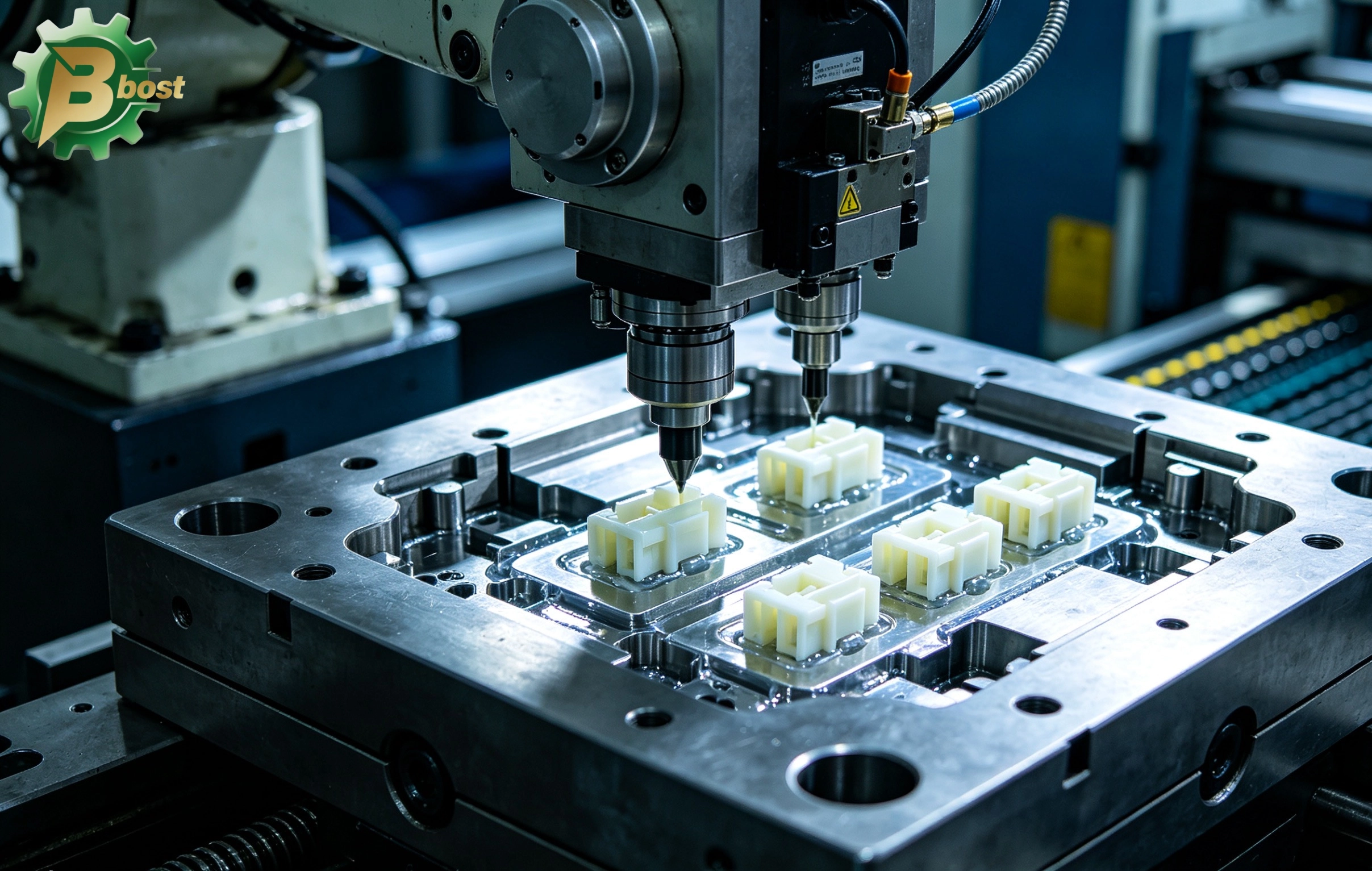
When executing a high performance plastic injection molding project, mold design accounts for 80% of success or failure. GZ-Bost’s engineering team performs specific mold design optimizations for high-performance materials:
-
Venting Systems: High-performance materials are prone to outgassing at high temperatures; poor venting leads to local burn marks. We utilize precision parting-line venting and vacuum venting technologies.
-
Gate Design: Given that high-performance materials often contain glass fiber or carbon fiber reinforcement, gate location and sizing must minimize fiber breakage and shear heat.
-
High-Hardness Mold Steel: Due to the abrasiveness of glass-filled materials, we select H13 or S136 steel with vacuum quenching to ensure a mold life of over 500,000 cycles.
5. Why Choose GZ-Bost as Your Partner?
Globally, there are thousands of injection molding factories, but few are proficient in high performance plastic injection molding. Customers trust us because we don't just provide products; we provide solutions.
-
Full Process Quality Traceability: Production data for every batch—including injection pressure, melt temperature, and holding time—is recorded by industrial monitoring systems.
-
Deep DFM Support: Our engineers use Moldflow analysis before mold fabrication to predict and resolve potential sink marks or weld lines.
-
Cleanroom Production: For parts in the medical and semiconductor industries, we provide controlled production environments that meet industry standards.
Conclusion: Let High-Performance Injection Molding Elevate Your Brand
With the power of high-performance materials, your products will gain a competitive edge through reduced costs and enhanced efficiency. Whether you are facing a complex mold structure problem or searching for a specialist in high performance plastic injection molding capable of stable supply, Guangzhou Bost (GZ-Bost) is your trusted choice.
Stop worrying about yield rates and lead times.
👉 Contact GZ-Bost Technical Experts for a Quote Today
👉 Browse Our Portfolio of High-Performance Injection Success Stories
Recommended for you
The Peak Art of Custom Manufacturing According to Drawings: Comprehensive Guide to Precision Solutions for Custom Parts According to Drawing
Ending Mechanical Wear and Resonance: The Comprehensive Guide to Precision Customization and Mass Production of a Custom Rubber Pad
The Ultimate Armor for Smart Hardware: Advanced Customization and Precision Injection Molding Guide for a Custom Plastic Box
The Ultimate Weapon to Tame Vibration and Noise: Deep Dive into the Custom Process and Mass Production Logic of a Custom Rubber Bushing
Product Categories
FAQ
FAQs
What are the core advantages of Best engineering plastics compared to ordinary plastics?
Best engineering plastics feature ultra-high mechanical strength, high-temperature resistance (-50°C to 300°C), chemical corrosion resistance, and wear resistance. Compared to ordinary plastics, their service life is extended by 3 to 8 times, making them suitable for replacing metals in harsh environments.
What is the delivery lead time? Do you offer global logistics?
Standard products: 5–15 working days; custom modifications: 2–4 weeks. We support global air/sea freight and provide export customs clearance documents (including REACH/UL certifications).
What is the minimum order quantity (MOQ)? Do you support small-batch trial production?
The MOQ for standard products is ≥100kg. We support small-batch trial production (as low as 20kg) and provide mold testing reports and performance data feedback.
Can Best customize modified plastics with special properties?
Yes! We offer modification services such as reinforcement, flame retardancy, conductivity, wear resistance, and UV resistance, for example:
• Adding carbon fiber to enhance stiffness
• Reducing the coefficient of friction through PTFE modification
• Customizing food-grade or medical-grade certified materials
How do I select the appropriate engineering plastic grade for my product?
Selection should be based on parameters such as load conditions (e.g., pressure/friction), temperature range, medium contact (e.g., oil/acid), and regulatory requirements (e.g., FDA/RoHS). Our engineers can provide free material selection consulting and sample testing.
You may also like
Custom Plastic Knobs Precision Injection Molded
More Details →
Custom Plastic Knobs Precision Injection Molded
Custom Injection Molded Parts from Drawings
More Details →
Custom Injection Molded Parts from Drawings
Underwater Camera Shell Custom Plastic Molding
More Details →
Underwater Camera Shell Custom Plastic Molding
Leave a Message
Have any questions or concerns about our products? Please leave us a message here, and our team will get back to you promptly.

24 hours quotes delivered
Submit CAD files, get quote in 24 hours

No MOQ required
From prototyping to high-volume

±0.02 mm Precision
Advanced CNC with full inspections

1,000+ tons in stock
26 materials ready to ship
© 2026 BOST. All Rights Reserved.