




 Scan QR Code
Send My Request
Mastering PEEK Injection Molding: The Complete Engineering Guide to Process & Mold Design
2026-04-23
Explore Bost’s expertise in PEEK injection molding with our deep dive into core processes and mold design. As a leading injection molding manufacturer, we deliver precision and quality to meet your advanced manufacturing needs. Trust Bost for innovative injection molding solutions.
- I. Why is PEEK Injection Molding the "Ultimate Challenge" in Molding?
- II. Core Process Parameters: PEEK Production Standard Reference Table
- III. High-Performance Mold Design: The 70% Factor for Yield Rate
- 1. Steel Selection and Hardness
- 2. Runner and Gate Design
- 3. Precision Venting Layout
- IV. Common Defect Analysis: How to Optimize Your PEEK Molding Solution?
- V. Why Choose a Professional Partner?
In the vast landscape of precision manufacturing, PEEK (Polyetheretherketone) is hailed as the "crown jewel" of high-performance plastics. Due to its exceptional thermal stability, chemical resistance, and mechanical strength, it has become the preferred alternative to metals in aerospace, medical devices, and semiconductor equipment. However, PEEK injection molding is by no means an easy task. Its ultra-high melting point (approx. 343°C) and rapid crystallization characteristics demand extremely rigorous standards for both processing equipment and mold design.
If you are currently facing challenges such as incomplete filling, surface darkening, or dimensional instability in PEEK parts, this guide provides in-depth analysis summarized directly from the production front lines.
I. Why is PEEK Injection Molding the "Ultimate Challenge" in Molding?
Unlike common ABS or PC materials, PEEK is a semi-crystalline polymer. During the injection molding process, the material state changes are extremely violent.
The first hurdle is thermal management. The melt temperature for PEEK usually needs to be between 370°C and 400°C. If the machine's heater bands cannot provide stable and continuous high heat, the melt will solidify prematurely in the runner, leading to "cold slugs" or short shots. The second is crystallization control. The mechanical properties of PEEK depend heavily on its degree of crystallinity. If cooled too quickly, the part surface will appear translucent and amorphous, which can lead to brittleness or severe dimensional shrinkage during later use.
II. Core Process Parameters: PEEK Production Standard Reference Table
To ensure the stability of PEEK injection molding, technical teams must strictly execute parameter management. Below are the core parameter ranges we recommend based on actual production:
III. High-Performance Mold Design: The 70% Factor for Yield Rate
In the realm of PEEK injection molding, there is a saying: "A good mold is half the battle." For this high-melting-point material, mold design must follow a unique logic.
1. Steel Selection and Hardness
Ordinary P20 steel will quickly suffer thermal fatigue at mold temperatures of 200°C. We typically recommend H13 or S136 high-hardness stainless steel with deep tempering. This is not just for wear resistance, but to ensure dimensional stability under long-term high-temperature cycling.
2. Runner and Gate Design
Since PEEK melt has high viscosity, runners should be full-round to minimize pressure loss. For gate design, side gates or large-size point gates are preferred. Experience shows that gate thickness should reach at least 50%-80% of the part's thickest section; otherwise, premature freezing at the gate during the packing stage will cause internal voids.
3. Precision Venting Layout
During high-pressure and high-speed injection, the trace gases released by PEEK accumulate rapidly at the end of the cavity. If venting is inadequate, burn marks occur easily. Vent depth is typically designed between 0.03mm - 0.05mm and must cover all filling extremities.
IV. Common Defect Analysis: How to Optimize Your PEEK Molding Solution?
As a professional injection molding provider, we often receive feedback regarding "insufficient strength."
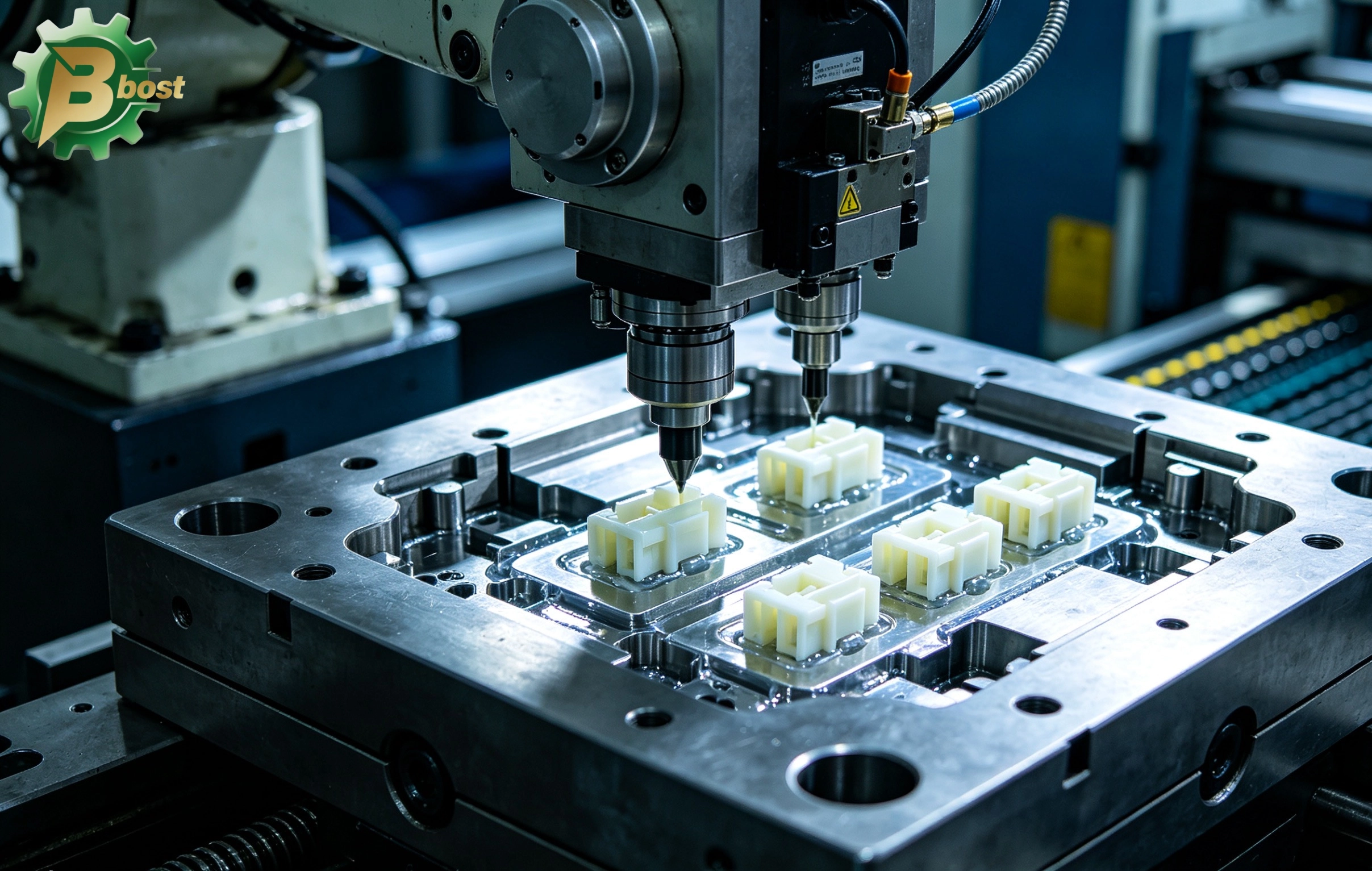
Often, this isn't a material issue, but a mismatch between injection speed and packing time. For an expensive material like PEEK, any scrap is a significant cost loss. At GZ-Bost, we utilize Moldflow analysis technology to simulate the melt's filling trajectory before the mold is built, predicting the location of weld lines. By optimizing gate locations, we ensure weld lines avoid the part's stress-bearing weak areas, increasing the yield rate to over 98%.
V. Why Choose a Professional Partner?
The high cost of PEEK injection molding means you don't have much room for "trial and error." Finding a manufacturer with deep material science knowledge and precision mold-making capabilities is vital.
GZ-Bost focuses on injection molding solutions for specialized engineering plastics. We not only have dedicated injection machines equipped with high-temperature ceramic heater bands but also a team of engineers who understand the nuances of PEEK, PPS, LCP, and other materials. Whether your product is a high-precision component for medical implants or a high-load part for aerospace, we can provide cost-saving and efficiency-enhancing advice from the DFM (Design for Manufacturing) stage.
Get Your PEEK Molding Expert Support: Searching for a reliable injection molding partner? Visit our official website www.gz-bost.com, submit your 3D drawings, and get a free technical assessment and quotation. Let our professional expertise help your product move from design to perfect mass production.
Recommended for you
The Peak Art of Custom Manufacturing According to Drawings: Comprehensive Guide to Precision Solutions for Custom Parts According to Drawing
Ending Mechanical Wear and Resonance: The Comprehensive Guide to Precision Customization and Mass Production of a Custom Rubber Pad
The Ultimate Armor for Smart Hardware: Advanced Customization and Precision Injection Molding Guide for a Custom Plastic Box
The Ultimate Weapon to Tame Vibration and Noise: Deep Dive into the Custom Process and Mass Production Logic of a Custom Rubber Bushing
Product Categories
FAQ
FAQs
What are the core advantages of Bost engineering plastics compared to ordinary plastics?
Bost engineering plastics feature ultra-high mechanical strength, high-temperature resistance (-50°C to 300°C), chemical corrosion resistance, and wear resistance. Compared to ordinary plastics, their service life is extended by 3 to 8 times, making them suitable for replacing metals in harsh environments.
How do I select the appropriate engineering plastic grade for my product?
Selection should be based on parameters such as load conditions (e.g., pressure/friction), temperature range, medium contact (e.g., oil/acid), and regulatory requirements (e.g., FDA/RoHS). Our engineers can provide free material selection consulting and sample testing.
What is the delivery lead time? Do you offer global logistics?
Standard products: 5–15 working days; custom modifications: 2–4 weeks. We support global air/sea freight and provide export customs clearance documents (including REACH/UL certifications).
What is the minimum order quantity (MOQ)? Do you support small-batch trial production?
The MOQ for standard products is ≥100kg. We support small-batch trial production (as low as 20kg) and provide mold testing reports and performance data feedback.
Can Bost customize modified plastics with special properties?
Yes! We offer modification services such as reinforcement, flame retardancy, conductivity, wear resistance, and UV resistance, for example:
• Adding carbon fiber to enhance stiffness
• Reducing the coefficient of friction through PTFE modification
• Customizing food-grade or medical-grade certified materials
You may also like
Custom Plastic Knobs Precision Injection Molded
More Details →
Custom Plastic Knobs Precision Injection Molded
Custom Injection Molded Parts from Drawings
More Details →
Custom Injection Molded Parts from Drawings
Underwater Camera Shell Custom Plastic Molding
More Details →
Underwater Camera Shell Custom Plastic Molding
Leave a Message
Have any questions or concerns about our products? Please leave us a message here, and our team will get back to you promptly.

24 hours quotes delivered
Submit CAD files, get quote in 24 hours

No MOQ required
From prototyping to high-volume

±0.02 mm Precision
Advanced CNC with full inspections

1,000+ tons in stock
26 materials ready to ship
© 2026 BOST. All Rights Reserved.