




 Scan QR Code
Send My Request
Ultimate Guide: How to Obtain High-Quality custom injection molding parts via Design and Process Optimization?
2026-04-13
Discover Bost’s guide on obtaining high-quality custom injection molding parts through expert design and process optimization. Learn how our custom injection molding services enhance precision, reduce costs, and accelerate production for superior results. Elevate your manufacturing with Bost today.
- 1. Why DFM (Design for Manufacturing) is the Foundation of Custom Injection Molding?
- 1. Uniformity of Wall Thickness
- 2. Draft Angle Settings
- 2. Key Factors Affecting the Quality of custom injection molding parts
- 1. Precision in Mold Design
- 2. Material Science Compatibility
- 3. Comparison Table: From Prototyping to Mass Production
- 4. In-depth Analysis: How to Optimize the Procurement Cost of custom injection molding parts?
- 1. Shortening the Cycle Time
- 2. The Rise of Automated Production
- 5. Addressing Pain Points: Quality Control (QC) in Precision Injection Molding
- 6. Industry Case Study: Tackling Complex custom injection molding parts Challenges
- Conclusion: Choosing the Right Partner
In the global manufacturing landscape, finding an injection molding supplier is easy, but obtaining custom injection molding parts that meet tight tolerances, offer stable performance, and achieve cost-efficiency is a rigorous engineering challenge. For overseas procurement managers and product engineers, the quality of these parts often dictates the market success of the final product.
At Guangzhou Bost, we have assisted countless clients in resolving technical hurdles from initial design to final delivery. Today, from the perspective of a senior injection molding engineer, we will explore the core dimensions and cost-optimization strategies you must focus on when sourcing custom injection molding parts.
1. Why DFM (Design for Manufacturing) is the Foundation of Custom Injection Molding?
When seeking custom injection molding parts, many clients overlook the importance of early design reviews. A beautiful CAD model may look flawless on a screen, but the laws of physics will ruthlessly expose design flaws on an actual injection molding machine.
1. Uniformity of Wall Thickness
Uneven wall thickness is the primary culprit behind warping and sink marks. When designing your custom injection molding parts, maintaining consistent wall thickness is vital. If a certain area must be thickened, we typically recommend using ribs instead of a solid thick section. This not only ensures strength but also shortens cooling time, directly reducing production costs.
2. Draft Angle Settings
Without a proper draft angle, parts will suffer from drag marks during ejection, or worse, damage the mold. Especially for custom injection molding parts requiring texturing, a draft angle of at least 3° is necessary. This is a detail often missed by junior designers.
2. Key Factors Affecting the Quality of custom injection molding parts
Producing high-quality custom injection molding parts requires the perfect synergy of mold design, material selection, machinery, and process parameters.
1. Precision in Mold Design
The mold is known as the "Mother of Industry." When handling custom injection molding parts with high tolerance requirements, the layout of the cooling system, the choice of gate location, and the venting design directly affect the flow behavior of the plastic melt. Poor gate placement can lead to visible weld lines, compromising both aesthetics and structural integrity.
2. Material Science Compatibility
Selecting the right resin is the other half of a project's success. From general-purpose PP and ABS to high-performance PEEK or glass-filled Nylon, the shrinkage and flowability of each material vary greatly. In the process of customizing custom injection molding parts, we recommend the most suitable modified materials based on the part's end-use environment, such as high-temperature resistance, impact resistance, or flame retardancy.
3. Comparison Table: From Prototyping to Mass Production
To help you understand how to choose the right production plan for your custom injection molding parts based on the project stage, we have summarized the following table:
| Dimension | Prototype Tooling | Production Tooling |
| Mold Material | Aluminum Alloy or P20 Steel | H13, S136, or NAK80 Hardened Steel |
| Mold Life | 500 - 5,000 cycles | 100,000 - 1,000,000+ cycles |
| Best For | Functional testing, market validation | Long-term mass supply, high-precision parts |
| Core Keyword Fit | Fast delivery of custom injection molding parts | Stable production of custom injection molding parts |
| Unit Cost | Relatively High | Extremely Low |
4. In-depth Analysis: How to Optimize the Procurement Cost of custom injection molding parts?
In B2B procurement, while price is important, the "Piece Price" is not the only metric for cost. Real cost optimization stems from precise control of the production cycle.
1. Shortening the Cycle Time
During the mass production phase of custom injection molding parts, every second saved translates into increased profit. By optimizing cooling channels (particularly using conformal cooling technology), we can significantly reduce cooling times. If your order volume exceeds 100,000 pieces, the initial investment in mold optimization will be recovered several times over through increased productivity.
2. The Rise of Automated Production
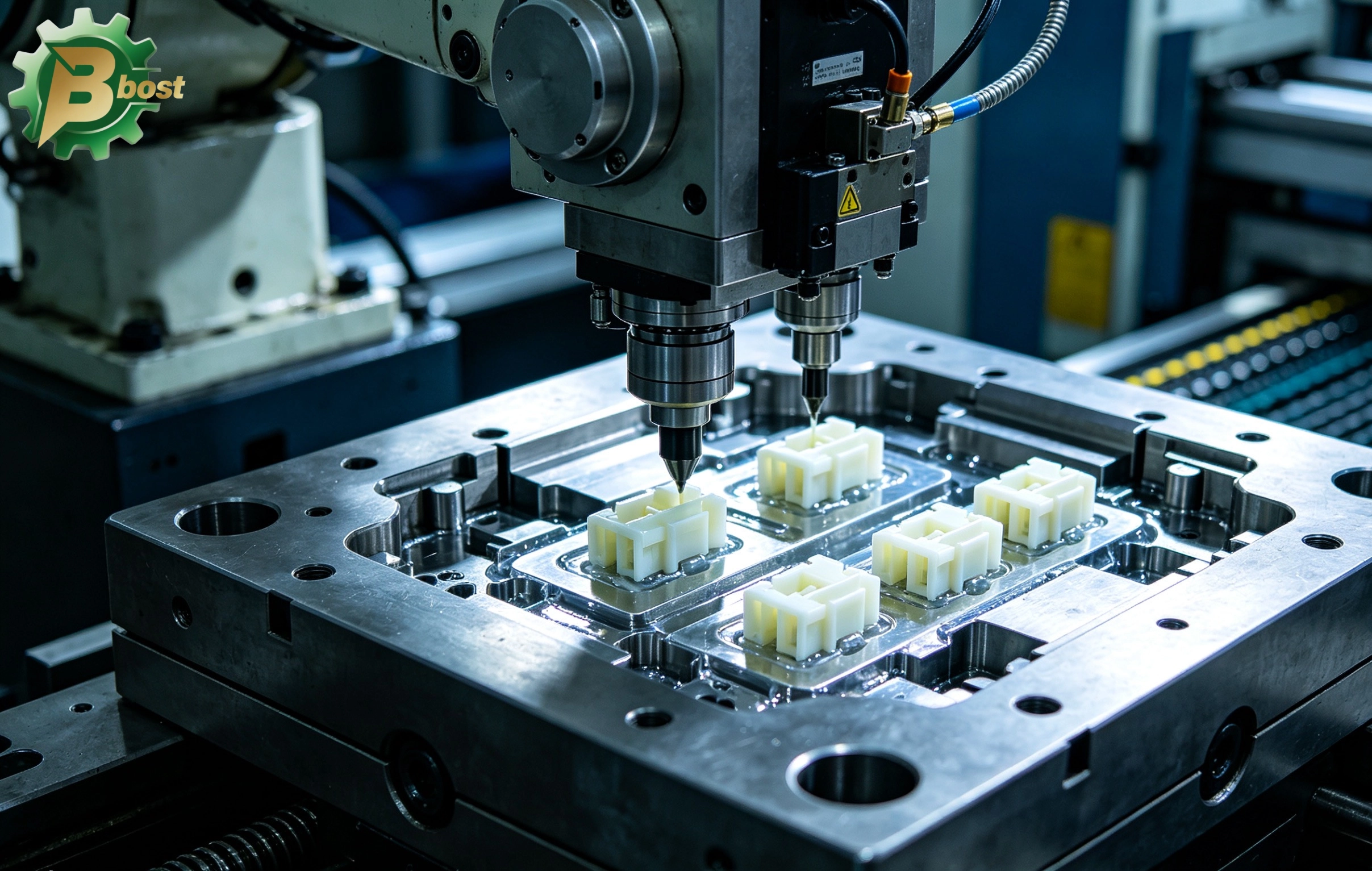
Labor costs are rising annually. By introducing robotic arms for fully automated production, Bost ensures the consistency of every cycle of custom injection molding parts while avoiding secondary contamination or damage caused by manual handling.
5. Addressing Pain Points: Quality Control (QC) in Precision Injection Molding
When sourcing custom injection molding parts, the biggest concern for buyers is "first samples are good, but mass production fails." This requires the supplier to have a robust quality assurance system.
-
Full Dimensional Inspection (FAI): During the sample approval stage, we use CMM to measure all critical dimensions.
-
In-Process Quality Control (IPQC): Real-time monitoring of injection pressure and temperature curves.
-
Material Traceability: Ensuring that every batch of custom injection molding parts uses the specified brand of raw materials, with zero tolerance for unauthorized regrind.
6. Industry Case Study: Tackling Complex custom injection molding parts Challenges
We once hosted a client from the medical device industry who needed custom injection molding parts with an extremely complex structure and strict airtightness requirements.
Traditional factories proposed solutions with very low yields because air became trapped at the end of the filling path. Our technical team utilized Moldflow Analysis to rebalance the gates and added a vacuum venting system. Ultimately, the yield rate for this part increased from 65% to 99.2%. This proves that when manufacturing high-end custom injection molding parts, deep technical expertise is far more valuable than a low price tag.
Conclusion: Choosing the Right Partner
The production of custom injection molding parts is never a simple mechanical repetition; it is an art of balance—finding the optimal solution between precision, speed, and budget. An excellent injection molding partner should identify potential risks during the design phase and provide stable, consistent delivery during mass production.
If you are looking for a reliable manufacturing solution for your new project's custom injection molding parts, or if your existing products are facing quality issues, please visit Guangzhou Bost Official Website.
[💡 Contact Us Now for a Free DFM Evaluation & Quote]
Our engineering team will provide professional technical support within 24 hours to help you bring your products to market faster.
Recommended for you
The Peak Art of Custom Manufacturing According to Drawings: Comprehensive Guide to Precision Solutions for Custom Parts According to Drawing
Ending Mechanical Wear and Resonance: The Comprehensive Guide to Precision Customization and Mass Production of a Custom Rubber Pad
The Ultimate Armor for Smart Hardware: Advanced Customization and Precision Injection Molding Guide for a Custom Plastic Box
The Ultimate Weapon to Tame Vibration and Noise: Deep Dive into the Custom Process and Mass Production Logic of a Custom Rubber Bushing
Product Categories
FAQ
FAQs
How do I select the appropriate engineering plastic grade for my product?
Selection should be based on parameters such as load conditions (e.g., pressure/friction), temperature range, medium contact (e.g., oil/acid), and regulatory requirements (e.g., FDA/RoHS). Our engineers can provide free material selection consulting and sample testing.
What are the core advantages of Bost engineering plastics compared to ordinary plastics?
Bost engineering plastics feature ultra-high mechanical strength, high-temperature resistance (-50°C to 300°C), chemical corrosion resistance, and wear resistance. Compared to ordinary plastics, their service life is extended by 3 to 8 times, making them suitable for replacing metals in harsh environments.
What is the delivery lead time? Do you offer global logistics?
Standard products: 5–15 working days; custom modifications: 2–4 weeks. We support global air/sea freight and provide export customs clearance documents (including REACH/UL certifications).
Can Bost customize modified plastics with special properties?
Yes! We offer modification services such as reinforcement, flame retardancy, conductivity, wear resistance, and UV resistance, for example:
• Adding carbon fiber to enhance stiffness
• Reducing the coefficient of friction through PTFE modification
• Customizing food-grade or medical-grade certified materials
What is the minimum order quantity (MOQ)? Do you support small-batch trial production?
The MOQ for standard products is ≥100kg. We support small-batch trial production (as low as 20kg) and provide mold testing reports and performance data feedback.
You may also like
Custom Plastic Knobs Precision Injection Molded
More Details →
Custom Plastic Knobs Precision Injection Molded
Custom Injection Molded Parts from Drawings
More Details →
Custom Injection Molded Parts from Drawings
Underwater Camera Shell Custom Plastic Molding
More Details →
Underwater Camera Shell Custom Plastic Molding
Leave a Message
Have any questions or concerns about our products? Please leave us a message here, and our team will get back to you promptly.

24 hours quotes delivered
Submit CAD files, get quote in 24 hours

No MOQ required
From prototyping to high-volume

±0.02 mm Precision
Advanced CNC with full inspections

1,000+ tons in stock
26 materials ready to ship
© 2026 BOST. All Rights Reserved.