




 Scan QR Code
Send My Request
Why Choosing a One Stop Plastic Injection Molding Service is the Secret to Reducing Total Cost of Ownership
2026-05-26
One stop plastic injection molding service and turnkey plastic injection molding services streamline production, cutting delays and costs. Bost reveals how partnering with a custom plastic injection molding manufacturer reduces total cost of ownership through integrated design, tooling, and manufacturing efficiency.
- 1. From Tooling Blueprint to Finished Part: Unpacking the Advantages of a One Stop Plastic Injection Molding Service
- Better Manufacturing Feasibility Through Early DFM Involvement
- Seamless Transitions Between Mold Design and Toolmaking
- 2. Segmented Sourcing vs. One-Stop Turnkey Service: A Deep Dive into Efficiency and Economics
- 3. Core Control Points in Precision Injection Molding: Turning Technical Expertise into Tangible Results
- 1. High-Accuracy Clamping and Injection Dynamics
- 2. Rigorous Material Stewardship and Advanced Compound Adjustments
- 4. How to Spot a Genuine Turnkey Injection Molding Partner
- Summary and Action Plan: Give Your Manufacturing Project the Perfect Start
In the realm of overseas B2B component procurement and product development, on-time delivery, quality consistency, and supply chain communication costs weigh far heavier on a project's success than mere per-unit pricing. Many product managers and procurement engineers have experienced this distinct pain point: tooling is designed and built at Factory A, but when transferred to Factory B for mass production, the final parts suffer from flash, sink marks, or assembly tolerances that exceed specifications. The two suppliers inevitably begin a cycle of finger-pointing—Factory A insists the mold matches the drawings perfectly, while Factory B complains that inherent tooling flaws make it impossible to stabilize the injection molding process parameters.
This hidden cost trap, born from fragmented supply chains, is driving more mature global buyers toward a one stop plastic injection molding service. As a specialized manufacturing brand dedicated to custom industrial production, Guangzhou Bost (Bost) leverages over a decade of technical expertise. We recognize the profound value of integrating mold design, engineering validation, precision injection molding, and secondary post-processing under a single roof. This article offers an in-depth analysis across technical execution, cost management, and risk mitigation to explain why a turnkey service represents the optimal strategy for modern B2B manufacturing.
1. From Tooling Blueprint to Finished Part: Unpacking the Advantages of a One Stop Plastic Injection Molding Service
A premium plastic component is never just a matter of injecting molten polymer into a block of steel; it is a precision marathon transitioning a digital layout into a micron-level physical object. The true essence of a one stop plastic injection molding service lies in its closed-loop execution.
Better Manufacturing Feasibility Through Early DFM Involvement
In our daily manufacturing routines at Bost, many initial 3D designs submitted by international clients look flawless in theory but present high risks of air traps, weld lines, or parting difficulties during the actual injection molding process. The primary value of an integrated service is the deployment of an experienced tooling engineering team to conduct exhaustive Design for Manufacturability (DFM) reviews before any mold steel is cut. We simulate melt fronts via Moldflow analysis to evaluate wall thickness uniformity, draft angles, and gate placements. Remedying issues at the design source saves thousands of dollars in modification costs and weeks of potential delays downstream.
Seamless Transitions Between Mold Design and Toolmaking
Once the mold design is finalized, digitized data flows directly to high-speed CNC machining centers and EDM units. Because subsequent injection production occurs in the adjacent bay, toolmakers carefully account for how specific resins—such as the high shrinkage of PC/ABS or the abrasive properties of glass-filled Nylon (PA66+GF)—impact the necessary hardness of tool steels like NAK80 or S136. This dedicated Design for Manufacturing mindset guarantees a level of synergy that fragmented sourcing simply cannot match.
[Client 3D CAD] -> [DFM & Moldflow] -> [Precision Machining] -> [In-House T1 Trial] -> [Automated Mass Molding]2. Segmented Sourcing vs. One-Stop Turnkey Service: A Deep Dive into Efficiency and Economics
To help global procurement professionals objectively assess their operational risks, we have detailed a comprehensive, quantified comparison between the traditional "Factory A for Tooling + Factory B for Molding" approach and the integrated one stop plastic injection molding service engineered by Bost:
| Assessment Metric | Segmented Sourcing (Separated Tooling & Molding) | Bost Turnkey One-Stop Service |
|---|---|---|
| Communication & Management Overhead | Requires managing two entities; vulnerable to language barriers, time zone gaps, and technical misalignments. | A single Project Manager (PM) oversees the entire lifecycle, providing singular technical accountability and cutting communication overhead by 70%. |
| Sampling & Trial (T1-T3) Cycles | International tool transit takes days; if issues emerge during off-site trials, tool shipping for modifications can delay projects by 4–6 weeks. | Trials and adjustments are conducted in the same facility; tool modifications and secondary validation occur within 24 hours, shrinking development timelines by 50%. |
| Quality Accountability | High risk of finger-pointing regarding whether defects stem from "tooling flaws" or "process variances." The buyer carries the financial burden. | Single-Point Accountability. Bost takes absolute responsibility for everything from tool geometry to the dimensional tolerances of the molded part. |
| Tool Life & Routine Maintenance | Contract molders rarely perform deep preventative maintenance on outside tooling, resulting in rapid wear and degraded tool longevity. | Lifetime complimentary minor maintenance. Strict tool checklists are executed during production runs to safeguard consistency across high-volume cycles. |
| Total Logistics Costs | Incurs specialized crate packaging, international ocean/air freight fees, import customs duties, and exposure to handling damage. | Zero internal transit freight. Molds move straight from toolroom assembly to the press bed, yielding optimized costs and direct global delivery of parts. |
3. Core Control Points in Precision Injection Molding: Turning Technical Expertise into Tangible Results
Amid the steady hum of industrial machinery, authentic manufacturing prowess reveals itself in an absolute command over micro-details. In precision injection molding, a dimensional variance of a mere 0.05 millimeters can render a medical device enclosure impossible to snap together or cause noticeable rattling in an automotive interior subassembly.
1. High-Accuracy Clamping and Injection Dynamics
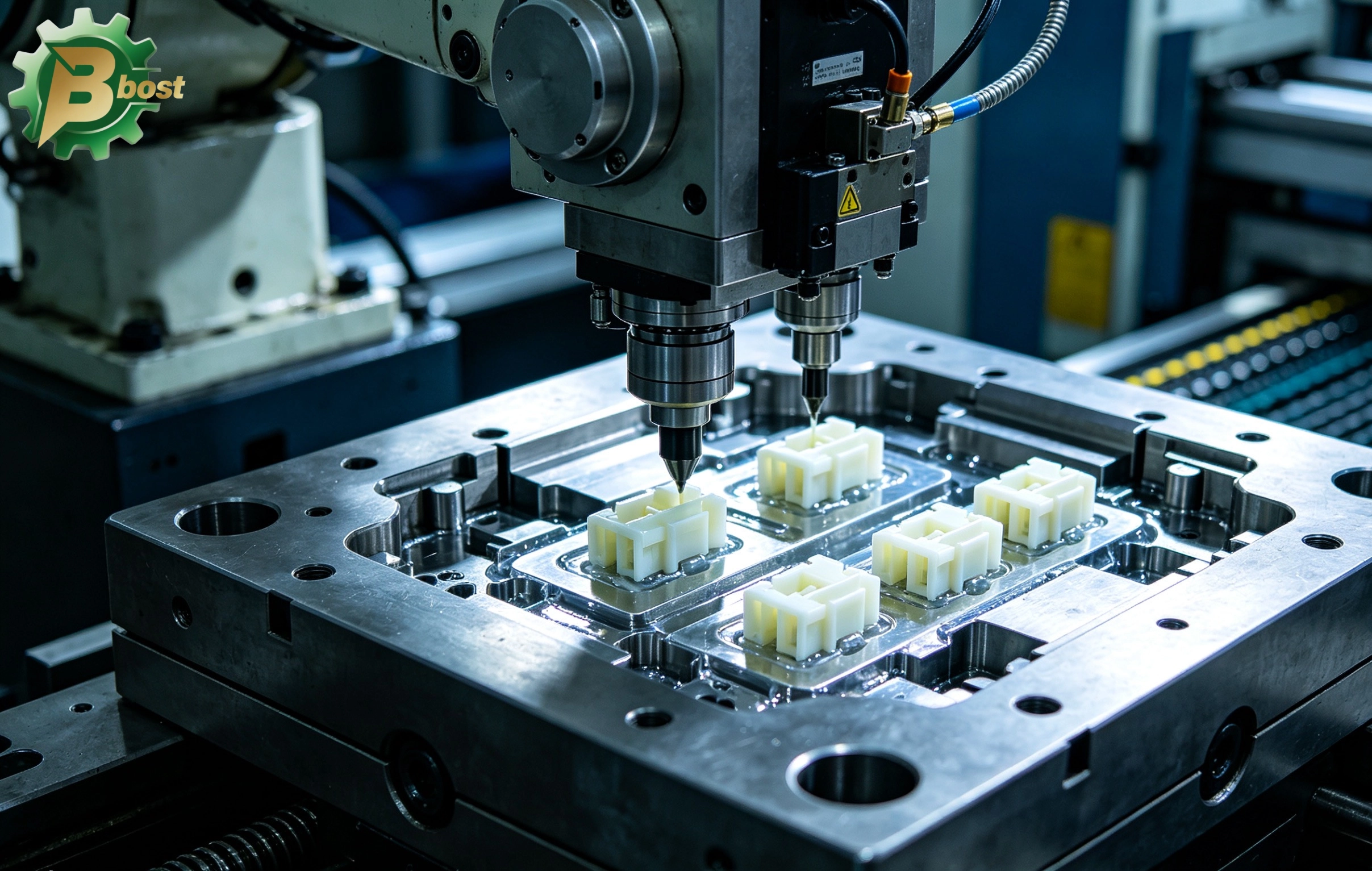
Within Bost’s modern, climate-controlled molding environment, every high-precision press runs via microsecond-level control architectures. For thin-walled, multi-cavity geometries or critical structural parts, we meticulously regulate the core trilogy: pressure, temperature, and time. An integrated service architecture allows our process technicians to participate in collecting trial data during the final stages of tool assembly. Utilizing scientific molding principles, they establish the exact velocity-to-pressure (V-P) switchover point and cooling cycles, reducing residual stress to prevent post-molding warpage months down the line.
2. Rigorous Material Stewardship and Advanced Compound Adjustments
Modern industrial applications demand increasingly rugged polymer performance. Whether processing heat-resistant PEEK, mechanically robust glass-reinforced nylon (PA+GF), or biocompatible medical-grade PP, Bost has implemented tightly regulated resin-drying and anti-contamination protocols. We eliminate impurities at the material intake because, during the injection molding process, even trace moisture levels will generate silver streaks on cosmetic surfaces or internal voids, severely undermining the impact strength of the finished product.
Real-World Case Study: A Western industrial instrumentation client required an internal component to achieve a certified IP67 waterproof rating. Their previous supplier, lacking a cohesive analysis of material shrinkage dynamics and mold cooling line geometry, delivered components with excessive post-molding distortion. Upon taking over the project, Bost redesigned the mold tooling using conformal cooling channels and optimized the injection packing profile. This kept component distortion under 0.03mm, clearing the client's strict pressure-leak testing on the first attempt.
4. How to Spot a Genuine Turnkey Injection Molding Partner
Digital B2B platforms are filled with manufacturers claiming to provide a one stop plastic injection molding service. To see past marketing claims and identify a genuinely capable supplier, savvy buyers evaluate these operational indicators:
-
Engineering Inquiry Depth: If a shop accepts your CAD files and quotes immediately without asking targeted technical questions or providing an itemized DFM report, it is often a red flag. Experienced engineers proactively identify design anomalies to insulate you from manufacturing risks.
-
In-House Machinery Synergy: A truly integrated facility houses multi-axis high-speed CNCs and mirror EDM hardware alongside a versatile matrix of injection presses (ranging from 50 to over 1,000 tons), backed by advanced metrology tools like CMMs and optical comparators.
-
Execution of Quality Control Systems: ISO 9001 registration is simply the baseline. True quality control shows in the daily application of First Article Inspection (FAI), In-Process Quality Control (IPQC), and Statistical Process Control (SPC) charting on the factory floor.
Summary and Action Plan: Give Your Manufacturing Project the Perfect Start
In today’s fast-paced global market, speed translates directly to market share, and quality defines brand equity. Aligning your enterprise with an established one stop plastic injection molding service supplier does more than turn raw resin pellets into physical products—it secures your peace of mind and builds operational predictability.
Guangzhou Bost (Bost) remains dedicated to engineering excellence. Through structured mold design, verified injection molding process controls, and end-to-end support across the product lifecycle, we help global small-to-medium businesses and enterprise market leaders bring their designs to life seamlessly. If you are seeking an expert manufacturing asset to optimize total costs and accelerate delivery timelines, explore our capabilities online at [www.gz-bost.com](httpswww.gz-bost.com](https://www.gz-bost.com).
[Connect with the Bost engineering team today at team@gz-bost.com to receive a custom DFM analysis and an accurate injection molding quote within 24 hours!]
Recommended for you
The Peak Art of Custom Manufacturing According to Drawings: Comprehensive Guide to Precision Solutions for Custom Parts According to Drawing
Ending Mechanical Wear and Resonance: The Comprehensive Guide to Precision Customization and Mass Production of a Custom Rubber Pad
The Ultimate Armor for Smart Hardware: Advanced Customization and Precision Injection Molding Guide for a Custom Plastic Box
The Ultimate Weapon to Tame Vibration and Noise: Deep Dive into the Custom Process and Mass Production Logic of a Custom Rubber Bushing
Product Categories
FAQ
FAQs
What is the delivery lead time? Do you offer global logistics?
Standard products: 5–15 working days; custom modifications: 2–4 weeks. We support global air/sea freight and provide export customs clearance documents (including REACH/UL certifications).
What is the minimum order quantity (MOQ)? Do you support small-batch trial production?
The MOQ for standard products is ≥100kg. We support small-batch trial production (as low as 20kg) and provide mold testing reports and performance data feedback.
Can Bost customize modified plastics with special properties?
Yes! We offer modification services such as reinforcement, flame retardancy, conductivity, wear resistance, and UV resistance, for example:
• Adding carbon fiber to enhance stiffness
• Reducing the coefficient of friction through PTFE modification
• Customizing food-grade or medical-grade certified materials
What are the core advantages of Bost engineering plastics compared to ordinary plastics?
Bost engineering plastics feature ultra-high mechanical strength, high-temperature resistance (-50°C to 300°C), chemical corrosion resistance, and wear resistance. Compared to ordinary plastics, their service life is extended by 3 to 8 times, making them suitable for replacing metals in harsh environments.
How do I select the appropriate engineering plastic grade for my product?
Selection should be based on parameters such as load conditions (e.g., pressure/friction), temperature range, medium contact (e.g., oil/acid), and regulatory requirements (e.g., FDA/RoHS). Our engineers can provide free material selection consulting and sample testing.
You may also like
Custom Plastic Knobs Precision Injection Molded
More Details →
Custom Plastic Knobs Precision Injection Molded
Custom Injection Molded Parts from Drawings
More Details →
Custom Injection Molded Parts from Drawings
Underwater Camera Shell Custom Plastic Molding
More Details →
Underwater Camera Shell Custom Plastic Molding
Leave a Message
Have any questions or concerns about our products? Please leave us a message here, and our team will get back to you promptly.

24 hours quotes delivered
Submit CAD files, get quote in 24 hours

No MOQ required
From prototyping to high-volume

±0.02 mm Precision
Advanced CNC with full inspections

1,000+ tons in stock
26 materials ready to ship
© 2026 BOST. All Rights Reserved.