




 Scan QR Code
Send My Request
B2B Sourcing & Technical Blueprint: The Step-by-Step Guide to Sourcing Custom Injection Molded Parts
2026-07-09
Custom plastic enclosure sourcing demands precision—this guide from Bost details how to select the right custom plastic enclosure manufacturer and navigate technical requirements for custom plastic enclosures for electronics. Follow each step to ensure quality, compliance, and cost-efficiency in your injection molded parts procurement.
- Step 1: Design Optimization and Pre-Manufacturability (DFM) Review
- Critical Engineering Parameters to Audit:
- Step 2: Strategic Mold Design and Material Selection
- Tooling Classification and Steel Selection
- Runner Systems: Cold vs. Hot
- Step 3: Mastering the Injection Molding Process Parameters
- Step 4: Quality Control, Inspection Metrology, and CPK Requirements
- Key Quality Evaluation Metrics
- Step 5: Vendor Evaluation Matrix for Overseas Buyers
- Accelerate Your Supply Chain with Guangzhou Bost (GZ-Bost)
- Ready to Optimize Your Hardware Production?
Author: Global Supply Chain & Technical Advisory Board | Published by: Guangzhou Bost (GZ-Bost)
Navigating the lifecycle of custom injection molded parts from an initial 3D CAD model to global high-volume distribution demands more than just a standard purchase order. It requires a flawless synchronization between product designers, supply chain managers, and tooling engineers.
When dealing with high-stakes industrial, medical, or automotive applications, any blind spot in design interpretation or manufacturing control can compound into catastrophic delays. This step-by-step engineering and procurement guide provides an actionable framework to de-risk your next project and ensure complete commercial success.
Step 1: Design Optimization and Pre-Manufacturability (DFM) Review
Before a single dollar is allocated to cutting tool steel, your 3D CAD files must undergo a strict Design for Manufacturability (DFM) assessment. This is where premium suppliers distinguish themselves by identifying latent design flaws.
Critical Engineering Parameters to Audit:
-
Wall Thickness Consistency: Ensure your part maintains a uniform nominal wall thickness. Sudden transitions invite internal stress and sink marks. Where variations are unavoidable, implement a smooth, tapered transition zone.
-
Rib-to-Wall Ratios: Internal reinforcement ribs must be designed to maximize stiffness without compromising aesthetics. To prevent sink marks on the cosmetic face, the root thickness of a rib should not exceed 40% to 60% of the main wall thickness.
-
Draft Angles: Every vertical wall must feature a release angle. Implement a minimum of 1° for smooth, untextured surfaces. For complex textures or EDM finishes, integrate a minimum of 3° to 5° to prevent drag marks and stress whitening during ejection.
Step 2: Strategic Mold Design and Material Selection
The longevity, cycle time, and piece-part cost of your custom injection molded parts are directly bound to the architecture of the injection mold.
Tooling Classification and Steel Selection
Depending on your projected Annual Volume (EAV), your tool must be classed accordingly:
-
Low-Volume Prototyping (Class 104/105): Utilizes Alumium or pre-hardened steels like P20. Ideal for 1,000 to 10,000 cycles.
-
Medium-Volume Production (Class 103): Utilizes NAK80 or P20 steel, capable of handling up to 100,000 cycles with moderate cycle-time optimization.
-
High-Volume Commercialization (Class 101/102): Hardened tool steels such as H13, S136, or 420 stainless steel. Designed to withstand over 1,000,000 cycles under intense clamping forces.
Runner Systems: Cold vs. Hot
For high-volume custom injection molded parts or premium resins, a hot runner system is highly recommended. While the initial capital expenditure is higher, it completely eliminates runner scrap material, reduces cycle times, and drastically improves the cosmetic consistency of the injection gate location.
Step 3: Mastering the Injection Molding Process Parameters
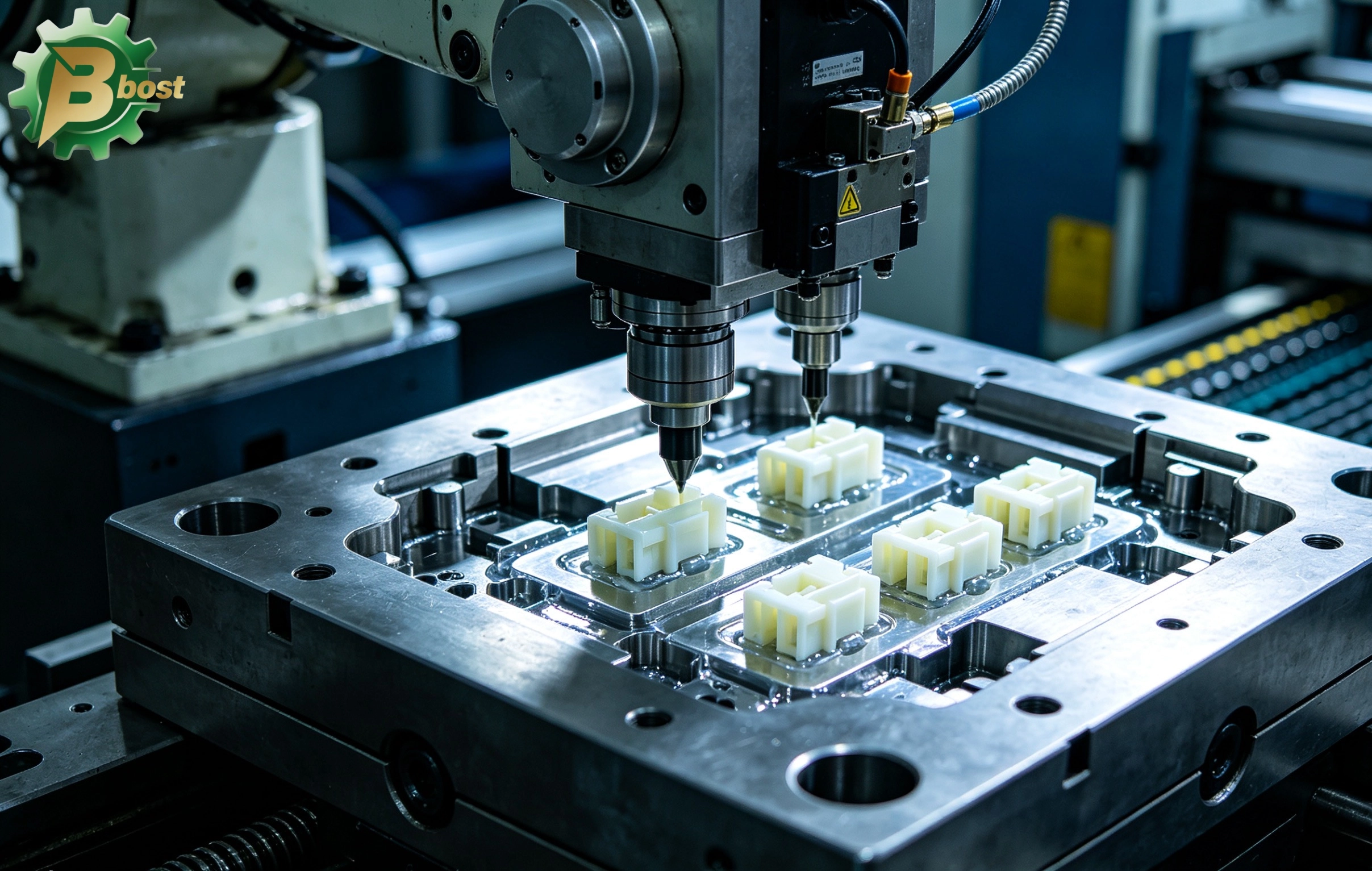
A world-class tool can still produce defective components if the injection molding process is not precisely stabilized. When evaluating a production facility, verify that they monitor and lock down the following dynamic parameters:
[Melt & Homogenize] ➔ [High-Speed Injection] ➔ [V-P Switching] ➔ [Controlled Packing] ➔ [Uniform Cooling]-
Velocity-to-Pressure (V-P) Switchover: The machine must transition from filling the cavity (velocity control) to packing the cavity (pressure control) at the exact millisecond the part is 95% to 98% full. An incorrect V-P switch point causes either flashing or short-shot defects.
-
Scientific Molding Principles: Ensure your manufacturing partner utilizes decoupled molding strategies. This decouples the filling stage from the packing stage, rendering the final dimensional quality of your custom injection molded parts immune to minor variations in batch-to-batch resin viscosity.
-
Precision Tooling Control: For thin-walled or ultra-precise components, verify that the supplier uses automated, all-electric injection machinery capable of locking in position repeatability within ±0.01 mm.
Step 4: Quality Control, Inspection Metrology, and CPK Requirements
High-end B2B procurement demands quantitative proof of quality. Do not rely on visual inspection alone. Ensure your quality agreement outlines clear, measurable metrics.
Key Quality Evaluation Metrics
| Inspection Category | Methodology & Tools | Target Metrics / Industry Benchmarks |
|---|---|---|
| Dimensional Analysis | Coordinate Measuring Machines (CMM), OMM, Digital Calipers | Adherence to ISO 20457 or custom tight tolerances down to ±0.02 mm. |
| Cosmetic Integrity | Visual Inspection Booths under standardized D65 lighting | Zero allowable flash, silver streaks, bubbles, or structural knit lines. |
| Mechanical Performance | Tensile Testing, Izod Impact Testing, Hardness Testing | Validated against raw material datasheet specifications. |
| Statistical Capability | CPK / PPK Statistical Process Control Software | Target CPK ≥ 1.33 for standard dimensions; CPK ≥ 1.67 for Critical-to-Quality (CTQ) dimensions. |
Step 5: Vendor Evaluation Matrix for Overseas Buyers
When selecting a contract manufacturer for custom injection molding, use this quick checklist to benchmark prospective partners against global industrial standards:
-
[ ] Certification Compliance: Are they certified to ISO 9001:2015? For medical or automotive projects, do they possess ISO 13485 or IATF 16949?
-
[ ] In-House Tooling Capabilities: Do they design and manufacture their own molds? Separate tooling and molding vendors frequently pass blame when quality issues arise.
-
[ ] Moldflow Capability: Can they provide an advanced Moldflow simulation report alongside their initial DFM proposal?
-
[ ] Clear IP Protection: Do they have strict data security measures to protect your proprietary 3D CAD designs?
Accelerate Your Supply Chain with Guangzhou Bost (GZ-Bost)
Sourcing premium custom injection molded parts does not have to be a high-risk venture. At Guangzhou Bost (GZ-Bost), we combine a decade of B2B global digital marketing experience with elite precision manufacturing infrastructure to deliver unparalleled peace of mind.
From your very first contact, our veteran engineering team provides comprehensive, complimentary DFM optimization and mold flow insights. Operating fully automated, high-precision injection lines and an independent, state-of-the-art toolmaking workshop, we guarantee that your product transitions from blueprint to physical asset smoothly, cost-effectively, and entirely on schedule.
Ready to Optimize Your Hardware Production?
Don't let design ambiguities stall your project or inflate your budget. Connect directly with our engineering specialists today.
-
Visit Our Portal: Guangzhou Bost Official Website
-
Get a Quote: Submit your STEP/IGS files for an immediate, comprehensive design feasibility assessment and customized commercial quotation.
Recommended for you
The Peak Art of Custom Manufacturing According to Drawings: Comprehensive Guide to Precision Solutions for Custom Parts According to Drawing
Ending Mechanical Wear and Resonance: The Comprehensive Guide to Precision Customization and Mass Production of a Custom Rubber Pad
The Ultimate Armor for Smart Hardware: Advanced Customization and Precision Injection Molding Guide for a Custom Plastic Box
The Ultimate Weapon to Tame Vibration and Noise: Deep Dive into the Custom Process and Mass Production Logic of a Custom Rubber Bushing
Product Categories
FAQ
FAQs
What is the minimum order quantity (MOQ)? Do you support small-batch trial production?
The MOQ for standard products is ≥100kg. We support small-batch trial production (as low as 20kg) and provide mold testing reports and performance data feedback.
What is the delivery lead time? Do you offer global logistics?
Standard products: 5–15 working days; custom modifications: 2–4 weeks. We support global air/sea freight and provide export customs clearance documents (including REACH/UL certifications).
How do I select the appropriate engineering plastic grade for my product?
Selection should be based on parameters such as load conditions (e.g., pressure/friction), temperature range, medium contact (e.g., oil/acid), and regulatory requirements (e.g., FDA/RoHS). Our engineers can provide free material selection consulting and sample testing.
What are the core advantages of Bost engineering plastics compared to ordinary plastics?
Bost engineering plastics feature ultra-high mechanical strength, high-temperature resistance (-50°C to 300°C), chemical corrosion resistance, and wear resistance. Compared to ordinary plastics, their service life is extended by 3 to 8 times, making them suitable for replacing metals in harsh environments.
Can Bost customize modified plastics with special properties?
Yes! We offer modification services such as reinforcement, flame retardancy, conductivity, wear resistance, and UV resistance, for example:
• Adding carbon fiber to enhance stiffness
• Reducing the coefficient of friction through PTFE modification
• Customizing food-grade or medical-grade certified materials
You may also like
Custom Plastic Knobs Precision Injection Molded
More Details →
Custom Plastic Knobs Precision Injection Molded
Custom Injection Molded Parts from Drawings
More Details →
Custom Injection Molded Parts from Drawings
Underwater Camera Shell Custom Plastic Molding
More Details →
Underwater Camera Shell Custom Plastic Molding
Leave a Message
Have any questions or concerns about our products? Please leave us a message here, and our team will get back to you promptly.

24 hours quotes delivered
Submit CAD files, get quote in 24 hours

No MOQ required
From prototyping to high-volume

±0.02 mm Precision
Advanced CNC with full inspections

1,000+ tons in stock
26 materials ready to ship
© 2026 BOST. All Rights Reserved.