




 Scan QR Code
Send My Request
Manufacturing & Supply Chain Depth Guide: How to Ensure Quality and Cost Balance for Custom Injection Molded Parts in High-Standard Industrial Project
2026-07-09
Custom plastic enclosure manufacturers face challenges balancing quality and cost in high-standard industrial projects. Bost’s guide details practical strategies for managing supply chains and ensuring precision in custom plastic enclosure for electronics, optimizing production without compromising standards.
- Three Core Dimensions Influencing the Cost and Quality of Custom Injection Molded Parts
- 1. Material Selection and Physical Boundaries
- 2. Geometric Precision of Mold Design
- 3. Dynamic Stability of the Injection Molding Process
- Data-Driven Precision Manufacturing: Impact of Core Process Parameters on Injection Molded Parts
- Process Parameters & Custom Injection Molded Parts Quality Correlation Table
- Mitigating Tooling Risks at the Source: DFM Application in Custom Injection Molded Parts Projects
- Partner with Guangzhou Bost (GZ-Bost) to Ensure the Solid Execution of Your Custom Injection Molded Parts Projects
Marketing Director | Published by: Guangzhou Bost (GZ-Bost)
In today's highly competitive global industrial manufacturing ecosystem, custom injection molded parts occupy an unshakable and central position, whether they are automotive sub-assemblies, consumer electronics enclosures, medical device precision components, or complex industrial switches. For global B2B overseas procurement managers and supply chain directors, sourcing a supplier capable of flawlessly delivering custom injection molded parts is far more than a routine purchasing task; it is a profound strategic game involving product life cycles, technical compliance, and capital efficiency.
During actual project implementation, many R&D teams frequently find themselves trapped in a dilemma: on one hand, pursuing ultimate product precision and flawless cosmetic surfaces often causes tooling development costs to escalate exponentially; on the other hand, over-compressing front-end budgets inevitably triggers severe quality crises during the mass production stage, such as part warpage, visible knit lines, and out-of-tolerance assembly dimensions. These bottlenecks not only delay the product's time-to-market but also incur exorbitant secondary mold modification costs and sunk time penalties.
Therefore, understanding how to utilize scientific mold design and optimized injection molding process strategies in the early stages to secure the premium quality of custom injection molded parts while unlocking the optimal cost solution has become a mandatory course for every successful hardware project. From the professional lens of veteran engineering manufacturing and supply chain management, this article will break down the core control dimensions of custom injection molded components.
Three Core Dimensions Influencing the Cost and Quality of Custom Injection Molded Parts
To achieve cost-effective manufacturing for custom injection molded parts, one must shatter the traditional myth that "high quality must equate to an exorbitant price." The underlying architecture governing the final integrated cost and macro quality of injection molded components focuses primarily on three interconnected dimensions:
1. Material Selection and Physical Boundaries
The directory of engineering plastics is immensely vast, ranging from baseline commodities like ABS and PP, to high-performance engineering alloys like PC/ABS, up to specialty super-plastics such as PEEK and PA66+GF (Glass Fiber reinforced). A material's fluidity (Melt Flow Index) and volumetric shrinkage rate directly dictate the parameter control window during precision injection molding. Blindly chasing over-engineered materials not only bloats raw resin procurement spending but may also force added complexity upon the mold mechanisms due to large shrinkage rates. When engineering custom injection molded parts, the resin grade must be strictly matched to actual working conditions (such as operating temperature, mechanical stress, and chemical exposure) to maintain economic rationality.
2. Geometric Precision of Mold Design
The mold is the mother of injection molding. For tooling engineered to yield high-precision custom injection molded parts, the configuration of side-actions (sliders), lifter mechanisms, runner types (hot runner vs. cold runner), and cooling circuit layouts are absolutely critical. Exceptional mold design can shave off precious seconds from the molding cycle time, and a shortened cycle maps directly onto a reduction in piece-part processing costs. Concurrently, a highly uniform distribution of cooling water completely eliminates residual internal stresses within the product, preventing the enclosure from deforming due to non-uniform cooling.
3. Dynamic Stability of the Injection Molding Process
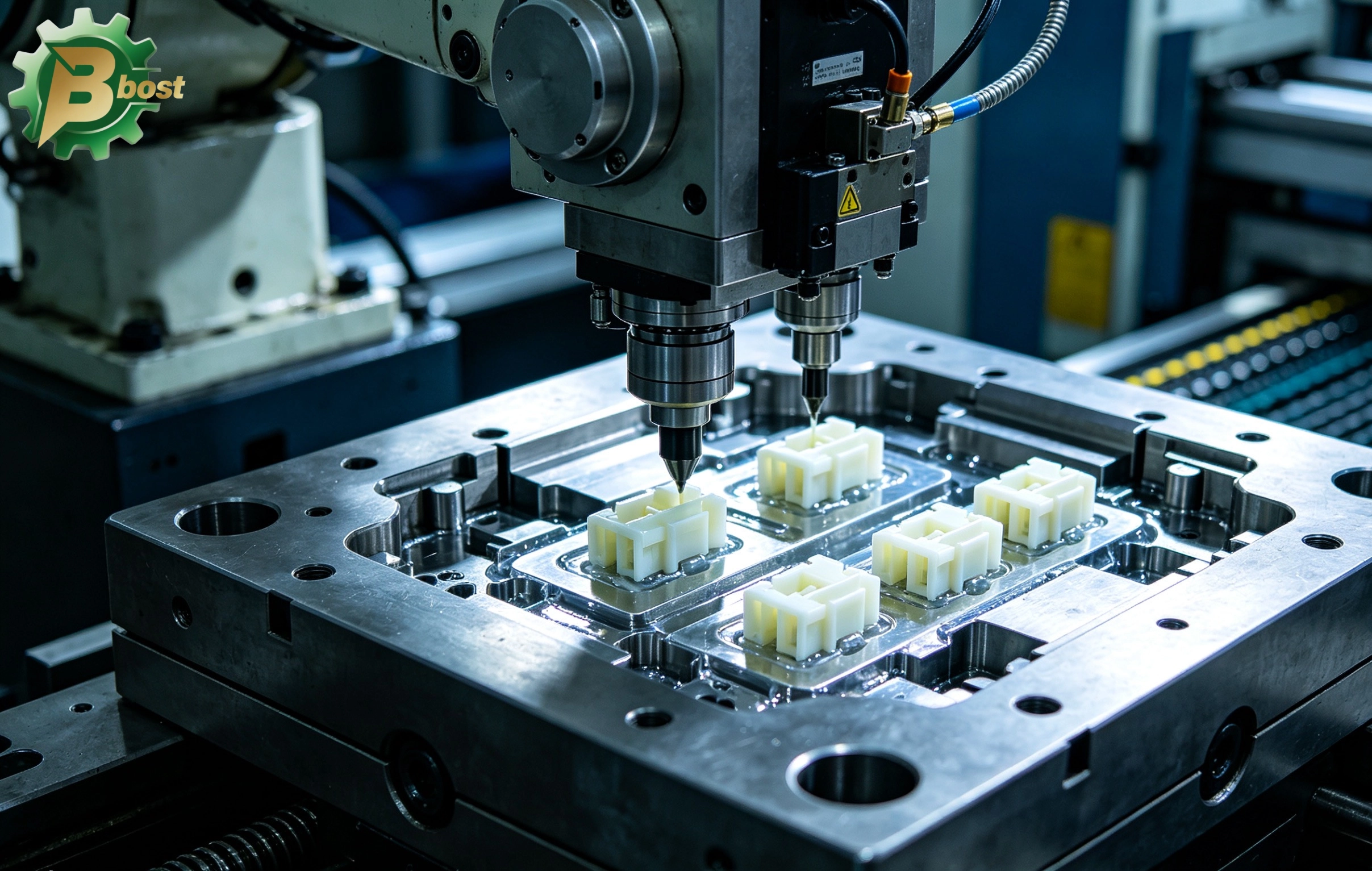
Even with top-tier resins and premium tooling, a high-quality output of custom injection molded parts cannot be sustained without robust control over the injection molding process. Process parameters—including injection pressure, packing transition velocity, melt temperature, and clamping force—must be executed via tight closed-loop control. Modernized, high-precision, all-electric injection molding machinery locks injection position accuracy within a tight ±0.01 mm variance band, thereby ensuring that every single batch of injection molded parts rolling off the assembly line maintains rigorous dimensional consistency.
Data-Driven Precision Manufacturing: Impact of Core Process Parameters on Injection Molded Parts
To help supply chain managers and mechanical engineers intuitively grasp the technical cause-and-effect relationships inside injection molding production, we have consolidated the core parameters and their cascading impacts on the final quality and defect mitigation of custom injection molded parts below:
Process Parameters & Custom Injection Molded Parts Quality Correlation Table
| Core Parameter | Optimization Goal | Direct Impact on Custom Injection Molded Parts | Common Defects If Miscontrolled |
|---|---|---|---|
| Injection Pressure & Speed | Dynamic profiled filling, precise V-P switching | Determines whether the polymer melt perfectly fills the microscopic boundaries of the mold cavity; influences the replication crispness of surface textures. | Excessive levels prompt flash; insufficient levels trigger short shots or prominent knit lines. |
| Packing Pressure & Time | Continuous compensation until gate freeze-off | Densely packs the internal molecular structure of the part to compensate for volumetric shrinkage during cooling; directly controls final weight and dimensions. | Deficient packing leads to surface sink marks or internal voids; excessive packing triggers ejection cracking. |
| Mold Temperature Control | Zoned precision thermal regulation, rapid balanced cooling | Directly dictates the crystallinity of semi-crystalline polymers, surface gloss aesthetics, and the distribution of residual internal stresses. | Non-uniform cooling triggers severe part warpage; overly low mold temperatures result in a dull surface finish. |
| Back Pressure & Screw Speed | Moderate back pressure for uniform melt degassing | Ensures plastic granules achieve thorough and uniform plasticization and shearing inside the barrel, preventing color streaking or trapped volatile gases. | Insufficient back pressure causes internal air entrapment or silver streaks; excessive back pressure prompts thermal degradation. |
Mitigating Tooling Risks at the Source: DFM Application in Custom Injection Molded Parts Projects
According to industrial manufacturing statistics, 80% of a product's manufacturing cost and latent quality vulnerabilities are permanently locked in the moment the design blueprints are signed off. Therefore, executing front-end DFM (Design for Manufacturability) assessments tailored specifically for custom injection molded parts represents the ultimate weapon for sophisticated overseas buyers to slash trial-and-error expenses.
In GZ-Bost's everyday engineering operations, we utilize advanced Moldflow analysis software to perform comprehensive physical check-ups on the wall thickness integrity of custom injection molded parts long before steel blocks are cut. For instance, the nominal wall thickness of an injection part should remain as uniform as possible. If thickness variations are mandatory due to spatial constraints, a smooth, tapered transition zone must be engineered, and the root base thickness of internal reinforcement ribs must never exceed 60% of the main wall thickness.
Furthermore, implementing adequate draft angles (typically no less than 1° for smooth outer walls, and upwards of 3° for textured surfaces) completely preemptes cosmetic imperfections such as part scuffing, drag marks, or stress whitening during high-velocity ejection cycles.
Partner with Guangzhou Bost (GZ-Bost) to Ensure the Solid Execution of Your Custom Injection Molded Parts Projects
Manufacturing flawless custom injection molded parts is a rigorous relay race spanning materials science, tooling craftsmanship, and process refinement. As an industry pioneer backed by over a decade of experience in B2B global digital marketing and precision manufacturing, Guangzhou Bost (GZ-Bost) always stands firmly from the customer's perspective, empowering global enterprises with rigorous industrial benchmarks.
We operate independent, high-precision toolmaking facilities alongside fully automated precision injection molding production lines under the strict mandates of the ISO 9001 Quality Management System. Whether you require micro-precision electronic components, high-load structural industrial enclosures, or tailored functional mechanical parts, we deliver a comprehensive, one-stop closed-loop solution from DFM optimization and mold design to high-volume commercial production.
We invite you to visit our official web portal at Guangzhou Bost to connect directly with our veteran engineering expert team. Submit your 3D CAD models (STEP/IGS) today to claim your complimentary in-depth design feasibility assessment and highly competitive customized quote. Let us join forces to engineer a hardware future optimized for both supreme quality and robust cost advantages!
Recommended for you
The Peak Art of Custom Manufacturing According to Drawings: Comprehensive Guide to Precision Solutions for Custom Parts According to Drawing
Ending Mechanical Wear and Resonance: The Comprehensive Guide to Precision Customization and Mass Production of a Custom Rubber Pad
The Ultimate Armor for Smart Hardware: Advanced Customization and Precision Injection Molding Guide for a Custom Plastic Box
The Ultimate Weapon to Tame Vibration and Noise: Deep Dive into the Custom Process and Mass Production Logic of a Custom Rubber Bushing
Product Categories
FAQ
FAQs
What is the minimum order quantity (MOQ)? Do you support small-batch trial production?
The MOQ for standard products is ≥100kg. We support small-batch trial production (as low as 20kg) and provide mold testing reports and performance data feedback.
What are the core advantages of Bost engineering plastics compared to ordinary plastics?
Bost engineering plastics feature ultra-high mechanical strength, high-temperature resistance (-50°C to 300°C), chemical corrosion resistance, and wear resistance. Compared to ordinary plastics, their service life is extended by 3 to 8 times, making them suitable for replacing metals in harsh environments.
Can Bost customize modified plastics with special properties?
Yes! We offer modification services such as reinforcement, flame retardancy, conductivity, wear resistance, and UV resistance, for example:
• Adding carbon fiber to enhance stiffness
• Reducing the coefficient of friction through PTFE modification
• Customizing food-grade or medical-grade certified materials
How do I select the appropriate engineering plastic grade for my product?
Selection should be based on parameters such as load conditions (e.g., pressure/friction), temperature range, medium contact (e.g., oil/acid), and regulatory requirements (e.g., FDA/RoHS). Our engineers can provide free material selection consulting and sample testing.
What is the delivery lead time? Do you offer global logistics?
Standard products: 5–15 working days; custom modifications: 2–4 weeks. We support global air/sea freight and provide export customs clearance documents (including REACH/UL certifications).
You may also like
Custom Plastic Knobs Precision Injection Molded
More Details →
Custom Plastic Knobs Precision Injection Molded
Custom Injection Molded Parts from Drawings
More Details →
Custom Injection Molded Parts from Drawings
Underwater Camera Shell Custom Plastic Molding
More Details →
Underwater Camera Shell Custom Plastic Molding
Leave a Message
Have any questions or concerns about our products? Please leave us a message here, and our team will get back to you promptly.

24 hours quotes delivered
Submit CAD files, get quote in 24 hours

No MOQ required
From prototyping to high-volume

±0.02 mm Precision
Advanced CNC with full inspections

1,000+ tons in stock
26 materials ready to ship
© 2026 BOST. All Rights Reserved.