




 Scan QR Code
Send My Request
Defect Resolution & Root-Cause Engineering: The Advanced Troubleshooting Guide for Custom Injection Molded Parts
2026-07-09
Custom plastic enclosure manufacturers will find precise defect resolution methods and root-cause engineering tactics tailored for custom plastic enclosures for electronics. Bost’s guide breaks down advanced troubleshooting steps to improve quality and reduce failures in custom injection molded parts.
- The Diagnostics Matrix: Defect vs. Root Cause
- Industrial Diagnostic & Rectification Matrix
- Deep-Dive Engineering Resolution Strategies
- 1. Solving Volumetric Shrinkage and Sink Marks
- 2. Eliminating Warpage and Residual Stress
- The Scientific Molding Approach to Defect Mitigation
- Secure Defect-Free Production with Guangzhou Bost (GZ-Bost)
- Transform Your Design into a Flawless Reality
Author: Technical Director & Polymer Rheology Specialist | Published by: Guangzhou Bost (GZ-Bost)
In high-precision manufacturing, encountering cosmetic or structural anomalies during the first article inspection (FAI) or initial sample run is a common engineering hurdle. However, treating symptoms rather than solving the physics-based root causes leads to endless trial-and-error loops, wasted resin, and blown lead times.
When producing custom injection molded parts, quality failures are rarely isolated incidents; they are the intersecting results of polymer thermodynamics, mold mechanics, and dynamic machine controls. This guide serves as an engineering blueprint to diagnose, isolate, and rectify the four most disruptive defects in injection molding.
The Diagnostics Matrix: Defect vs. Root Cause
Before altering machine settings or modifying tool steel, engineers must establish a quantitative diagnostic baseline. The table below outlines the structural and thermal triggers for common injection molding failures.
Industrial Diagnostic & Rectification Matrix
| Visual/Structural Defect | Primary Polymer Behavior | Machine-Side Root Cause | Mold-Side Root Cause |
|---|---|---|---|
| Sink Marks | Localized volumetric shrinkage due to uncompensated thermal mass. | Packing pressure too low; packing time shorter than gate freeze-off time. | Inadequate cooling circuit proximity near thick sections; gate size too restrictive. |
| Part Warpage | Non-uniform residual stress distribution across varying planes. | Melt temperature too high; cooling cycle premature; injection velocity unbalanced. | Unbalanced cooling differential between core and cavity halves; uneven ejector pin force. |
| Flash (Burrs) | Melt viscosity drops too low, or cavity pressure exceeds clamp tonnage. | Injection pressure or speed excessive; clamping force set below safety thresholds. | Parting line wear; misaligned guide pins; inadequate structural support plates in the mold. |
| Knit Lines (Melt Lines) | Poor molecular entanglement at converging flow fronts. | Melt or mold temperature too low; injection speed insufficient to maintain flow front energy. | Gates positioned too far apart; inadequate venting at the extremity of the weld zone. |
Deep-Dive Engineering Resolution Strategies
1. Solving Volumetric Shrinkage and Sink Marks
Sink marks occur when the outer skin of a molded component solidifies first, but the molten core continues to shrink, pulling the surface inward. Linear mold shrinkage is mathematically represented as:
$$S = \frac{L_d - L_p}{L_d}$$
Where $S$ is the shrinkage rate, $L_d$ is the mold cavity dimension, and $L_p$ is the final part dimension. To suppress sink marks without bloating part weight:
-
The Packing Phase Cure: Maintain packing pressure until the gate fully freezes. If the gate freezes prematurely due to a restrictive design, the machine can no longer pack the cavity interior, rendering parameter tuning useless.
-
DFM Correction: Redesign thick-walled intersections using a smooth, tapered transition zone. Ensure internal rib bases conform strictly to the $60%$ maximum threshold of the primary wall thickness.
2. Eliminating Warpage and Residual Stress
Warpage is the structural manifestation of differential shrinkage. If the core side of a tool is significantly hotter than the cavity side, the part will bend toward the hotter half upon ejection due to delayed cooling shrinkage.
Engineering Best Practice: Implement a segmented thermal control strategy. Utilize independent thermolators for the core and cavity inserts. For high-crystalline materials (such as PA66+GF or POM), keeping a high but completely uniform mold temperature minimizes post-molding crystallization warpage.
The Scientific Molding Approach to Defect Mitigation
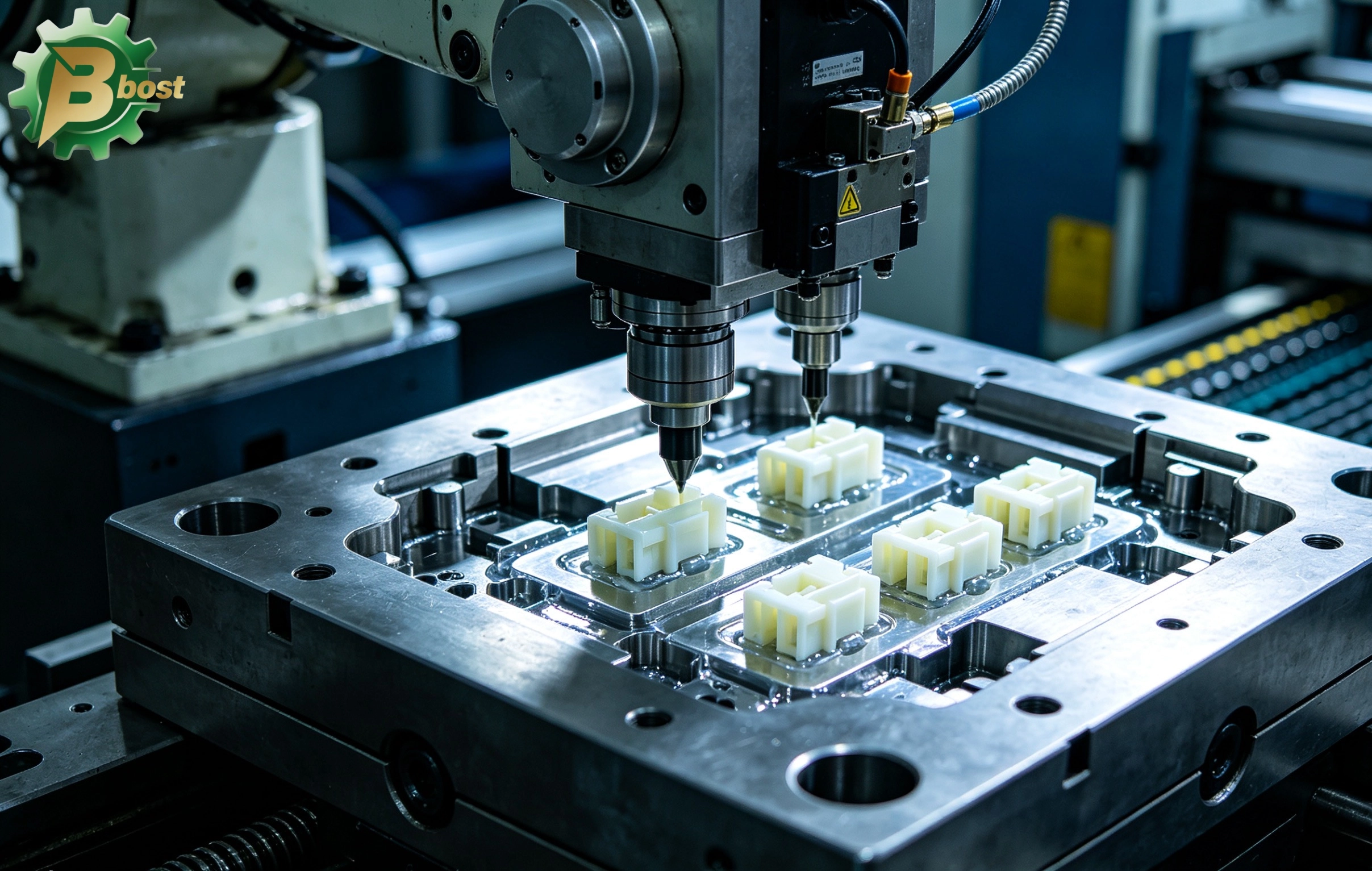
Modern precision manufacturing rejects the traditional practice of "knob-twisting" by machine operators. Premium contract manufacturers rely on Scientific Molding—a data-driven methodology that isolates variables into independent stages:
Stage 1: Viscosity Curve Optimization (Isolate Shear Rate) ⬇Stage 2: Cavity Fill Balance (Ensure Uniform Flow Profiles) ⬇Stage 3: Pressure Profile Window (Isolate Pack/Hold Dynamics) ⬇Stage 4: Thermal Gate Freeze Study (Determine True Solidification Time)By executing a comprehensive Gate Freeze Study, engineers plot part weight against packing time. The exact second the part weight plateaus represents the precise moment the gate has solidified. Packing beyond this point wastes energy and increases cycle time; packing less than this invites structural voids.
Secure Defect-Free Production with Guangzhou Bost (GZ-Bost)
Achieving dimensional consistency across hundreds of thousands of custom injection molded parts requires an engineering partner that prioritizes scientific manufacturing over guesswork. At Guangzhou Bost (GZ-Bost), our engineering-first culture ensures your projects bypass the typical production pitfalls.
We couple our intensive B2B global supply chain expertise with advanced metrology and automated, closed-loop molding infrastructure. Every tool built in our high-precision workshop undergoes rigorous scientific molding optimization, giving you comprehensive DFM analysis, moldflow profiles, and process capability indexing (CPK) as standard deliverables.
Transform Your Design into a Flawless Reality
Eliminate quality volatility and de-risk your global supply chain today. Connect with our technical team to secure precision execution for your hardware assets.
-
Explore Our Engineering Standards: Guangzhou Bost Official Website
-
Request Technical Review: Upload your native 3D files (STEP/IGS) for a thorough manufacturability and defect-prevention evaluation.
Recommended for you
The Peak Art of Custom Manufacturing According to Drawings: Comprehensive Guide to Precision Solutions for Custom Parts According to Drawing
Ending Mechanical Wear and Resonance: The Comprehensive Guide to Precision Customization and Mass Production of a Custom Rubber Pad
The Ultimate Armor for Smart Hardware: Advanced Customization and Precision Injection Molding Guide for a Custom Plastic Box
The Ultimate Weapon to Tame Vibration and Noise: Deep Dive into the Custom Process and Mass Production Logic of a Custom Rubber Bushing
Product Categories
FAQ
FAQs
How do I select the appropriate engineering plastic grade for my product?
Selection should be based on parameters such as load conditions (e.g., pressure/friction), temperature range, medium contact (e.g., oil/acid), and regulatory requirements (e.g., FDA/RoHS). Our engineers can provide free material selection consulting and sample testing.
What is the minimum order quantity (MOQ)? Do you support small-batch trial production?
The MOQ for standard products is ≥100kg. We support small-batch trial production (as low as 20kg) and provide mold testing reports and performance data feedback.
What are the core advantages of Bost engineering plastics compared to ordinary plastics?
Bost engineering plastics feature ultra-high mechanical strength, high-temperature resistance (-50°C to 300°C), chemical corrosion resistance, and wear resistance. Compared to ordinary plastics, their service life is extended by 3 to 8 times, making them suitable for replacing metals in harsh environments.
What is the delivery lead time? Do you offer global logistics?
Standard products: 5–15 working days; custom modifications: 2–4 weeks. We support global air/sea freight and provide export customs clearance documents (including REACH/UL certifications).
Can Bost customize modified plastics with special properties?
Yes! We offer modification services such as reinforcement, flame retardancy, conductivity, wear resistance, and UV resistance, for example:
• Adding carbon fiber to enhance stiffness
• Reducing the coefficient of friction through PTFE modification
• Customizing food-grade or medical-grade certified materials
You may also like
Custom Plastic Knobs Precision Injection Molded
More Details →
Custom Plastic Knobs Precision Injection Molded
Custom Injection Molded Parts from Drawings
More Details →
Custom Injection Molded Parts from Drawings
Underwater Camera Shell Custom Plastic Molding
More Details →
Underwater Camera Shell Custom Plastic Molding
Leave a Message
Have any questions or concerns about our products? Please leave us a message here, and our team will get back to you promptly.

24 hours quotes delivered
Submit CAD files, get quote in 24 hours

No MOQ required
From prototyping to high-volume

±0.02 mm Precision
Advanced CNC with full inspections

1,000+ tons in stock
26 materials ready to ship
© 2026 BOST. All Rights Reserved.