




 Scan QR Code
Send My Request
The Ultimate Engineer's Guide: Mastering the Four Core Dimensions of Over Molding Mass Production
2026-03-23
Over molding bridges rigid plastics and soft elastomers—but getting it right demands precision across materials, mold design, process control, and manufacturing expertise. This guide distills the four essential dimensions to help engineering and procurement teams move from prototype to stable mass production with confidence.
In today's pursuit of the ultimate product experience, Over Molding is no longer the exclusive domain of high-end consumer electronics. From ergonomically comfortable medical surgical instruments to industrial sensors with strict waterproof ratings, this technology is becoming a core means of increasing product value.
However, perfectly fusing two distinctly different materials—typically a rigid engineering plastic substrate and a flexible thermoplastic elastomer (such as TPE or TPU)—is significantly more technically demanding than traditional single-shot injection molding. Many engineers start the R&D phase with high expectations, only to encounter severe obstacles like soft and hard material delamination, crushed substrates, or flash and burrs during actual mass production, leading to project delays or even scrap.
This guide is specifically tailored for hardware R&D teams and procurement decision-makers. We will provide you with a systematic methodology for implementing Over Molding projects, from material pairing to mold design and refined injection molding process control, helping you create impeccable industrial masterpieces.
Dimension 1: Cracking Material Compatibility—The Double Insurance of Chemical Bonding and Mechanical Interlocking
The foundation of successful Over Molding lies in whether the two materials are "compatible." If there is no good molecular-level affinity between the soft and hard materials, the product will quickly delaminate when subjected to external pulling forces or temperature fluctuations.
Pursuing Ultimate Chemical Bonding: This is the ideal over-molding state. By selecting materials with similar polarities (for example, a PC/ABS skeleton paired with a specific grade of TPU), the molecular chains of the two materials will penetrate each other at the interface and create solid chemical cross-linking under high-temperature and high-pressure environments. During the material selection phase, always request compatibility tensile test reports for Over Molding from your material suppliers.
Clever Mechanical Interlocking: When product functional requirements dictate the use of naturally incompatible material combinations (such as POM paired with certain specialty elastomers), physical locking becomes the lifesaver. Excellent engineers will design through-holes, dovetail grooves, or edge-wrapping structures on the rigid substrate, allowing the soft rubber to firmly "bite" the rigid skeleton through these physical spaces. Even if chemical adhesion is insufficient, the mechanical structure ensures the two will never separate.
Dimension 2: The Precision Mold Design That Determines Success or Failure—The Art of Shut-off Areas
In all Over Molding projects, the machining precision of the second-shot mold (the over-mold) directly dictates the yield rate of the finished product. The "flash" and "crushed skeletons" that cause the most headaches for injection molding factories usually stem from errors in the initial mold design.
Seamless Shut-off Areas: Soft rubber materials have extremely strong fluidity in a high-temperature molten state, penetrating almost any microscopic gap. Therefore, the mold's shut-off surface must achieve a micrometer-level perfect fit with the contour of the first-shot substrate. We generally recommend reserving a "pre-load" of 0.05mm - 0.12mm at the shut-off area, utilizing the clamping force when the mold closes to slightly compress the rigid substrate. This achieves an absolute physical seal and completely eliminates flash.
Strategic Layout of Gates and Venting: The soft rubber gate should avoid the product's high-stress areas and visible cosmetic surfaces as much as possible. Simultaneously, to prevent the melt temperature from dropping too much before filling the mold cavity, the runner must be as short as possible. For large-area over-molded products, a multi-point gating strategy must be adopted to ensure pressure balance during the precision injection molding process, preventing the first-shot rigid substrate from being deformed by injection pressure.
Dimension 3: Mastering the Injection Molding Process—The Balancing Act of "Ice" and "Fire"
With a perfect material plan and a high-precision mold, machine tuning on the production line is the final critical step. Over Molding is highly sensitive to temperature and pressure, leaving an extremely low margin for error.
Substrate Pre-heating Treatment: To enhance the adhesion effect, the first-shot rigid substrate usually needs to be baked and pre-heated before being placed into the second-shot mold cavity, or the residual heat from the first shot must be utilized. An icy cold substrate will cause the second-shot soft rubber melt to drop in temperature rapidly and freeze upon contact, making it impossible to form a deep molecular bond.
Segmented Pressure and Speed Control: The injection molding process for over-molding must strictly follow the golden rule of "fast first, slow later." The initial stage uses rapid filling to prevent the melt front from condensing; the end stage switches to slow holding pressure to prevent high pressure from damaging the substrate or causing soft rubber overflow. The precise recording and solidification of process curves are the core secrets to ensuring consistent product quality across every batch.
Dimension 4: Finding a High-Quality Manufacturing Partner with Mass Production Capabilities
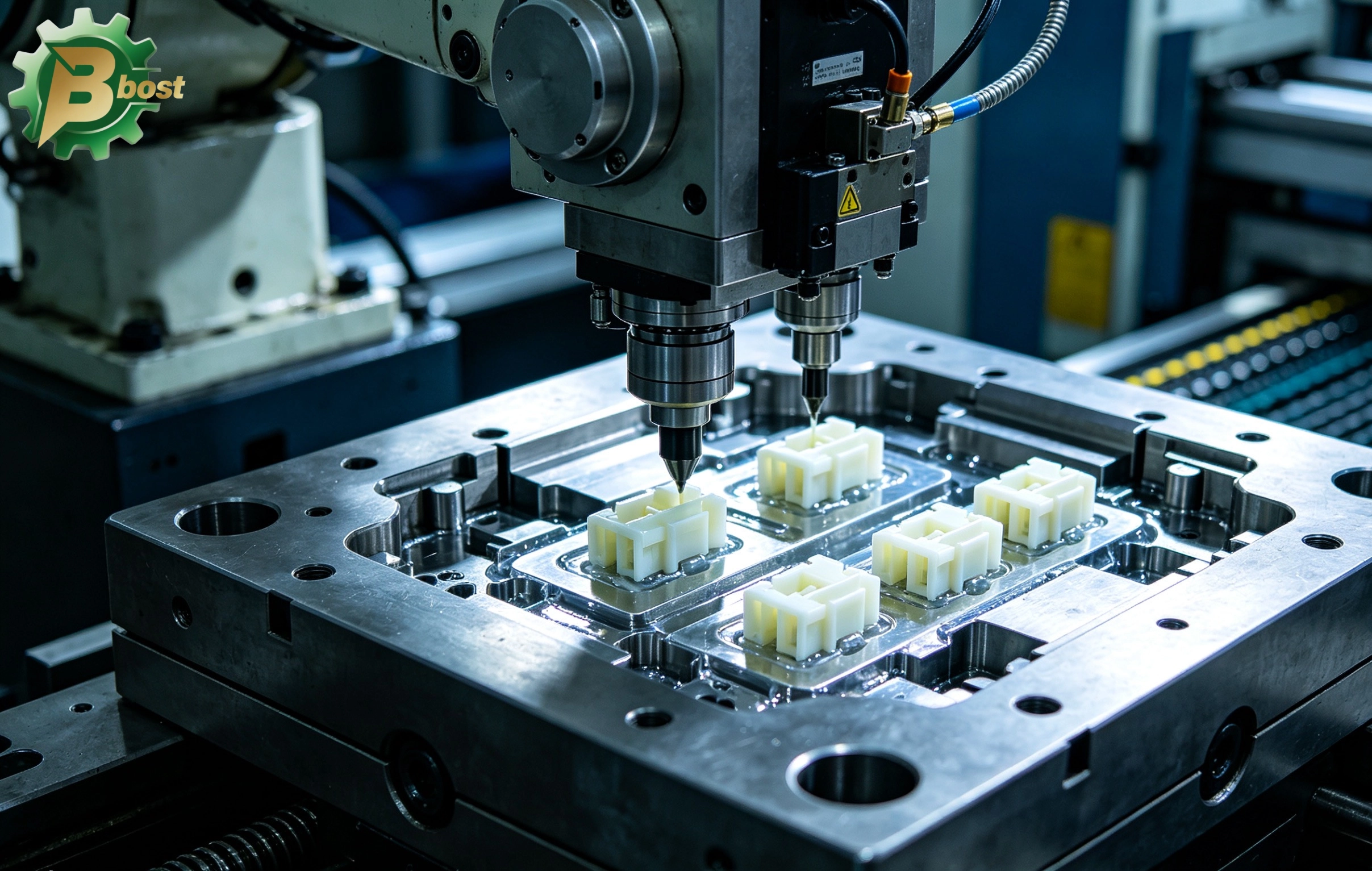
Over Molding is absolutely not an isolated production process; it requires deep synergy between product design, mold manufacturing, and injection molding production. To save on initial tooling costs, many companies choose OEMs lacking two-color or over-molding experience, only to consume multiples of time and financial costs in repeated mold modifications and extremely high scrap rates.
At Guangzhou Bost (GZ-Bost), we not only provide world-class precision injection molding OEM services but also deeply intervene in DFM (Design for Manufacturability) evaluation during the early stages of project R&D. We deeply understand the impact that every micrometer of steel tolerance and every degree Celsius of barrel temperature difference has on the lifespan of the final product.
Your pain points are the subjects we conquer. Whether you are developing complex medical devices or pursuing the ultimate tactile feel in consumer electronics, we are ready to escort your project to success. We welcome you to visit our official website at to explore more industry success cases. Contact our team of senior engineers right now to get a free project evaluation and a detailed mass production quote. Let us work together to transform your brilliant vision into stunning, high-quality hardware products that amaze the market!
Recommended for you
The Peak Art of Custom Manufacturing According to Drawings: Comprehensive Guide to Precision Solutions for Custom Parts According to Drawing
Ending Mechanical Wear and Resonance: The Comprehensive Guide to Precision Customization and Mass Production of a Custom Rubber Pad
The Ultimate Armor for Smart Hardware: Advanced Customization and Precision Injection Molding Guide for a Custom Plastic Box
The Ultimate Weapon to Tame Vibration and Noise: Deep Dive into the Custom Process and Mass Production Logic of a Custom Rubber Bushing
Product Categories
FAQ
FAQs
What is the minimum order quantity (MOQ)? Do you support small-batch trial production?
The MOQ for standard products is ≥100kg. We support small-batch trial production (as low as 20kg) and provide mold testing reports and performance data feedback.
What are the core advantages of Bost engineering plastics compared to ordinary plastics?
Bost engineering plastics feature ultra-high mechanical strength, high-temperature resistance (-50°C to 300°C), chemical corrosion resistance, and wear resistance. Compared to ordinary plastics, their service life is extended by 3 to 8 times, making them suitable for replacing metals in harsh environments.
What is the delivery lead time? Do you offer global logistics?
Standard products: 5–15 working days; custom modifications: 2–4 weeks. We support global air/sea freight and provide export customs clearance documents (including REACH/UL certifications).
How do I select the appropriate engineering plastic grade for my product?
Selection should be based on parameters such as load conditions (e.g., pressure/friction), temperature range, medium contact (e.g., oil/acid), and regulatory requirements (e.g., FDA/RoHS). Our engineers can provide free material selection consulting and sample testing.
Can Bost customize modified plastics with special properties?
Yes! We offer modification services such as reinforcement, flame retardancy, conductivity, wear resistance, and UV resistance, for example:
• Adding carbon fiber to enhance stiffness
• Reducing the coefficient of friction through PTFE modification
• Customizing food-grade or medical-grade certified materials
You may also like
Custom Plastic Knobs Precision Injection Molded
More Details →
Custom Plastic Knobs Precision Injection Molded
Custom Injection Molded Parts from Drawings
More Details →
Custom Injection Molded Parts from Drawings
Underwater Camera Shell Custom Plastic Molding
More Details →
Underwater Camera Shell Custom Plastic Molding
Leave a Message
Have any questions or concerns about our products? Please leave us a message here, and our team will get back to you promptly.

24 hours quotes delivered
Submit CAD files, get quote in 24 hours

No MOQ required
From prototyping to high-volume

±0.02 mm Precision
Advanced CNC with full inspections

1,000+ tons in stock
26 materials ready to ship
© 2026 BOST. All Rights Reserved.