




 Scan QR Code
Send My Request
The Ultimate Guide: A Comprehensive 2026 Injection Molding Guide for Custom Parts
2026-04-17
Discover Bost’s 2026 Injection Molding Guide for custom parts, featuring expert insights on high performance plastic injection molding. Learn from leading high performance injection molding suppliers to optimize your production with quality and precision. Your trusted resource for innovative solutions.
In modern manufacturing, injection molding is the most efficient means of achieving mass production of precision plastic components. However, for many procurement managers and junior engineers, the process can seem like a "black box." A detailed Injection Molding Guide not only helps you avoid design flaws but also significantly reduces production costs.
With over 15 years of industry experience, GZ-Bost has broken down the injection molding process into five critical stages, aiming to provide you with a practical handbook from design to finished product.
1. Design Phase: DFM is the Bedrock of Success
Before starting any custom injection molding parts project, design optimization is the top priority.
-
Wall Thickness Consistency: Uneven wall thickness is the primary culprit for sink marks and warping.
-
Draft Angle: To ensure the part is ejected smoothly from the mold, a draft angle of 1.0° to 2.0° is typically required.
-
Rib Design: The thickness of ribs should not exceed 60% of the main wall thickness to prevent shrinkage on the cosmetic surface.
2. Mold Manufacturing: Precision Dictates Everything
Tooling is the largest portion of the injection molding cost. Depending on the product life cycle, you can choose different mold classes:
| Mold Class | Expected Cycles | Common Materials | Typical Application |
| Prototype (Class 105) | < 500 | Aluminum / Mild Steel | Validation, Market Testing |
| Production (Class 103) | 100k - 500k | P20 / 718H | Medium Volume, Electronics |
| High Volume (Class 101) | > 1M | S136 / H13 (Hardened) | High Volume, Medical, Auto |
3. Material Selection: Balancing Performance and Cost
In any Injection Molding Guide, material selection directly impacts physical properties. Beyond basic ABS and PP, we frequently process high-performance engineering plastics:
-
PC/ABS: Combines the strength of PC with the processability of ABS, often used in automotive interiors.
-
PA66 + GF (Glass Fiber): Significantly enhances the rigidity and heat resistance of the parts.
-
PEEK: An aerospace-grade material that is heat-resistant and extremely strong.
4. The Production Cycle: The Four Stages of Scientific Molding
A standard injection molding cycle includes:
-
Clamping: The machine applies massive force to ensure the mold stays closed during injection.
-
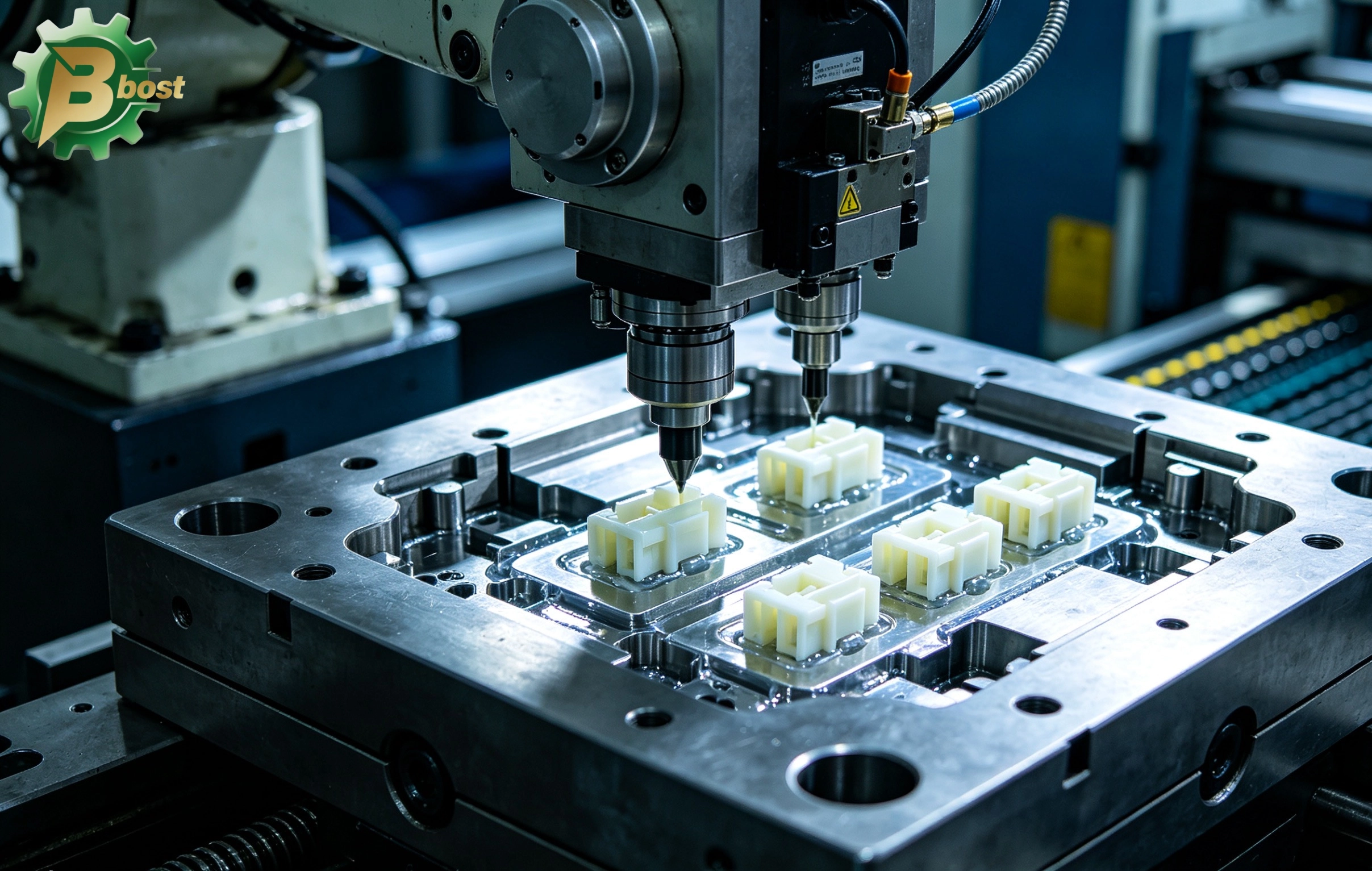
Injection: Molten plastic is injected into the mold cavity under high pressure.
-
Cooling: The most time-consuming part of the cycle; scientific water channel design can shorten cooling time by 20%.
-
Ejection: The mold opens, and ejector pins push the finished part into the collection bin.
5. Quality Control: How to Judge Your Supplier?
A professional injection molding manufacturer must have a rigorous inspection process:
-
First Article Inspection (FAI): Confirming the first part fully meets drawing tolerances.
-
CMM Inspection: Using coordinate measuring machines to detect complex geometric tolerances.
-
Stress Testing: Conducting destructive tests on functional parts to ensure structural reliability.
Conclusion and Call to Action
This Injection Molding Guide is just the tip of the iceberg. Behind every successful custom injection molding parts project are countless parameter adjustments and engineering optimizations.
If you are facing project bottlenecks or need a professional cost analysis, the technical team at GZ-Bost is standing by.
Ready to optimize your supply chain?
Recommended for you
The Peak Art of Custom Manufacturing According to Drawings: Comprehensive Guide to Precision Solutions for Custom Parts According to Drawing
Ending Mechanical Wear and Resonance: The Comprehensive Guide to Precision Customization and Mass Production of a Custom Rubber Pad
The Ultimate Armor for Smart Hardware: Advanced Customization and Precision Injection Molding Guide for a Custom Plastic Box
The Ultimate Weapon to Tame Vibration and Noise: Deep Dive into the Custom Process and Mass Production Logic of a Custom Rubber Bushing
Product Categories
FAQ
FAQs
What are the core advantages of Best engineering plastics compared to ordinary plastics?
Best engineering plastics feature ultra-high mechanical strength, high-temperature resistance (-50°C to 300°C), chemical corrosion resistance, and wear resistance. Compared to ordinary plastics, their service life is extended by 3 to 8 times, making them suitable for replacing metals in harsh environments.
Can Best customize modified plastics with special properties?
Yes! We offer modification services such as reinforcement, flame retardancy, conductivity, wear resistance, and UV resistance, for example:
• Adding carbon fiber to enhance stiffness
• Reducing the coefficient of friction through PTFE modification
• Customizing food-grade or medical-grade certified materials
What is the minimum order quantity (MOQ)? Do you support small-batch trial production?
The MOQ for standard products is ≥100kg. We support small-batch trial production (as low as 20kg) and provide mold testing reports and performance data feedback.
What is the delivery lead time? Do you offer global logistics?
Standard products: 5–15 working days; custom modifications: 2–4 weeks. We support global air/sea freight and provide export customs clearance documents (including REACH/UL certifications).
How do I select the appropriate engineering plastic grade for my product?
Selection should be based on parameters such as load conditions (e.g., pressure/friction), temperature range, medium contact (e.g., oil/acid), and regulatory requirements (e.g., FDA/RoHS). Our engineers can provide free material selection consulting and sample testing.
You may also like
Custom Plastic Knobs Precision Injection Molded
More Details →
Custom Plastic Knobs Precision Injection Molded
Custom Injection Molded Parts from Drawings
More Details →
Custom Injection Molded Parts from Drawings
Underwater Camera Shell Custom Plastic Molding
More Details →
Underwater Camera Shell Custom Plastic Molding
Leave a Message
Have any questions or concerns about our products? Please leave us a message here, and our team will get back to you promptly.

24 hours quotes delivered
Submit CAD files, get quote in 24 hours

No MOQ required
From prototyping to high-volume

±0.02 mm Precision
Advanced CNC with full inspections

1,000+ tons in stock
26 materials ready to ship
© 2026 BOST. All Rights Reserved.