




 Scan QR Code
Send My Request
Breaking the Limits of Multi-Material Integration: The Engineering Art of Precision Insert Molding and Overmolding
2026-07-17
One stop plastic injection molding service and turnkey plastic injection molding services from Bost reveal advanced techniques in precision insert molding and overmolding. Learn how to engineer seamless multi-material integration to enhance product durability and design flexibility.
- 1. Critical Technical Barriers in Insert Molding & Overmolding
- 1. Achieving High Interface Bonding Strength (Preventing Delamination)
- 2. Precise Flash and Shut-off Control
- 3. Preventing Insert Displacement under High Shear Forces
- 2. Material Compatibility Guide: The Key to Successful Overmolding
- 3. Tooling and Scientific Molding: The Blueprint for Defect-Free Production
- 1. Tooling Design with Compliant Shut-off Faces
- 2. Preheating Protocols for Metal Inserts
- 3. Integrated Multi-Shot (Two-Shot) Molding
- 4. Why Partner with Bost for Your Multi-Material Projects?
- Conclusion: Accelerate Your Multi-Material Molding Project
In modern industrial design, single materials rarely satisfy the diverse and complex requirements of structural strength, waterproofing, ergonomic grip, and electrical insulation. To break these limitations, product designers rely on insert molding and overmolding technologies.
Whether it is a high-voltage battery junction box integrated with heavy copper busbars for new energy vehicles, surgical instruments requiring IP68-rated slip-resistant medical handles, or premium electronics housings with rugged threaded brass inserts, these multi-material technologies are indispensable. However, combining metal with plastic, or bonding rigid engineering resins with soft thermoplastic elastomers (like TPE or TPU), presents steep manufacturing hurdles on the factory floor.
As a leading provider of a one stop plastic injection molding service, Guangzhou Bost (Bost) brings over a decade of technical experience serving global industrial OEMs. In this article, we analyze how to conquer delamination, flashing, and internal stress cracking through precision mold design and scientific injection molding process controls.
1. Critical Technical Barriers in Insert Molding & Overmolding
Succeeding with a high-quality multi-material component requires overcoming three fundamental engineering bottlenecks:
1. Achieving High Interface Bonding Strength (Preventing Delamination)
Whether two distinct materials can remain permanently fused under structural stress is the primary metric of overmolding success.
-
Mechanical Interlocking: This involves engineering undercut features, knurled textures, recesses, or through-holes into the metal insert or rigid plastic substrate. The molten polymer flows into these geometries and solidifies, creating a permanent mechanical lock.
-
Chemical Molecular Diffusion: During overmolding, the molten elastomer (e.g., TPE) must partially melt the surface of the rigid plastic substrate (e.g., ABS or PC) upon contact. This allows the polymer chains of both materials to diffuse and entangle. If they are chemically incompatible or if the interface temperature is too low, the materials will easily delaminate in the field.
2. Precise Flash and Shut-off Control
Metal inserts naturally carry dimensional manufacturing tolerances. When loading a metal insert into a steel mold cavity, designing a rigid, unyielding shut-off face can crush the insert or damage the mold steel. Conversely, if the shut-off gap is too loose, high injection pressures (reaching tens of megapascals) will force molten plastic into the seams, creating heavy flash. This skyrockets post-molding trimming labor and increases scrap rates.
3. Preventing Insert Displacement under High Shear Forces
During the high-speed, high-pressure injection fill stage, molten polymer flow exerts significant shear force. If the locating pins or nest structures in the mold are unoptimized, or if the gate is positioned directly opposite the insert, this lateral force will displace or bend the insert by tens of microns, ruining the final assembly tolerances.
2. Material Compatibility Guide: The Key to Successful Overmolding
In overmolding design, pairing the right substrate and overmold material is critical to achieving a robust chemical bond. The table below outlines the material compatibility matrices verified by the Bost engineering team in production:
| Rigid Substrate | Common Soft Overmold | Bonding Compatibility | Bonding Mechanism & Design Advice |
|---|---|---|---|
| PC, ABS, PC/ABS | TPE / TPU | Excellent | Highly compatible molecular polarities lead to excellent thermal fusion. While chemical bonding is robust, integrating minor mechanical undercuts offers dual security. |
| Nylon (PA6/PA66) | Specialized PA-bonded TPE / TPU | Good | Must utilize specialized TPE compounds modified specifically for polyamide bonding. Since nylon is hygroscopic, pre-molding drying is critical, and mold temperatures should exceed 80°C. |
| PP (Polypropylene) | PP-compatible TPE | Good | Since PP is non-polar, a PP-based TPE formulation is required to achieve chemical fusion. |
| PBT / PET | TPU / Polyester-TPE | Moderate to Good | Narrow processing window. Requires highly precise control over melt temperature and injection speed to facilitate adequate molecular entanglement. |
| Metal (Al, Cu, Steel) | Any Polymer (Insert Molding) | None (No Chemical Bond) | Requires physical locking via surface knurling, keyways, and undercut slots, or pre-treating the metal with specialized bonding primers. |
3. Tooling and Scientific Molding: The Blueprint for Defect-Free Production
To guarantee that every composite component leaves our facility with zero defects, Bost couples advanced mold design with disciplined scientific molding control:
[Metal/Plastics Insert Pre-treatment] ──> Clean/degrease & preheat to minimize thermal delta ↓[Precision Tooling Design] ──> Spring-loaded nests / hydraulic sliders to absorb insert tolerances ↓[Moldflow Shear & Force Analysis] ──> Optimize gate locations to minimize shear force on inserts ↓[Scientific Molding Control] ──> Slow touch at shut-off ──> High-speed fill cavity ──> Precise pack switch ↓[Quality Assurance Inspection] ──> 2.5D/CMM metrology for insert concentricity & peel testing1. Tooling Design with Compliant Shut-off Faces
To accommodate the dimensional fluctuations of metal inserts, Bost integrates compliant tool shut-off designs, such as spring-loaded cavity blocks or micro-adjustable slide cores. When the mold clamps shut, these inserts flex slightly. This creates a secure, leak-free seal around the metal insert without scratching the metal surface or wearing the tool steel.
2. Preheating Protocols for Metal Inserts
The coefficient of linear thermal expansion (CLTE) of metals is significantly lower than that of plastics. When a hot polymer melt encounters a cold metal insert inside the mold cavity, the plastic at the interface freezes instantly. This creates high internal stress, which can lead to cracking and poor bonding over time. Bost utilizes integrated induction or infrared preheating stations to heat metal inserts to 100°C - 130°C before insertion. This enhances polymer adhesion and relieves interfacial stress.
3. Integrated Multi-Shot (Two-Shot) Molding
For high-volume overmolding projects, Bost operates advanced multi-shot injection molding presses equipped with rotary platens. The machine injects the rigid substrate (Shot 1), rotates the mold half, and immediately overmolds the soft elastomer (Shot 2) in a single cycle. This process takes only seconds. Because the substrate is still warm, molecular diffusion is highly efficient, boosting bond strength by over 50% compared to cold insert overmolding.
4. Why Partner with Bost for Your Multi-Material Projects?
Multi-material molding is a complex discipline. Choosing Bost’s one stop plastic injection molding service gives your enterprise a dedicated engineering and production resource:
-
Design-for-Assembly & Material Guidance: Our materials specialists evaluate your operating environment (e.g., UV resistance, chemical exposure, sealing demands) to recommend the most reliable polymer pairs, backed by upfront DFM feedback.
-
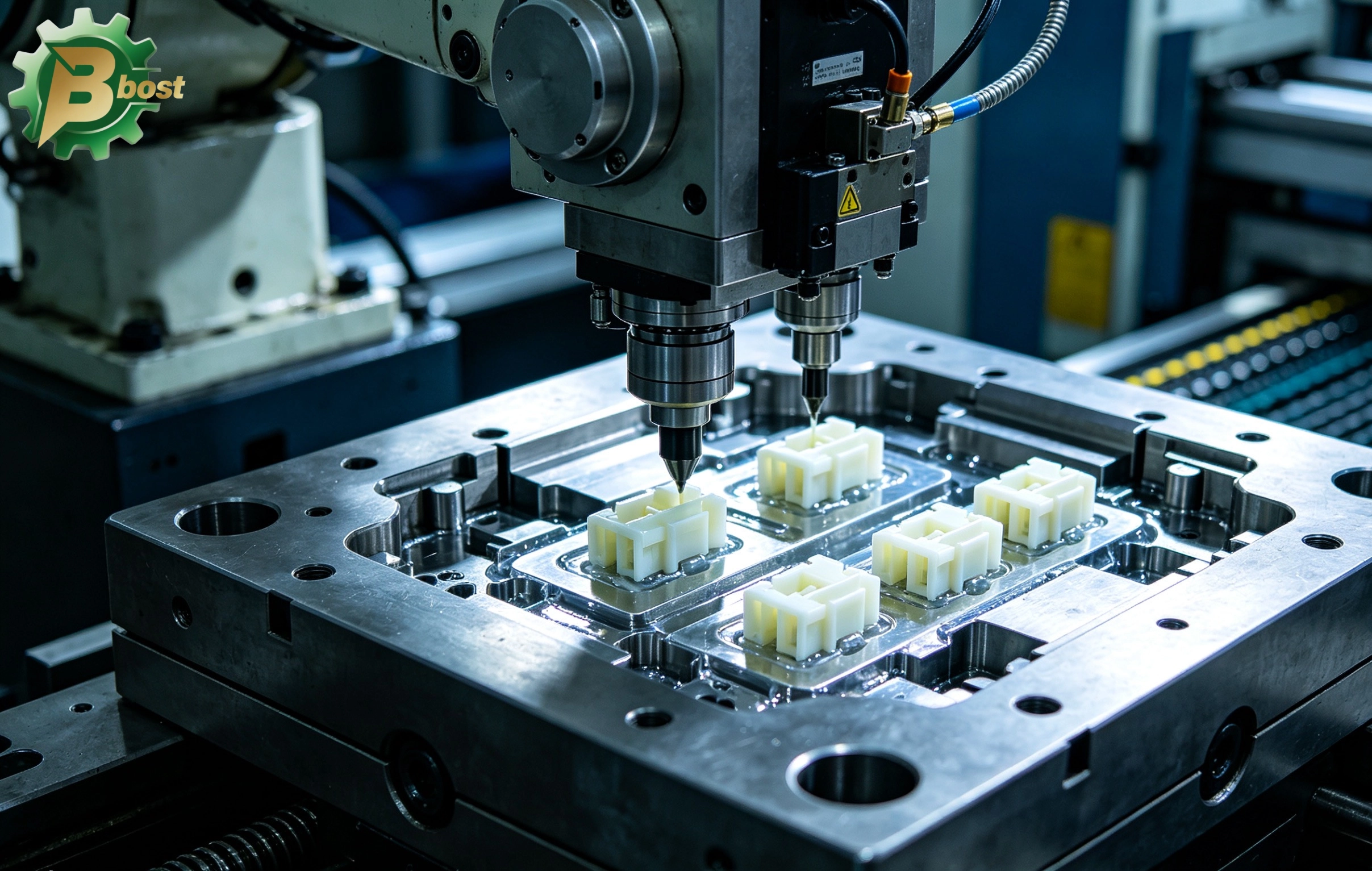
Automated, Repeatable Production: Our facility features multi-axis robotic arms programmed to automate insert loading and part extraction. This eliminates human variability, cycle-time fluctuations, and contamination risks, ensuring long-term quality consistency.
-
Rigorous Quality Testing: The Bost metrology lab conducts thermal shock testing, peel-force testing, and automated pressure-leak tests to ensure your parts never delaminate or leak under demanding field conditions.
Conclusion: Accelerate Your Multi-Material Molding Project
Whether you are looking to enhance the cosmetic feel of a consumer device or secure a metal thread in a rugged electrical enclosure, precision insert molding and overmolding are key to achieving your engineering goals.
Guangzhou Bost (Bost) is dedicated to manufacturing high-quality custom plastic connector housings, overmolded grips, and complex insert-molded assemblies. If you are developing a new multi-material product or looking to resolve peeling, flashing, or dimensional issues in an existing run, our engineering team is ready to help.
Explore our technical portfolio and manufacturing technologies online at www.gz-bost.com.
[Submit your 2D or 3D CAD files to our engineering desk at team@gz-bost.com today. Our technical team will provide a free multi-material DFM assessment and a detailed project quotation within 24 hours!]
Recommended for you
The Peak Art of Custom Manufacturing According to Drawings: Comprehensive Guide to Precision Solutions for Custom Parts According to Drawing
Ending Mechanical Wear and Resonance: The Comprehensive Guide to Precision Customization and Mass Production of a Custom Rubber Pad
The Ultimate Armor for Smart Hardware: Advanced Customization and Precision Injection Molding Guide for a Custom Plastic Box
The Ultimate Weapon to Tame Vibration and Noise: Deep Dive into the Custom Process and Mass Production Logic of a Custom Rubber Bushing
Product Categories
FAQ
FAQs
How do I select the appropriate engineering plastic grade for my product?
Selection should be based on parameters such as load conditions (e.g., pressure/friction), temperature range, medium contact (e.g., oil/acid), and regulatory requirements (e.g., FDA/RoHS). Our engineers can provide free material selection consulting and sample testing.
What are the core advantages of Bost engineering plastics compared to ordinary plastics?
Bost engineering plastics feature ultra-high mechanical strength, high-temperature resistance (-50°C to 300°C), chemical corrosion resistance, and wear resistance. Compared to ordinary plastics, their service life is extended by 3 to 8 times, making them suitable for replacing metals in harsh environments.
Can Bost customize modified plastics with special properties?
Yes! We offer modification services such as reinforcement, flame retardancy, conductivity, wear resistance, and UV resistance, for example:
• Adding carbon fiber to enhance stiffness
• Reducing the coefficient of friction through PTFE modification
• Customizing food-grade or medical-grade certified materials
What is the minimum order quantity (MOQ)? Do you support small-batch trial production?
The MOQ for standard products is ≥100kg. We support small-batch trial production (as low as 20kg) and provide mold testing reports and performance data feedback.
What is the delivery lead time? Do you offer global logistics?
Standard products: 5–15 working days; custom modifications: 2–4 weeks. We support global air/sea freight and provide export customs clearance documents (including REACH/UL certifications).
You may also like
Custom Plastic Knobs Precision Injection Molded
More Details →
Custom Plastic Knobs Precision Injection Molded
Custom Injection Molded Parts from Drawings
More Details →
Custom Injection Molded Parts from Drawings
Underwater Camera Shell Custom Plastic Molding
More Details →
Underwater Camera Shell Custom Plastic Molding
Leave a Message
Have any questions or concerns about our products? Please leave us a message here, and our team will get back to you promptly.

24 hours quotes delivered
Submit CAD files, get quote in 24 hours

No MOQ required
From prototyping to high-volume

±0.02 mm Precision
Advanced CNC with full inspections

1,000+ tons in stock
26 materials ready to ship
© 2026 BOST. All Rights Reserved.