




 Scan QR Code
Send My Request
Compress R&D Cycles by 30%: How Global OEMs Leverage a One Stop Plastic Injection Molding Service to Conquer NPI Bottlenecks?
2026-07-17
One stop plastic injection molding service and full-service plastic injection molding streamline product launches by cutting R&D cycles 30%. Bost reveals how custom plastic injection molding services solve NPI bottlenecks for global OEMs, accelerating development and reducing time to market.
- 1. The Critical Efficiency Vulnerabilities in Segmented Sourcing During NPI
- 1. Disconnect Between CAD Ideation and the Mass Production Injection Molding Process
- 2. The Endless Loop of Engineering Change Notices (ECN)
- 3. Vacuum of Accountability in the "Quality Grey Zone"
- 2. How Turnkey One-Stop Injection Molding Restores Supply Chain Velocity
- 3. Engineering Deep Dive: The Technical Execution Behind Bost's Turnkey Service
- 1. Scientific Molding Control Paradigms
- 2. Expert Materials Science and Quality Stewardship
- 4. Partner with Guangzhou Bost: Accelerate Your Manufacturing Success
In today’s hyper-competitive global manufacturing landscape, speed-to-market is the ultimate moat for OEMs (Original Equipment Manufacturers) and hardware startups alike. Transforming an innovative product concept into a physical shelf-ready reality requires navigating a complex series of lifecycles: industrial design, structural engineering, tool fabrication, sample validation, and full-scale mass production.
However, the traditional "segmented sourcing" model—where Design Firm A creates the blueprints, Toolmaker B cuts the steel, and Molding Shop C runs the production—has become the single greatest bottleneck in New Product Introduction (NPI). Due to technological disconnects and fragmented accountability between disparate vendors, project delays, budget overruns, and quality defects are all too common.
To resolve this systemic challenge, mature global procurement managers and advanced hardware enterprises are prioritizing a one stop plastic injection molding service to streamline their supply chains. As a highly specialized manufacturing partner, Guangzhou Bost (Bost) integrates expert engineering, precision toolmaking, and automated molding resources to help global clients compress their product development timelines by 30% or more, without sacrificing quality.
1. The Critical Efficiency Vulnerabilities in Segmented Sourcing During NPI
In demanding industries such as high-density connectors, medical consumables, automotive electronics, and premium consumer goods, plastic components feature thin walls and micro-level tolerances. Segmenting your procurement across different vendors inevitably exposes your project to three catastrophic efficiency gaps:
1. Disconnect Between CAD Ideation and the Mass Production Injection Molding Process
Industrial design teams naturally prioritize product aesthetics, ergonomics, and spatial function. However, they frequently overlook the intricate physical behaviors of thermoplastic polymers inside a steel mold cavity, such as melt flow, local cooling rates, and anisotropic shrinkage. If a toolmaker builds a mold without direct inputs from the injection molder who will run it, they cannot properly position ejector pins, plan adequate venting slots, or optimize cooling lines during the initial mold design stage. This inevitably leads to cosmetic and structural defects—such as sink marks, severe warpage, and brittle weld lines—requiring expensive, reactive tooling modifications.
2. The Endless Loop of Engineering Change Notices (ECN)
During the pilot run phase of a new product, fine-tuning dimensional details is standard procedure. If your tooling vendor and injection molding facility are geographically isolated, executing a single design change turns into an administrative and logistical nightmare. The mold must be decommissioned, securely crated, shipped back to the toolmaker for CNC or EDM adjustments, and then freighted back to the molder for re-testing. This not only incurs substantial shipping costs and import tariffs but also destroys your critical time-to-market window.
3. Vacuum of Accountability in the "Quality Grey Zone"
When molded components fail to meet mechanical or dimensional specifications during final assembly, segmented vendors quickly deflect blame. The injection molder will claim that the mold cavities are out of tolerance or that the steel is flexing under pressure. Conversely, the toolmaker will argue that the molder's precision injection molding parameters—such as holding pressure, melt temperature, or injection speed—are unoptimized. As the buyer, your engineering team is forced to act as an uncompensated technical mediator, absorbing both the stress and the financial liability of these delays.
2. How Turnkey One-Stop Injection Molding Restores Supply Chain Velocity
A true one stop plastic injection molding service is far more than a tooling shop with a few injection presses running on the side. It is a highly synchronized engineering system that seamlessly binds every phase of the manufacturing lifecycle.
The table below contrasts the operational realities of traditional segmented sourcing against Bost’s integrated NPI model:
| NPI Project Phase | Traditional Segmented Sourcing | Bost Integrated One-Stop Service | Efficiency Impact |
|---|---|---|---|
| Design Evaluation (DFM) | Toolmaker provides isolated DFM suggestions without real-world mass-production molding experience. | Tooling designers and senior molding process engineers conduct joint reviews to optimize parts for the actual injection molding process. | Eliminates up to 40% of downstream tooling modifications. |
| Tooling & Initial Trial (T1) | Molds are trialed on basic, manually operated presses at the tool shop, lacking mass-production validation. | Finished tools are transferred directly to our automated molding hall. CMM and optical metrology deliver a full FAI report within 24 hours. | Cuts T1 approval times by 7 to 10 days. |
| Engineering Changes (ECN) | Off-site modifications require complex shipping logistics and multi-party video conferences, delaying approvals. | Toolmakers and process technicians collaborate on-site. Modifications are machined in our toolroom and re-sampled immediately. | Accelerates ECN execution by more than 60%. |
| Transition to Mass Production | Mold is crated and shipped to a separate factory, requiring complete re-calibration and parameter troubleshooting. | Zero transit distance, zero transition friction. Optimal "Golden Parameters" established during trials are loaded directly into mass-production presses. | Eliminates transit damage risks; advances market launch by 2 weeks. |
| Lifecycle Mold Care | Tooling is run at a contract molding facility where preventative maintenance is often neglected, shortening tool life. | Lifetime tool stewardship. Our molding and tooling departments execute integrated preventative maintenance programs on-site. | Maximizes tool longevity and ensures long-term part consistency. |
3. Engineering Deep Dive: The Technical Execution Behind Bost's Turnkey Service
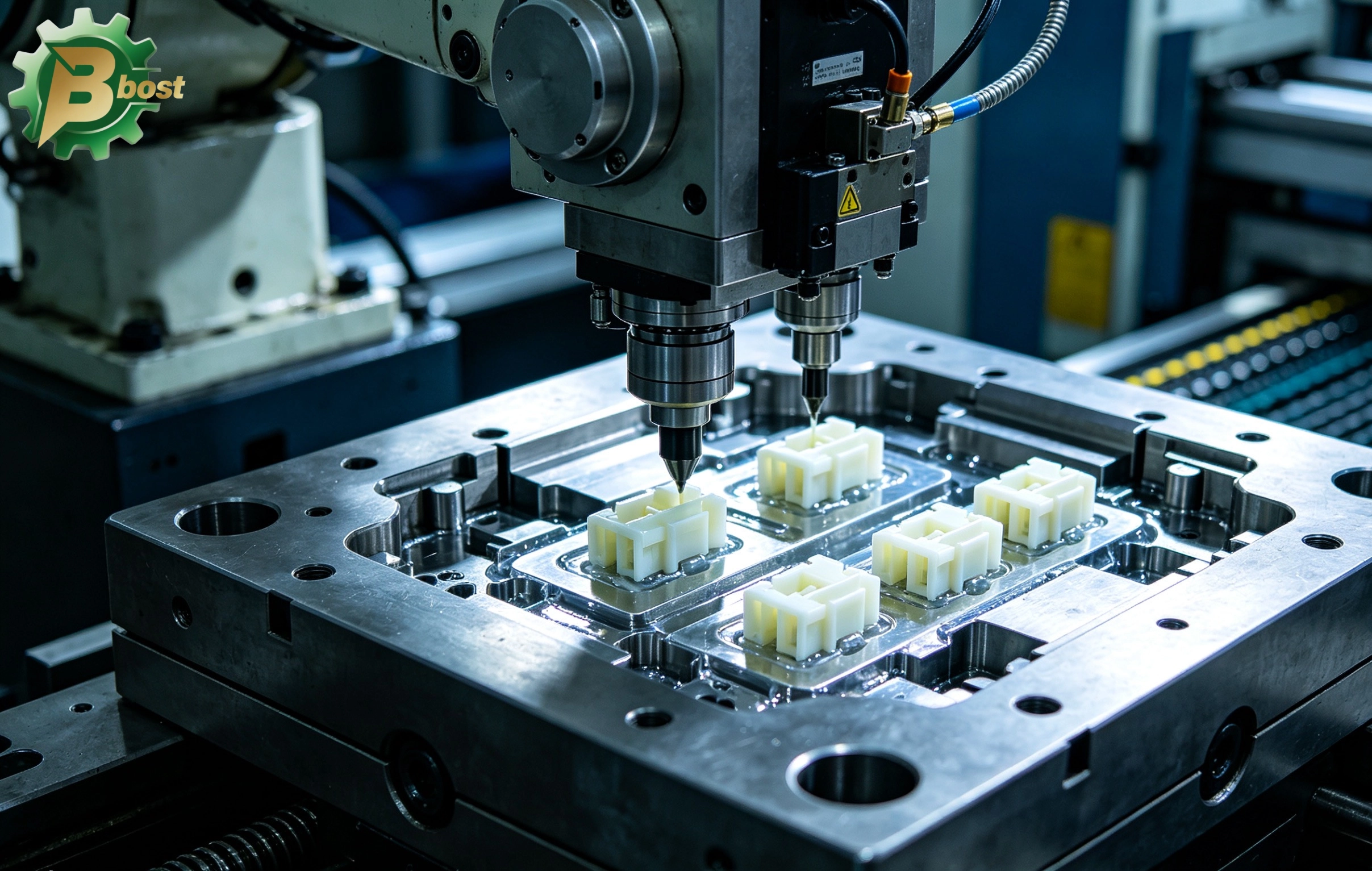
At Bost, we believe that marketing claims must be backed by rigorous industrial execution. The true backbone of our one stop plastic injection molding service is our disciplined investment in advanced software, high-precision hardware, and scientific molding principles.
1. Scientific Molding Control Paradigms
To guarantee the dimensional integrity of critical electronic housings and medical components, we reject the trial-and-error approach to machine setup in favor of Scientific Molding:
-
Decoupled Molding (Decoupled II & III): Our process engineers isolate the filling phase from the packing phase. By monitoring real-time in-cavity pressure profiles, the press automatically switches to pack pressure at exactly 95% volumetric fill. This insulates the final parts from natural variations in raw material viscosity between different polymer batches.
-
Conformal Cooling Geometries: When dealing with complex precision injection molding configurations, traditional straight-drilled cooling channels cannot cool deep pockets or thin ribs evenly, causing internal stress and warpage. Bost utilizes metal 3D printing technologies to build conformal cooling channels inside core inserts. This improves cooling efficiency by 30% and keeps part deformation to an absolute minimum.
2. Expert Materials Science and Quality Stewardship
Different engineering plastics—such as PC, PMMA, PA66+GF, and high-temperature PEI—behave uniquely under thermal and shear stresses.
-
Bost operates a centralized, high-efficiency desiccant drying infrastructure. We ensure that hygroscopic engineering resins are dried to a moisture content below 0.02% before entering the injection barrel, preventing cosmetic blemishes, silver streaks, and loss of mechanical properties caused by hydrolytic degradation.
-
Whether your application demands specialized LCP (Liquid Crystal Polymer) for high-temperature lead-free soldering or custom flame-retardant, anti-static polymer alloys, our materials engineers are ready to guide your selection from day one.
NPI Case Study in Speed-to-Market:
In 2025, a European medical technology leader approached Bost to develop a multi-cavity, ultra-thin-walled drug delivery connector. Due to strict clinical trial schedules, the timeline for hardware delivery was capped at an aggressive 35 days.
Upon receiving the 3D CAD files, our NPI team completed a comprehensive Moldflow simulation within 12 hours, identifying a structural weakness where weld lines would form in thin ribs. By optimizing gate locations and introducing hot runner drops, we eliminated this risk during the mold design phase. Thanks to our integrated toolroom and molding shop, we delivered fully validated T1 samples matching medical-grade cleanliness standards in just 21 days—two weeks ahead of schedule.
4. Partner with Guangzhou Bost: Accelerate Your Manufacturing Success
In a fast-moving global market, managing fragmented suppliers should not stand in the way of product innovation. Partnering with Bost for a one stop plastic injection molding service gives your enterprise a dedicated, highly integrated manufacturing resource that understands design, tooling, and precision molding.
We operate a versatile fleet of high-precision all-electric and servo-hydraulic injection molding presses (ranging from 50 to 1200 tons), housed in an ISO 9001 certified facility. Backed by advanced metrology equipment—including Coordinate Measuring Machines (CMM), optical comparators, and automated insertion-force testers—we verify the quality of every single run.
If you are looking for a reliable manufacturing partner to reduce total costs, eliminate communication barriers, and significantly accelerate your time-to-market, Guangzhou Bost is ready to deliver.
Discover our full range of manufacturing capabilities online at www.gz-bost.com.
[Submit your 2D or 3D CAD files to our engineering desk at team@gz-bost.com today. Our technical specialists will provide a free DFM manufacturability report and an accurate project quotation within 24 hours!]
Recommended for you
The Peak Art of Custom Manufacturing According to Drawings: Comprehensive Guide to Precision Solutions for Custom Parts According to Drawing
Ending Mechanical Wear and Resonance: The Comprehensive Guide to Precision Customization and Mass Production of a Custom Rubber Pad
The Ultimate Armor for Smart Hardware: Advanced Customization and Precision Injection Molding Guide for a Custom Plastic Box
The Ultimate Weapon to Tame Vibration and Noise: Deep Dive into the Custom Process and Mass Production Logic of a Custom Rubber Bushing
Product Categories
FAQ
FAQs
Can Bost customize modified plastics with special properties?
Yes! We offer modification services such as reinforcement, flame retardancy, conductivity, wear resistance, and UV resistance, for example:
• Adding carbon fiber to enhance stiffness
• Reducing the coefficient of friction through PTFE modification
• Customizing food-grade or medical-grade certified materials
What is the delivery lead time? Do you offer global logistics?
Standard products: 5–15 working days; custom modifications: 2–4 weeks. We support global air/sea freight and provide export customs clearance documents (including REACH/UL certifications).
What are the core advantages of Bost engineering plastics compared to ordinary plastics?
Bost engineering plastics feature ultra-high mechanical strength, high-temperature resistance (-50°C to 300°C), chemical corrosion resistance, and wear resistance. Compared to ordinary plastics, their service life is extended by 3 to 8 times, making them suitable for replacing metals in harsh environments.
How do I select the appropriate engineering plastic grade for my product?
Selection should be based on parameters such as load conditions (e.g., pressure/friction), temperature range, medium contact (e.g., oil/acid), and regulatory requirements (e.g., FDA/RoHS). Our engineers can provide free material selection consulting and sample testing.
What is the minimum order quantity (MOQ)? Do you support small-batch trial production?
The MOQ for standard products is ≥100kg. We support small-batch trial production (as low as 20kg) and provide mold testing reports and performance data feedback.
You may also like
Custom Plastic Knobs Precision Injection Molded
More Details →
Custom Plastic Knobs Precision Injection Molded
Custom Injection Molded Parts from Drawings
More Details →
Custom Injection Molded Parts from Drawings
Underwater Camera Shell Custom Plastic Molding
More Details →
Underwater Camera Shell Custom Plastic Molding
Leave a Message
Have any questions or concerns about our products? Please leave us a message here, and our team will get back to you promptly.

24 hours quotes delivered
Submit CAD files, get quote in 24 hours

No MOQ required
From prototyping to high-volume

±0.02 mm Precision
Advanced CNC with full inspections

1,000+ tons in stock
26 materials ready to ship
© 2026 BOST. All Rights Reserved.