




 Scan QR Code
Send My Request
Bridging the Manufacturing Gap: How to Achieve High-Standard Mass Production of Custom Plastic Parts?
2026-04-08
Discover how Bost, a leading custom plastic parts manufacturer, bridges the manufacturing gap to deliver high-standard mass production of custom plastic parts. Explore expert strategies to ensure quality, efficiency, and precision in every order. Trust Bost for reliable, scalable solutions.
- Why Are High-Quality Custom Plastic Parts So Elusive?
- Pain Point 1: Useless DFM and Congenital Defects in Mold Design
- Pain Point 2: The Mismatch Between Material Properties and the Injection Molding Process
- The Core Password to Creating High-Precision Custom Plastic Parts
- 1. The Micron-Level Contest: High-Standard Precision Mold Manufacturing
- 2. Millisecond-Level Response: Stringent Tuning of Precision Injection Parameters
- Finding a Reliable Custom Plastic Parts Manufacturing Partner: More Than Just a Quote
In today's rapidly changing landscape of hardware development and product iteration, product managers and structural engineers often face an extremely realistic challenge: how to transform a perfect 3D model on a computer screen into a tightly fitting, highly textured physical component in reality? Whether you are in consumer electronics, automotive components, or the medical device industry, high-quality custom plastic parts are a critical element that determines the ultimate success or failure of a product.
Many procurement teams and startups often fall into a cognitive trap in the early stages: they believe that as long as they have the drawings, any injection molding factory can produce the item. However, when the first batch of trial mold samples is received, a series of problems such as surface sink marks, out-of-tolerance dimensions, and assembly interference often deal a devastating blow to the project schedule. Manufacturing custom plastic parts is by no means simply "heating plastic and filling an iron cavity"; it is a systematic engineering process that integrates materials science, thermodynamics, and precision machining.
This article will dive deep into the real frontline scenarios of the injection molding workshop to deconstruct the pain points from drawing to mass production for you, revealing the core logic of creating top-tier custom plastic parts.
Why Are High-Quality Custom Plastic Parts So Elusive?
In actual supply chain management, due to the uneven capabilities of suppliers, clients frequently encounter various thorny production accidents. To avoid these minefields, we first need to understand the two core pain points when manufacturing custom plastic parts.
Pain Point 1: Useless DFM and Congenital Defects in Mold Design
The 70% success rate of an excellent plastic product is already determined during the mold design phase. Many inexperienced suppliers, in a rush to grab orders, often skip the crucial DFM (Design for Manufacturability) evaluation step.
When facing structurally complex custom plastic parts, if a precise mold flow analysis is not conducted in the early stages, it is impossible to predict the filling state of the plastic melt in the mold cavity. This leads to various "terminal illnesses" during subsequent mold trials: such as severe sink marks caused by uneven wall thickness; overly deep weld lines caused by improper gate location design; or stress marks and drag marks caused by insufficient draft angles. These defects, triggered by congenital deficiencies in mold design, cannot be remedied no matter how much the injection molding machine parameters are adjusted later, ultimately leading to the expensive cost of mold modification or even remaking the mold entirely.
Pain Point 2: The Mismatch Between Material Properties and the Injection Molding Process
Different application scenarios have vastly different requirements for the physical and chemical properties of custom plastic parts. Some require extremely high impact resistance (like PC), some require excellent chemical resistance (like PP), and others need to withstand high temperatures (like PPS, PEEK).
However, choosing the right material is only the first step. Every kind of plastic pellet has its own unique "temperament," which directly tests the factory's level of injection molding process. For example, when processing crystalline plastics (like POM, PA), if the mold temperature is not controlled within the ideal range, or the holding pressure time is insufficient, the product will experience uncontrollable post-shrinkage after cooling, causing the originally precise assembly dimensions to go seriously out of shape. For another example, if hygroscopic materials are not thoroughly baked and dehumidified before injection molding, the moisture generated in the molten state will leave unsightly silver streaks (splay marks) on the product surface.
The Core Password to Creating High-Precision Custom Plastic Parts
Truly capable manufacturing partners do not pin their hopes of solving problems on luck, but rely on rigorous engineering logic and sophisticated equipment. To stably output high-standard custom plastic parts, absolute advantages must be established in the following dimensions.
1. The Micron-Level Contest: High-Standard Precision Mold Manufacturing
The mold is the mother of industry. For demanding custom plastic parts, the machining precision of the mold directly dictates the upper limit of the product. Excellent mold factories will use imported high-speed CNC machining centers, slow-feeding wire EDM, and mirror spark machines to control the machining tolerance of the mold core at the micron level.
In addition, an efficient cooling channel design (such as conformal cooling technology) and a reasonable venting layout are equally indispensable. Good venting can effectively avoid localized burns caused by trapped air (the diesel effect), while a uniform cooling system can significantly reduce the warpage deformation of the product caused by excessive temperature differences, which is particularly crucial for the production of large-area or thin-walled custom plastic parts.
2. Millisecond-Level Response: Stringent Tuning of Precision Injection Parameters
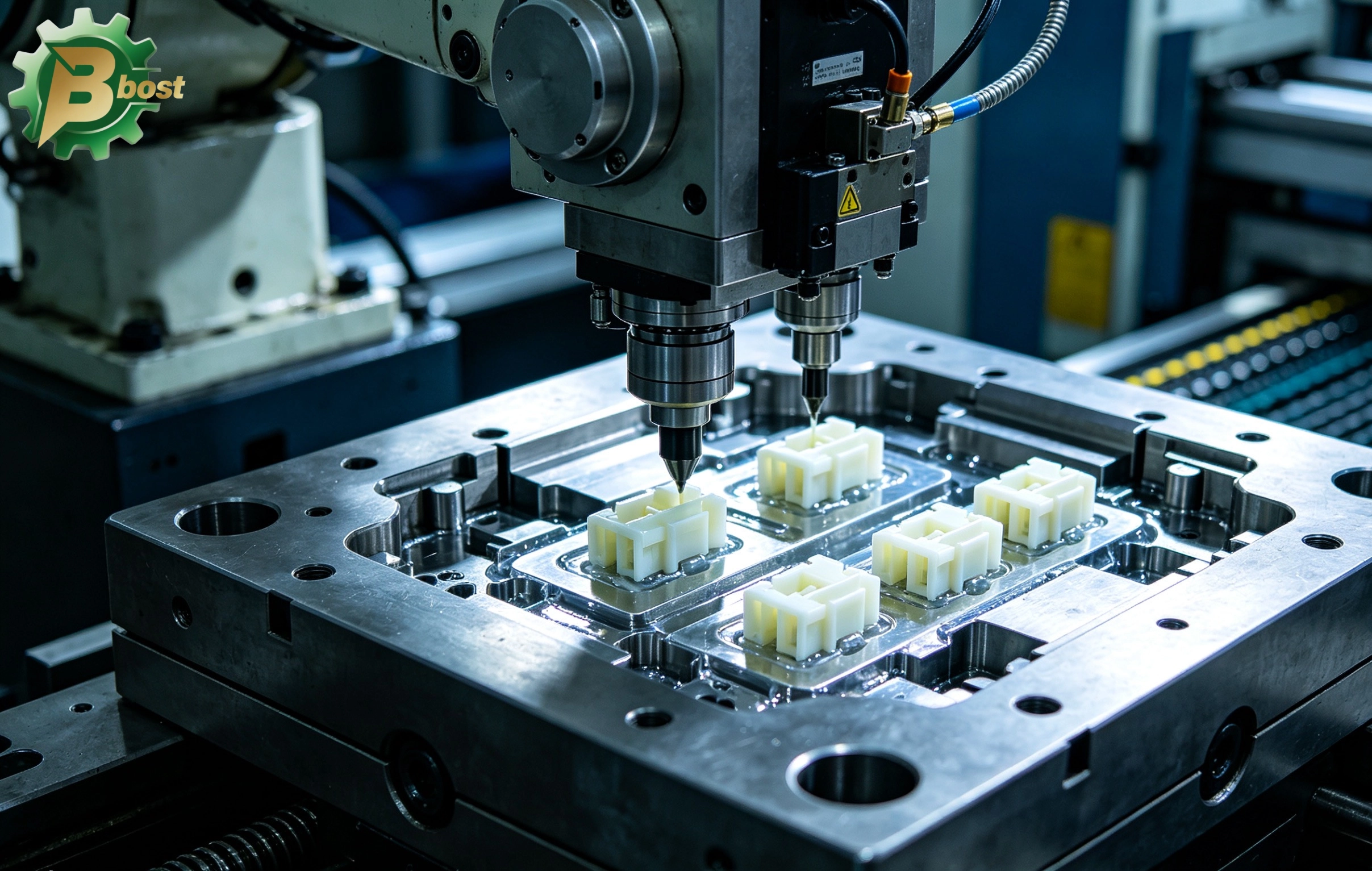
When the perfect mold is mounted onto the injection molding machine, the real "combat" has just begun. Precision injection molding is no longer the traditional "good enough" approach, but a precise control of temperature, pressure, speed, and time.
For structurally complex custom plastic parts, injection molding engineers need to set multiple stages of injection speeds and position switching points. When the plastic melt first enters the mold cavity, high-speed injection is used to overcome flow resistance; the moment the cavity is filled, it quickly switches to a low speed and transitions into the holding pressure phase to prevent product flash (burrs) and compensate for cooling shrinkage. This requires the injection molding equipment to have an extremely high response speed and closed-loop control capability. Only when every fluctuation of the process parameters is absolutely accurate can we ensure that the custom plastic parts produced in every shot maintain a high degree of consistency.
Finding a Reliable Custom Plastic Parts Manufacturing Partner: More Than Just a Quote
When searching for suppliers, many procurement personnel habitually lock their eyes on the lowest quotation. However, for highly customized projects, what hides behind a low price is often cut-corner mold steel, inferior raw materials mixed with regrind, and totally unsecured delivery times. True cost-effectiveness comes from a supplier's strong engineering support capability and the execution power to do things right the first time.
At Guangzhou Bost (Bost), we deeply understand that behind every custom plastic part carries the client's eager anticipation for the product's market launch and stringent requirements for quality. We do not merely provide processing services; we are dedicated to becoming your extended engineering team. From early 3D drawing reviews, detailed DFM reports, and high-precision mold design and manufacturing, to the final mass production utilizing advanced injection molding processes, we provide you with a worry-free, full-chain service.
If your new project requires the development of high-quality custom plastic parts, or if you are troubled by the low yield rate of your current supplier, please do not let inferior manufacturing links slow down the pace of your product's success anymore. Visit our official website now at https://www.gz-bost.com, upload your design drawings, and have an in-depth, one-on-one communication with our senior engineering experts. Let us provide you with the most competitive injection molding solutions and precise quotations with our professional technical strength and strict quality control!
Recommended for you
The Peak Art of Custom Manufacturing According to Drawings: Comprehensive Guide to Precision Solutions for Custom Parts According to Drawing
Ending Mechanical Wear and Resonance: The Comprehensive Guide to Precision Customization and Mass Production of a Custom Rubber Pad
The Ultimate Armor for Smart Hardware: Advanced Customization and Precision Injection Molding Guide for a Custom Plastic Box
The Ultimate Weapon to Tame Vibration and Noise: Deep Dive into the Custom Process and Mass Production Logic of a Custom Rubber Bushing
Product Categories
FAQ
FAQs
What is the delivery lead time? Do you offer global logistics?
Standard products: 5–15 working days; custom modifications: 2–4 weeks. We support global air/sea freight and provide export customs clearance documents (including REACH/UL certifications).
What are the core advantages of Bost engineering plastics compared to ordinary plastics?
Bost engineering plastics feature ultra-high mechanical strength, high-temperature resistance (-50°C to 300°C), chemical corrosion resistance, and wear resistance. Compared to ordinary plastics, their service life is extended by 3 to 8 times, making them suitable for replacing metals in harsh environments.
What is the minimum order quantity (MOQ)? Do you support small-batch trial production?
The MOQ for standard products is ≥100kg. We support small-batch trial production (as low as 20kg) and provide mold testing reports and performance data feedback.
Can Bost customize modified plastics with special properties?
Yes! We offer modification services such as reinforcement, flame retardancy, conductivity, wear resistance, and UV resistance, for example:
• Adding carbon fiber to enhance stiffness
• Reducing the coefficient of friction through PTFE modification
• Customizing food-grade or medical-grade certified materials
How do I select the appropriate engineering plastic grade for my product?
Selection should be based on parameters such as load conditions (e.g., pressure/friction), temperature range, medium contact (e.g., oil/acid), and regulatory requirements (e.g., FDA/RoHS). Our engineers can provide free material selection consulting and sample testing.
You may also like
Custom Plastic Knobs Precision Injection Molded
More Details →
Custom Plastic Knobs Precision Injection Molded
Custom Injection Molded Parts from Drawings
More Details →
Custom Injection Molded Parts from Drawings
Underwater Camera Shell Custom Plastic Molding
More Details →
Underwater Camera Shell Custom Plastic Molding
Leave a Message
Have any questions or concerns about our products? Please leave us a message here, and our team will get back to you promptly.

24 hours quotes delivered
Submit CAD files, get quote in 24 hours

No MOQ required
From prototyping to high-volume

±0.02 mm Precision
Advanced CNC with full inspections

1,000+ tons in stock
26 materials ready to ship
© 2026 BOST. All Rights Reserved.