




 Scan QR Code
Send My Request
Overcoming Micron-Level Tolerances: How to Manufacture Highly Reliable Custom Plastic Connectors via Precision Injection Molding?
2026-07-16
Custom plastic connector manufacturers and suppliers face tight micron-level tolerances that demand exact precision. Bost details proven injection molding techniques to ensure highly reliable custom plastic connectors, minimizing defects and boosting performance in critical applications.
- 1. Core Technical Challenges in Custom Plastic Connector Manufacturing
- 1. Extreme Dimensional Tolerances (Micron-Level)
- 2. Balancing Ultra-Thin Walls with Polymer Flowability
- 3. Surface Mount Technology (SMT) Reflow Resistance
- 2. Technical Performance Breakdown: Key Engineering Plastics for Connectors
- 3. Tooling and Precision Molding: The Blueprint for Zero-Defect Production
- 1. Ultra-Precision Tool Machining
- 2. Upfront Optimization via Moldflow Analysis
- 3. Scientific Molding Control Paradigms
- 4. Why Partner with Bost for Your Custom Connector Projects?
- Conclusion: Start Your Custom Connector Project Today
In modern industrial manufacturing, connectors play a critical role, whether in the battery management systems (BMS) of new energy vehicles, high-end medical device signal interfaces, or precision control boards for smart home electronics. A custom plastic connector that measures only a few millimeters carries the immense responsibility of enduring thousands of mating cycles, ensuring high-voltage insulation, resisting high-temperature soldering, and maintaining robust signal integrity in harsh environments.
For global procurement managers and hardware design engineers, locating a manufacturing partner capable of flawlessly executing high-precision, high-performance custom connectors is challenging. Connector wall thicknesses are often extremely thin (sometimes below 0.3mm), and the pin arrays are incredibly dense. Any slight dimensional deviation, part warpage, or flash will lead to assembly failures or, worse, electrical short circuits.
As a highly specialized provider of one stop plastic injection molding service, Guangzhou Bost (Bost) brings over a decade of technical experience in supplying global industrial markets. In this article, we analyze how to build a superior-quality custom plastic connector through the lenses of material science, mold design, and precision injection molding.
1. Core Technical Challenges in Custom Plastic Connector Manufacturing
Succeeding with a high-quality custom plastic connector requires overcoming three fundamental manufacturing hurdles:
1. Extreme Dimensional Tolerances (Micron-Level)
A connector’s primary physical function is to secure metal terminal pins. If the terminal cavities, guide holes, or snaps in the plastic housing vary even slightly—exceeding a tolerance of $\pm0.02\text{mm}$—assemblies will fail. Pins will either resist insertion or sit too loosely (inadequate retention force). This demands micron-level precision control starting from the initial mold design stage down to post-molding shrinkage calibration.
2. Balancing Ultra-Thin Walls with Polymer Flowability
To satisfy the demand for thinner and lighter devices, connector pitch dimensions continue to shrink (down to 0.8mm, 0.5mm, or even lower), which compresses wall thicknesses to between $0.25\text{mm}$ and $0.4\text{mm}$. During the injection molding process, molten resin cools rapidly when entering such restricted spaces. Without ideal material selections and accurate injection pressure controls, parts run high risks of short shots or structural weak points at the weld lines.
3. Surface Mount Technology (SMT) Reflow Resistance
Most modern electronic connectors are soldered onto PCBs via SMT. During reflow soldering, connectors must withstand temperatures exceeding $260^\circ\text{C}$ for several seconds. Poor material selection results in component softening, blistering, or significant thermal shrinkage, which displaces the precise alignment of the pins.
2. Technical Performance Breakdown: Key Engineering Plastics for Connectors
At the onset of any custom connector project, selecting the right polymer compound determines the product's ultimate structural success and overall cost structure. The table below outlines the core resins that Bost routinely recommends based on different industrial environments:
| Polymer Type | Continuous Temp Resistance | Mechanical Strength & Rigidity | Flowability (Thin-Wall Suitability) | Key Pros & Cons | Typical Connector Applications |
|---|---|---|---|---|---|
| LCP (Liquid Crystal Polymer) | $240^\circ\text{C} - 280^\circ\text{C}$ | Extremely High (Lowest CLTE) | Exceptional (Best for thin walls) | Pros: Outstanding dimensional stability, very low melt viscosity, superior reflow heat resistance.Cons: Higher cost, slightly weaker weld line strength. | High-density board-to-board connectors, USB Type-C ports, micro-FPC connectors. |
| PPS (Polyphenylene Sulfide) | $220^\circ\text{C} - 240^\circ\text{C}$ | Extremely High (Excellent chemical resistance) | Excellent | Pros: Rigid, naturally flame retardant, more cost-effective than LCP.Cons: Brittle texture, high mold wear, highly prone to flash. | Automotive under-hood connectors, industrial electrical sockets, high-power terminal blocks. |
| PBT (Polybutylene Terephthalate) | $120^\circ\text{C} - 140^\circ\text{C}$ | Moderate to High | Good | Pros: Excellent dielectric properties, high toughness, very low water absorption, economical.Cons: Low thermal resistance, cannot survive SMT reflow profiles. | Traditional automotive wire-harness connectors (crimped/non-soldered), consumer electronics housings, waterproof plugs. |
| Nylon (High-Temp Nylon like PA4T/PA9T) | $180^\circ\text{C} - 220^\circ\text{C}$ | High Toughness, High Impact | Excellent | Pros: Outstanding fatigue resistance for high-cycle insertion, easy to color-code.Cons: Hydroscopic; demands strict drying and precise mold shrinkage control. | Automotive sensor interfaces, industrial RJ45 Ethernet jacks, high-life push switches. |
3. Tooling and Precision Molding: The Blueprint for Zero-Defect Production
Premium engineering resins represent only half of the solution. The secret to transforming raw granules into flawless physical connectors lies in the precision of Bost's mold design and injection molding process controls.
[Client 3D CAD Data] ↓[Moldflow Flow & Deformation Simulation] ──> Predict weld lines, air traps, and warpage ↓[Precision Tooling Fabrication] ──> Japanese Sodick Mirror EDM + High-Speed CNC (Tolerance ±0.005mm) ↓[Scientific Molding Process] ──> Precise multi-stage injection speed, pack pressure, & cavity thermal cycles ↓[Metrology & QA Check] ──> CMM and 2.5D optical inspection of critical dimensions for smooth assembly1. Ultra-Precision Tool Machining
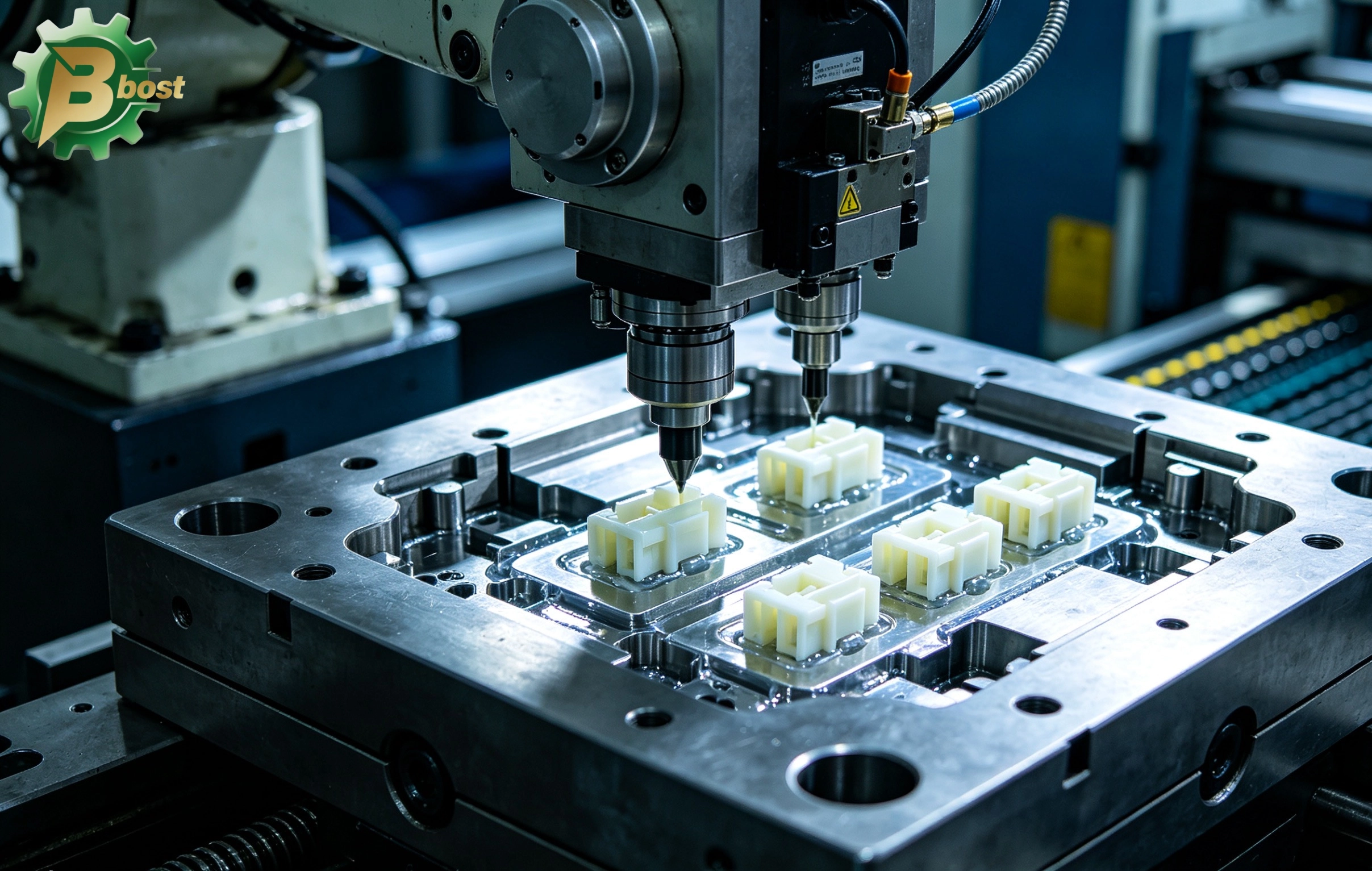
Within the Bost tooling department, we utilize high-precision Sodick wire-cutting systems and mirror EDMs to cut core cavities and pins. Because connector tooling features minute geometries, we hold machining tolerances to within $\pm0.005\text{mm}$ (5 microns). Additionally, we implement advanced modular insert designs. This provides highly effective venting paths and allows our clients to swap out individual pin inserts if wear occurs over time, avoiding the heavy costs of building complete replacement molds.
2. Upfront Optimization via Moldflow Analysis
Prior to cutting steel, our engineering team executes rigorous Moldflow simulations to study:
-
Weld Line Mitigation: Connectors contain dozens of pin cores. As the melt splits and reunites around these pins, weld lines form. Insufficient local temperatures make these lines structurally fragile. We carefully position the injection gates to force weld lines into low-stress areas of the part.
-
Optimized Venting: Injection molding extremely thin-walled parts requires ultra-high fill speeds. If air cannot escape the tool quickly, it compresses and ignites, causing burn marks or short shots. We engineer micro-precision venting channels along the parting lines and ejector pins to prevent this.
3. Scientific Molding Control Paradigms
For the mass production of a custom plastic connector, we eliminate the guesswork of traditional press setup by adopting Scientific Molding practices:
-
Decoupled Molding: We separate the high-speed fill phase from the packing phase. By monitoring in-cavity pressures, the press automatically switches to pack once the cavity reaches 95% volume. This isolates the parts from natural material viscosity variations.
-
Precise Mold Temperature Management: High-performance polymers like LCP and PPS require mold temperatures exceeding $120^\circ\text{C}$. We pair dedicated oil heaters with engineered cooling/heating circuits, maintaining thermal variation across multi-cavity molds (e.g., 16 or 32 cavities) to within $\pm1^\circ\text{C}$. This ensures that every single connector produced matches the master dimensions.
4. Why Partner with Bost for Your Custom Connector Projects?
In fast-moving industries like automotive and consumer electronics, development schedules are tight, and managing fragmented suppliers who point fingers at each other is an unnecessary risk. Bost eliminates these hurdles via a unified one stop plastic injection molding service:
-
Upfront DFM Reviews: Within 24 hours of receiving your 3D CAD files, we provide a detailed DFM report outlining draft issues, wall variations, and fill risks, resolving potential issues before tooling begins.
-
Integrated Tooling & Production: Because our tooling shop and injection presses reside in the same facility, any dimension corrections needed during sampling are resolved immediately. Our toolmakers and molding engineers coordinate on-site to adjust molds and re-sample within 24 hours.
-
Turnkey Secondary Operations: We support complex operations such as insert molding, pin insertion, potting, and ultrasonic welding. You receive fully integrated assemblies ready for final device installation.
Conclusion: Start Your Custom Connector Project Today
A small plastic connector represents the security and integrity of your entire product system. Aligning your production with a manufacturing partner that understands precision tolerances, tooling physics, and engineering resins is the most reliable way to complete your project on time and within budget.
Guangzhou Bost (Bost) is dedicated to manufacturing high-quality custom plastic connector solutions. If you are developing a new connector or need to resolve cracking, warpage, or assembly issues in an existing design, our engineers are here to help.
Explore our technical capabilities online at www.gz-bost.com or reach out directly to our engineering desk.
[Submit your 3D/2D CAD files to team@gz-bost.com today for a free DFM manufacturability assessment and a competitive project quote within 24 hours!]
Recommended for you
The Peak Art of Custom Manufacturing According to Drawings: Comprehensive Guide to Precision Solutions for Custom Parts According to Drawing
Ending Mechanical Wear and Resonance: The Comprehensive Guide to Precision Customization and Mass Production of a Custom Rubber Pad
The Ultimate Armor for Smart Hardware: Advanced Customization and Precision Injection Molding Guide for a Custom Plastic Box
The Ultimate Weapon to Tame Vibration and Noise: Deep Dive into the Custom Process and Mass Production Logic of a Custom Rubber Bushing
Product Categories
FAQ
FAQs
What is the delivery lead time? Do you offer global logistics?
Standard products: 5–15 working days; custom modifications: 2–4 weeks. We support global air/sea freight and provide export customs clearance documents (including REACH/UL certifications).
What are the core advantages of Bost engineering plastics compared to ordinary plastics?
Bost engineering plastics feature ultra-high mechanical strength, high-temperature resistance (-50°C to 300°C), chemical corrosion resistance, and wear resistance. Compared to ordinary plastics, their service life is extended by 3 to 8 times, making them suitable for replacing metals in harsh environments.
What is the minimum order quantity (MOQ)? Do you support small-batch trial production?
The MOQ for standard products is ≥100kg. We support small-batch trial production (as low as 20kg) and provide mold testing reports and performance data feedback.
Can Bost customize modified plastics with special properties?
Yes! We offer modification services such as reinforcement, flame retardancy, conductivity, wear resistance, and UV resistance, for example:
• Adding carbon fiber to enhance stiffness
• Reducing the coefficient of friction through PTFE modification
• Customizing food-grade or medical-grade certified materials
How do I select the appropriate engineering plastic grade for my product?
Selection should be based on parameters such as load conditions (e.g., pressure/friction), temperature range, medium contact (e.g., oil/acid), and regulatory requirements (e.g., FDA/RoHS). Our engineers can provide free material selection consulting and sample testing.
You may also like
Custom Plastic Knobs Precision Injection Molded
More Details →
Custom Plastic Knobs Precision Injection Molded
Custom Injection Molded Parts from Drawings
More Details →
Custom Injection Molded Parts from Drawings
Underwater Camera Shell Custom Plastic Molding
More Details →
Underwater Camera Shell Custom Plastic Molding
Leave a Message
Have any questions or concerns about our products? Please leave us a message here, and our team will get back to you promptly.

24 hours quotes delivered
Submit CAD files, get quote in 24 hours

No MOQ required
From prototyping to high-volume

±0.02 mm Precision
Advanced CNC with full inspections

1,000+ tons in stock
26 materials ready to ship
© 2026 BOST. All Rights Reserved.