




 Scan QR Code
Send My Request
From Material Dialogue to Data Delivery: Defining Truly Reliable Custom Injection Molded Parts
2026-03-12
Bost defines reliability in custom injection molded parts. We transform material dialogue into precise data delivery, ensuring every part meets your exact specifications for performance and quality.
From Material Dialogue to Data Delivery: Defining Truly Reliable "Custom Injection Molded Parts" Services
In over a decade of collaborating with global engineering plastics clients at Bost, one phrase we hear most often is: "Finding a truly technical injection molding supplier is harder than expected."
This might sound surprising, but it makes sense upon reflection. Browse supplier directories—everyone claims expertise in precision injection molding, equipment lists look similar, quotes are comparable. But when drawings are actually sent, differences emerge: some suppliers simply "process drawings" without questioning material selection; others deliver perfect samples but encounter defects during mass production; still others collaborate smoothly during prototyping but fail to scale up, causing months of delays.
Today, drawing from Bost's practical experience, I want to share how we define a truly reliable custom injection molded parts service, and the three technical principles we consistently uphold when handling high-performance engineering plastics like PEEK, PEI, and PPS.
1. Starting with Material Dialogue: We Don't Rush Quotes, We First Understand Your Application
Many clients wonder when contacting us: "It's been days since I sent drawings—why no quote yet?"
This is intentional. At Bost, receiving an inquiry triggers not an immediate cost calculation, but a complete "material-application scenario" review by our engineering team.
Why Material Dialogue Matters
The same PEEK grade behaves differently for medical implants versus industrial bearings. With glass fiber reinforcement, shrinkage curves can vary dramatically between 30% and 40% filler content. Rushing to quote without these details risks discovering problems after mold fabrication—costing clients both time and money.
A relevant example from last year illustrates this perfectly: A European medical device company needed to replicate a critical PEEK insulator after their previous supplier went bankrupt, leaving them with only drawings. Rather than offering an immediate quote, we scheduled a two-hour online meeting to understand the part's operating environment, stress conditions, and the original failure modes.
During this dialogue, we discovered that while the original drawings specified PEEK, they completely ignored the internal stresses generated during precision injection molding at the thick-thin transitions. We recommended adjusting the rib thickness and optimizing the gate location. The final product not only perfectly replaced the original but achieved 30% higher fatigue life.
The Bost Approach
So, when you send drawings to Bost and our engineers start asking about "operating temperature," "chemical resistance requirements," or "stress conditions," please do not be bothered. Behind these questions lies our commitment to delivering responsible custom injection molded parts every single time.
2. From Prototype to Production: No Supplier Changes, No Restarts
Startups and low-volume clients dread one particular scenario: prototype shops that deliver quickly and cheaply but cannot scale up when small-scale trials or mass production begins. This forces companies to find a new supplier, re-review drawings, and remake molds—resetting all accumulated experience to zero and doubling both time and cost.
Bost's "One-Stop" Integration Logic
At Bost, we deliberately bridge the entire journey from prototype to production. This is not just about having both CNC and injection molding machines on-site—it is about seamless engineering team integration and the continuity of technical standards.
When a project needs dozens of validation samples quickly, we machine them with precision CNC. Simultaneously, our injection molding engineering team gets involved early, conducting a thorough Design for Manufacturing (DFM) analysis. They scrutinize every detail, identifying issues that are invisible during prototyping but certain to emerge during mass production:
Abrupt wall thickness transitions that could create internal stress and potential deformation.
Tall, unsupported ribs that may cause uneven cooling and dimensional instability.
Gate locations that need adjustment to prevent visible or structural weld lines in stress-bearing areas.
By the time validation is complete and mold production begins, all these optimizations are already incorporated. There is no new supplier search, no ramp-up period, and no secondary engineering fees.
Questions You Can Ask Us
When evaluating Bost's custom injection molded parts services, feel free to ask:
If I start prototyping with you, will the drawings need to be re-reviewed for mass production?
How do you control batch-to-batch material variations between sampling and full production?
How do you ensure that capacity scales smoothly from trials to full-scale manufacturing?
We put our answers—and our track record—on the table.
3. Process Control: We Don't Rely on a "Veteran's Feel"—We Let Data Speak
This is the issue that concerns procurement professionals most, yet it is often overlooked. Many suppliers can deliver perfect samples, only to encounter a cascade of defects during mass production. Why? Because the samples were hand-tuned by master technicians. But when production shifts to different operators, parameters drift, and yields collapse.
Bost's Scientific Molding System
In Bost's workshop, we often say: "Feel is good, but data is better." True precision injection molding transforms process parameters from subjective "experience" into objective "science."
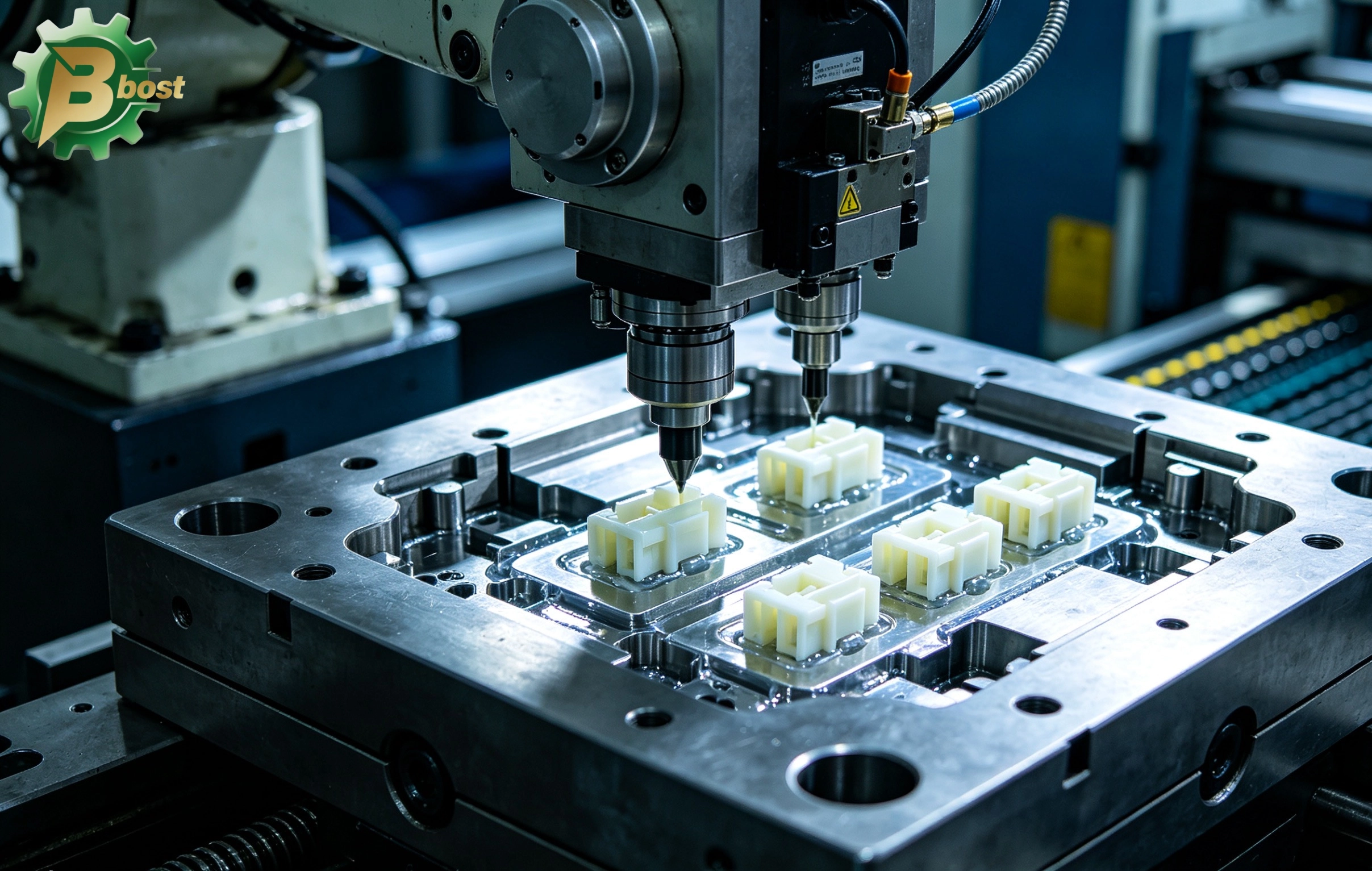
Viscosity Curve Testing—We perform this for every new mold's first run. By monitoring filling pressure across different injection speeds, we identify the material's "sweet spot" within that specific tool: the speed range where filling pressure remains most stable. Locking in this window establishes the production baseline. Any operator maintaining parameters within this validated window will deliver reliable quality.
Cavity Pressure Monitoring—We install sensors inside the molds, tracking real-time pressure curves for every cycle. When curves deviate abnormally (for example, a pressure spike caused by poor venting), the system automatically alarms and can even reject suspect parts on the spot. This proactive approach beats relying on human inspection for "burn marks" or "short shots," truly achieving "defect prevention" rather than "defect screening."
Our Quality Commitment
If you visit Bost, pay attention to these details:
Are there real-time process parameter displays on the shop floor?
Are operators constantly tweaking machines, or are they monitoring data screens?
How are defects handled? Is there a clear traceability system?
We confidently state that teams which prioritize process control will not say, "Our master technicians have rich experience." They will say, "Our CPK values consistently exceed 1.33."
Conclusion: Reliable Injection Molding Services Lie in Every Technical Detail
Reflecting on the thousands of projects we have served over the years, we increasingly appreciate one fundamental truth: custom injection molded parts services are not about selling machine hours; they are about selling problem-solving capability.
A partner who truly understands materials, molds, and process control can eliminate 80% of potential pitfalls at the drawing stage, saving you countless detours from prototype to production. This is precisely what the Bost team has dedicated over a decade to achieving.
If you are seeking such an injection molding expert for your next project—one who specializes in high-performance materials like PEEK, PEI, and PPS—we welcome a deeper discussion. As a testament to our commitment, we consistently offer free DFM analysis to every client, optimizing your design before any steel is cut.
Click here to visit Bost's official website to submit your project requirements and receive professional technical advice and a quote.
Recommended for you
The Peak Art of Custom Manufacturing According to Drawings: Comprehensive Guide to Precision Solutions for Custom Parts According to Drawing
Ending Mechanical Wear and Resonance: The Comprehensive Guide to Precision Customization and Mass Production of a Custom Rubber Pad
The Ultimate Armor for Smart Hardware: Advanced Customization and Precision Injection Molding Guide for a Custom Plastic Box
The Ultimate Weapon to Tame Vibration and Noise: Deep Dive into the Custom Process and Mass Production Logic of a Custom Rubber Bushing
Product Categories
FAQ
FAQs
What are the core advantages of Best engineering plastics compared to ordinary plastics?
Best engineering plastics feature ultra-high mechanical strength, high-temperature resistance (-50°C to 300°C), chemical corrosion resistance, and wear resistance. Compared to ordinary plastics, their service life is extended by 3 to 8 times, making them suitable for replacing metals in harsh environments.
How do I select the appropriate engineering plastic grade for my product?
Selection should be based on parameters such as load conditions (e.g., pressure/friction), temperature range, medium contact (e.g., oil/acid), and regulatory requirements (e.g., FDA/RoHS). Our engineers can provide free material selection consulting and sample testing.
What is the minimum order quantity (MOQ)? Do you support small-batch trial production?
The MOQ for standard products is ≥100kg. We support small-batch trial production (as low as 20kg) and provide mold testing reports and performance data feedback.
What is the delivery lead time? Do you offer global logistics?
Standard products: 5–15 working days; custom modifications: 2–4 weeks. We support global air/sea freight and provide export customs clearance documents (including REACH/UL certifications).
Can Best customize modified plastics with special properties?
Yes! We offer modification services such as reinforcement, flame retardancy, conductivity, wear resistance, and UV resistance, for example:
• Adding carbon fiber to enhance stiffness
• Reducing the coefficient of friction through PTFE modification
• Customizing food-grade or medical-grade certified materials
You may also like
Custom Plastic Knobs Precision Injection Molded
More Details →
Custom Plastic Knobs Precision Injection Molded
Custom Injection Molded Parts from Drawings
More Details →
Custom Injection Molded Parts from Drawings
Underwater Camera Shell Custom Plastic Molding
More Details →
Underwater Camera Shell Custom Plastic Molding
Leave a Message
Have any questions or concerns about our products? Please leave us a message here, and our team will get back to you promptly.

24 hours quotes delivered
Submit CAD files, get quote in 24 hours

No MOQ required
From prototyping to high-volume

±0.02 mm Precision
Advanced CNC with full inspections

1,000+ tons in stock
26 materials ready to ship
© 2026 BOST. All Rights Reserved.